Introduction
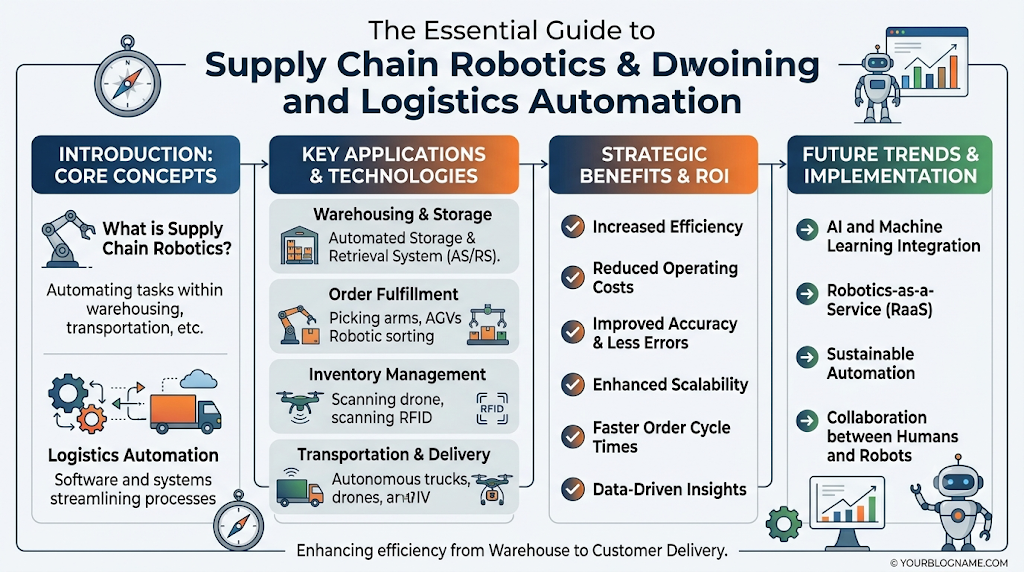
Modern supply chains are facing unprecedented challenges. Global networks have grown highly complex, consumer expectations for fast delivery have skyrocketed, and labor shortages frequently disrupt fulfillment schedules. To stay competitive, businesses can no longer rely solely on legacy, manual workflows. This pressing operational pressure has accelerated the adoption of robotics in warehouse and logistics environments. Robotic systems are transforming how facilities receive, store, track, and ship goods. By integrating advanced machinery with intelligent software, companies can establish resilient workflows capable of handling major market fluctuations. For those eager to understand or implement these systems, RobotsOps.com serves as an accessible educational learning resource. The platform breaks down complex industrial hardware and workflows into clear, actionable knowledge. By reading this guide, you will learn the fundamental mechanics of supply chain robotics, the primary types of machines driving automation, and practical strategies to transform traditional logistics infrastructures into highly optimized operations.
What Are Robotics Operations in Supply Chains?
Featured Snippet Definition:
Robotics operations in supply chains refer to the systematic integration, management, and orchestration of automated machinery, autonomous vehicles, and robotic arms to execute repetitive physical tasks within warehouses, distribution centers, and manufacturing facilities.
The core objectives of these operations are straightforward: eliminate manual bottlenecks, maximize physical space utilization, and accelerate throughput.
In modern logistics, robotics bridges the gap between digital data and physical execution. When an e-commerce order is placed online, a software signal instantly commands a physical machine to locate, retrieve, and transport that specific item.
Within industrial automation, this reliable interaction minimizes operational friction. Instead of forcing human workers to walk miles across vast facility floors, robotic automation brings the inventory directly to the worker, redefining the speed and scale of global commerce.
Core Components of Robotics Operations
   [Warehouse Management System (WMS)]
                   │
         ┌─────────┴─────────┐
         ▼                   ▼
  [Vision Systems]   [Robotic Machinery]
         │                   │
         └─────────┬─────────┘
                   ▼
  ┌─────────────────────────────────────┐
  │  Industrial Robots | AMRs | AGVs    │
  │  Robotic Arms      | Automation     │
  └─────────────────────────────────────┘
Industrial Robots
Industrial robots are high-capacity, heavy-duty machines built to handle repetitive and physically demanding tasks. In manufacturing and heavy logistics, they lift massive payloads, palletize heavy goods, and operate continuously in demanding environments.
Autonomous Mobile Robots (AMRs)
AMRs are agile, intelligent warehouse robots equipped with onboard sensors, cameras, and navigation software. Unlike older automated systems, AMRs map their own paths through a facility dynamically. If an obstacle, such as a pallet or a worker, blocks an aisle, the AMR recalculates its route in real time without human intervention.
Automated Guided Vehicles (AGVs)
AGVs are reliable transport vehicles that travel along fixed, predefined paths. These paths are typically dictated by magnetic strips, wires, or optical markers placed on the warehouse floor. They are ideal for moving large volumes of materials along consistent, unchanging routes, such as transporting raw parts straight to a production line.
Robotic Arms
Robotic arms provide precise mechanical articulation, making them perfect for static workstations. Equipped with specialized end-effectors like vacuum grippers or mechanical claws, these devices pick up individual items from bins, sort packages into specific shipping containers, or assemble delicate components.
Vision Systems
Vision systems serve as the eyes of supply chain robotics. Utilizing industrial cameras and advanced image-processing software, these systems allow robots to recognize object shapes, read text-based barcodes, verify labels, and detect physical defects with microscopic precision.
Warehouse Management Integration
Robots do not operate in isolation. They connect directly with a facility’s Warehouse Management System (WMS) or Enterprise Resource Planning (ERP) platform. This integration ensures that every mechanical movement matches live inventory tallies, picking lists, and incoming customer orders.
How Robotics Operations Improve Supply Chains
Automating Material Handling
Traditional material handling requires operators to manually drive forklifts, lift heavy boxes, and push heavy carts across facilities. Robotic automation takes over these grueling tasks. For instance, when a trailer arrives at a distribution center, automated conveyor systems and robotic lifters unload the cargo seamlessly, keeping docks clear and turning trailers around in a fraction of the time.
Improving Inventory Accuracy
Human inventory counts are prone to occasional counting errors and misplaced clipboards. Warehouse robots outfitted with RFID readers and vision systems can scan entire storage racks overnight. They update the central database instantly, achieving nearly perfect inventory accuracy and preventing costly stockouts.
Speeding Up Order Fulfillment
Speed is a massive competitive advantage. In a robotics-enabled warehouse, the moment a customer clicks “buy,” an AMR navigates to the correct aisle, retrieves the storage bin, and delivers it to a packing station. This goods-to-person methodology slashes order cycle times from hours to minutes.
Enhancing Quality Inspection
Manual visual inspections can miss subtle flaws over a long shift due to eye strain. Industrial robots equipped with high-resolution vision systems check every single product passing down a conveyor belt. They flag dented packaging, incorrect weight distributions, or misprinted barcodes instantly, keeping defective products out of delivery trucks.
Reducing Human Errors
Misplaced items and incorrect order shipments waste significant revenue and damage customer trust. Robotic arms and sorting systems operate with consistent mathematical precision. A robot picks the exact SKU required by the digital order file every single time, drastically dropping return rates driven by shipping errors.
Increasing Warehouse Safety
Warehouses present inherent physical hazards, including heavy falling objects, forklift collisions, and repetitive strain injuries. Introducing robotics in logistics allows machines to take over dangerous tasks, such as working in sub-zero cold storage zones or lifting heavy objects, keeping human employees out of harm’s way.
Supporting Continuous Operations
Unlike human teams who require shifts, rests, and breaks, robotic workflows can run around the clock. Automated systems operate continuously through weekends and holidays, allowing businesses to seamlessly absorb sudden spikes in e-commerce volume without encountering operational backlogs.
RobotsOps.com Guide to Robotics in Supply Chain Operations
Understanding Warehouse Automation
Stepping into warehouse automation requires a clear understanding of your facility’s current bottlenecks. Successful automation begins by identifying repetitive, low-value movements—such as long walking paths between aisles—and introducing targeted robotic solutions like AMRs to absorb that travel time.
Building Efficient Logistics Workflows
An efficient robotics workflow connects hardware capabilities with clear digital directives. For maximum efficiency, design workflows where incoming goods are instantly scanned, categorized by vision systems, and handed off to autonomous vehicles for immediate storage, minimizing any idle time on the facility floor.
Improving Inventory Management
True inventory control relies on real-time data visibility. By deploying robots that scan stock levels during routine transport operations, businesses maintain an accurate view of available products, which allows procurement teams to confidently automate their reorder points.
Optimizing Manufacturing Processes
Integrating industrial robots directly into production lines ensures material feeds remain perfectly synchronized with manufacturing speeds. Robotic systems can precisely pace the delivery of components to assembly cells, preventing both parts shortages and congested work areas.
Preparing for Smart Supply Chains
Building a modern supply chain requires scalable infrastructure. Companies should prioritize modular robotic fleets and flexible software platforms, ensuring that adding more hardware during peak seasons requires minimal configuration and zero downtime.
Real-World Applications
E-Commerce Warehouses
E-commerce facilities manage millions of distinct SKUs and unpredictable order volumes. Large-scale fulfillment centers use thousands of small warehouse robots to move mobile shelving units directly to stationary pickers, fulfilling orders around the clock.
Manufacturing Plants
In heavy manufacturing, robotic arms lift heavy structural components, perform precise welding operations, and safely move finished assemblies away from hazardous production zones onto transport vehicles.
Distribution Centers
Cross-docking distribution centers utilize heavy-duty palletizing robots to rapidly organize mixed goods from arriving trucks, restacking them onto new pallets bound for specific retail stores with optimized speed.
Food and Beverage Logistics
Food safety requires strict temperature control and sanitation. Robotics systems excel in chilled or frozen environments, handling frozen foods or dairy products effortlessly without requiring frequent human warm-up breaks.
Pharmaceutical Supply Chains
Pharmaceutical logistics demands flawless track-and-trace precision. Vision-equipped robotic systems sort, verify, and pack delicate medicine bottles, ensuring correct serialization labels are present while maintaining a sterile environment.
Automotive Industry
Automotive assembly relies heavily on large industrial robots. These machines precisely position vehicle frames, install heavy engines, and apply even coats of paint with accuracy levels that ensure high-quality standards across every vehicle produced.
Benefits of Robotics Operations
- Increased Productivity: Facilities handle significantly more volume per square foot because machines move faster and require zero operational downtime.
- Faster Order Processing: Rapid automated picking and sorting dramatically shorten the time between an online checkout and package dispatch.
- Better Inventory Control: Automated real-time scanning provides immediate visibility into stock levels, eliminating manual counting errors.
- Improved Product Quality: Consistent handling and automated optical inspections prevent damaged or defective items from reaching consumers.
- Enhanced Worker Safety: Diverting heavy lifting and hazardous material transport to machinery prevents workplace injuries.
- Lower Operational Costs: Reduced waste, fewer shipping mistakes, and optimized labor allocation lower the overall cost per shipped package.
Traditional Supply Chains vs. Robotics-Enabled Supply Chains
| Feature | Traditional Supply Chains | Robotics-Enabled Supply Chains |
| Material Handling | Manual labor, manual forklifts, hand trucks | Automated systems, AMRs, AGVs, robotic arms |
| Inventory Tracking | Periodic cycle counts, manual clipboards | Real-time tracking via automated scans and sensors |
| Order Fulfillment | Slower, walking-intensive picking methods | Faster, optimized goods-to-person picking systems |
| Error Rate | Higher due to human fatigue and oversight | Lower due to software-driven precision and validation |
| Operational Efficiency | Moderate, limited by shift schedules and labor | High, supported by continuous 24/7 operating cycles |
Common Challenges and Practical Solutions
High Initial Investment
Purchasing advanced industrial robots, sensor systems, and automation software requires upfront capital, which can be daunting for growing operations.
Solution: Avoid full-scale automation on day one. Begin with a targeted pilot program, such as deploying two or three AMRs in a single picking aisle, and expand the fleet as the return on investment is realized.
System Integration
Connecting new warehouse robots with decades-old legacy legacy enterprise resource planning (ERP) systems can cause software conflicts and data silos.
Solution: Work exclusively with automation providers that supply robust Application Programming Interfaces (APIs) and standardized middleware designed to bridge the gap between hardware and software.
Workforce Training
Existing warehouse personnel may lack the technical knowledge required to configure, troubleshoot, or operate sophisticated robotic workflows.
Solution: Establish dedicated training programs alongside your deployment schedule, upskilling floor workers into specialized automation operators and fleet supervisors.
Maintenance Requirements
Complex mechanical components, laser sensors, and batteries require routine upkeep to avoid unexpected equipment failures.
Solution: Implement a strict preventive maintenance program. Use onboard software diagnostics to identify early signs of mechanical wear before a machine breaks down mid-shift.
Scalability
A business may struggle to reconfigure rigid automation layouts when product dimensions change or when seasonal demands peak.
Solution: Prioritize flexible, software-driven AMRs over permanent infrastructure like fixed conveyor belts, allowing you to easily map new paths when facility needs evolve.
Best Practices for Implementing Robotics
- Automate repetitive warehouse tasks first: Target basic, highly repetitive tasks like moving pallets across long distances before automating complex workflows.
- Integrate robots with warehouse management systems: Ensure your WMS communicates cleanly with your robotic fleet to prevent tracking discrepancies.
- Train employees regularly: Provide continuous technical training to help floor personnel work alongside automated systems safely and confidently.
- Monitor robot performance continuously: Analyze daily throughput metrics and travel times to identify mechanical bottlenecks early.
- Schedule preventive maintenance: Treat maintenance schedules as non-negotiable tasks to protect your long-term capital investments.
Key Performance Metrics to Track
┌────────────────────────────────────────────────────────┐
│               CORE AUTOMATION METRICS                  │
├───────────────────────────┬────────────────────────────┤
│  Order Fulfillment Time   │  Inventory Accuracy Rate   │
├───────────────────────────┼────────────────────────────┤
│  Warehouse Throughput     │  Robot Utilization Rate    │
├───────────────────────────┼────────────────────────────┤
│  System Downtime Hours    │  Total Cost Per Shipment   │
└───────────────────────────┴────────────────────────────┘
- Order Fulfillment Time: Measures the speed from initial order receipt to final packaging.
- Inventory Accuracy: The percentage match between digital database figures and physical inventory.
- Warehouse Throughput: The total volume of packages processed and shipped out within a specific timeframe.
- Robot Utilization: The actual running time of your automated machinery versus its total idle time.
- Downtime: The total duration of unplanned system halts caused by mechanical or software errors.
- Operational Efficiency: The total cost per shipment, indicating how cost-effectively the facility runs over time.
Career Opportunities in Supply Chain Automation
The rapid growth of logistics automation has opened up numerous career paths for students, engineers, and tech-focused professionals:
- Robotics Engineer: Focuses on designing, building, and programming the physical machinery and control systems used in facilities.
- Automation Engineer: Specializes in integrating diverse hardware components with industrial software to build automated systems.
- Warehouse Automation Specialist: Oversees day-to-day robotic fleets within fulfillment environments to ensure optimal uptime.
- Supply Chain Engineer: Analyzes end-to-end logistics data to find where automation can eliminate traditional operational bottlenecks.
- Logistics Technology Consultant: Advises companies on choosing, financing, and implementing industrial robots based on business needs.
- Industrial Automation Engineer: Designs workflows, floor layouts, and safety systems to optimize human-machine collaboration.
Future of Robotics in Supply Chains
AI-Powered Warehouse Robots
Future warehouse robots will leverage advanced artificial intelligence to learn from their environments. Rather than relying entirely on pre-programmed instructions, these machines will autonomously figure out the most stable way to grip unfamiliar items or pack fragile containers without damage.
Autonomous Logistics Networks
Automation will expand far beyond warehouse walls. Future ecosystems will connect automated warehouses directly with self-driving delivery vans and autonomous freight trucks, creating seamless, hands-free distribution lines.
Predictive Warehouse Management
Advanced software systems will analyze historical order volumes to predict seasonal buying surges. Automated fleets will use this data to pre-stage high-demand products closer to shipping bays before orders are officially placed.
Collaborative Robots (Cobots)
Cobots are uniquely engineered to work directly alongside human colleagues without protective safety cages. Outfitted with sensitive touch sensors, they instantly stop moving if they make light contact with a person, blending human dexterity with mechanical power.
Smart Distribution Centers
Next-generation facilities will function as fully unified, self-optimizing ecosystems. Lights-out warehouses will handle the receiving, sorting, and shipping of products entirely automated, reserving human oversight for high-level data management.
Common Misconceptions
Robots Completely Replace Human Workers
Automation shifts the nature of warehouse labor rather than eliminating it entirely. While machines absorb heavy lifting and repetitive walking, facilities require human teams to supervise fleets, resolve software issues, and manage complex exceptions.
Robotics Is Only for Large Warehouses
While massive fulfillment hubs deploy extensive automation, small and mid-sized enterprises can easily use modular AMRs or targeted robotic arms to optimize specific bottleneck areas without breaking their budgets.
Automation Eliminates All Errors
Robotics drastically drops error rates, but systems still depend on accurate data entry and clean coding. If a human operator inputs incorrect SKU data into a WMS, the robot will accurately pick the wrong item.
Robotics Systems Require No Maintenance
Industrial machinery requires consistent, active upkeep. Neglecting sensor cleaning, calibration updates, or mechanical lubrication will lead to decreased operational speeds and costly, unexpected system downtime.
FAQ Section
- What is the difference between an AMR and an AGV?
AGVs follow fixed, predetermined paths dictated by magnetic tape or wires on the floor and must stop when blocked. AMRs use onboard cameras and sensors to navigate dynamically, allowing them to map alternative paths around obstacles.
- How do robotics operations lower logistics costs?
By accelerating processing times, lowering return rates caused by shipping errors, reducing inventory damage, and operating efficiently 24/7 without costly building modifications.
- Can small businesses afford to implement warehouse robots?
Yes, because modular automation allows businesses to start small. Companies can deploy single robotic arms or small AMR fleets to target specific bottlenecks, expanding hardware over time.
- What software connects industrial robots to warehouses?
Robots connect via standardized middleware APIs directly to Warehouse Management Systems (WMS), Enterprise Resource Planning (ERP) tools, and Warehouse Execution Systems (WES).
- Do warehouse robots work safely around human employees?
Yes, modern collaborative robots and AMRs feature advanced safety sensors, lidar, and auto-stop mechanisms that detect human presence and immediately halt movement to prevent accidents.
- What industrial tasks are best suited for robotic arms?
Static, highly repetitive tasks such as picking small individual items from storage bins, sorting packages by postal code, or palletizing heavy boxes for shipment.
- How accurate are automated inventory tracking systems?
When integrated with vision systems or RFID technology, robotics operations can elevate overall inventory tracking accuracy to nearly 99.9%, eliminating human counting mistakes.
- How long does it take to see a return on investment (ROI) from robotics?
Depending on the scale of deployment, facility layout, and baseline operational costs, most companies typically achieve noticeable ROI within twelve to twenty-four months.
- What happens to robots if the facility loses internet connectivity?
Most modern warehouse robots run on localized network architectures, allowing them to complete current tasks safely or safely park themselves until connection is restored.
- How do I start learning about supply chain automation?
Educational resources like RobotsOps.com provide beginner-friendly guides, technical breakdowns, and best practices to help you build a solid foundation in industrial automation.
Final Summary
Integrating robotics operations into modern supply chains is no longer a luxury reserved for tech giants; it has become essential for building resilient, scalable businesses. Automation actively resolves complex logistical challenges by transforming material handling, safeguarding inventory accuracy, speeding order fulfillment, and protecting floor workers from hazardous tasks. By grounding facility workflows in data-driven precision, organizations can comfortably navigate labor fluctuations and changing consumer demands. For students, engineers, and supply chain managers looking to master these developments, platforms like RobotsOps.com provide the clear technical insight needed to understand these systems. Prioritizing flexible, smart optimization today ensures your operational infrastructure remains strong, profitable, and ready for tomorrow’s market demands.
