Introduction
If you are looking for a reliable, structured path to move to Europe, Austria stands out as an exceptional choice. The country is actively looking for global talent to join its workforce and support its thriving economy.To make this process transparent, the Austrian government relies heavily on an objective immigration framework. At the heart of this framework is the Red-White-Red Card Austria (Rot-Weiß-Rot-Karte), which acts as your primary gateway to working and living here legally.To navigate this pathway successfully, you must first understand the Austria PR Points Calculator. This points-based system ensures that visa allocation remains fair, measurable, and highly aligned with the country’s economic needs.Before spending your time, energy, and money on visa applications, performing an accurate eligibility check is absolutely critical. Knowing your score beforehand saves you from sudden rejections and helps you plan your profile improvements strategically.You can easily evaluate your initial scores using the comprehensive Austria PR Points Calculator to see exactly where you stand.This ultimate guide will break down everything you need to know about the Austrian points system. We will explore how points are distributed, how to calculate your own score, and how to successfully secure your residence permit.
What Is Austria PR Points Calculator?
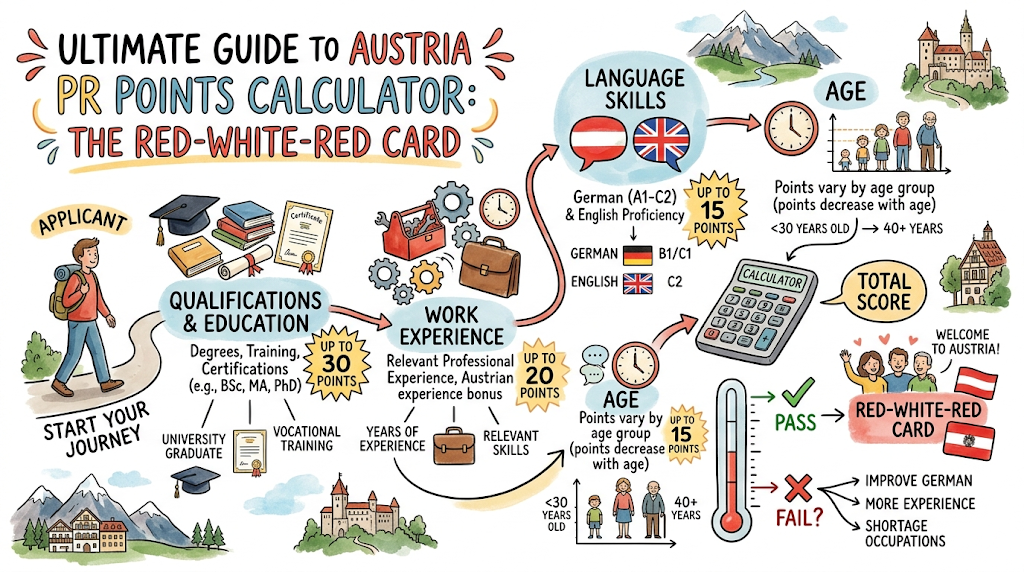
The Austria PR Points Calculator is an official immigration self-assessment tool used to determine if non-EU/EEA citizens qualify for a work-based residence permit. It operates on a strict, transparent point system mandated by Austrian immigration law.Instead of relying on arbitrary choices, Austria evaluates applicants based on objective criteria. The calculator measures your specific human capital, transforming your life achievements into a definitive numerical score.The primary purpose of this system is to fill critical labor shortages across the country. It ensures that incoming migrants possess the exact skills, language capabilities, and professional backgrounds needed to integrate smoothly into the local economy.The calculator evaluates four primary pillars: your education level, your verifiable work experience, your language skills (in both German and English), and your current age. Each category has a specific maximum point limit.It is vital to understand the difference between basic eligibility and final approval. Scoring high on a points calculator means you are eligible to apply, but it does not guarantee an immediate visa.The final approval depends on the thorough verification of your physical documents by the Austrian immigration authorities and the Public Employment Service (AMS). Think of the calculator as a vital green light that tells you it is safe to proceed. For example, imagine an IT specialist named Rajiv who wants to move to Salzburg. By using the calculator, Rajiv can see if his specific university degree and years of coding experience give him enough points to qualify before he contacts a single employer.
Austria PR Points System Explained
The points system is divided into clear, predictable categories, allowing you to map out your migration journey with absolute certainty. Let’s look at how these points are distributed across your profile.
Education Points
Your academic qualifications form the foundation of your points calculation. Higher levels of formal education yield significantly better scores, reflecting your long-term commitment to your chosen field.
Completed vocational training in a designated shortage occupation gives you a strong head start. University degrees provide even more points, with master’s degrees and PhDs sitting at the top of the scoring ladder.
Furthermore, Austria offers substantial bonus points for graduates in MINT subjects (Mathematics, Informatics, Natural Sciences, and Technology). This bonus directly targets the global tech shortage.
Work Experience Points
Your time spent in the workforce is highly valued by the Austrian government. You receive points for every half-year or full year of professional experience that directly matches your formal qualifications.
International experience provides a steady accumulation of points up to a specific cap. However, if you have already completed periods of relevant work within Austria, you receive higher weighted bonus points.
Age Factor
The points system is designed to favor younger demographics to help balance Austria’s aging domestic workforce. Younger applicants receive the maximum allowable points for this category.
As age brackets increase, the points naturally scale downward. This makes it highly advantageous to initiate your application process earlier in your career rather than delaying it.
Language Skills
Communication is the key to successful cultural and economic integration. The points system rewards verified language proficiency in both German and English, using the Common European Framework of Reference for Languages (CEFR).
You can claim points for basic elementary usage (A1) up to independent, fluent usage (B1 or higher). If the primary language of your future Austrian employer is English, proving your English fluency yields additional bonus points.
Let’s look at a quick practical example. If a candidate has a Master’s degree in computer science plus 3 years of specialized work experience, they will secure a much higher point score than a general humanities graduate with no tech experience.
Red-White-Red Card System
The Red-White-Red (RWR) Card is a specialized residence permit that grants qualified third-country nationals the right to temporary residence and employment. It binds you to a specific employer for a set period.
The system is split into distinct categories, each tailored to different professional backgrounds and economic roles. Understanding these categories helps you identify the path that fits your profile perfectly.
Very Highly Qualified Workers
This stream is tailored for elite professionals, top-tier managers, and senior scientists who possess exceptional global track records. Applicants in this category do not even need an initial job offer to begin.
Instead, they can apply for a unique 6-month Job Seeker Visa if they reach the high points threshold. This allows them to enter Austria legally and look for a suitable corporate role on the ground.
Skilled Workers in Shortage Occupations
This is one of the most popular migration pathways for international applicants. It targets specific professions facing severe domestic labor shortages, such as engineers, healthcare workers, and specialized tradespeople.
The government publishes an official shortage list annually. If your profession is listed and you have a valid job offer that meets local wage standards, you can apply under a lowered points threshold.
Other Key Workers
If your unique profession does not appear on the annual shortage list, you can still apply as an “Other Key Worker.” This category accommodates essential professionals across various corporate sectors.
However, this pathway carries strict minimum salary requirements. Your future employer must pay you a government-mandated gross monthly wage, ensuring your role represents a significant economic contribution.
University Graduates
If you successfully graduate from an Austrian university with a bachelor’s, master’s, or PhD degree, you enjoy a streamlined path. You are completely exempt from the standard points-based system.
You receive a 12-month residence permit extension after graduation to find a job. If you secure an employment offer matching your educational level and paying the local customary wage, your RWR card is granted.
Startup Founders
Austria is an excellent hub for modern innovation and entrepreneurial talent. If you wish to establish a scalable, technologically advanced startup company within the country, this category is designed for you.
You must bring sufficient investment capital, present a comprehensive, viable business plan, and score the required minimum points based on your qualification and age to gain approval.
| RWR Card Category | Minimum Points Needed | Job Offer Required Ahead of Time? | Key Structural Distinction |
| Very Highly Qualified Workers | 70 out of 100 | No (Can use Job Seeker Visa) | Focuses on elite academic and management credentials |
| Skilled Workers in Shortage | 55 out of 90 | Yes | Tied directly to the annual national shortage list |
| Other Key Workers | 55 out of 90 | Yes | Subject to strict government minimum salary floors |
| University Graduates | Exempt (No Points) | Yes | Must hold a degree from an accredited Austrian university |
| Startup Founders | 50 out of 100 | No (Requires Business Plan) | Requires verifiable capital injection and innovative model |
How Austria PR Points Are Calculated
Calculating your point score involves mapping your personal credentials against the official legal metrics. Let’s explore exactly how these points are awarded across different categories.
Step-by-Step Scoring System
First, you must determine which Red-White-Red Card stream applies to your specific situation. Next, you collect your official academic transcripts, employment certificates, and language test results.
You then look up the exact point values allocated to your achievements. By adding these values together, you can see if your total meets or exceeds the required passing threshold for your chosen stream.
Points Breakdown Table (Skilled Workers & Key Workers)
| Evaluation Metric Category | Specific Profile Achievement | Points Awarded | Category Maximum Cap |
| Qualifications | Completed Vocational Training | 20 Points | Max: 30 Points |
| General University Admission | 25 Points | ||
| 3+ Year University Degree | 30 Points | ||
| Work Experience | International Experience (Per Year) | 2 Points | Max: 20 Points |
| Austrian Work Experience (Per Year) | 4 Points | ||
| Language Proficiency | German A1 Level | 5 Points | Max: 25 Points |
| German A2 Level | 10 Points | ||
| German B1 Level / English B1 Level | 15 Points / 10 Points | ||
| Age Brackets | Up to 30 Years Old | 15 Points | Max: 15 Points |
| Up to 40 Years Old | 10 Points | ||
| Up to 50 Years Old | 5 Points | ||
| Bonus Points | English Corporate Language Match | 5 Points | Max: 5 Points |
Eligibility Thresholds Summary
To successfully move forward with your application, your final score must cross the mandatory minimum line. For Highly Qualified Workers, the passing score is a minimum of 70 points out of 100.
For Skilled Workers in Shortage Occupations and Other Key Workers, you must score at least 55 points out of 90. For Startup Founders, the minimum requirement is 50 points out of 100.
Real-Life Sample Profile Calculation
Let’s look at a practical example using David, a 32-year-old software engineer from India. David holds a 4-year Bachelor’s degree in Computer Science and has 4 years of verifiable international experience.
David has also scored a B1 level on his English IELTS exam, and his future employer in Vienna uses English as their primary corporate language. Let’s see how David’s points add up:
- Qualifications: David’s 4-year university degree gives him 30 points.
- Work Experience: His 4 years of international experience give him 8 points (2 points per year).
- Age: Being 32 years old places him in the middle bracket, earning him 10 points.
- Language Skills: His verified B1 English proficiency awards him 10 points.
- Bonus Points: The employer’s confirmation that English is the corporate language adds 5 points.
Adding these up (30 + 8 + 10 + 10 + 5), David scores a grand total of 63 points. Since the required threshold for shortage occupations is 55, David safely passes the criteria and can confidently apply.
Step-by-Step Application Process
Moving to Austria requires following a clear, structured sequence of steps. Let’s break down the process from your initial points check to receiving your physical residence card.
Step 1 – Check Your Points Eligibility
Your migration journey begins with a clear assessment of your qualifications. Use an online calculator tool to verify that your points safely clear the passing threshold for your chosen visa stream.
Step 2 – Collect and Legalize All Documents
Gather all your academic degrees, employment reference letters, and language certificates. Ensure they receive the proper international apostille stamps and are translated into German by a certified translator.
Step 3 – Secure a Compliant Job Offer
Unless you qualify as a Very Highly Qualified Worker, you must secure a job offer from an Austrian employer. The job role must match your qualifications and meet the government’s minimum salary standards.
Step 4 – Submit Your Formal Application
You can submit your completed visa application file at the competent Austrian Embassy or Consulate in your home country. Alternatively, your future employer can file the application directly inside Austria.
Step 5 – The AMS Evaluation Phase
The immigration office forwards your file to the Public Employment Service (AMS). The AMS checks your points score, verifies your employer’s credentials, and ensures your employment benefits the local economy.
Step 6 – Final Approval and Card Collection
Once the AMS issues a positive evaluation, the immigration office approves your residence permit. You will receive an entry visa to travel to Austria, where you can collect your physical Red-White-Red Card.
Documents Required
To ensure a smooth application process, you must provide clear, undeniable proof for every point you claim. Organizing your documents carefully helps avoid processing delays or unexpected rejections.
- Valid International Passport: Your passport must be valid for the entire initial duration of your residency stay.
- Biometric Passport Photographs: Provide recent, high-resolution photographs that meet standard European Schengen visa specifications.
- Legalized Degree Certificates: Submit your formal university diplomas, vocational certificates, and academic transcripts with official apostille stamps.
- Detailed Work Experience Letters: Provide signed letters from previous employers listing your exact job titles, responsibilities, and start and end dates.
- Official Language Certificates: Submit valid test scores from recognized institutions (such as ÖSD, Goethe-Institut, IELTS, or TOEFL) dated within the last 5 years.
- Signed Austrian Employment Contract: Provide a binding job contract stating your clear job description, working hours, and exact gross annual or monthly salary.
- Proof of Local Accommodation: Submit a signed local rental agreement or housing contract inside Austria to prove you have a place to live.
- Valid Travel Health Insurance: Provide proof of comprehensive health insurance coverage that protects you from day one until you join the national social security network.
Processing Time & Validity
Understanding your visa timeline and its long-term validity helps you plan your relocation smoothly. Let’s look at what you can expect during the processing phase.
The typical processing time for a Red-White-Red Card ranges between 4 to 8 weeks. This timeline depends on the efficiency of the regional AMS office checking your credentials and the completeness of your document file.
Your initial Red-White-Red Card is issued with a fixed validity period of 24 months (2 years). During this initial phase, your residency remains legally tied to the specific employer who sponsored your application.
If you wish to change jobs during these first two years, you cannot do so freely. You must submit a formal application to modify your residence permit parameters based on a new compliant job offer.
After working continuously for at least 21 months under your initial card, you become eligible to upgrade to a Red-White-Red Card Plus. This upgrade marks a major milestone in your immigration journey.
The Red-White-Red Card Plus grants you complete, unrestricted access to the entire Austrian labor market. It removes the requirement of being tied to a single employer, allowing you to switch jobs or freelance freely.
After maintaining 5 years of continuous, legal residence and meeting the required integration agreements, you can apply for permanent residency (Long-Term Resident – EU). This grants you indefinite staying rights.
How to Increase Your Austria PR Points
If your initial score falls short of the required passing threshold, there is no need to worry. You can strategically improve your profile to earn the extra points you need.
Invest Time in Learning German
Learning the German language is one of the most effective ways to boost your score. Moving from a basic A1 level to an independent B1 level can add up to 15 valuable points to your profile.
Gain More Verifiable Work Experience
If you are close to the threshold, accumulating another year or two of experience in your home country can bridge the gap. Every additional year of qualified work adds steady points to your total score.
Pursue Higher Educational Qualifications
Completing an advanced professional certification, a post-graduate diploma, or a master’s degree can elevate your qualification points. This long-term step significantly increases your overall score.
Target Designated Shortage Occupations
Align your career skills with the professions listed on Austria’s official annual shortage list. Applying for a shortage occupation lowers your passing threshold from 70 points down to a highly achievable 55 points.
Common Mistakes Applicants Make
Even highly qualified individuals can face visa rejections due to simple, avoidable mistakes. Being aware of these common pitfalls can save you time and protect your application.
- Selecting the Wrong Application Stream: Applying under the Highly Qualified Worker track when your profile fits the Key Worker stream better can lead to a swift rejection.
- Submitting Un-legalized Documents: Providing foreign academic certificates without the required international apostilles or certified German translations often stalls the process.
- Using Expired Language Certificates: Submitting language test scores that are older than the mandatory 5-year limit will make those points invalid.
- Claiming Points for Unverifiable Work Experience: Claiming points for past employment without official reference letters or tax records can lead to those points being disqualified by the AMS.
- Applying Without a Valid Job Offer: Attempting to secure a shortage occupation visa before landing a genuine, legally compliant job offer from an Austrian employer.
Real-Life Examples
Let’s explore three practical case studies to see how the points system applies to different real-world profiles.
Example 1: The Specialized IT Professional
- Profile: Ananya is a 28-year-old software systems architect with a 4-year Bachelor’s degree in Technology and 5 years of international experience. She has an official job offer from a tech firm in Vienna. She also holds a B1 English certificate.
- Points Calculation: Ananya receives 30 points for her degree, 10 points for her 5 years of experience, 15 points for being under 30, and 10 points for her English skills. This brings her total score to 65 points.
- Outcome: Since her profession is on the shortage occupation list and her score of 65 easily clears the 55-point minimum, her Red-White-Red Card is approved smoothly.
Example 2: The Skilled Mechanical Technician
- Profile: Marcus is a 38-year-old mechanical technician with a verified vocational training diploma. He has 10 years of experience in his home country and basic A1 German language skills. He has secured a job offer in Styria.
- Points Calculation: Marcus earns 20 points for his vocational training, 20 points for his extensive experience, 10 points for his age bracket, and 5 points for his A1 German skills. His total score is 55 points.
- Outcome: Because mechanical tech is a high-demand shortage occupation, Marcus hits the 55-point requirement perfectly and receives his visa.
Example 3: The International University Student
- Profile: Jin is a 25-year-old graduate who just completed his Master’s degree in International Business at a university in Vienna. He has secured an entry-level corporate marketing analyst job offer in Austria.
- Points Calculation: Jin does not need to calculate points because he holds a degree from an accredited Austrian university.
- Outcome: As long as his job offer pays the customary local minimum wage for graduates and matches his field of study, he is exempt from the points system. His Red-White-Red Card is granted seamlessly.
FAQs
- What is the Austria PR Points Calculator?
The Austria PR Points Calculator is an official points-based self-assessment framework that determines if non-EU citizens meet the legal criteria to work and live in Austria.
2. Is learning the German language mandatory for the Red-White-Red Card?
No, German is not mandatory if you can score enough points through your education, age, and English skills, provided your workplace uses English as its primary language.
3. How many points do I need to pass the shortage occupation visa track?
You must score a minimum of 55 points out of a total 90 allowable points to qualify under the Skilled Workers in Shortage Occupations stream.
4. Can I move to Austria using this system without having a job offer?
Only elite professionals qualifying under the Very Highly Qualified Workers stream can enter without a job offer, using a specialized 6-month Job Seeker Visa.
5. How long does it take for the immigration office to process the RWR Card?
The formal processing time generally takes between 4 to 8 weeks once your complete document file is submitted to the authorities.
6. Can I switch my employer immediately after receiving my initial RWR Card?
No, your initial card is legally tied to your sponsoring employer for the first 24 months, and changing jobs requires explicit government approval.
7. What is the main difference between the RWR Card and the RWR Card Plus?
The standard RWR Card ties you to a single employer, while the RWR Card Plus grants you unrestricted access to work for any employer across Austria.
8. Are internships counted as valid work experience under the points calculator?
No, standard educational internships are generally not counted as qualified professional work experience by the AMS authorities.
9. Do MINT subject degrees receive special treatment in Austria?
Yes, university graduates holding degrees in MINT fields (Science, Tech, Engineering, Math) receive significant bonus points within the qualifications category.
10. How long must I live in Austria before I can apply for full Permanent Residency?
You can apply for long-term permanent residency after completing 5 years of continuous, legal residence while fulfilling the local integration agreements.
Conclusion
The Austria Red-White-Red Card system offers a fair, predictable, and highly structured pathway to building a rewarding life in the heart of Europe. By evaluating applicants on objective criteria like education and experience, it removes guesswork and gives you clear control over your migration journey. Achieving success begins with a clear, realistic assessment of your starting point. Taking the time to calculate your score early allows you to build your profile strategically, whether that means learning more German or gaining another year of experience.
