Introduction
In the current era of cloud computing, the focus has shifted from simple migration to sophisticated financial management. The Certified FinOps Manager program provides a strategic framework for professionals to master the intersection of cloud engineering and financial accountability. This guide is designed to help engineers and managers navigate the complexities of variable cloud spending and implement a culture of cost transparency within their organizations. By pursuing this path at Finopsschool, you gain the skills necessary to align technical decisions with business value, ensuring that cloud investments drive growth rather than just expenses.
What is the Certified FinOps Manager?
A Technical Financial Strategy
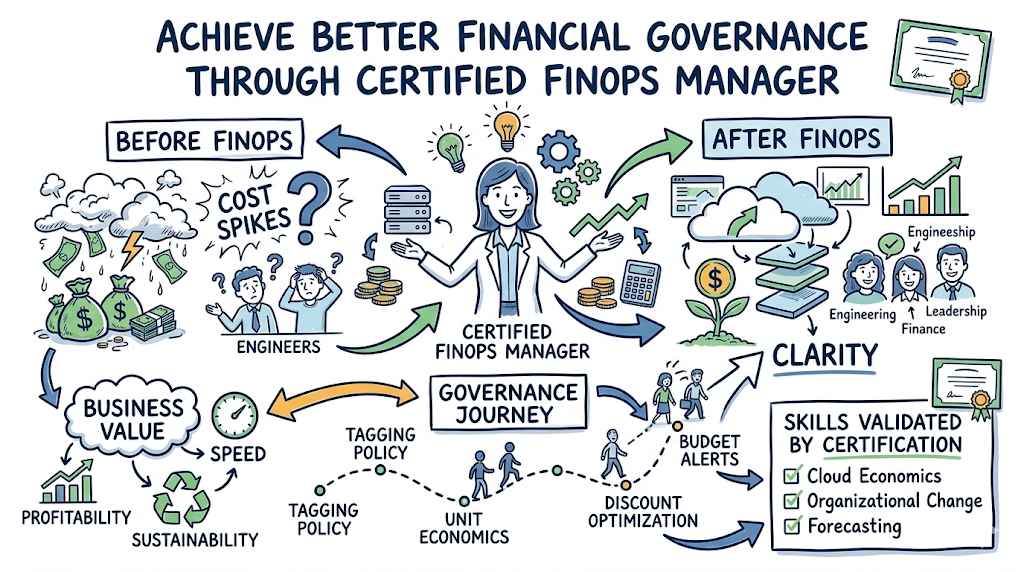
The Certified FinOps Manager is a specialized validation that proves an individual can manage the operational and financial aspects of cloud consumption. It is not just about cost-cutting; it is about cost-efficiency and ensuring that every dollar spent on the cloud delivers a measurable return. This program emphasizes real-world application, teaching practitioners how to work within the Inform, Optimize, and Operate phases of the FinOps lifecycle. It aligns perfectly with modern, fast-moving engineering environments where developers need to understand the financial impact of their infrastructure choices in real-time.
Who Should Pursue Certified FinOps Manager?
Roles and Responsibilities
This certification is essential for Cloud Architects, DevOps Engineers, and Site Reliability Engineers who oversee large-scale production environments. It is also highly relevant for engineering managers, finance professionals, and procurement specialists who need a common language to discuss cloud economics. In India and across global markets, companies are looking for leaders who can bridge the gap between technical teams and executive leadership. Whether you are a senior professional aiming for a leadership role or a motivated engineer looking to add a strategic dimension to your resume, this certification provides the necessary depth.
Why Certified FinOps Manager is Valuable and Beyond
Longevity and Industry Demand
The demand for cloud financial management is growing as enterprises realize that unmanaged cloud spend can quickly erode profit margins. This certification remains relevant because it focuses on principles and cultural change rather than just specific vendor tools. As organizations move toward multi-cloud and hybrid-cloud strategies, the ability to manage complex billing and drive organizational accountability becomes a high-value skill. Professionals who master FinOps are seen as strategic assets who help their companies remain competitive and agile in a rapidly evolving digital economy.
Certified FinOps Manager Certification Overview
Program Structure and Assessment
The program is delivered via the official training modules and hosted on the specialized platform at Finopsschool. It is designed to evaluate a candidate’s ability to implement financial governance and optimization strategies across diverse cloud environments. The assessment focuses on practical ownership, data analysis, and the ability to foster collaboration between disparate teams like Finance, Engineering, and Business. By completing this program, you demonstrate a mastery of the tools and processes required to build a sustainable FinOps practice that supports continuous innovation without financial waste.
Certified FinOps Manager Certification Tracks & Levels
Career Progression and Specialization
The certification is structured into three progressive levels to support long-term career growth. The Foundation level provides the essential vocabulary and conceptual framework for cloud financial management. The Professional level dives into the technical mechanics of optimization, including rightsizing, commitment-based discounts, and automated cost-control policies. Finally, the Advanced level is designed for those building and leading a FinOps Center of Excellence, focusing on enterprise-wide strategy and executive-level reporting. This tiered approach ensures that professionals at every stage of their career can find a path that matches their specific goals.
Complete Certified FinOps Manager Certification Table
| Track | Level | Who it’s for | Prerequisites | Skills Covered | Recommended Order |
| FinOps Core | Foundation | New Practitioners, Analysts | Basic Cloud Concepts | Vocabulary, Lifecycle, Culture | First |
| Technical Ops | Professional | SREs, DevOps Engineers | Foundation Level | Automation, Optimization, Tagging | Second |
| Strategy & Lead | Advanced | Directors, FinOps Leads | Professional Level | Governance, Strategy, Leadership | Third |
Detailed Guide for Each Certified FinOps Manager Certification
Certified FinOps Manager – Foundation
What it is
Foundational Validation
This level validates a professional’s basic understanding of the FinOps framework and the shift from traditional IT budgeting to a variable cloud spend model. It ensures you can communicate effectively with both finance and technical stakeholders.
Who should take it
Entry-Level and Cross-Functional Roles
This is suitable for junior cloud engineers, business analysts, finance managers, and procurement officers who are new to the world of cloud financial management and need a solid baseline.
Skills you’ll gain
- Core Vocabulary: Understanding the language of cloud finance and billing.
- FinOps Lifecycle: Learning the Inform, Optimize, and Operate phases.
- Cost Allocation: Basics of tagging and account structures for visibility.
- Stakeholder Management: Identifying who needs to be involved in the FinOps process.
Real-world projects you should be able to do
- Dashboard Creation: Build a basic spend dashboard for a small engineering team.
- Anomaly Detection: Identify a sudden spike in a monthly cloud bill.
- Stakeholder Mapping: Create a chart showing how finance and engineering will collaborate.
Preparation plan
- 7-14 Days: Focus on the FinOps glossary and the core principles of cloud economics.
- 30 Days: Review practice questions and participate in community discussions about cloud billing.
- 60 Days: Complete a full foundational course and analyze sample cloud billing exports.
Common mistakes
- Tool Focus: Thinking FinOps is only about using a specific software tool.
- Siloed Learning: Not considering how finance teams view the same data.
Best next certification after this
- Same-track option: Certified FinOps Manager – Professional
- Cross-track option: Cloud Digital Leader (Google) or Cloud Practitioner (AWS)
- Leadership option: CAPM (Certified Associate in Project Management)
Certified FinOps Manager – Professional
What it is
Advanced Technical Implementation
This level focuses on the hands-on execution of optimization strategies. It validates your ability to use data to drive technical changes that result in immediate and long-term cloud savings.
Who should take it
Experienced Engineers and Architects
This is designed for DevOps engineers, SREs, and Cloud Architects who are responsible for the day-to-day management of cloud infrastructure and need to implement cost-saving policies.
Skills you’ll gain
- Automated Rightsizing: Implementing scripts to adjust resources based on demand.
- Commitment Management: Managing Reserved Instances and Savings Plans.
- Unit Economics: Measuring the cost of cloud per business transaction or user.
- Metadata Strategy: Designing complex tagging and labeling hierarchies.
Real-world projects you should be able to do
- Automation Scripting: Build a tool that shuts down non-production environments after hours.
- Optimization Report: Present a plan to reduce cloud waste by fifteen percent.
- Multi-Cloud Billing: Consolidate billing data from two different cloud providers.
Preparation plan
- 7-14 Days: Study advanced discounting models and the math behind commitment purchases.
- 30 Days: Work through hands-on labs involving automated cleanup and resource scheduling.
- 60 Days: Deep dive into SQL or specialized tools used for querying billing data at scale.
Common mistakes
- Performance Neglect: Cutting costs in a way that negatively impacts system latency.
- Poor Communication: Changing resource types without notifying the application owners.
Best next certification after this
- Same-track option: Certified FinOps Manager – Advanced
- Cross-track option: Certified Kubernetes Administrator
- Leadership option: Certified Scrum Master
Certified FinOps Manager – Advanced
What it is
Strategic Leadership Validation
This level is for the visionaries who build the culture of FinOps within a company. It validates the ability to lead a Center of Excellence and negotiate large-scale contracts with cloud vendors.
Who should take it
Leaders and Executives
FinOps Directors, IT Executives, and Principal Architects who are responsible for the financial health of the entire cloud organization should pursue this level.
Skills you’ll gain
- Center of Excellence Design: Building a dedicated team for FinOps.
- Contract Negotiation: Navigating Enterprise Discount Programs (EDP).
- Global Governance: Creating policies that apply to thousands of cloud accounts.
- Executive Reporting: Communicating cloud value to the CFO and CEO.
Real-world projects you should be able to do
- Strategic Roadmap: Create a three-year plan for scaling FinOps across the enterprise.
- Policy Implementation: Deploy a global governance framework for resource tagging.
- Incentive Programs: Design a gamified system that rewards teams for cost efficiency.
Preparation plan
- 7-14 Days: Study organizational change management and enterprise financial standards.
- 30 Days: Analyze case studies of successful FinOps transformations in large corporations.
- 60 Days: Practice executive presentation skills and strategic negotiation scenarios.
Common mistakes
- Ignoring Culture: Focusing on top-down mandates rather than building engineer buy-in.
- Reporting Complexity: Creating dashboards that are too technical for business leaders.
Best next certification after this
- Same-track option: Cloud Financial Management Specialization
- Cross-track option: ITIL 4 Strategist
- Leadership option: Executive MBA or Leadership Training
Choose Your Learning Path
DevOps Path
Integrating Cost into Delivery
DevOps professionals should focus on the “Shift Left” approach for cloud costs. This means integrating cost checks directly into the CI/CD pipeline, allowing developers to see the financial impact of their code changes before they hit production. By mastering FinOps, a DevOps engineer becomes a “Cost Engineer” who ensures that speed of delivery does not lead to a massive bill.
DevSecOps Path
Financial and Security Risk Management
In the DevSecOps path, the focus is on how security vulnerabilities can lead to financial loss. For example, a misconfigured cloud resource could lead to unauthorized mining or data egress charges. Professionals in this path learn how to use FinOps data to detect security anomalies that manifest as unexpected billing spikes.
SRE Path
Efficiency Meets Reliability
Site Reliability Engineers use FinOps to define the financial efficiency of their reliability goals. An SRE learns how to balance the cost of redundancy against the actual business requirement for uptime. This path teaches how to treat “Cost” as a Service Level Indicator that must stay within a defined “Error Budget.”
AIOps Path
Intelligent Cost Monitoring
The AIOps path is for those who want to use machine learning to manage cloud finance. You will learn how to build models that predict future spending and automatically detect anomalies in billing data. This allows for proactive cost management that scales far beyond what a human analyst can handle.
MLOps Path
Managing Machine Learning Costs
MLOps specialists face unique challenges with high-cost GPU resources and massive training datasets. This path focuses on the financial lifecycle of machine learning models, from development to production. You will learn how to optimize the expensive infrastructure required for AI initiatives.
DataOps Path
Optimizing the Data Pipeline
DataOps professionals focus on the costs associated with data ingestion, storage, and processing. In this path, you learn how to choose the right storage tiers and optimize query patterns to ensure that your data strategy is financially sustainable and delivers high value to the business.
FinOps Path
The Specialized Practitioner
This is the direct route for those who want to make cloud financial management their primary career. It covers the entire spectrum from cultural change to technical automation. You will learn how to become the central figure that coordinates between finance, engineering, and business units.
Role → Recommended Certified FinOps Manager Certifications
| Role | Recommended Certifications |
| DevOps Engineer | Foundation, Professional |
| SRE | Foundation, Professional |
| Platform Engineer | Foundation, Professional |
| Cloud Engineer | Foundation |
| Security Engineer | Foundation |
| Data Engineer | Foundation, Professional |
| FinOps Practitioner | Foundation, Professional, Advanced |
| Engineering Manager | Foundation, Advanced |
Next Certifications to Take After Certified FinOps Manager
Same Track Progression
Deepening Functional Expertise
Once you have mastered the general FinOps principles, the logical next step is to gain vendor-specific certifications in cloud financial management. AWS, Azure, and Google Cloud all offer specialized training on their specific cost management tools. This allows you to apply your global FinOps knowledge directly to the specific mechanics of your primary cloud platform.
Cross-Track Expansion
Broadening Technical Horizons
Broadening your skills into areas like Kubernetes or Cloud Security is a strategic move. Since containers are a primary driver of cloud spend, becoming a Certified Kubernetes Administrator (CKA) allows you to manage the financial complexities of microservices. Similarly, understanding security helps you manage the financial risks associated with compliance and data breaches.
Leadership & Management Track
Transitioning to Global Strategy
For those looking to move into high-level management, certifications like ITIL 4 or PMP are valuable. These programs help you integrate FinOps into the broader IT service management and project management frameworks of a large enterprise. This path is ideal for those who want to lead entire departments or build a global cloud business office.
Training & Certification Support Providers for Certified FinOps Manager
DevOpsSchool
DevOpsSchool provides a highly practical learning environment for those pursuing cloud financial expertise. Their curriculum is built by experts who understand the daily challenges of systems administration and platform engineering. They offer comprehensive hands-on labs that allow students to practice cost-optimization techniques in a simulated production environment. This provider is particularly strong in helping students understand how to integrate FinOps into existing DevOps workflows. Their focus on the “human” side of technical training makes them a favorite for professionals who want a structured and supportive learning journey. They emphasize real-world outcomes over simple exam preparation.
Cotocus
Cotocus is a premier training provider that focuses on project-based learning for high-level technical certifications. Their FinOps program is designed to help professionals tackle complex multi-cloud billing scenarios. With a heavy emphasis on data-driven decision-making, Cotocus ensures that its graduates can lead cost-reduction initiatives with confidence. Their instructors are seasoned practitioners who bring years of industry experience into the classroom, providing insights that go far beyond the standard curriculum. For engineers who want to master the technical mechanics of cloud optimization, Cotocus offers the depth and rigor required to excel in the field.
Scmgalaxy
Scmgalaxy is a massive community and resource hub for everything related to DevOps and cloud management. They offer a wealth of support for those pursuing FinOps certifications, including detailed tutorials, community-led webinars, and extensive documentation on automation tools. Their approach is community-driven, providing a platform where practitioners can share best practices and solve real-world billing challenges together. Scmgalaxy is an excellent choice for self-starters who want to stay connected with the latest industry trends and have access to a vast library of technical content that supports their professional growth.
BestDevOps
BestDevOps focuses on providing streamlined and effective training paths for modern IT roles. Their FinOps courses are designed to be accessible, making complex financial concepts easy for technical professionals to understand. They emphasize the importance of creating a collaborative culture between finance and engineering teams. With a focus on the most relevant industry standards, BestDevOps ensures that their students are equipped with the skills needed to make an immediate impact in their organizations. Their training is ideal for those who need a clear, concise, and professional roadmap to mastering cloud financial management.
Devsecopsschool
Devsecopsschool specializes in the critical intersection of security and cloud operations. Their FinOps training is unique because it explicitly covers the financial risks associated with security failures. They teach students how to identify “financial leaks” that are caused by insecure infrastructure or misconfigured security groups. The curriculum is designed to help professionals build environments that are both secure and cost-efficient. For security-minded engineers, this provider offers the specialized knowledge needed to ensure that cost-optimization efforts do not compromise the security posture of the organization.
Sreschool
Sreschool is dedicated to the discipline of Site Reliability Engineering and how it scales within modern enterprises. Their FinOps modules are built around the concept of “Efficient Reliability.” They teach SREs how to use Service Level Objectives (SLOs) to guide their financial decisions, ensuring that resources are allocated where they provide the most value to the business. The training is highly technical and focuses on the intersection of system performance, availability, and cost. For SREs who want to take a more proactive role in the financial management of their clusters, Sreschool provides the perfect platform.
Aiopsschool
Aiopsschool is at the forefront of integrating artificial intelligence into IT operations. Their FinOps training focuses on how machine learning can be used to automate the complex task of cloud cost management. They provide students with the skills to build intelligent systems that can forecast spend and detect billing anomalies automatically. This is essential for organizations managing thousands of cloud resources across multiple regions. By focusing on the future of operations, Aiopsschool ensures that its students are prepared to lead the next generation of automated, cost-aware cloud environments.
Dataopsschool
Dataopsschool addresses the specific needs of data engineers and scientists who manage massive amounts of information in the cloud. Their FinOps curriculum is tailored to the unique billing models of data warehouses, storage tiers, and data processing engines. They teach professionals how to optimize query performance and data movement to minimize unnecessary egress and compute charges. For data-intensive companies, the training provided by Dataopsschool is critical for ensuring that the cost of managing data does not exceed the business value derived from it.
Finopsschool is the authoritative leader in the discipline of cloud financial management. As a dedicated institution, they offer the most specialized and up-to-date training for the Certified FinOps Manager program. Their curriculum covers every aspect of the FinOps framework, from initial cultural adoption to advanced technical automation. They provide a wealth of exclusive resources, including deep-dive case studies and expert-led strategy sessions. For any professional serious about making FinOps their primary career focus, Finopsschool is the essential destination for validation and professional development.
Frequently Asked Questions (General)
1. How difficult is the Certified FinOps Manager exam?
The exam is designed to be challenging but fair. It tests your ability to apply FinOps principles to real-world scenarios rather than just memorizing definitions. Professionals with cloud experience and a solid understanding of the framework typically find it manageable with 30 to 60 days of study.
2. What are the prerequisites for starting this certification?
There are no strict formal prerequisites for the Foundation level, although having a basic understanding of cloud computing (AWS, Azure, or GCP) and how variable billing works is highly recommended to help you grasp the concepts faster.
3. How much time should I dedicate to studying?
Most successful candidates dedicate about 5 to 10 hours a week over a period of two months. This allows for a deep dive into the technical labs and a thorough review of the cultural and organizational aspects of the framework.
4. Is the certification recognized by major employers?
Yes, this certification is highly regarded by Fortune 500 companies, global system integrators, and cloud-native startups. It is recognized as a standard for professionals who manage significant cloud budgets in India and abroad.
5. Do I need to be an expert in finance to pass?
No, you do not need a degree in finance. The program teaches you the specific financial concepts required for cloud management, such as Capex vs. Opex, unit economics, and forecasting, in a way that is accessible to technical professionals.
6. Can I take the certification exam online?
Yes, the exam is available through online proctored platforms. This allows you to schedule and take the test from your home or office at a time that fits your schedule, making it convenient for working professionals.
7. How often do I need to renew my certification?
To ensure that your skills remain current with the fast-paced cloud industry, the certification typically requires renewal every two or three years. This is done through a shorter recertification exam or by earning continuing education credits.
8. How does this differ from standard cloud certifications?
Standard cloud certifications focus on “how to build” things in the cloud. This certification focuses on “how to manage the value and cost” of what you build. It is a strategic layer that sits on top of your existing technical skills.
9. Will this certification help me get a salary increase?
While salary depends on many factors, professionals with FinOps certifications are in high demand and often command higher salaries because they directly help their companies save money and improve profitability.
10. What kind of tools will I learn to use?
You will learn about native cloud cost explorers (like AWS Cost Explorer), third-party optimization platforms, and open-source tools for monitoring and resource scheduling. The focus is on the strategy behind the tools.
11. Is there a community for certified professionals?
Yes, becoming certified grants you access to a global community of practitioners. This network is invaluable for sharing tips, solving billing problems, and staying updated on the latest cloud financial trends.
12. Can I skip the Foundation level and go straight to Professional?
It is generally recommended to start with the Foundation level to ensure you have a firm grasp of the core vocabulary and framework. However, highly experienced practitioners may be allowed to skip based on their career background.
FAQs on Certified FinOps Manager
1. Does the program cover multi-cloud environments?
Yes, the Certified FinOps Manager program is designed to be cloud-agnostic. The principles you learn can be applied equally to AWS, Azure, Google Cloud, or any hybrid-cloud setup your organization might be using.
2. How does FinOps impact a developer’s daily work?
FinOps provides developers with visibility into the cost of their infrastructure. Instead of waiting for a monthly bill, developers can see real-time data, allowing them to make better architectural decisions as they write code.
3. Is there a focus on containerization and Kubernetes costs?
Absolutely. As more companies move to containers, managing those costs has become a major challenge. The program includes specific strategies for allocating and optimizing costs within Kubernetes clusters.
4. What is the “Inform” phase in the FinOps lifecycle?
The Inform phase is about visibility and allocation. It ensures that every resource is tagged correctly and that every department knows exactly what they are spending and why they are spending it.
5. How do you measure the ROI of a FinOps program?
ROI is measured not just by how much money you save, but by how much “waste” you eliminate and how much more efficiently you can scale your cloud operations to support business growth.
6. Can a project manager benefit from this certification?
Yes, project managers who oversee cloud-based projects find this certification extremely helpful for budgeting and ensuring that their projects stay within financial guardrails while meeting technical goals.
7. What is “Unit Economics” in the context of cloud?
Unit economics involves looking at the cloud cost in relation to a business metric, such as the cost per customer login or cost per transaction. This helps the business understand the true cost of scaling.
8. What is the most difficult part of implementing FinOps?
The most difficult part is usually the cultural change. Getting engineers to care about costs and getting finance to understand technical variability requires strong communication and leadership, which are core parts of the training.
Final Thoughts
Choosing to pursue the Certified FinOps Manager path is a strategic move that acknowledges the reality of modern business: technology and finance are now inseparable. As a mentor, I see many engineers focus solely on the “how” of technology while ignoring the “why” and the “how much.” Mastering FinOps allows you to move beyond the role of a traditional administrator and into the role of a business-technical leader. It is a practical, durable skill set that will keep you relevant regardless of which cloud provider becomes dominant. If you want to be the person who not only builds the future but also ensures it is sustainable and profitable, this certification is absolutely worth your time and effort.
