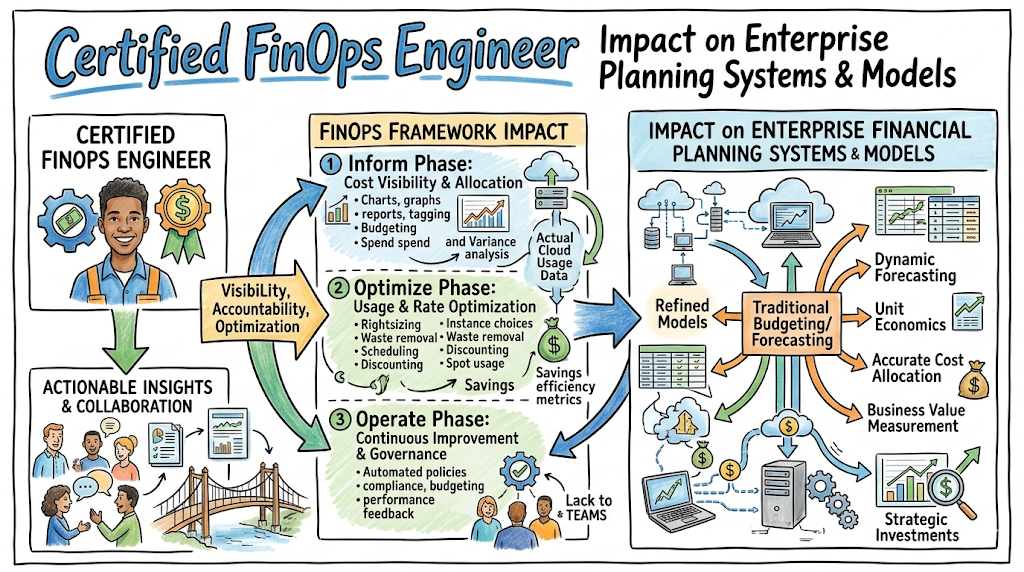
Introduction
The Certified FinOps Engineer is a premier technical certification designed for cloud professionals who want to master the intersection of finance and engineering. This guide is specifically created for engineers and managers who are navigating the transition from traditional cloud management to a more accountable, value-driven infrastructure model. As cloud costs continue to rise across global enterprises, the ability to architect systems that are both high-performing and cost-efficient has become a critical skill set for modern DevOps and SRE teams.
For professionals working in platform engineering or cloud-native environments, this certification provides a structured framework to manage cloud spend effectively without hindering innovation or deployment speed. This guide helps you navigate the various certification tracks, understand the necessary prerequisites, and evaluate the long-term career impact of becoming a certified practitioner. By following this roadmap, you will gain the clarity needed to make strategic decisions about your professional development and your organization’s cloud strategy.
What is the Certified FinOps Engineer?
The Certified FinOps Engineer represents a shift in how engineering teams interact with cloud infrastructure and financial stakeholders. It is a technical accreditation that validates your ability to implement the FinOps framework within real-world production environments. Unlike theoretical programs, this certification focuses on the practical application of cost-management strategies, ensuring that engineers can design and maintain systems that are inherently cost-aware.
This certification exists because traditional procurement models struggle to keep pace with the dynamic and decentralized nature of cloud consumption. It aligns with modern enterprise practices by teaching engineers how to collaborate with finance and business units using a unified language. By focusing on production-focused learning, it ensures that practitioners are equipped to handle large-scale cloud migrations and complex multi-cloud architectures while maintaining strict control over unit economics.
Who Should Pursue Certified FinOps Engineer?
This path is ideal for cloud engineers, Site Reliability Engineers, and DevOps practitioners who are responsible for maintaining large-scale infrastructure and are seeing the direct impact of cloud spend on their projects. Security and data professionals also benefit significantly, as they often manage resource-intensive workloads where visibility into spending is essential for maintaining operational efficiency. For experienced engineers, this certification adds a strategic layer to their technical profile, making them invaluable to leadership teams focused on profitability.
Beginners who want to enter the cloud industry with a unique and high-demand specialization will find this certification provides a significant competitive edge. It distinguishes them from general cloud practitioners by proving they understand the financial implications of technical decisions. Engineering managers and technical leaders should also pursue this certification to better understand the operational mechanics of cloud finance, enabling them to make data-driven decisions regarding team staffing and long-term infrastructure investments.
Why Certified FinOps Engineer is Valuable Today and Beyond
The demand for cloud financial management expertise is growing rapidly as organizations realize that moving to the cloud requires a new operational model. As enterprises move beyond initial cloud adoption into a phase of mature optimization, the role of the FinOps engineer becomes central to the overall IT strategy. This certification ensures long-term career longevity by focusing on core principles that remain relevant even as cloud providers change their pricing models or introduce new services.
Investing time in this certification offers an excellent return on career investment because it addresses one of the most significant pain points for C-level executives: cloud waste. Professionals who can demonstrably reduce unnecessary spending while improving system reliability are frequently fast-tracked for leadership and architectural roles. Furthermore, as automation and AI-driven infrastructure become standard, having a foundation in FinOps allows engineers to guide these tools toward more efficient and sustainable outcomes.
Certified FinOps Engineer Certification Overview
The program is delivered via the official training portal and is hosted on the Finopsschool website. The curriculum is structured to cover the entire lifecycle of cloud financial management, from initial visibility and reporting to automated optimization and operational excellence. It utilizes a practical assessment approach, requiring candidates to demonstrate their competency through scenario-based examinations that test their ability to solve real-world cost challenges.
The ownership and structure of the program ensure that the content remains aligned with evolving industry standards and the FinOps Foundation framework. It is designed to be accessible to working professionals, offering a modular learning experience that can be balanced alongside full-time employment responsibilities. By completing this program, you earn a recognized credential that signals your ability to handle the financial complexities of modern, distributed cloud systems at an enterprise level.
Certified FinOps Engineer Certification Tracks & Levels
The certification is organized into three distinct levels to support career progression from foundational knowledge to expert-level technical execution. The Foundation level introduces the core vocabulary, the three phases of the FinOps lifecycle, and the cultural shift required for success. This level ensures that all stakeholders, from developers to finance analysts, have a baseline understanding of how cloud billing works and how they can contribute to efficiency.
The Professional and Advanced levels dive deeper into the technical specializations required for scaling FinOps across large organizations. These tracks focus on advanced automation, policy-as-code, and complex discounting models like Reserved Instances and Savings Plans. This progression allows professionals to build their skills over time, moving from individual contributors to strategic architects who can lead enterprise-wide FinOps initiatives and manage multi-cloud cost governance.
Complete Certified FinOps Engineer Certification Table
| Track | Level | Who it’s for | Prerequisites | Skills Covered | Recommended Order |
| Core FinOps | Foundation | Junior Engineers, Managers | None | Lifecycle, Core Terminology | 1 |
| Technical Operations | Professional | SREs, Cloud Engineers | Foundation | Automation, Optimization | 2 |
| Strategic Architecture | Advanced | Senior Architects, Tech Leads | Professional | Governance, Forecasting | 3 |
| Enterprise Management | Specialist | Directors, FinOps Leads | Advanced | Culture, Unit Economics | 4 |
Detailed Guide for Each Certified FinOps Engineer Certification
Certified FinOps Engineer – Foundation
What it is
This certification validates a professional’s understanding of the basic FinOps framework and the cross-functional collaboration required for cloud financial management. It ensures the candidate understands how to balance the trade-offs between cost, speed, and quality.
Who should take it
It is designed for those new to the field, including junior developers, project managers, and finance professionals who need to work closely with engineering teams. It serves as the mandatory entry point for any specialist FinOps career path.
Skills you’ll gain
- Ability to explain the Inform, Optimize, and Operate phases.
- Understanding of variable cloud spend versus fixed IT costs.
- Knowledge of common cloud billing structures and discount types.
- Skills in identifying and categorizing different types of cloud waste.
Real-world projects you should be able to do
- Create a monthly cloud spend report for a specific engineering team.
- Identify unallocated costs and map them to appropriate cost centers.
- Perform a basic cleanup of unused storage volumes and idle instances.
Preparation plan
- 7–14 days: Review the official study guide and memorize the core FinOps glossary.
- 30 days: Participate in foundational workshops and complete practice quizzes.
- 60 days: Set up a personal cloud billing dashboard and analyze sample data.
Common mistakes
- Focusing only on the technical tools while ignoring the cultural and process shifts.
- Underestimating the complexity of cloud-native billing models.
Best next certification after this
- Same-track option: Certified FinOps Engineer – Professional
- Cross-track option: AWS Certified Cloud Practitioner
- Leadership option: Certified Scrum Master (CSM)
Certified FinOps Engineer – Professional
What it is
The Professional level validates the technical execution of FinOps strategies, focusing on automation and deep-dive optimization of cloud resources. It proves that an engineer can implement cost-saving measures in production without causing downtime.
Who should take it
This is intended for mid-to-senior level cloud engineers, SREs, and DevOps practitioners who have hands-on experience managing infrastructure. It is the primary credential for those who want to lead FinOps engineering tasks.
Skills you’ll gain
- Implementing automated rightsizing and scheduling for compute workloads.
- Designing resource tagging and hierarchy structures for complex accounts.
- Managing commitment-based discounts and performance-based scaling.
- Building advanced cost-monitoring and alerting systems using code.
Real-world projects you should be able to do
- Develop a script to automatically terminate non-compliant cloud resources.
- Architect a multi-cloud cost allocation model for a global enterprise.
- Lead a rightsizing exercise for a large Kubernetes cluster to improve utilization.
Preparation plan
- 7–14 days: Focus on the technical documentation for cloud-native billing APIs.
- 30 days: Complete advanced labs focusing on policy-as-code and automation.
- 60 days: Implement a pilot optimization program in a non-production environment.
Common mistakes
- Neglecting the governance aspects of automated cost-cutting measures.
- Failing to account for the impact of optimization on application performance.
Best next certification after this
- Same-track option: Certified FinOps Engineer – Advanced
- Cross-track option: Certified Kubernetes Administrator (CKA)
- Leadership option: Engineering Manager Leadership Track
Choose Your Learning Path
DevOps Path
The DevOps path integrates cost optimization directly into the continuous integration and deployment pipelines. Engineers learn to treat cost as a first-class metric, ensuring that architectural decisions are evaluated for their financial impact before code is deployed. This path focuses on providing developers with real-time feedback on the cost implications of their infrastructure choices. By embedding FinOps into the DevOps lifecycle, organizations can prevent “bill shock” and ensure that growth remains sustainable and profitable.
DevSecOps Path
In the DevSecOps path, the focus is on maintaining a high security and compliance posture while optimizing the costs of security tooling. Professionals learn to balance the expenses of logging, monitoring, and traffic inspection against the organization’s risk tolerance. This involves optimizing data retention strategies and selecting security services that offer the best value for money. This path ensures that the security stack remains efficient and does not become a disproportionate drain on the overall cloud budget.
SRE Path
The Site Reliability Engineering path centers on the relationship between system reliability and cloud expenditure. SREs learn to define Service Level Objectives (SLOs) that include cost targets, ensuring that over-provisioning is avoided in favor of precise engineering. This path involves deep dives into automated scaling, load balancing efficiency, and the cost of building redundant architectures. The goal is to maintain maximum uptime and performance at the lowest possible price point through rigorous technical optimization.
AIOps Path
The AIOps path focuses on using artificial intelligence to manage and optimize complex cloud environments at scale. Engineers learn to deploy machine learning models that can predict spend anomalies and automatically adjust infrastructure in real-time. This path is for those who want to build self-healing systems that optimize themselves based on historical usage patterns and predicted future demand. It involves using advanced data science techniques to identify hidden inefficiencies in massive cloud datasets that humans cannot see.
MLOps Path
The MLOps path specifically addresses the unique financial challenges associated with machine learning and AI workloads. Professionals focus on optimizing the high costs of GPU utilization, managing large training datasets in cloud storage, and selecting the right instance types for model inference. Since AI projects can quickly become expensive, this path is critical for data science teams that need to scale their models sustainably. It bridges the gap between technical experimentation and production-grade cost management for AI-driven products.
DataOps Path
The DataOps path focuses on the financial management of data pipelines, warehouses, and analytics platforms. Engineers learn how to optimize query performance in systems like BigQuery or Snowflake to reduce per-query costs and prevent runaway expenses. This path also covers storage tiering strategies and the financial impact of data egress fees across different cloud regions. The objective is to provide a cost-effective data foundation for organizations that process massive volumes of information every day.
FinOps Path
The pure FinOps path is designed for those who want to specialize entirely in cloud financial management as a dedicated career. It covers the full spectrum of the framework, from high-level procurement and contract negotiation to granular technical optimization. Professionals on this path often lead central FinOps units, coordinating efforts between engineering, finance, and executive leadership teams. This is the ultimate path for those aiming to become a Head of FinOps or a Cloud Business Manager within a large enterprise.
Role → Recommended Certified FinOps Engineer Certifications
| Role | Recommended Certifications |
| DevOps Engineer | Foundation, Professional |
| SRE | Professional, Advanced |
| Platform Engineer | Professional, Advanced |
| Cloud Engineer | Foundation, Professional |
| Security Engineer | Foundation, Professional |
| Data Engineer | Foundation, Professional |
| FinOps Practitioner | All Levels (Foundation to Specialist) |
| Engineering Manager | Foundation, Specialist |
Next Certifications to Take After Certified FinOps Engineer
Same Track Progression
Once you have completed the core engineering levels, the next step is to move into deep specializations within the FinOps domain. This involves focusing on specific technical areas such as container cost management, multi-cloud governance at scale, or advanced financial modeling for cloud infrastructure. You might also look toward expert-level certifications that focus on specialized cloud financial tools or proprietary platform optimizations. Deepening your expertise ensures you remain the primary authority for complex architectural decisions involving multi-million dollar cloud budgets.
Cross-Track Expansion
To become a more versatile professional, expanding your skills into adjacent domains like Kubernetes or security is highly recommended. For example, earning a Certified Kubernetes Administrator (CKA) allows you to apply your FinOps knowledge specifically to microservices and container orchestration. Similarly, a security-focused certification helps you understand how to optimize the costs of a robust security infrastructure without increasing risk. Broadening your skillset makes you a more effective leader who can handle the diverse challenges of modern cloud operations.
Leadership & Management Track
For those looking to move into management, transition toward certifications that focus on business strategy and organizational leadership. This includes understanding IT service management (ITSM) frameworks or pursuing advanced training in technology management. Since FinOps is as much about people and processes as it is about technical tools, leadership training helps you drive the cultural changes necessary for success. This track prepares you for high-level roles such as Director of Cloud Operations or Chief Cloud Officer, where you will oversee large-scale IT transformations.
Training & Certification Support Providers for Certified FinOps Engineer
DevOpsSchool
DevOpsSchool is a leading global provider that focuses on community-driven learning and long-term career support for engineering professionals. They provide comprehensive training programs for the Certified FinOps Engineer, emphasizing hands-on labs and real-world project scenarios that mirror actual enterprise environments. Their instructors are industry veterans who bring years of practical experience to the classroom, ensuring that students learn more than just theory. With a strong presence in India and abroad, they offer flexible learning options including online bootcamps and corporate training sessions. Their commitment to student success extends beyond the classroom with dedicated placement assistance and a vast library of technical resources for continuous learning.
Cotocus
Cotocus specializes in consulting-led training, which means their curriculum is heavily influenced by the actual problems they solve for corporate clients. When you train for the Certified FinOps Engineer with Cotocus, you are learning from practitioners who are actively managing cloud costs for large enterprises. Their approach is highly pragmatic, focusing on the specific tools and strategies that yield the fastest return on investment for businesses. They offer personalized coaching and mentorship, making them a preferred choice for senior engineers and managers who need high-level strategic insights. Their training modules are updated frequently to reflect the latest changes in cloud provider pricing and FinOps industry standards.
Scmgalaxy
Scmgalaxy is well-known in the engineering community for its deep technical documentation and extensive repository of DevOps and FinOps resources. Their training program for the Certified FinOps Engineer is designed for those who prefer a content-rich, research-oriented learning experience. They provide detailed study guides, whitepapers, and technical blogs that go deep into the mechanics of cloud financial management. Scmgalaxy also hosts a vibrant community forum where students can interact with experts and peers to solve complex technical challenges. Their focus is on building a strong theoretical foundation followed by rigorous technical execution, ensuring that candidates are well-prepared for both the exam and the job.
BestDevOps
BestDevOps offers a career-centric approach to training, specifically designed to help professionals transition into high-demand roles like FinOps engineering. Their Certified FinOps Engineer program includes extensive interview preparation, resume building, and portfolio development alongside the technical curriculum. They focus on the high-level skills that make candidates stand out to recruiters, such as the ability to present cost-saving data to executive stakeholders. The training is structured to be fast-paced and high-impact, making it ideal for busy professionals who want to upgrade their skills quickly. BestDevOps prides itself on its high certification success rate and its strong network of partner companies looking for FinOps talent.
Devsecopsschool.com
Devsecopsschool.com focuses on the critical intersection of security and operations, offering a unique perspective on the Certified FinOps Engineer program. Their training emphasizes how to manage the costs of security infrastructure and compliance monitoring without sacrificing safety. Students learn how to build cost-effective security pipelines and how to optimize the financial footprint of their DevSecOps stack. This provider is ideal for security professionals who want to add financial management to their toolkit or for FinOps practitioners who want to specialize in secure cloud environments. Their labs often feature security-specific scenarios, such as optimizing the cost of large-scale log ingestion and analysis in the cloud.
Sreschool.com
Sreschool.com is dedicated to the principles of Site Reliability Engineering, and their FinOps training is built around the concept of “Economic Reliability.” They teach candidates how to balance the financial cost of redundancy and high availability with the need for system uptime. The Certified FinOps Engineer program at Sreschool.com is highly analytical, focusing on metrics, SLOs, and data-driven decision-making. Students learn how to use advanced monitoring tools to track unit economics at the service level. This training is perfect for SREs who want to take ownership of their team’s cloud budget and for engineering leaders who need to justify infrastructure spend based on reliability requirements.
Aiopsschool.com
Aiopsschool.com sits at the cutting edge of infrastructure management, focusing on how artificial intelligence can be used to automate FinOps processes. Their training for the Certified FinOps Engineer includes modules on machine learning-driven cost forecasting and automated anomaly detection. They teach students how to deploy and manage AIOps tools that can perform rightsizing and scheduling tasks without human intervention. This forward-looking approach is designed for engineers who want to stay ahead of the curve as cloud management becomes increasingly automated. The curriculum at Aiopsschool.com bridges the gap between traditional cloud engineering and the future of self-optimizing, intelligent infrastructure that prioritizes financial efficiency.
Dataopsschool.com
Dataopsschool.com addresses the unique financial challenges of managing large-scale data platforms and analytics pipelines. Their Certified FinOps Engineer training is tailored for data engineers and architects who deal with expensive workloads like Big Data processing and data warehousing. They provide specific strategies for optimizing storage costs, managing data egress fees, and improving the performance of SQL queries to reduce consumption. Students gain hands-on experience with the billing models of major data platforms, ensuring they can build cost-effective data architectures from the start. This provider is the top choice for organizations that are heavily invested in data-driven decision-making and need to control their ballooning data cloud costs.
Finopsschool.com is the primary hosting platform and authority for the Certified FinOps Engineer program, offering the most direct and comprehensive learning path. As the specialist provider for this certification, they offer a curriculum that is perfectly aligned with the official exam objectives and industry best practices. Their resources include a wide range of learning materials, from self-paced videos to live instructor-led workshops and interactive labs. By training directly with the source, students ensure they are getting the most accurate and up-to-date information available in the FinOps domain. The school also provides a platform for networking with other FinOps professionals, fostering a global community of experts dedicated to cloud financial excellence.
Frequently Asked Questions (General)
- How difficult is the Certified FinOps Engineer certification?
The difficulty level is considered moderate to high, as it requires a unique blend of technical infrastructure knowledge and financial literacy. It is more challenging than a standard cloud practitioner exam because it requires you to solve scenario-based optimization problems.
- How much time is required to prepare for the certification?
Most professionals with some cloud experience can expect to spend 4 to 8 weeks in consistent study. This time is needed to master the FinOps lifecycle, understand complex billing models, and practice using various cost-management tools.
- Are there any mandatory prerequisites?
While there are no official prerequisites for the Foundation level, it is highly recommended that you have a basic understanding of cloud computing and at least one year of experience in a technical or financial cloud-related role.
- What is the typical return on investment for this certification?
The ROI is high, as certified professionals are in high demand across enterprise sectors. Many organizations offer salary premiums for these skills, and the knowledge gained can lead to significant cost savings for your company, justifying the investment.
- Is the certification recognized globally?
Yes, it is a globally recognized credential that is valued by major enterprises, consulting firms, and cloud service providers worldwide. It follows industry standards that are applicable regardless of your geographic location.
- Do I need to be a developer to pass the exam?
You do not need to be a full-time software developer, but you should be comfortable with technical concepts like APIs, resource tagging, and basic automation logic. The Professional level requires more hands-on technical skills.
- How long is the certification valid?
The certification is usually valid for two to three years. Given the rapid pace of change in the cloud industry, periodic renewal is necessary to ensure your skills stay aligned with current pricing models and technologies.
- Can the exam be taken remotely?
Yes, the exam is typically offered through an online proctored environment, allowing you to take it from your home or office as long as you meet the technical and security requirements.
- Does the exam focus on a specific cloud provider?
The Certified FinOps Engineer program is cloud-agnostic. While it uses examples from major providers like AWS, Azure, and Google Cloud, the core focus is on universal principles that apply to any cloud or multi-cloud environment.
- What study materials are most effective?
Effective materials include the official study guides, hands-on lab sessions, practice exams, and community-driven resources like whitepapers and webinars. Working with a dedicated training provider also offers a significant advantage.
- Is there a community for certified individuals?
Yes, becoming certified gives you access to an exclusive network of FinOps professionals. This community is a valuable resource for sharing best practices, troubleshooting challenges, and finding specialized career opportunities.
- What is the passing score for the exam?
The passing score varies but generally falls between 70% and 75%. The exam is designed to ensure that you have a thorough grasp of the concepts rather than just an ability to memorize facts.
FAQs on Certified FinOps Engineer
- What makes the Certified FinOps Engineer different from other cloud certs?
Standard cloud certifications focus on how to build and deploy systems. This certification focuses on how to manage the financial lifecycle of those systems, ensuring that engineering decisions are aligned with business profitability and unit economics.
- How does this certification help with Kubernetes costs?
The program includes specific modules on container cost allocation and optimization. You will learn how to gain visibility into pod-level costs and how to rightsize Kubernetes clusters to prevent significant resource waste in microservices environments.
- Can an engineering manager benefit from this technical certification?
Yes, it is highly beneficial for managers as it provides the technical and financial framework needed to lead high-performing teams. It helps managers justify infrastructure budgets and make strategic decisions based on actual cloud consumption data.
- How does the certification address multi-cloud environments?
The framework taught in the program is specifically designed to handle the complexity of multi-cloud setups. It teaches you how to normalize data from different cloud providers into a single, unified view for consistent reporting and optimization.
- Is the certification valuable for a finance professional?
While the exam has technical components, finance professionals who want to specialize in cloud procurement find it invaluable. it helps them understand the engineering perspective, allowing for better collaboration and more accurate financial forecasting.
- What is the “Inform” phase in the FinOps lifecycle?
The Inform phase is the critical first step focused on visibility and transparency. It involves tagging resources, allocating costs to the correct business units, and creating dashboards so that teams can see exactly what they are spending in real-time.
- How does the certification handle automated cost remediation?
The Professional and Advanced levels cover how to implement “policy-as-code” to automatically handle cost-saving tasks. This includes scheduling non-production resource shutdowns and automatically resizing instances based on actual performance metrics.
- Why should I choose Finopsschool for my training?
Finopsschool provides a specialized, focused environment that is 100% dedicated to cloud financial management. Their curriculum is created by industry pioneers and is constantly updated to reflect the most current and effective FinOps strategies in the market.
Final Thoughts: Is Certified FinOps Engineer Worth It?
In a technical landscape where cloud bills are often the second-largest expense after payroll, the ability to manage those costs is no longer just a “nice-to-have” skill. It is a fundamental requirement for senior engineering roles. This certification proves that you are not just a builder, but a strategic asset who understands how to drive growth without unchecked spending. It bridges the gap between the server room and the boardroom, giving you the language and tools to lead major infrastructure projects successfully.
For any professional committed to a long-term career in cloud-native technologies, this path offers a clear way to stand out. It provides a unique blend of technical depth and business acumen that is rare in the market today. Whether you are an engineer looking to specialize or a manager looking to optimize your team’s output, becoming a certified practitioner is a high-impact investment. It ensures that your skills remain relevant, your projects remain profitable, and your career continues to advance in the ever-evolving world of cloud operations.
