Introduction
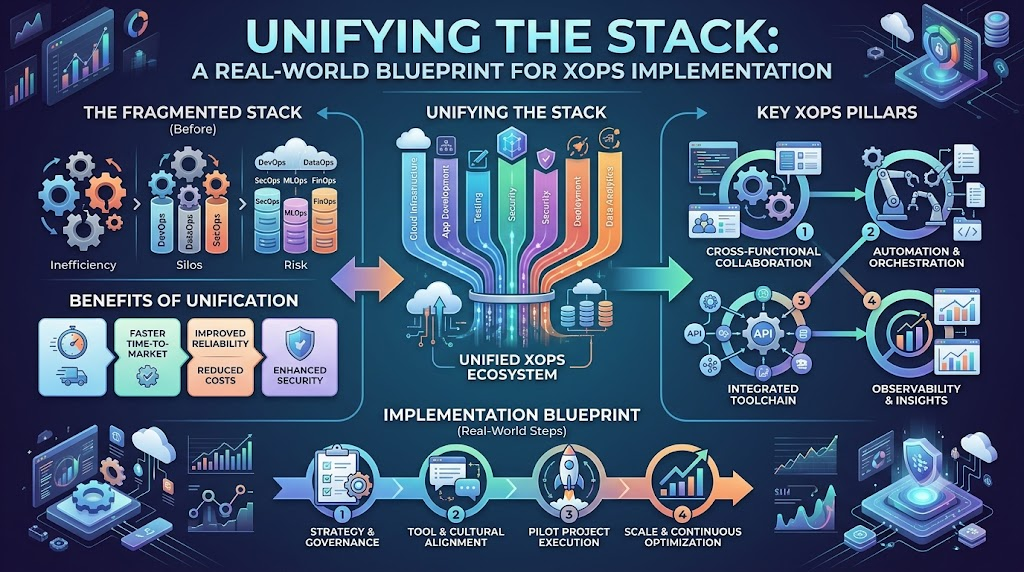
Modern engineering environments rarely handle software code in isolation. Production ecosystems now run distributed microservices alongside automated data pipelines, machine learning models, infrastructure platforms, and real-time security auditing. While DevOps laid the groundwork for automated software delivery, scaling separate pipelines for data engineering, model deployment, cloud spending, and threat monitoring creates operational silos. This operational fragmentation is where XOps enters the conversation. As an overarching umbrella framework, XOps unifies specialized operational disciplines—including DevOps, DataOps, MLOps, AIOps, SecOps, and FinOps—under a consistent foundation of automation, observability, and cross-functional governance. Understanding what XOps is and how its component disciplines interact is critical for organizations seeking to scale resilient digital infrastructure without exponential increases in operational overhead. For structured learning paths and certifications across these intersecting disciplines, resources like XOpsSchool provide detailed curricula to bridge these exact capability gaps.
What Is XOps?
XOps (Everything Operations) is an operational meta-framework that applies continuous integration, continuous delivery (CI/CD), infrastructure automation, and automated governance to every facet of technology operations. Rather than managing software development, data warehousing, artificial intelligence, security, and cloud expenditure through disconnected teams and disparate toolchains, XOps establishes standardized, repeatable operational patterns across the entire technology stack.
The term represents an evolution rather than a replacement of DevOps. While traditional DevOps centers on the bridge between software developers and IT operations, modern systems require specialized operational treatment for dynamic assets:
- Code releases (DevOps)
- Data pipelines and schema changes (DataOps)
- Non-deterministic machine learning models (MLOps)
- Automated telemetry analysis and remediation (AIOps)
- Continuous compliance and threat prevention (SecOps)
- Cloud cost optimization and budget accountability (FinOps)
Under an XOps model, these practices share unified interfaces, standard infrastructure provisioning tools, and consistent operational metrics.
How XOps Works: Core Workflow and Operational Lifecycle
The XOps operational lifecycle bridges software engineering, data ingestion, AI training, and production maintenance into four synchronized operational planes:
[ Code / Data / Models ]
           │
           ▼
┌───────────────────────────────────────────────────────────┐
│                 Continuous Pipeline Plane                 │
│      (CI/CD, Data Orchestration, Model Retraining)       │
└──────────────────────────┬────────────────────────────────┘
                           │
                           ▼
┌───────────────────────────────────────────────────────────┐
│                Platform & Foundation Plane                │
│    (IaC, Kubernetes, GitOps, Secure Runtime Enclaves)    │
└──────────────────────────┬────────────────────────────────┘
                           │
                           ▼
┌───────────────────────────────────────────────────────────┐
│              Observability & Analytics Plane              │
│       (Metrics, Logs, Traces, Telemetry, Drift AI)        │
└──────────────────────────┬────────────────────────────────┘
                           │
                           ▼
┌───────────────────────────────────────────────────────────┐
│              Feedback & Governance Feedback Loop          │
│       (Policy-as-Code, FinOps Audits, Incident SRE)       │
└───────────────────────────────────────────────────────────┘
- Continuous Pipeline Plane: Pipelines automate the validation of software commits, data schema transformations, and model artifact builds using declarative orchestration.
- Platform and Foundation Plane: Infrastructure as Code (IaC) tools configure unified compute platforms (primarily Kubernetes and managed cloud primitives) to ensure reproducible runtime environments for applications, analytics engines, and inference workloads.
- Observability and Analytics Plane: Distributed telemetry agents collect structured logs, open metrics, and execution traces via open standards (such as OpenTelemetry). AIOps engines ingest this stream to detect runtime anomalies, performance regressions, and pipeline bottlenecks.
- Governance and Feedback Loop: Policy engines execute continuous verification for security posture, license compliance, cloud consumption thresholds, and model drift, triggering automated rollbacks or platform scaling events.
The Core Disciplines of the XOps Ecosystem
To understand XOps in practice, operations teams must recognize the specific function and integration point of each operational discipline.
| XOps Discipline | Primary Asset Managed | Key Operational Goals | Core Technologies |
| DevOps | Application Source Code & Binaries | Shorten release cycles, automate testing, ensure deployment velocity | Git, Jenkins, GitHub Actions, Docker |
| DataOps | Data Ingestion, Schemas, & ETL/ELT | Guarantee data quality, automate data pipelines, reduce pipeline downtime | Apache Airflow, dbt, Apache Kafka, Snowflake |
| MLOps | ML Models, Datasets, & Hyperparameters | Manage model versioning, automate retraining, track inference performance | Kubeflow, MLflow, Feast, Triton |
| AIOps | System Telemetry, Alerts, & Event Logs | Noise reduction, root-cause analysis, proactive incident mitigation | Dynatrace, Datadog, BigPanda, Prometheus |
| SecOps | Vulnerabilities, Identity, & Policies | Shift-left security testing, automate compliance checks, secure runtimes | Trivy, HashiCorp Vault, OPA/Gatekeeper, SonarQube |
| FinOps | Cloud Spend, Resource Allocation, & Unit Costs | Financial accountability, rightsizing compute resources, cost visibility | Kubecost, AWS Cost Explorer, CloudHealth |
| Platform Engineering | Internal Developer Platforms (IDPs) | Standardize self-service environments, reduce developer cognitive load | Backstage, Terraform, Crossplane, Argo CD |
Real-World Use Case: The Autonomous Customer Recommendation Engine
To see how XOps works in production, consider an enterprise e-commerce platform running an AI-driven personal recommendation engine:
- DevOps provisions the microservice APIs hosting the recommendation endpoints, using automated GitHub Actions pipelines to deploy container updates to Amazon EKS clusters via Argo CD.
- DataOps orchestrates streaming Apache Kafka topics and automated dbt jobs that extract anonymized customer clickstreams, cleans the records, and writes reliable feature tables into Snowflake.
- MLOps triggers an automated retraining job in Kubeflow when new feature sets land, validates that the new model version outperforms baseline F1-scores, and automates canary deployments for inference servers.
- SecOps runs static code scans across the Python microservices, tests container images for Common Vulnerabilities and Exposures (CVEs) during the build, and enforces runtime access policies through Open Policy Agent (OPA).
- FinOps monitors cluster compute node utilization with Kubecost, ensuring inference pods run on cost-efficient Spot/preemptible instances with dynamic horizontal pod autoscaling.
- AIOps ingests Prometheus metrics across the clusters, automatically filtering out transient network noise and identifying database connection connection exhaustion before it results in customer latency spikes.
Without an XOps framework, these tasks exist in isolated functional teams, leading to delayed model rollouts, stale inference pipelines, unaccounted cloud spend, and unresolved cross-boundary production outages.
Benefits of an Integrated XOps Strategy
- Reduced Pipeline Fragmentation: Shared CI/CD design patterns eliminate the need to reinvent deployment and scheduling engines for every technical domain.
- Accelerated Time to Value: Data scientists, software engineers, and security analysts can leverage standardized platform self-service interfaces rather than submitting cross-departmental tickets.
- Predictable Operational Governance: Security scanning, cost tracking, and access controls are integrated directly into automated pipelines as code rather than evaluated manually at arbitrary intervals.
- Holistic Observability: Correlation engines connect infrastructure health metrics directly to data pipeline latency and model inference drift, reducing Mean Time to Resolution (MTTR).
Operational Challenges and Implementation Pitfalls
Adopting an integrated XOps model introduces structural and technical hurdles that teams must navigate deliberately:
- Organizational Resistance and Silos: Data engineers, machine learning researchers, and cloud infrastructure engineers often report to different leadership teams with conflicting operational KPIs. Unifying workflows requires cultural realignment alongside technical standardization.
- Tooling Fatigue and Over-Engineering: Teams often adopt complex orchestration suites before standardizing baseline requirements, resulting in brittle configurations and high maintenance burdens.
- The Skills Dilemma: Finding engineers fluent in traditional CI/CD patterns, distributed data warehousing, and GPU-driven model inference is challenging. Organizations must invest in upskilling their existing operations talent in adjacent domains.
Best Practices for Building an XOps Foundation
- Establish a Common Platform Engineering Layer: Build a centralized internal platform where developers, data engineers, and ML teams provision pre-configured, policy-compliant compute environments via declarative code.
- Adopt Declarative Configuration (GitOps): Store application manifests, data pipeline orchestration DAGs, and infrastructure definitions in version control to ensure auditability and automated state reconciliation.
- Shift Non-Functional Checks Left: Automate security scans, static code audits, and FinOps resource budget checks directly within the commit pull-request phase.
- Standardize on Open Telemetry Formats: Avoid proprietary agent lock-in by using open-source telemetry collectors that route log, metric, and trace streams to centralized analytical backends.
Frequently Asked Questions
What does XOps stand for?
XOps stands for “Everything Operations” or the convergence of specialized IT operational disciplines, including DevOps, DataOps, MLOps, AIOps, SecOps, and FinOps, into an integrated engineering framework.
How does XOps differ from traditional DevOps?
DevOps focuses primarily on accelerating the release and maintenance of traditional application code. XOps expands these principles to manage dynamic, non-code assets such as data pipelines, machine learning models, infrastructure spend, and automated security policies.
Is XOps a replacement for Platform Engineering?
No. Platform Engineering is an operational enabler of XOps. Platform engineering teams construct the self-service platforms and automated developer interfaces that operational teams use to execute XOps workflows efficiently.
Why is DataOps included within the XOps framework?
Data pipelines require automated testing, versioning, deployment, and monitoring similar to application software. DataOps integrates data ingestion, ETL/ELT transformations, and schema governance directly into automated operational lifecycles.
What role does AIOps play in an XOps ecosystem?
AIOps applies machine learning and automated analytics to real-time operations data, logs, and metrics. It filters out alert noise, identifies root causes across complex systems, and automates remediation actions to maintain reliability.
What tools are foundational to implementing XOps?
Core tooling typically centers on container orchestration (Kubernetes), Infrastructure as Code (Terraform, OpenTofu), continuous delivery controllers (Argo CD, GitLab CI/CD), and open telemetry frameworks (Prometheus, OpenTelemetry, Grafana).
How does SecOps integrate into XOps workflows?
SecOps ensures vulnerability scanning, compliance verification, and secrets management are automated within the CI/CD and deployment pipelines—shifting security validations left rather than checking them manually before production releases.
Does an organization need an entirely new team to manage XOps?
No. Rather than creating another operational silo, organizations typically establish platform engineering teams or center-of-excellence groups that provide standardized tooling, guidance, and pipelines to existing software, data, and operations engineers.
What is the biggest mistake companies make when adopting XOps?
The most frequent mistake is attempting to solve operational silos purely through tool acquisition without standardizing workflows, defining ownership boundaries, or aligning cross-functional incentives.
How can engineers build skills for an XOps career path?
Engineers should start with foundational Linux, networking, and Git workflows, master container orchestration with Kubernetes, learn at least one infrastructure automation tool (like Terraform), and study specialized tracks in data engineering pipelines or ML operational runtimes.
Conclusion
The modern enterprise technology stack has grown beyond the boundaries of traditional software releases. When organizations run mission-critical machine learning systems, terabyte-scale data pipelines, and distributed cloud applications, managing operations in isolated functional groups creates technical debt, operational blind spots, and delivery delays. XOps provides a structured roadmap out of these operational silos. By translating proven practices from continuous delivery and Infrastructure as Code into data operations, model management, security governance, and cloud economics, XOps builds resilient systems capable of rapid evolution. Rather than viewing DevOps, MLOps, and DataOps as separate operational paths, treating them as interconnected elements of a unified operations strategy establishes the foundation for sustainable technological scale.
