A factory checks 10,000 parts a day. One worker inspects each part for a few seconds. By hour seven, tired eyes start to miss small scratches they would have caught that morning.
This isn’t a fault of the worker. It’s simply how human attention works over long shifts. A robot, on the other hand, checks part number 10,000 the same way it checked part number one.
This is exactly why robots have become such a useful tool for quality control. Let’s look at how they actually help.
What Is Quality Control?
Quality control means checking products or processes to make sure they meet required standards.
Simple example: A factory making glass bottles checks each bottle for cracks, wrong shape, or missing labels before it ships out.
The goal is simple: catch problems before they reach the customer.
Why Quality Control Can Be Difficult
Quality control sounds simple, but it comes with real challenges.
- Large production volumes – Some factories produce thousands of items a day.
- Repetitive inspection work – Checking the same thing over and over gets tiring.
- Small defects – Tiny flaws can be easy to miss.
- Human fatigue – Long shifts naturally reduce focus.
- Different inspection results – Two people may judge the same part differently.
- Slow manual checks – Manual inspection takes time.
- Difficult inspection areas – Some spots are hard to reach or see clearly.
- Need for detailed records – Keeping accurate logs by hand is hard to maintain.
This doesn’t mean human workers can’t do quality checks well. It means robots can support people by handling repeated, precise inspection tasks.
How Robots Support Quality Control
Robots can help with several parts of the inspection process.
- Product inspection – Checking items for visible problems.
- Measurement – Confirming exact sizes or dimensions.
- Position checks – Making sure parts are placed correctly.
- Surface inspection – Looking for scratches, marks, or texture issues.
- Assembly checks – Confirming parts are put together correctly.
- Sorting – Separating good items from defective ones.
- Defect detection – Spotting flaws using cameras or sensors.
- Data collection – Recording inspection results for later review.
Each of these tasks benefits from a robot’s ability to repeat the same process precisely, again and again.
How Robot Accuracy Helps Quality Control
Robots can repeat programmed movements with high consistency.
Simple example: A robotic arm checks the same part at the exact same position, hundreds of times a day, without drifting from that position.
This repeatable movement helps create consistent inspection results. The robot doesn’t get tired or distracted partway through a shift.
That said, robots aren’t always perfectly accurate. Performance depends on the robot itself, its sensors, how well it’s calibrated, the environment it works in, and the software running it.
Role of Machine Vision in Robotic Inspection
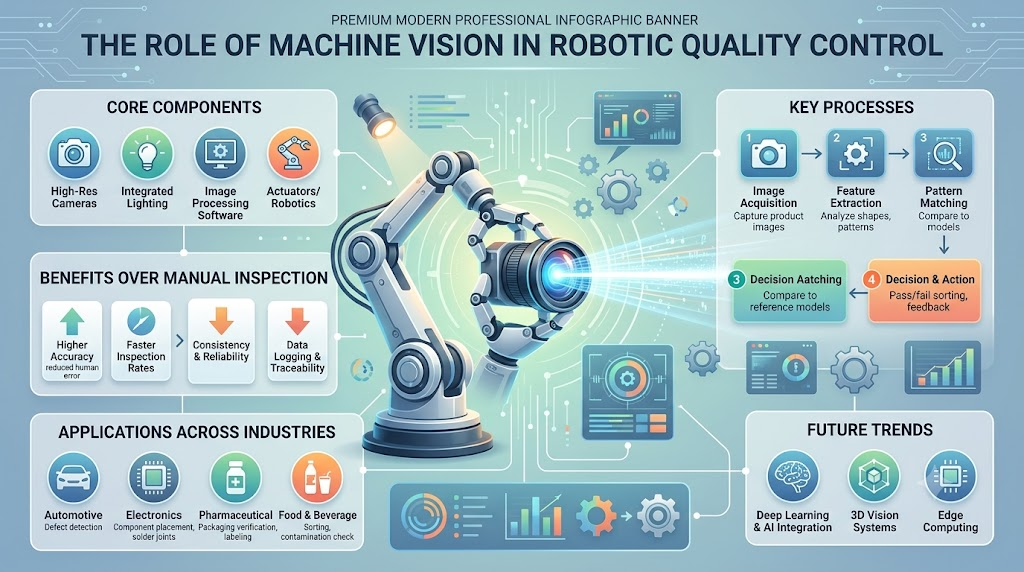
Machine vision means using cameras and image-processing software to let a robot “see” and check products.
A machine vision system can look for:
- Scratches
- Missing parts
- Wrong placement
- Shape differences
- Surface defects
- Color differences
- Product labels
Machine vision doesn’t work alone. It’s usually one part of a larger inspection system, working alongside sensors and robot movement to complete a full check.
Role of Sensors in Quality Control
Sensors give robots the information they need to check products properly.
- Cameras – Capture images for visual inspection.
- Force sensors – Measure pressure, useful for checking assembly fit.
- Distance sensors – Measure gaps or spacing.
- Position sensors – Confirm exact part location.
- Temperature sensors – Check for heat-related issues.
- Proximity sensors – Detect how close an object is.
RobotsOps content explains that sensor feedback helps robots compare actual movement with the expected result, so they can correct errors as they go. In simple terms, sensors act like the robot’s eyes and sense of touch.
Automated Defect Detection
Robots and automated systems can help catch defects as products move through production.
Simple example:
A camera checks every bottle on the line. It spots one bottle with a missing cap. The system flags this bottle and moves it away from the good products, before it ever reaches packaging.
This kind of step-by-step process, check, detect, separate, happens constantly and quickly, without needing a person to stop the line.
Robots and Consistent Inspection
Repeated inspection tasks benefit a lot from automation.
- Same movement, every time
- Same inspection path
- Same measurement process
- Repeatable checks
- Consistent data collection
This doesn’t mean robots remove every source of variation. Lighting changes, sensor wear, and calibration drift can all still affect results over time. But for repetitive tasks, robots offer a level of consistency that’s hard to match manually.
Robots and Human Quality Teams
Robots and people work best as a team, not as replacements for each other.
Robots can help with:
- Repetitive checks
- High-volume inspection
- Measurements
- Data collection
- Sorting
People can help with:
- Complex decisions
- Unusual defects
- Process improvement
- Final review
- System supervision
Robots handle the repetitive load well, while people bring judgment for situations robots aren’t built to handle.
Real-World Example: Robotic Quality Inspection
Here’s how a typical robotic inspection might work in a factory making metal parts.
A robot moves each part into an inspection position. A camera checks the surface for scratches or marks. A sensor confirms the part is positioned correctly. The system compares these results against expected values.
Parts that fail any check get separated from the good ones automatically. All inspection data gets saved, so the team can review patterns later.
This whole process can repeat thousands of times a day, with the same steps followed every time.
Quality Control in Different Industries
Robotic quality control shows up across many industries.
- Automotive – Checking parts and assembly accuracy.
- Electronics – Inspecting circuit boards and components.
- Food and packaging – Checking seals, labels, and fill levels.
- Pharmaceuticals – Verifying packaging and dosage accuracy.
- Warehouses – Checking items during sorting and packing.
- Metal manufacturing – Inspecting surfaces and dimensions.
Each industry applies these ideas a bit differently, based on what matters most for their products.
How Robot Data Helps Quality Control
Robots don’t just inspect products, they also collect useful data along the way.
This data can include:
- Inspection results
- Defect counts
- Measurement values
- Cycle times
- Sensor readings
- Error events
- Production records
Teams can review this data over time to spot repeated quality problems, like a certain machine causing the same defect again and again.
RobotOps and Quality Control
RobotOps connects directly to how well robotic quality control actually works.
RobotsOps describes RobotOps as applying DevOps-style practices to robot development, deployment, monitoring, and maintenance. In simple terms, it’s about managing the software and systems behind robots properly.
RobotOps supports quality control through:
- Robot monitoring
- Telemetry, meaning data sent back from the robot about its status
- Software testing
- Simulation
- Version control for robot software
- Deployment checks before changes go live
- Incident tracking
- Maintenance records
Without solid RobotOps practices, even a well-designed inspection robot can produce unreliable results over time.
Monitoring Robot Performance
Teams should keep a close eye on robots used for quality checks.
Useful things to track include:
- Robot status
- Sensor health
- Inspection errors
- Cycle time
- Position accuracy
- Failed jobs
- Software errors
- Maintenance needs
RobotsOps content also highlights telemetry, monitoring dashboards, alerts, and anomaly detection as important parts of keeping robotic systems running well.
Testing Robotic Quality Control Systems
Robotic inspection systems need regular testing, just like any other software or hardware system.
This includes:
- Software testing
- Sensor testing
- Simulation testing
- Inspection rule testing
- Hardware testing
- Real-world validation
Updates should be tested before wider deployment, not rolled out directly to a full production line. RobotsOps describes simulation and automated testing as useful parts of robotics CI/CD workflows, helping teams catch problems before they affect real products.
Benefits of Robots for Quality Control
- Consistent inspection – The same process, run the same way, every time.
- Faster checks – Robots can inspect much faster than manual review.
- Repeatable measurements – Less variation between checks.
- Early defect detection – Problems get caught sooner in the process.
- Better inspection records – Data gets logged automatically.
- Less repetitive manual work – Frees people for more complex tasks.
- Better production data – More detailed records over time.
- Support for high-volume inspection – Handles large volumes without fatigue.
These are real, practical benefits, though they don’t add up to perfect quality control.
Limitations of Robotic Quality Control
Robotic systems come with real challenges too.
- High setup cost – Initial investment can be significant.
- Sensor limits – Sensors can only detect what they’re designed to detect.
- Calibration needs – Systems need regular calibration to stay accurate.
- Lighting problems for vision systems – Poor lighting can affect camera results.
- Software errors – Bugs can cause missed or wrong detections.
- Maintenance needs – Robots and sensors need upkeep over time.
- Difficult defects – Some flaws are hard for automated systems to catch.
- Changing product designs – New products may need system updates.
- Need for human review – Complex or unusual cases still need people.
Robots improve quality control best when the full system, hardware, software, and process, is designed and maintained well.
Best Practices for Robotic Quality Control
- Define clear inspection rules. Know exactly what counts as a defect.
- Choose suitable sensors. Match sensors to the specific task.
- Calibrate the system regularly. Keep accuracy consistent over time.
- Test the robot before production use. Catch issues before they affect real products.
- Use simulation where useful. Test scenarios safely before going live.
- Monitor inspection results. Watch for patterns and unusual changes.
- Track repeated defects. Use data to find root causes.
- Keep software updated in a controlled way. Avoid untested changes on live systems.
- Maintain the robot and sensors. Regular upkeep prevents accuracy drift.
- Keep human review for difficult cases. Let people handle what robots can’t judge well.
Robots vs Manual Quality Inspection
| Area | Manual Inspection | Robotic Inspection |
|---|---|---|
| Repeated tasks | Can become tiring over time | Handles repetition consistently |
| Inspection speed | Limited by human pace | Generally faster |
| Consistency | Can vary between people or shifts | Generally more consistent |
| Data collection | Often manual, can be incomplete | Usually automatic and detailed |
| Complex decisions | Strong at judgment calls | Limited to programmed rules |
| Human involvement | Fully human-driven | Still needs human oversight |
| Best use | Complex, unusual, or judgment-based checks | High-volume, repetitive checks |
Common Mistakes to Avoid
- Using poor-quality sensors – Cutting corners here affects every result.
- Skipping calibration – Leads to drifting accuracy over time.
- Ignoring lighting conditions – Can seriously affect vision-based checks.
- Not testing software changes – Risky updates can cause missed defects.
- Ignoring inspection data – Missing chances to spot recurring problems.
- Creating too many false defect alerts – Leads to wasted time and distrust in the system.
- Not maintaining the robot – Increases the risk of errors and downtime.
- Expecting robots to handle every type of defect – Some issues still need human judgment.
Future of Robotic Quality Control
Robotic quality control is likely to keep improving in several areas.
- Better machine vision accuracy
- Wider use of sensors
- AI-assisted inspection support
- Richer robot data
- Digital twins, meaning virtual copies of physical systems for testing
- More automated testing
- Remote monitoring capabilities
- Stronger RobotOps workflows overall
These improvements should make robotic inspection more capable over time, though human oversight will likely remain an important part of the process.
FAQs
1. How do robots improve quality control?
Robots inspect products consistently, repeat the same checks precisely, and collect detailed data that helps teams catch and track defects.
2. Can robots detect product defects?
Yes, using cameras, sensors, and inspection software, robots can detect defects like scratches, missing parts, or wrong measurements.
3. How does machine vision help robots inspect products?
Machine vision lets robots use cameras and image-processing software to check for visual defects, like surface marks or wrong placement.
4. What sensors are commonly used for robotic inspection?
Common sensors include cameras, force sensors, distance sensors, position sensors, and proximity sensors.
5. Can robots improve inspection consistency?
Yes, robots repeat the same inspection movements and checks precisely, which helps reduce variation between inspections.
6. Can robots fully replace human quality inspectors?
No, robots handle repetitive and high-volume checks well, but people are still needed for complex decisions and unusual cases.
7. How does RobotOps support quality control?
RobotOps manages the software, monitoring, testing, and maintenance behind robotic systems, helping keep inspection results reliable.
8. Why is robot calibration important for quality control?
Without regular calibration, a robot’s accuracy can drift over time, leading to unreliable inspection results.
9. What are the main challenges of robotic quality inspection?
Challenges include setup cost, sensor limits, calibration needs, lighting issues, and the need for ongoing maintenance.
10. Which industries use robots for quality control?
Industries like automotive, electronics, food and packaging, pharmaceuticals, and metal manufacturing commonly use robotic inspection.
Conclusion
Robots bring real value to quality control by handling repetitive inspection tasks with steady precision. They can check products faster, collect detailed data, and catch defects that might slip past a tired eye late in a shift.
That said, robots work best as part of a well-maintained system, alongside skilled people who handle the complex cases robots aren’t built for. Quality control still needs both, robots for consistency and speed, and people for judgment and oversight.
