Introduction
Robotics automation is transforming modern industries by solving some of the biggest operational challenges. Companies worldwide face persistent labor shortages, rising operational costs, and increasing demands for faster production. Intelligent machinery bridges these gaps, allowing businesses to scale operations while maintaining unmatched quality standards. In this comprehensive guide, you will learn everything you need to know about designing, deploying, and managing advanced operational pipelines. We will break down complex mechanical concepts into simple terms, explore real-world industrial applications, and analyze the software systems that orchestrate these mechanical marvels. Whether you are an aspiring automation engineer, a business owner looking to scale, or a technology enthusiast, understanding these systems is key to navigating the future of work. To help you get started on this technological journey, platforms like RobotsOps.com provide deep insights, practical tutorials, and expert resources to master the world of automated physical systems.
Understanding Robotic Automation Workflows
What is Robotic Automation?
At its core, robotic automation is the practice of using programmable physical machines to execute specific tasks that were previously performed by humans. Unlike software-only automation, which handles digital data inside a computer, robotics interacts directly with the physical world.
These systems use a combination of structural hardware, electrical power, and digital logic to manipulate objects, navigate environments, and perform complex physical processes. The ultimate goal is to create a self-sustaining cycle where machines perform predictable physical actions with minimal human intervention.
Evolution of Robotics in Modern Industries
The journey of industrial machinery began decades ago with massive, single-purpose mechanical arms. These early machines were bolted to factory floors, surrounded by heavy safety cages, and programmed to repeat one exact motion millions of times, such as welding a specific car door joint.
As computer processing power exploded and sensor technologies advanced, machines evolved from blind, rigid tools into highly adaptable, intelligent assets. Today, modern industrial robotics incorporates advanced vision systems, machine learning algorithms, and spatial awareness. This allows machines to work safely alongside humans, adapt to changing environments, and switch between completely different tasks with a simple software update.
Difference Between Manual Processes and Robotic Workflows
To truly appreciate the value of automation, it helps to compare traditional manual operations with modern automated sequences.
| Operational Feature | Manual Processes | Robotic Workflows |
| Consistency | Variables like fatigue, distraction, and physical strain cause output quality to fluctuate over an eight-hour shift. | Operating parameters remain identical whether it is the first cycle of the day or the thousandth. |
| Operational Speed | Restricted by natural human physical limitations and mandatory safety thresholds. | Optimized to run at maximum mechanical thresholds without stopping for breaks. |
| Data Collection | Relies on manual logging, which is prone to administrative errors, gaps, and delays. | Built-in sensors automatically capture precise operational metrics in real time. |
| Safety Risks | Humans face injury risks when handling toxic chemicals, extreme heat, or heavy loads. | Specialized machinery safely executes dangerous tasks, protecting human operators. |
Importance of Workflow Automation
Workflow automation matters because it acts as the connective tissue between isolated machines and broader business objectives. A standalone machine is only as useful as the instructions it receives.
By designing integrated operational pipelines, businesses ensure that every piece of equipment on the factory floor works in perfect harmony with inventory databases, safety systems, and quality control protocols. This holistic integration maximizes asset utilization, eliminates production bottlenecks, and allows companies to respond instantly to changing market demands.
Core Components of Robotic Automation Workflows
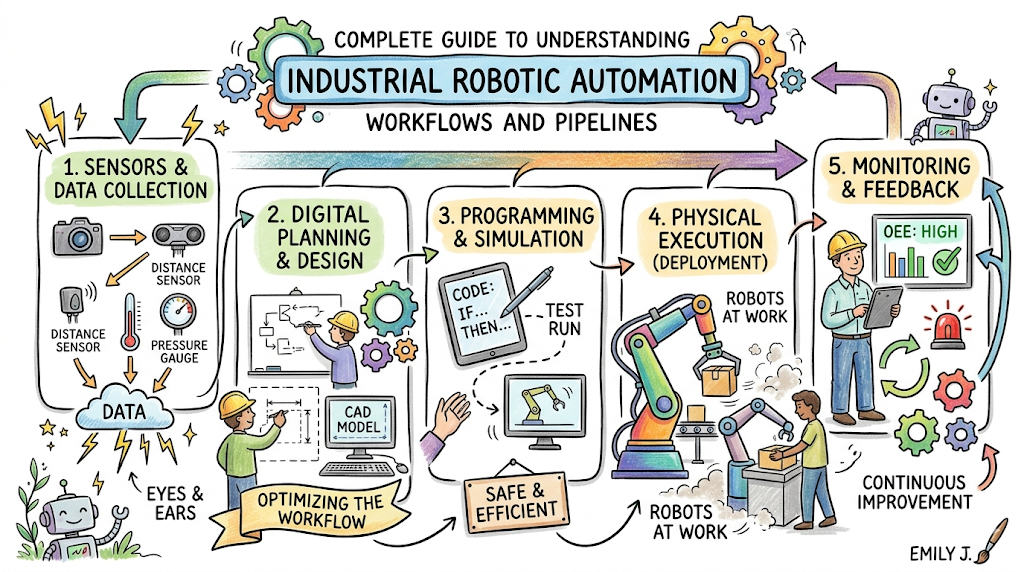
Sensors and Data Collection
Sensors act as the eyes, ears, and fingertips of an automated machine. Without them, a mechanical arm would move blindly, risking damage to itself and surrounding materials.
Modern systems utilize a vast array of digital sensors to gather environmental data. High-resolution cameras and LiDAR systems provide spatial vision, allowing machines to recognize object shapes and depths. Proximity sensors detect when an object is nearby, while force-torque sensors allow a mechanical gripper to hold a fragile egg without crushing it. These sensors constantly stream raw physical data back to the central processing unit.
Robotic Controllers
If sensors are the eyes of the machine, the controller is the brain. Typically housed in a rugged industrial enclosure, the controller is a specialized computer that runs the machine’s operating system and control software.
The controller receives digital signals from the sensors, processes that data using pre-programmed logic, and sends precise electrical commands to the machine’s actuators and motors. It calculates exactly how much electrical current to send to a motor to move an arm a fraction of a millimeter, ensuring smooth and accurate physical trajectories.
Workflow Orchestration
An orchestration system is the master conductor of an automated facility. In a complex environment like a smart factory, you rarely have just one machine working in isolation. You might have ten mechanical arms, five mobile transport units, and three automated conveyor belts working together.
The workflow orchestration software coordinates these distinct assets. It ensures that the conveyor belt stops when a mobile unit arrives, and tells the mechanical arm exactly when to pick up a product, preventing costly collisions and operational delays.
Artificial Intelligence and Decision-Making
Artificial Intelligence (AI) elevates traditional machinery by introducing adaptive decision-making capabilities. Historically, if a part arrived on a conveyor belt upside down, a standard machine would fail or jam.
With AI-driven automation, the system uses computer vision to detect the incorrect orientation, analyze the situation, and alter its grip pattern in real time to correct the mistake. Machine learning models also allow systems to learn from past experiences, continuously optimizing their paths to save time and energy.
Monitoring and Optimization Systems
To keep a complex operational pipeline running smoothly, operators require deep visibility into performance metrics. Monitoring systems collect real-time data on machine health, cycle times, and error rates.
This data is fed into centralized dashboards where engineers can track performance. Advanced optimization software analyzes these data streams to find hidden inefficiencies, such as a micro-delay in a mechanical joint, allowing teams to fine-tune software parameters for maximum output.
How Robotic Automation Workflows Operate
Task Identification
The operational pipeline always begins with identifying a specific physical task that needs to be performed. This involves breaking down a larger business objective into discrete, programmable steps.
Example: An e-commerce company may use robotic systems to speed up packaging and shipment operations. The specific task identified is picking a product out of a storage bin and placing it safely into a shipping box.
Process Automation
Once the task is clearly defined, engineers translate those physical actions into digital code. This step establishes the primary automation sequence, programming the machine’s default movements, speed profiles, and handling instructions.
Example: A warehouse robot can automatically scan inventory and transport products without human intervention. The system references the barcode data to confirm it has captured the correct item before moving forward.
Workflow Coordination
With the individual task programmed, the machine must now be integrated into the broader operational ecosystem. This step connects the machine’s internal software with external equipment and central databases.
Example: Imagine a factory assembly line where robotic arms perform repetitive tasks continuously with high precision. The arm must sync its movements perfectly with a moving conveyor line, waiting for a sensor signal that confirms a new chassis has arrived in front of it.
Data Processing and Decision Execution
As the machine executes its automated tasks, it constantly processes incoming data streams to make real-time operational adjustments. This step ensures the machine can handle slight variations in its environment without stopping the entire production line.
Example: For instance, robotic automation workflows can help healthcare systems organize medicine delivery efficiently. If a delivery machine encounters an unexpected obstacle like a cleaning cart in a hospital hallway, its internal computer processes the lidar data and calculates an alternate route in real time.
Continuous Monitoring and Improvement
The final phase of the workflow is an ongoing loop of analysis and optimization. The system continuously logs its performance metrics, allowing operators to identify long-term trends and implement improvements. Through platforms like RobotsOps.com, teams can learn how to set up continuous data feedback loops that flag mechanical wear before it causes an unexpected breakdown.
Types of Robotic Automation Systems
Industrial Robotics
Industrial robots are the heavy-duty workhorses of the automation world. These systems include massive articulated arms, delta robots for high-speed picking, and gantry systems for moving heavy payloads. They are engineered for high speed, extreme precision, and heavy lifting. Because they move with immense force, they typically operate inside designated safety enclosures to protect human workers from accidental contact.
Collaborative Robots (Cobots)
Collaborative robots, or cobots, represent a major shift in workplace design. Unlike traditional industrial machines, cobots are designed with built-in safety sensors, rounded edges, and force-limiting mechanisms.
If a cobot makes contact with a human worker, it immediately halts its movement without causing injury. This allows humans and machines to work side by side in shared spaces, combining human problem-solving skills with mechanical consistency.
Autonomous Mobile Robots (AMRs)
Autonomous Mobile Robots are self-navigating vehicles that move freely through dynamic environments. Unlike older Automated Guided Vehicles (AGVs) that require magnetic strips or wires embedded in the floor, AMRs use onboard cameras, LiDAR, and digital maps to navigate around unexpected obstacles. They are widely used in logistics and warehousing to transport goods across massive facilities efficiently.
AI-Powered Robotics
AI-powered systems integrate advanced machine learning models directly into mechanical operations. These systems excel at handling high variability, such as sorting mixed recycling streams or picking randomly piled parts out of a deep bin. By analyzing visual data in real time, AI-powered machines learn to adapt to unpredictable shapes, orientations, and materials, making decisions on the fly.
Cloud-Based Robotic Systems
Cloud-based systems offload heavy computational tasks from the local machine controller to powerful remote servers. This architecture allows multiple machines across different global facilities to share a centralized intelligence pool. When one machine in a facility learns a more efficient way to perform a task, that software update can be deployed instantly to every other connected machine in the network.
Real-World Applications of Robotic Automation
Manufacturing and Assembly Lines
The manufacturing sector remains a primary adopter of advanced automation pipelines. In modern automotive plants, mechanical arms perform highly precise welding, spot painting, and windshield installations. By automating these heavy, repetitive steps, manufacturers can produce vehicles at incredible speeds while ensuring every single weld meets exact structural safety standards.
Warehouse and Logistics Automation
E-commerce fulfillment centers rely heavily on coordinated mobile fleets to meet rapid shipping deadlines. When a customer places an order online, an AMR can automatically navigate to the correct shelf, lift the inventory pod, and bring it directly to a human packing station. This eliminates miles of walking for warehouse staff, drastically speeds up order fulfillment times, and reduces picking errors.
Healthcare Robotics
In the healthcare industry, automated workflows improve patient care and streamline administrative tasks. Specialized robotic systems sort, package, and track medications in hospital pharmacies, minimizing the risk of prescription errors. Additionally, mobile disinfection robots use UV-C light to sanitize operating rooms autonomously, ensuring hospital environments are thoroughly decontaminated.
Retail and E-Commerce Automation
Retailers use automation to manage inventory and improve customer service. Automated storage and retrieval systems (ASRS) allow grocery hubs to pack online orders in record time. In retail stores, small scanning robots patrol aisles after hours, detecting out-of-stock items and misplaced products to ensure inventory data remains perfectly accurate.
Smart Factory Operations
In a fully integrated smart factory, every stage of production is interconnected through an intelligent ecosystem. Raw materials are received by autonomous forklifts, processed by AI-driven machining centers, and packaged by collaborative systems. All these assets share data continuously, allowing the entire facility to automatically adjust production speeds based on real-time supply chain updates.
Benefits of Robotic Automation Workflows
Improved Operational Efficiency
Automated machinery can run continuously without experiencing fatigue, distractions, or drops in performance. This predictable consistency allows management to forecast production volumes with extreme accuracy. By eliminating operational variations and unnecessary micro-delays, businesses can significantly increase their total daily throughput.
Reduced Human Error
Even the most highly trained human operators will occasionally make mistakes due to exhaustion or repetitive stress. Automated systems execute their instructions identically every single time, down to the micrometer. This high precision reduces material waste, eliminates costly product reworks, and ensures that every finished item meets strict quality control standards.
Faster Task Execution
Mechanical actuators move at velocities that humans simply cannot match safely. Whether it is a high-speed delta robot sorting thousands of small food products per minute or an automated welding arm fusing metal components in seconds, automated workflows accelerate production cycles, helping companies hit aggressive market deadlines.
Enhanced Scalability
When a business experiences a sudden spike in demand, scaling a manual workforce requires time-consuming hiring, onboarding, and training processes. With an automated pipeline, scaling up often requires adjusting software parameters or running existing equipment for extra shifts. If physical expansion is necessary, duplicating a proven, pre-configured automated cell is far faster than building a manual team from scratch.
Better Safety and Reliability
By assigning dangerous, ergonomically straining, and hazardous tasks to specialized machinery, companies significantly reduce workplace injuries. Machines safely handle extreme temperatures, heavy lifting, and toxic environments. This creates a safer overall workplace, protects valuable human capital, and lowers corporate insurance and compliance costs.
Cost Optimization
While the upfront investment in automated machinery can be substantial, the long-term cost benefits are clear. Automated workflows lower total operational costs by minimizing product scrap, reducing energy waste through optimized paths, and lowering labor expenses. Over time, these operational savings deliver a clear return on investment, making businesses far more competitive.
Common Challenges in Robotic Automation
High Initial Investment
The initial capital required to purchase mechanical hardware, license orchestration software, and hire specialized integration engineers can be a significant hurdle for small to medium-sized enterprises. Companies must carefully analyze their long-term operational savings to justify these upfront costs and calculate an accurate return on investment.
Integration Complexity
Integrating new machinery into an existing facility is rarely as simple as plugging it in. Legacy factory equipment often uses older communication protocols that do not easily interface with modern internet-of-things (IoT) sensors or cloud platforms. Overcoming these compatibility gaps requires skilled integration specialists who understand both old-school industrial wiring and modern digital software.
Maintenance and Downtime
Automated systems are complex electro-mechanical assemblies subject to physical wear and tear. If a critical component breaks unexpectedly, an entire production line can grind to a halt, costing thousands of dollars per minute. To prevent this, businesses must shift from reactive maintenance to proactive, data-driven preventative upkeep strategies.
Security and Safety Risks
As industrial equipment becomes increasingly connected to local networks and the cloud, it becomes vulnerable to digital security threats. A malicious network intrusion could compromise sensitive production data or disrupt physical operations. Furthermore, if safety software is poorly configured, fast-moving hardware can pose real physical risks to nearby personnel.
Workforce Adaptation Challenges
Introducing automation can cause anxiety among existing staff who may worry about job displacement. If workers do not understand or trust the new technology, they may resist using it, leading to poor adoption rates. Companies must proactively invest in retraining programs to help their workforce transition into higher-value roles, such as automation supervisors and maintenance technicians.
Best Practices for Implementing Robotic Automation
Start with Repetitive Processes
When introducing automation to a facility, avoid trying to automate your most complex process first. Instead, look for the lowest-hanging fruit: tasks that are highly repetitive, manual, and predictable.
Automating a simple packing or sorting station allows your internal team to build confidence, learn the software interfaces, and secure an early operational win before tackling more complex production lines.
Build Scalable Automation Pipelines
Always design your hardware layout and software architecture with future growth in mind. Choose modular software frameworks and flexible orchestration platforms that can easily accommodate additional machines later on. This prevents you from getting locked into a rigid, dead-end configuration when your business needs to scale up production down the road.
Monitor Robotic Performance
Do not treat automation as a set-it-and-forget-it solution. Implement robust monitoring dashboards to track key performance indicators (KPIs) like overall equipment effectiveness (OEE), average cycle times, and error logs. Consistently reviewing this data helps engineering teams identify subtle operational drift and fine-tune system configurations for optimal performance.
Improve Human-Robot Collaboration
To get the most out of your investment, design your workspace to maximize collaboration between human workers and automated assets. Clearly define safe operational zones, deploy collaborative cobots where direct interaction is necessary, and ensure that human operators receive comprehensive training on how to interface with the machinery safely and effectively.
Continuously Optimize Workflows
Treat your automated pipeline as a living, evolving ecosystem. As your products change and software algorithms improve, revisit your automated sequences. Periodically updating your machine paths, upgrading your vision models, and refining your orchestration logic ensures your system remains as fast, efficient, and cost-effective as possible.
Robotic Automation vs Traditional Workflows
To evaluate whether an operational upgrade is justified, it is helpful to look at a direct performance comparison between traditional human-centric methods and automated workflows across key operational criteria.
Speed and Accuracy
Traditional methods are bound by human physical limits and fatigue, which naturally causes processing speeds to vary throughout the day. Automated sequences execute commands at consistently high speeds with sub-millimeter precision. This drastically reduces the number of defective products that end up in the scrap bin.
Manual Labor vs Intelligent Automation
Manual workflows require significant human effort for repetitive, physically exhausting tasks, which increases the risk of workplace injuries and high staff turnover. Intelligent automation reallocates these tedious duties to robust machines. This frees up human workers to focus on complex responsibilities like quality auditing, strategic planning, and system maintenance.
Scalability Differences
Scaling up a traditional manual operation requires significant time and money to hire, vet, and train new employees. In contrast, scaling an automated framework can often be achieved by modifying software instructions, running existing hardware for longer hours, or deploying pre-configured modular machine cells across the facility floor.
Monitoring and Optimization
In traditional settings, tracking operational performance relies on workers manually writing down numbers or filling out spreadsheets, which often introduces errors and delays. Automated setups collect rich data right at the source. Built-in sensors automatically log every single move, error code, and completed cycle in real time, giving managers the precise insights they need to optimize the line.
Operational Efficiency Comparison
| Metric | Traditional Workflows | Automated Workflows |
| Operational Hours | Limited by standard shifts and mandatory break times. | Capable of true 24/7 continuous operation. |
| Defect Rates | Higher variability due to human fatigue and oversight. | Low, highly controlled defect rates. |
| Data Visibility | Delayed, periodic, and prone to logging mistakes. | Instantaneous, transparent digital tracking. |
| Response to Change | Requires widespread employee retraining sessions. | Handled via rapid, centralized software updates. |
Essential Technologies Supporting Robotic Automation
Artificial Intelligence and Machine Learning
Artificial Intelligence and Machine Learning provide the advanced logic required for modern intelligent automation. Machine learning models can analyze thousands of historical production cycles to accurately predict when a mechanical part is likely to fail, allowing teams to perform maintenance before an unexpected breakdown occurs. AI also powers deep computer vision models, giving machines the ability to recognize, sort, and handle irregular objects.
IoT and Smart Sensors
The Industrial Internet of Things (IIoT) connects individual physical machines to a broader digital network. Smart sensors mounted on a machine can monitor factors like operational temperatures, vibration frequencies, and power consumption. This continuous streams of data give engineers an incredibly detailed view of factory-floor health and efficiency.
Cloud Computing
Cloud computing provides the scalable data storage and massive processing power needed to manage enterprise-wide automation networks. By hosting orchestration software and analytics engines in the cloud, companies can easily manage multiple facilities from a single dashboard. This centralized approach makes it easy to roll out system updates and share operational insights globally.
Edge Computing
While the cloud is great for long-term data analysis, some decisions must be made in milliseconds. Edge computing solves this by processing data directly on or near the local machine instead of sending it to a distant server. This ultra-low latency data processing is essential for time-sensitive tasks, such as triggering an emergency stop when a safety sensor detects an obstacle.
Workflow Automation Platforms
Workflow automation platforms provide the intuitive software interfaces that engineers and managers use to control automated environments. These platforms connect different hardware components, database systems, and enterprise resource planning (ERP) software into a single user-friendly system, making it much simpler to build, monitor, and adjust complex production pipelines.
Career Opportunities in Robotics Automation
Skills Required for Robotics Professionals
To build a successful career in this booming field, professionals need a balanced mix of hardware and software skills. On the technical side, it is crucial to understand core programming concepts, industrial communication networks, and electrical schematics. Additionally, soft skills like analytical thinking, methodical problem-solving, and clear communication are essential for diagnosing complex system errors and collaborating with cross-functional teams.
Popular Career Roles
The rapid growth of industrial technology has created a variety of rewarding career paths:
- Automation Systems Integrator: Focuses on connecting different hardware and software systems to work together smoothly.
- Robotics Software Engineer: Develops the core code, computer vision algorithms, and navigation logic that drive intelligent machines.
- Industrial Maintenance Technician: Diagnoses, services, and repairs physical machine components to ensure maximum operational uptime.
- Workflow Optimization Specialist: Analyzes operational data streams to find and eliminate production bottlenecks.
Certifications and Learning Resources
Earning recognized industry certifications is an excellent way to stand out in the job market. Programs focused on Programmable Logic Controllers (PLCs), the Robot Operating System (ROS), and specialized industrial safety standards are highly valued by employers. Taking structured online courses and participating in hands-on technical bootcamps can also help you quickly build the practical skills needed for real-world roles.
Learning Opportunities from RobotsOps.com
If you want to accelerate your professional journey, RobotsOps.com offers an invaluable hub of educational content. The platform provides beginner-friendly breakdowns of complex orchestration software, practical guides on setting up data collection loops, and expert insights into real-world industrial best practices. Leveraging these resources helps aspiring professionals stay ahead of industry trends and master modern automated pipelines.
Future of Robotic Automation Workflows
AI-Driven Robotics
The future of industrial technology is deeply tied to advanced artificial intelligence. Next-generation systems will feature true self-learning capabilities, allowing machines to independently figure out how to handle new tasks without requiring manual programming. These systems will continuously optimize their own motion paths and operational logic, reaching unprecedented levels of efficiency.
Autonomous Industrial Systems
We are moving away from isolated machines toward fully autonomous industrial ecosystems. Future facilities will operate as highly coordinated networks where every asset communicates and collaborates automatically. If a delivery truck gets delayed by traffic, the warehouse scheduling software will instantly re-route internal mobile fleets to prioritize other tasks, minimizing lost time.
Smart Warehouses and Logistics
Logistics networks will continue to push the boundaries of automation. Future smart warehouses will feature dense, three-dimensional storage frameworks where autonomous systems handle products flawlessly from arrival to final dispatch. These facilities will run with incredible spatial efficiency, using advanced AI models to predict local demand and automatically rearrange inventory ahead of time.
Human-Robot Collaboration
The relationship between humans and machines will grow even closer and more intuitive. Future collaborative environments will move beyond simple proximity safety sensors. Advanced systems will use natural language processing and gesture recognition, allowing human supervisors to direct complex mechanical assets as easily as they would a coworker.
Future Intelligent Operations
Ultimately, the evolution of automated systems will lead to completely self-optimizing operational pipelines. These highly resilient networks will monitor their own physical wear, reconfigure their workflows to route around broken components, and automatically order their own replacement parts. This extreme level of reliability will allow businesses to run highly efficient, uninterrupted global operations.
FAQ Section
- What is the difference between hardware robotics and software automation (RPA)?
Hardware robotics involves programmable physical machines that interact directly with the real world to move objects, assemble products, or navigate spaces. Robotic Process Automation (RPA), on the other hand, is entirely software-based. RPA uses software “bots” to automate repetitive digital tasks inside a computer, such as copying data between spreadsheets, filling out forms, or processing invoices.
2. How much technical experience do I need to start learning about automation workflows?
You do not need a degree in advanced engineering to start learning. Modern industry tools are becoming much more user-friendly, featuring intuitive visual programming interfaces and drag-and-drop workflow platforms. Having a basic understanding of computer logic, a curious mindset, and a willingness to learn step-by-step will give you a fantastic foundation for mastering automated pipelines.
3. Can small businesses afford to implement robotic automation workflows?
Yes, automation is no longer just for massive corporations. Thanks to the rise of modular collaborative robots (cobots), affordable smart sensors, and flexible software-as-a-service (SaaS) orchestration tools, small businesses can easily implement cost-effective automation. Starting with a single small, high-impact automated cell allows smaller companies to scale up gradually as they grow.
4. What are the primary safety protocols for industrial robotic workflows?
Safety relies on a multi-layered approach. Traditional high-speed industrial robots use physical cages, light curtains, and safety pressure mats to stop all movement the moment a human enters the work area. Modern cobots feature built-in force-limiting sensors and vision systems that allow them to automatically slow down or stop if they sense a human worker nearby.
5. How does cloud computing improve the management of automated machines?
Cloud computing connects isolated machines into a single, cohesive global network. It allows businesses to collect data from multiple facilities, run deep performance analysis on powerful remote servers, and deploy software updates instantly across all connected hardware. This centralized control makes it simple to maintain high operational standards across different global locations.
6. What is the best way to transition my current manual workforce into automated operations?
The most successful transitions focus heavily on clear communication and proactive retraining programs. Introduce automation as a helpful tool that eliminates dangerous, exhausting tasks rather than as something intended to replace workers. Investing in upskilling programs empowers your team to step into higher-value roles, such as system operators, quality inspectors, and automation maintenance technicians.
Conclusion
The rapid rise of intelligent robotic automation workflows marks a major turning point in how global industries operate. As we have explored in this guide, modern automation is far more than just deploying standalone mechanical arms. True digital transformation happens when you connect smart sensors, powerful controllers, and advanced AI into a single, seamless operational pipeline.
While making the transition to automated systems comes with clear challenges—like upfront costs and integration hurdles—the long-term rewards are undeniable. Businesses that embrace automated workflows enjoy unmatched operational efficiency, rock-solid quality control, safer workplaces, and the ability to scale up seamlessly.
