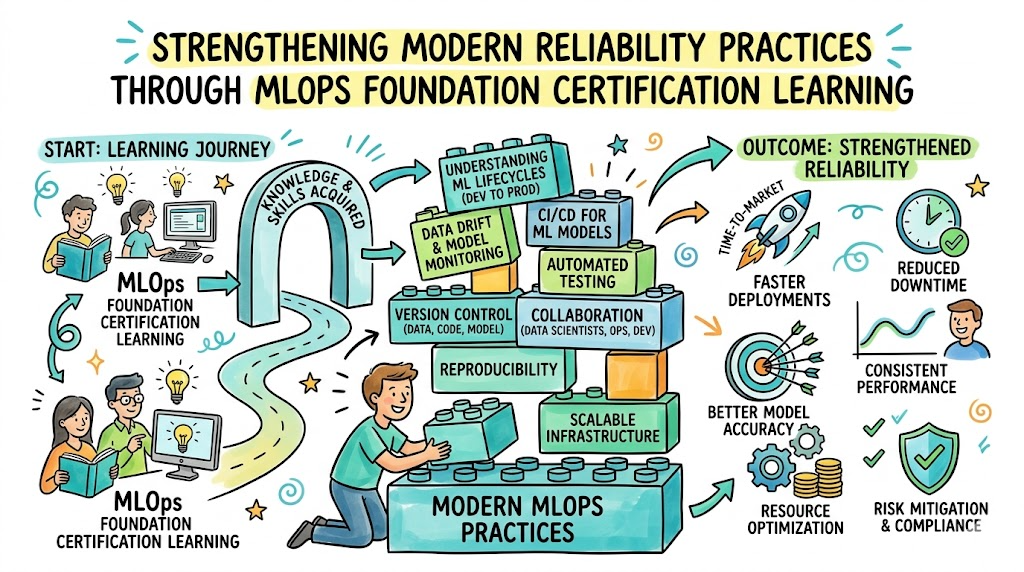
Introduction
The MLOps Foundation Certification is a transformative milestone for engineering professionals who are ready to bridge the gap between experimental data science and production-grade software engineering. As machine learning models move from isolated notebooks to large-scale enterprise applications, the industry requires a standardized approach to manage the entire lifecycle of these assets. This guide is designed for DevOps engineers, SREs, and platform architects who want to apply rigorous operational principles to the world of artificial intelligence. By exploring the curriculum and objectives provided by Aiopsschool, professionals can make informed decisions about their career trajectory and technical upskilling needs. This comprehensive overview clarifies how these certifications align with modern cloud-native practices and help technical leaders build more resilient, scalable, and observable machine learning systems.
What is the MLOps Foundation Certification?
The MLOps Foundation Certification represents the standard for professional competency at the intersection of Machine Learning, DevOps, and Data Engineering. It is not just another theoretical course on algorithms; it is a production-focused validation of an engineer’s ability to deploy and maintain models at scale. This certification exists to solve the “last mile” problem in AI, where many models are built but few are successfully operationalized.
It emphasizes real-world engineering workflows, focusing on reproducibility, traceability, and automated governance. By aligning with enterprise practices, it ensures that machine learning assets are treated with the same level of discipline as traditional software code. The certification demonstrates that a professional can navigate the complexities of automated retraining, model versioning, and high-performance infrastructure management in a modern business environment.
Who Should Pursue MLOps Foundation Certification?
This certification is specifically built for software engineers and systems professionals who are tasked with scaling AI initiatives within their organizations. Site Reliability Engineers (SREs) and DevOps practitioners will find it particularly valuable, as it provides the specific patterns needed to handle the non-deterministic nature of machine learning workloads. Cloud architects who design the infrastructure for high-performance computing also benefit from understanding the unique resource and orchestration needs of ML pipelines.
Furthermore, engineering managers and technical leaders who need to oversee cross-functional teams will gain the vocabulary and structural knowledge required to lead successful MLOps initiatives. In the Indian market, where the demand for AI integration is skyrocketing across fintech, healthcare, and e-commerce, this certification serves as a powerful differentiator. It is equally relevant for data engineers who want to move beyond building pipelines and into the realm of model lifecycle management and automated governance.
Why MLOps Foundation Certification is Valuable and Beyond
The value of the MLOps Foundation Certification lies in its focus on longevity and foundational principles rather than fleeting tool-specific tutorials. While specific libraries and frameworks change frequently, the principles of model observability, data lineage, and automated deployment remain constant. Enterprises are moving away from manual model handovers toward automated, reproducible systems to ensure compliance and cost-efficiency.
The shift toward the industrialization of AI ensures that professionals with MLOps expertise will remain in high demand. The return on career investment is significant because it places the professional at the intersection of high-growth fields like cloud engineering and automation. By mastering these operational workflows, you protect your career against the commoditization of basic coding skills and position yourself as a specialist capable of managing the most complex systems in a modern enterprise stack.
MLOps Foundation Certification Overview
The MLOps Foundation Certification program is delivered via the official portal and hosted on the platform. It is structured to provide a comprehensive roadmap from foundational concepts to advanced operational mastery. The certification is built on a modular assessment approach, requiring candidates to demonstrate knowledge through a mix of conceptual understanding and practical application scenarios.
It is owned and governed by industry experts who ensure the curriculum remains aligned with the latest cloud-native standards. The program covers essential competency areas, including model versioning, feature stores, and infrastructure as code for machine learning. Earning this certification implies a commitment to technical excellence and a deep understanding of the unique challenges posed by machine learning in production, such as data drift and feedback loops.
MLOps Foundation Certification Tracks & Levels
The certification structure is categorized into three primary levels: Foundation, Professional, and Advanced. The Foundation level is designed for those new to the field, focusing on core terminology, the MLOps lifecycle, and basic automation concepts. It provides the essential building blocks for any engineer entering the space and establishes a common language for the entire team.
The Professional level dives deeper into specific implementation strategies, covering complex pipeline orchestration and advanced monitoring for models in high-stakes environments. For those seeking to become subject matter experts, the Advanced level focuses on architectural design and organizational leadership in AI operations. There are also specialized tracks tailored to different functional roles, such as the DevOps track for automation experts or the SRE track for those focused on reliability.
Complete MLOps Foundation Certification Table
| Track | Level | Who it’s for | Prerequisites | Skills Covered | Recommended Order |
| Core MLOps | Foundation | Beginners, Junior Engineers | Basic Python & Linux | MLOps Lifecycle, Versioning | 1st |
| Operations | Professional | DevOps/SRE Professionals | Foundation Cert | CI/CD for ML, Monitoring | 2nd |
| Engineering | Professional | Data & Cloud Engineers | Foundation Cert | Feature Stores, Data Pipelines | 2nd |
| Architecture | Advanced | Solutions Architects | Professional Cert | Multi-cloud ML, Governance | 3rd |
| Management | Leadership | Engineering Managers | General IT Knowledge | ROI of MLOps, Team Scaling | Optional |
Detailed Guide for Each MLOps Foundation Certification
MLOps Foundation Certification – Foundation Level
What it is
This certification validates a candidate’s understanding of the basic principles of machine learning operations. it covers the fundamental terminology, the differences between traditional DevOps and MLOps, and the various stages of the machine learning lifecycle.
Who should take it
This is designed for software engineers, junior data scientists, and systems administrators who want to transition into MLOps roles. It is also suitable for technical recruiters and project managers who need to understand the technical constraints of ML projects.
Skills you’ll gain
- Understanding the MLOps maturity model and where organizations sit on the curve.
- Knowledge of version control for both code and data.
- Ability to identify model drift and basic performance degradation.
- Familiarity with the roles and responsibilities within a cross-functional MLOps team.
Real-world projects you should be able to do
- Setting up a basic automated data versioning pipeline for a small dataset.
- Creating a documentation framework for model tracking and metadata management.
- Developing a basic monitoring dashboard for tracking model inference latency.
Preparation plan
- 7-14 Days: Focus on terminology, reading official documentation, and understanding the core MLOps pillars.
- 30 Days: Complete hands-on labs related to Git and basic containerization.
- 60 Days: Deep dive into end-to-end lifecycle theory and take multiple practice assessments to ensure conceptual clarity.
Common mistakes
- Focusing too much on the mathematical details of machine learning algorithms instead of the operational workflow.
- Ignoring the importance of data lineage and focusing solely on the model code.
- Underestimating the complexity of environment consistency across dev, staging, and production.
Best next certification after this
- Same-track option: MLOps Professional Certification.
- Cross-track option: DataOps Foundation Certification.
- Leadership option: Certified Engineering Manager.
Choose Your Learning Path
DevOps Path
The DevOps path focuses on the automation of infrastructure and deployment pipelines specifically for machine learning models. Engineers on this path will learn how to integrate ML training jobs into CI/CD pipelines and how to manage GPU-based compute clusters. The goal is to treat the model as a deployable artifact that can be tested, scanned, and promoted through various environments. This path is ideal for those who want to apply their existing automation knowledge to the field of AI.
DevSecOps Path
In the DevSecOps path, the priority is securing the machine learning supply chain and data assets. This involves scanning training data for sensitive information, ensuring the integrity of pre-trained models, and implementing robust access controls for model APIs. Professionals will learn about adversarial attacks and how to build defensive layers within the deployment pipeline. This is a critical path for industries like banking and healthcare where data privacy and model security are paramount for compliance.
SRE Path
The SRE path for MLOps emphasizes the reliability and performance of machine learning services in live production environments. This includes setting Service Level Objectives for model inference, managing auto-scaling for fluctuating workloads, and implementing complex feedback loops for automated retraining. SREs learn how to handle the unique failure modes of ML, such as when a model provides technically correct but logically incorrect answers. It is a path focused on system uptime and consistency.
AIOps Path
The AIOps path focuses on using machine learning and data science techniques to improve traditional IT operations and infrastructure. Engineers learn how to implement anomaly detection in log files, automate root cause analysis, and predict infrastructure failures before they occur. This path is distinct because it uses ML as a tool to help the operations team work more efficiently. It requires a deep understanding of observability data and the ability to train models on high-volume system telemetry.
MLOps Path
The dedicated MLOps path is for the operations engineer who manages the entire lifecycle from data ingestion to model retirement. It combines elements of data engineering, cloud architecture, and traditional DevOps to create a seamless pipeline for data scientists. This path covers everything from feature stores and hyperparameter tuning automation to shadow deployments and A/B testing in production. It is the most direct route for those wanting to specialize entirely in machine learning infrastructure.
DataOps Path
The DataOps path concentrates on the health and flow of the data that feeds the machine learning models. Without high-quality, reproducible data, MLOps cannot function, making this path essential for the overall ecosystem. Professionals learn about data versioning, automated data quality checks, and building resilient data lakes. It bridges the gap between raw data sources and the feature engineering stage, ensuring that the input to the ML models is always reliable and timely.
FinOps Path
The FinOps path addresses the massive costs associated with training and running large-scale machine learning models in the cloud. It involves monitoring GPU utilization, optimizing spot instance usage for training jobs, and implementing cost-allocation tags for different ML projects. Professionals on this path learn how to provide financial visibility to engineering teams and how to balance model performance with cloud spending. This is increasingly important as companies look to scale their AI initiatives sustainably.
Role → Recommended MLOps Foundation Certifications
| Role | Recommended Certifications |
| DevOps Engineer | MLOps Foundation, MLOps Professional (Operations Track) |
| SRE | MLOps Foundation, SRE Advanced |
| Platform Engineer | MLOps Foundation, Cloud Architect |
| Cloud Engineer | MLOps Foundation, Multi-cloud Infrastructure |
| Security Engineer | MLOps Foundation, DevSecOps Professional |
| Data Engineer | MLOps Foundation, DataOps Foundation |
| FinOps Practitioner | MLOps Foundation, FinOps Certified Practitioner |
| Engineering Manager | MLOps Foundation, AI Strategy for Leaders |
Next Certifications to Take After MLOps Foundation Certification
Same Track Progression
Once the foundation is established, the natural next step is to pursue the Professional and Advanced levels within the MLOps track. These certifications move away from general concepts and into specific toolchains and complex architectural patterns. Deep specialization allows an engineer to take on roles like ML Platform Lead, where they are responsible for the entire infrastructure strategy. This progression ensures that you stay at the forefront of technical innovation and maintain a competitive edge in the job market.
Cross-Track Expansion
For those who want to be more versatile, expanding into adjacent tracks like DataOps or DevSecOps is highly recommended. Understanding how data is curated or how pipelines are secured provides a much broader perspective on the machine learning ecosystem. This cross-pollination of skills makes you a versatile professional who can handle multiple aspects of a project. It is particularly useful in modern organizations where engineers are expected to understand the full stack of operational disciplines.
Leadership & Management Track
If your goal is to move into people management or high-level strategy, certifications in Engineering Management or AI Business Strategy are the logical next steps. These programs help you translate the technical successes of MLOps into business value, such as reduced time-to-market or improved model accuracy. Transitioning to leadership requires a shift from technical execution to strategic planning, and these certifications provide the framework for making that transition successfully while keeping your technical background.
Training & Certification Support Providers for MLOps Foundation Certification
DevOpsSchool
DevOpsSchool is a leading provider of technical training that focuses on the practical application of modern engineering principles. Their curriculum for MLOps is designed by industry veterans who understand the challenges of moving machine learning from research to production. They provide extensive hands-on labs, real-world case studies, and mentorship that helps students master the complexities of CI/CD, containerization, and automation. With a focus on building a strong community of learners, DevOpsSchool ensures that every student has the resources and support needed to achieve their certification goals and advance their careers in the competitive tech landscape.
Cotocus
Cotocus offers specialized training and consulting services that cater to the needs of modern cloud and automation professionals. Their approach to MLOps training is highly interactive, focusing on small group sessions that allow for deep dives into specific technical challenges. They emphasize the importance of infrastructure as code and automated testing in the machine learning lifecycle. By providing a personalized learning experience, Cotocus helps engineers gain the confidence to implement sophisticated MLOps workflows in their own organizations. Their instructors bring years of real-world experience, ensuring that the training is both relevant and immediately applicable to enterprise environments.
Scmgalaxy
Scmgalaxy is a comprehensive resource hub and training provider that has supported the DevOps and SRE community for many years. They offer a wide range of tutorials, workshops, and certification preparation courses that focus on the tools and processes behind efficient software delivery. For MLOps, they provide specialized tracks that cover data versioning, model tracking, and pipeline automation. Their community-driven model ensures that learners have access to the latest industry trends and a network of peers for collaboration. Scmgalaxy is an ideal choice for professionals who value continuous learning and want to stay updated on the rapidly evolving MLOps toolset.
BestDevOps
BestDevOps is committed to providing the highest quality educational content for engineers who want to excel in modern operational roles. Their MLOps training modules are structured to be high-impact and concise, making them perfect for working professionals. They focus on the most effective practices in the industry, ensuring that students learn how to build scalable and reliable machine learning platforms. By cutting through the noise and focusing on core principles, BestDevOps helps its students achieve certification quickly and effectively. Their reputation for excellence and their focus on real-world outcomes make them a trusted partner for both individuals and corporate teams.
devsecopsschool.com
The platform devsecopsschool.com focuses on the critical intersection of development, security, and operations. Their MLOps training specifically addresses the security requirements of machine learning, such as protecting data privacy and ensuring model integrity. They provide engineers with the skills needed to build secure pipelines that can withstand modern threats and comply with strict regulatory standards. By integrating security into the foundation of the learning path, they prepare professionals to take on high-stakes roles in industries like finance and healthcare. Their courses are a blend of technical depth and strategic oversight, making them a unique and valuable resource.
sreschool.com
At sreschool.com, the focus is entirely on reliability, observability, and performance engineering. Their MLOps courses are designed for engineers who are responsible for the stability of production machine learning systems. They teach students how to manage error budgets, implement effective monitoring, and handle the unique failure modes associated with AI. By applying SRE principles to MLOps, they help organizations build systems that are not only powerful but also consistently available. The training is rigorous and hands-on, ensuring that graduates are ready to handle the pressure of managing mission-critical infrastructure in any environment.
The platform aiopsschool.com is a dedicated portal for certifications in the AI and Machine Learning operations space. It provides the official roadmap and assessment framework for the MLOps Foundation Certification. Their content is designed to be comprehensive, covering everything from basic concepts to advanced deployment strategies. They offer a variety of learning modes, including self-paced modules and instructor-led workshops, to accommodate different learning styles. As the primary host for these certifications, they ensure that the curriculum is always up to date with the latest industry standards and technological advancements, providing a reliable path for professional growth.
dataopsschool.com
Focusing on the data management aspect of the MLOps lifecycle, dataopsschool.com provides essential training for data engineers and operations professionals. They emphasize the importance of automated data quality, versioning, and lineage in the machine learning process. Their courses are designed to help students build resilient data pipelines that can feed models with the high-quality information they need to perform accurately. By mastering the principles of DataOps, professionals can eliminate the bottlenecks that often slow down AI projects. Dataopsschool.com is a vital resource for anyone who wants to specialize in the foundation of the machine learning stack.
finopsschool.com
As machine learning costs continue to rise, finopsschool.com provides the training needed to manage the financial aspects of AI infrastructure. Their curriculum covers cloud cost optimization, GPU utilization monitoring, and financial accountability for engineering teams. They help professionals bridge the gap between technical performance and business profitability. For MLOps engineers, this knowledge is a significant differentiator that allows them to lead more efficient and sustainable projects. Finopsschool.com provides the frameworks and tools needed to ensure that AI innovation does not come at an unsustainable cost, making it an essential part of the modern certification landscape.
Frequently Asked Questions (General)
- How difficult is the MLOps Foundation exam?The exam is designed to be accessible for those with a baseline understanding of IT operations, but it requires a solid grasp of how ML differs from traditional software. It focuses on logic and workflow rather than memorizing complex code.
- What is the recommended preparation time?For a working professional, 30 to 60 days is usually sufficient. This allows for a mix of theoretical study and a few hours of hands-on practice with tools like Git, containerization, and basic ML libraries.
- Are there any specific prerequisites?While there are no hard barriers, a basic understanding of Linux, Python, and the general DevOps lifecycle is highly recommended to get the most out of the course materials.
- Does this certification help in getting a job?Yes, it serves as a validated signal to employers that you understand the operational complexities of AI. It is particularly effective for standing out in a crowded market of general DevOps engineers.
- Is the certification valid globally?Yes, the principles taught are industry-standard and apply to cloud environments and enterprise data centers anywhere in the world, including major tech hubs in India and Europe.
- How often does the certification need to be renewed?Typically, these certifications are valid for two to three years. This ensures that the professional remains current with the rapidly evolving tools and best practices in the MLOps space.
- Can a Data Scientist benefit from this?Absolutely. Data scientists who understand the operations side can build models that are much easier to deploy, making them more valuable to their engineering teams and reducing friction during handovers.
- What is the format of the assessment?The assessment usually consists of multiple-choice questions that present real-world scenarios. You will be asked to choose the best operational approach for a given problem, such as handling data drift.
- Is there a focus on specific tools like Jenkins or GitLab?While the certification mentions these tools, it focuses on the underlying principles of CI/CD. The goal is to make the knowledge transferable across any toolset an enterprise might use.
- How does MLOps differ from AIOps?MLOps is about the operations of machine learning models (deployment). AIOps is about using AI to help with IT operations (monitoring and anomaly detection).
- What is the ROI of this certification?Beyond potential salary increases, the ROI is measured in reduced deployment times and higher model reliability in your actual work. It reduces the firefighting associated with unmanaged ML.
- Can I take the exam online?Yes, the certification is designed to be flexible for professionals and can be completed via the official hosting platform with online proctoring.
FAQs on MLOps Foundation Certification
- What makes this foundation certification unique compared to other ML courses?This program is specifically designed for the operations side of the house. While many courses teach you how to build a model, this one teaches you how to keep it running safely and efficiently in production.
- Will I learn about specific cloud providers like AWS or Azure?The certification focuses on cloud-agnostic principles. Whether you are using AWS, Azure, or an on-premise Kubernetes cluster, the operational workflows you learn will be applicable across all of them.
- Does the course cover the ethics of AI?Yes, the foundation level touches on governance and bias detection. Understanding how to monitor for unfair outcomes is a key part of operationalizing machine learning in a responsible enterprise environment.
- Is there a heavy focus on math?No, this is an engineering and operations credential. While you need to understand what a model does, you do not need a PhD in mathematics or statistics to succeed in the foundation level.
- How does this certification address model drift?It teaches you the monitoring patterns required to detect when a model’s performance starts to degrade. You will learn about automated triggers for retraining models when real-world data changes.
- Are feature stores covered in the foundation level?Yes, the concept of a feature store is introduced as a central repository for ML data. You will learn why they are important for maintaining consistency between the training and inference stages.
- Does it cover containerization?Containerization is a core pillar of MLOps. The certification validates your understanding of why containers are essential for ensuring that the ML environment is identical across all stages of the pipeline.
- Is this suitable for Engineering Managers?Yes, it is highly recommended for managers. It provides the high-level perspective needed to estimate project timelines, manage cross-functional risks, and understand the resource requirements for AI initiatives.
Final Thoughts
From a mentor’s perspective, the answer is a clear yes, provided you are looking for long-term career stability rather than a quick buzzword to add to your resume. The reality of modern engineering is that machine learning is becoming an embedded part of almost every software product. If you are a DevOps or SRE professional, staying relevant means understanding how to manage these new, non-deterministic workloads. The MLOps Foundation Certification provides a structured, vendor-neutral way to gain that knowledge.
It is not a magic bullet that will instantly double your salary, but it is a significant building block in a specialized career path. It moves you from being a generalist to a specialist in a field where talent is currently very scarce. If you enjoy the challenge of building complex, automated systems and want to be at the forefront of the next major shift in IT operations, this certification is a practical and necessary step. Focus on the principles, do the hands-on work, and you will find that the value of this credential far exceeds the time invested.
