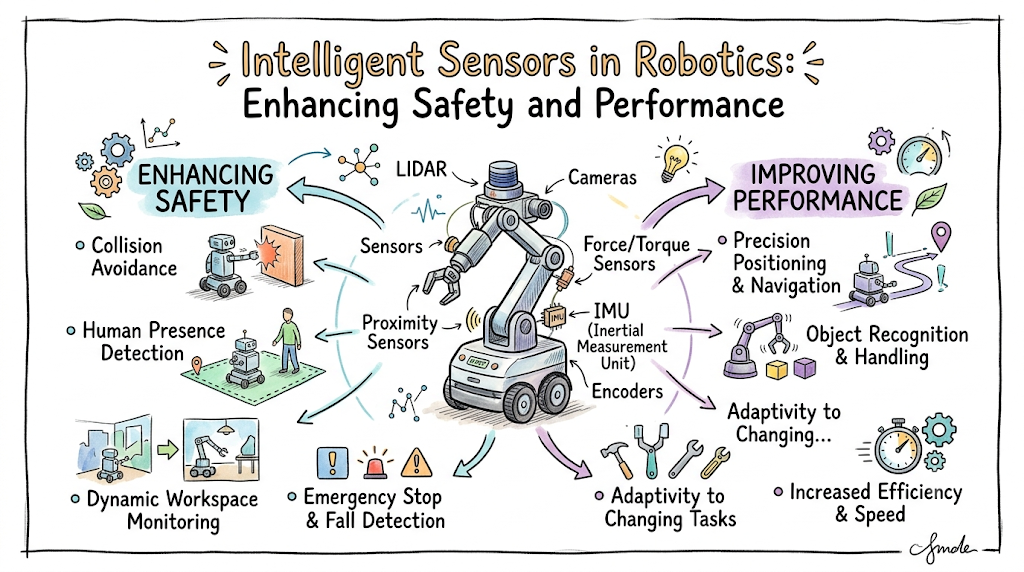
In the early days of industrial automation, machines did exactly that unless engineers hardcoded every single movement into their software. Today, modern industrial robots and autonomous systems handle unpredictable environments with incredible grace. This sudden leap in capability is not just due to better motors or faster processors; it comes down to the rapid evolution of robotics sensors. In simple terms, sensors act as the eyes, ears, and nerve endings of a robot. Without them, a robotic arm is just a collection of metal joints following fixed paths. With them, that same arm becomes an intelligent system capable of adjusting its grip, avoiding human coworkers, and identifying defects on a fast-moving assembly line. As automation reshapes global industries, understanding how these components work together is no longer optional for anyone entering the field. Whether you are a beginner taking your first steps in engineering or an automation professional looking to sharpen your skills, this breakdown will give you a clear, practical understanding of modern robotic perception. To help you master these concepts and advance your career in this rapidly growing industry, RobotsOps provides practical resources and expert educational insights designed for the next generation of automation specialists.
The Evolution of Sensors in Robotics
Early Robotic Systems and Limited Awareness
The earliest industrial robots were strong but completely blind. Operating inside heavy steel cages, these machines followed rigid, pre-programmed coordinate paths. If an object moved just an inch out of its expected position, the robot would still press down, often crushing the part or damaging its own mechanical joints. Operators spent countless hours designing physical fixtures to hold parts in exact locations because the machines lacked any form of environmental awareness. This lack of feedback made early automation highly inflexible and expensive to modify.
The Rise of Intelligent Sensing Technologies
As microelectronics advanced, engineers began integrating simple electronic components to give machines basic feedback. Microswitches provided a sense of touch, while primitive light beams detected if a part was present on a conveyor belt. These small additions completely changed how factories operated. Instead of moving blindly, a robotic arm could wait until a sensor confirmed a part arrived before beginning its task. This marked the transition from hardcoded automation to adaptive machine behavior.
Sensors as the Foundation of Modern Robotics
Today, sensing technologies form the literal foundation of robotics intelligence. Modern autonomous systems do not just react to isolated triggers; they construct rich, continuous digital maps of their surroundings. This high-level awareness allows machines to work safely alongside humans in un-caged environments. The drop in component costs and the rise of powerful onboard microprocessors have made complex sensing arrays standard across all industries, turning raw data into the lifeblood of industrial productivity.
Understanding Sensors in Robotics Operations
The Core Function of Robotics Sensors
The main job of any sensor is to translate physical properties from the real world into electronic signals that a computer can read. In robotics operations, this means converting attributes like distance, heat, light, pressure, and acceleration into digital data. This continuous stream of information gives the machine a sense of perception. By measuring these variables accurately, the robotic control systems can understand both the state of the robot itself and the condition of the surrounding world.
Why Robots Need Sensors
Robots rely on feedback loops to navigate, maintain balance, and make real-time operational decisions. If an autonomous mobile robot moves through a warehouse, it needs constant data to avoid workers, calculate optimal routes, and find its docking station. Without reliable hardware gathering this information, a robot cannot handle changes in its environment. Safety protocols also depend heavily on this data; a robot must slow down or stop instantly the moment a human enters its workspace.
Sensors vs. Actuators
To understand how a robot functions, it helps to look at the difference between sensing and acting. Think of sensors as the nervous system that gathers information, while actuators represent the muscles that perform physical work. Actuators include components like electric motors, hydraulic cylinders, and pneumatic grippers that move the robot’s joints. The control system acts as the brain, reading the data provided by the sensors and determining exactly how the actuators should move next.
The Perception-Driven Robotics Mindset
Modern engineering prioritizes a perception-driven approach to system design. Instead of writing thousands of lines of rigid code for every possible scenario, developers create algorithms that allow the robot to interpret live sensor data and choose its own path. This mindset makes autonomous systems incredibly resilient. When a robot can perceive its environment, it can successfully complete tasks even when faced with unexpected obstacles, shifting workloads, or changing lighting conditions.
The 7 Core Types of Sensors Used in Robotics
1. Proximity Sensors
Proximity sensors detect the presence or absence of nearby objects without making physical contact. Industrial robots rely heavily on these components to confirm that a part is positioned correctly before attempting to pick it up. Magnetic, capacitive, and inductive variations allow these devices to detect different types of materials, such as metals or plastics. By providing instant binary feedback, they prevent machines from attempting actions when parts are missing, protecting the system from mechanical errors.
2. Ultrasonic Sensors
Ultrasonic sensors measure distance by emitting high-frequency sound waves and timing how long it takes for the echo to bounce back. This operates exactly like the sonar used by bats or submarines. Because they rely on sound rather than light, ultrasonic sensors work perfectly in dusty environments or places with challenging lighting conditions. Warehouse robots frequently use them as a budget-friendly way to detect large walls, loading docks, and other obstacles during navigation.
3. Infrared Sensors
Infrared sensors use invisible light beams to detect objects or measure distances. Active variations emit infrared light and analyze the reflection, while passive types read the thermal energy radiating from surrounding objects. In robotics automation, these low-cost components are excellent for basic line-following tasks, proximity detection, and simple cliff-detection routines that keep small service robots from falling down stairs.
4. Machine Vision Cameras
Machine vision cameras serve as the ultimate visual intelligence tool for modern robotic control systems. By capturing high-resolution video streams, these systems allow robots to perform complex tasks like quality inspection, sorting varied objects, and reading barcodes. Combined with modern image-processing software, machine vision enables a robotic arm to identify randomly scattered items in a bin, determine their orientation, and pick them up flawlessly.
5. Force and Torque Sensors
Force and torque sensors measure the physical resistance a robot encounters while performing a task. Typically mounted at the wrist of a robotic arm, these devices give the machine a highly sensitive sense of touch. This feedback is crucial for delicate operations like polishing surfaces, assembling fragile electronics, or turning screws. If the sensor detects a sudden spike in resistance, the robot instantly stops to avoid damaging the part or stripping the threads.
6. IMU and Motion Sensors
An Inertial Measurement Unit, or IMU, combines accelerometers and gyroscopes into a single package to track an object’s speed, orientation, and gravitational forces. Drones and aerial robotics rely completely on IMUs to maintain steady flight and combat crosswinds. On the ground, mobile robots use IMU data to track their tilt angle, maintain balance on uneven terrain, and calculate their position when moving through areas without clear visual landmarks.
7. LiDAR and Advanced Mapping Sensors
LiDAR stands for Light Detection and Ranging. This advanced sensor fires thousands of rapid laser pulses every second to measure distances with extreme accuracy. By calculating the precise return time of each pulse, LiDAR creates detailed three-dimensional point clouds of the surrounding environment. Autonomous vehicles and advanced autonomous systems use LiDAR as their primary navigation tool to map out complex terrain and detect small obstacles hundreds of feet away.
Key Robotics Sensor Concepts Every Beginner Must Know
Active vs. Passive Sensors — Explained Simply
Understanding how different sensors gather information is crucial when designing a robot. Hardware generally falls into one of two categories: active or passive.
- Active Sensors: these devices inject energy into the surrounding environment to take a measurement. Examples include ultrasonic sensors emitting sound waves and LiDAR firing lasers.
- Passive Sensors: these devices simply observe the environment by absorbing energy that is already there. Examples include standard vision cameras capturing ambient light and thermal sensors reading heat signatures.
- Energy Consumption: Active sensors generally use more power because they must generate their own signals.
- Environmental Impact: Passive sensors are completely stealthy and do not interfere with other nearby systems, whereas multiple active sensors can sometimes confuse one another if they use the same frequencies.
Sensor Fusion
Most beginners overlook a critical challenge: no single piece of hardware provides a perfect view of the world. Cameras can get blinded by bright sunlight, while ultrasonic sensors can be fooled by soft, sound-absorbing surfaces. To fix this, engineers use a method called sensor fusion. Sensor fusion is the practice of combining data from multiple different sensors to create a single, highly accurate picture of reality. By blending the visual detail of a camera with the precise distance measurements of a LiDAR unit, the robot’s computer gets a highly reliable understanding of its surroundings.
Machine Vision and Perception
Visual intelligence goes far beyond simply capturing a clear picture. True robotic perception requires interpreting what those pixels actually mean. Modern software algorithms scan incoming video frames to isolate shapes, track movements, and recognize specific patterns. This allows an industrial robot to instantly tell the difference between a tool it needs to pick up and a worker’s hand, ensuring smooth operations while maintaining a safe environment.
Localization and Navigation
For a mobile robot to move successfully, it must answer two fundamental questions at all times: “Where am I?” and “Where am I going?” This process relies on localization algorithms that cross-reference data from wheels, IMUs, and laser scanners. In indoor environments where GPS signals cannot reach, robots use these inputs to build maps from scratch while tracking their own location simultaneously, allowing them to navigate safely without getting lost.
Real-Time Data Processing
Sensors generate an enormous amount of information every second. If a robot takes too long to process this data, it will react late and crash into obstacles. Real-time data processing ensures that incoming signals are analyzed by the control processor within milliseconds. This rapid loop allows the machine to adjust its motor speeds and change directions instantly when something unexpected blocks its path.
The Four Pillars of Robotic Perception
Every successful robotic action follows a cyclical four-step process driven by information flow:
[ Sensing ] ──> [ Interpretation ] ──> [ Decision-Making ] ──> [ Action ]
- Sensing: The hardware gathers raw physical data from the surrounding environment.
- Interpretation: The onboard computer cleans up the noisy data and extracts meaningful features.
- Decision-Making: The software determines the best course of action based on this interpreted map.
- Action: The robot sends commands to its actuators to execute the physical movement, starting the cycle over again.
Traditional Automation vs. Sensor-Driven Robotics — What’s the Real Difference?
The Philosophy Difference
Traditional automation focuses on absolute predictability. Machines are set up to do the exact same repetitive task millions of times without deviation. If anything changes in the workflow, the system fails. Sensor-driven robotics, on the other hand, embraces unpredictability. These systems are designed to adapt to a changing world, shifting their movements on the fly to handle variations in part sizes, positions, and environmental conditions.
Roles & Responsibilities Compared
Operating these different systems requires specialized technical skill sets across industrial teams:
- Automation Engineers: These professionals typically design fixed factory layouts, program standard PLCs, and focus on maximizing speed and consistency for repetitive production lines.
- Robotics Engineers: These experts focus on developing mechanical linkages, designing control algorithms, and writing code that defines how a machine moves its limbs.
- Robotics Operations Specialists: These specialists focus on the daily deployment, monitoring, and live optimization of adaptive robotic fleets, ensuring that hardware arrays remain perfectly calibrated in dynamic settings.
Can Traditional Automation and Robotics Work Together?
Absolutely. In modern industrial facilities, traditional conveyor belts and fixed pneumatic presses handle the bulk transport of materials, while adaptive robots handle complex tasks like picking, sorting, and final assembly. This blended approach gives manufacturers the high throughput of classic automation alongside the agility of modern robotic intelligence.
Which Industries Benefit Most from Sensor-Driven Robotics?
Industries that manage unpredictable workflows benefit the most from these advanced technologies. E-commerce fulfillment warehouses, dynamic recycling sorting centers, and agricultural businesses picking fresh produce all rely heavily on adaptive machines. Because these environments cannot be perfectly standardized, sensors are the only tool that makes automation possible in these sectors.
Real-World Applications of Robotics Sensors
Manufacturing and Industrial Automation
On the modern automotive assembly line, industrial robots use high-precision force sensors to press windshields into place without cracking the glass. Machine vision systems inspect weld beads in real time, checking for microscopic air bubbles that could weaken the car’s frame. This constant monitoring keeps production quality high and cuts down on expensive manual inspections.
Autonomous Vehicles and Transportation
Self-driving cars and delivery pods utilize a dense array of LiDAR, radar, and cameras to safely share roads with human drivers. These devices continuously scan for pedestrians, interpret traffic lights, and spot sudden lane changes. By processing this diverse data instantly, the vehicle’s navigation system can safely brake or steer away from potential collisions long before a human driver could react.
Warehouse and Logistics Robotics
Modern fulfillment centers employ fleets of autonomous mobile robots to carry heavy shelves directly to human packing stations. These units navigate busy warehouse floors using proximity sensors and floor-facing cameras that read matrix codes on the ground. By optimizing their travel routes in real time, they prevent traffic jams and keep supply chains moving efficiently.
Drones and Aerial Robotics
Drones rely on precise barometric pressure sensors, GPS trackers, and IMUs to stay level while flying in heavy winds. When performing commercial inspections on wind turbines or oil rigs, onboard cameras and distance sensors keep the drone at a safe distance from the structures, avoiding catastrophic crashes while capturing clear inspection footage.
Healthcare and Service Robotics
In hospitals, medical robots assist surgeons by providing steady guidance during complex procedures. Force-feedback systems allow doctors to feel the resistance of human tissue through a digital interface, making surgeries less invasive and highly precise. Meanwhile, mobile service robots use ultrasonic sensors to glide through busy hospital corridors to deliver fresh linens and medications to patient rooms safely.
Common Misconceptions About Robotics Sensors
Misconception 1 — One Sensor Can Do Everything
Many beginners believe that installing a high-quality camera can solve every single environmental challenge. In reality, visual systems struggle in low-light environments, dusty factories, or changing weather conditions. A well-designed system always pairs vision with complementary hardware like ultrasonic or proximity sensors to cover those blind spots.
Misconception 2 — More Sensors Always Mean Better Performance
It is tempting to pack a robot with every sensor available on the market. However, every added component increases the processing burden on the central computer and introduces more points of failure. The best engineering designs focus on using the minimum number of high-quality sensors needed to safely and effectively complete the job.
Misconception 3 — Sensors Make Robots Fully Autonomous
Hardware only gathers raw data; it does not choose what to do with it. Without clever software, machine learning models, and properly tuned control loops, a robot with advanced sensors is still completely helpless. True autonomy comes from the software’s ability to interpret that raw data and turn it into safe physical actions.
Misconception 4 — Vision Systems Replace Other Sensors
While machine vision is incredibly powerful, it cannot measure physical resistance or track subtle changes in acceleration very well. A camera cannot feel the exact torque applied to a bolt, nor can it match the direct precision of an IMU during high-speed aerial acrobatics. Each piece of hardware serves a distinct, vital purpose.
Misconception 5 — Robotics Sensors Are Only Used in Factories
While factory floors remain a major home for automation, these devices are used almost everywhere today. You can find them inside smart home vacuum cleaners, automated agricultural tractors harvesting fields, environmental monitoring buoys at sea, and advanced prosthetic limbs that adapt to a user’s walking speed.
Misconception 6 — Sensor Data Is Always Accurate
Electrical noise, dust buildup on lenses, temperature swings, and mechanical vibrations can all corrupt sensor readings over time. Engineers must write software filters to clean up this data and schedule regular maintenance routines to clean and recalibrate the hardware, ensuring the system remains safe and accurate.
Essential Technologies Supporting Robotics Sensors
Machine Vision Systems
To make sense of visual data, industrial robots rely on specialized processors running advanced computer vision software. These platforms clean up raw image streams, adjust for sudden lighting shifts, and isolate distinct objects. This background processing turns a simple camera sensor into a powerful system that can guide complex robotic movements.
Navigation and Mapping Technologies
Autonomous systems often combine multiple data inputs using Simultaneous Localization and Mapping, or SLAM, algorithms. SLAM allows a mobile robot to sketch out a map of an unfamiliar room while tracking its own coordinates inside that space. This technology is vital for deep-sea exploration vessels, mining robots, and warehouse fleets alike.
Edge Computing and Embedded Systems
Sending massive amounts of raw sensor data to a distant cloud server creates long delays that can cause accidents. To avoid this, modern robots use edge computing, processing their data locally on powerful compact microprocessors mounted right on the machine. This local processing allows the robot to react instantly to sudden changes in its environment.
Artificial Intelligence and Robotics
Artificial intelligence helps robots find meaning within complex data streams. Instead of relying on rigid, hand-written rules to identify objects, deep learning algorithms analyze thousands of examples to recognize parts, read human body language, and predict obstacle paths, giving the machine a high level of operational intelligence.
Industrial Robotics Platforms
Modern industrial robots operate within interconnected digital networks. Sensors stream performance metrics to central dashboards, allowing operations teams to spot wear and tear before a component actually breaks down. This predictive maintenance strategy keeps production lines running smoothly and prevents unexpected factory downtime.
Becoming a Robotics Operations Professional
Essential Skills Every Robotics Practitioner Needs
Breaking into this exciting industry requires a balanced mix of hands-on skills and theoretical knowledge. You need a solid grasp of basic robotics programming to configure control loops, combined with an understanding of electrical engineering to wire up components safely. Troubleshooting skills are equally critical; you must know how to diagnose erratic data streams, trace bad wiring, and clean up noisy signals. Familiarity with automation hardware like PLCs and basic AI concepts will also help you stand out to employers.
Step-by-Step Learning Path
If you are starting from scratch, begin your journey by exploring simple open-source microcontroller platforms like Arduino or Raspberry Pi. Wire up basic ultrasonic and infrared sensors, and write simple code to make a small toy car avoid obstacles. Once you master the basics, move up to advanced environments like the Robot Operating System (ROS) and experiment with simulated LiDAR maps. Finally, gain hands-on experience with industrial automation hardware through local lab classes, internships, or technical training courses.
Certifications and Learning Programs Worth Exploring
Earning industry certifications is an excellent way to validate your skills and boost your career opportunities. Look for dedicated training tracks covering industrial robotics platforms, PLC programming, and machine vision integration. Many leading technology schools and automation vendors offer specialized credentials in sensor integration, workplace safety protocols, and advanced robotic maintenance.
Educational Resources with [PROVIDER_NAME]
As you build up your skills, having access to structured, practical learning materials makes a massive difference. Aspiring technicians and automation enthusiasts can explore deep instructional content and career guidance via [RobotsOps], which focuses on breaking down complex industrial automation concepts into highly digestible, career-focused learning modules.
The Future of Robotics Sensors
Smarter Perception Systems
The next generation of sensing hardware will feature built-in microprocessors running light AI models right on the chip itself. Instead of streaming raw data to a central computer, a proximity sensor will simply report the exact type of object it sees. This smart design cuts down on internal wiring and frees up processing power for the robot’s main computer.
Advanced Autonomous Robotics
As mapping hardware becomes cheaper and lighter, we will see a massive rise in fully autonomous systems operating out in the wild. Future agricultural robots will navigate muddy fields to pick ripe crops completely unassisted, while delivery systems will handle complex urban environments safely, changing how goods travel across cities.
Human-Robot Collaboration
The factories of tomorrow will replace heavy safety cages with intelligent, collaborative workspaces. Next-generation proximity and skin-like touch sensors will allow humans and large industrial robots to work side-by-side on assembly tasks. If a worker brushes against a robotic arm, the machine will instantly cushion the impact and stop moving, preventing injuries.
Skills That Will Matter Most in Future Robotics Careers
As hardware continues to evolve, the demand for skilled professionals who can manage these systems will skyrocket. The most valuable careers will belong to individuals who understand sensor integration, data analytics, and AI-driven control systems. Mastering the intersection of physical hardware and smart software will position you for long-term success in the automation industry.
FAQ Section
- What is the primary role of sensors in robotics operations?
Sensors gather physical data from the surrounding world—such as distance, light, velocity, and force—and convert it into electronic signals. This continuous stream of feedback allows the robotic control systems to perceive its environment, navigate safely, and make real-time decisions.
2. How do active and passive sensors differ in robotics automation?
Active sensors emit their own energy into the environment to take a measurement, such as an ultrasonic sensor sending out sound waves or a LiDAR unit firing lasers. Passive sensors simply absorb existing energy from the world around them, like a machine vision camera capturing ambient light.
3. Why do modern industrial robots use sensor fusion?
No single sensor works perfectly in every situation because cameras can get blinded by bright light and lasers can struggle in heavy smoke. Sensor fusion combines data from multiple different devices simultaneously, giving the robot a far more accurate and reliable map of its surroundings.
4. What skills do I need to become a robotics operations specialist?
You need a strong mix of electrical troubleshooting, basic programming knowledge, and familiarity with automation frameworks. Understanding how to calibrate machine vision systems, wire sensor arrays, and diagnose noisy data streams are all essential skills for this career path.
5. Can sensors help prevent industrial accidents in automation environments?
Yes, proximity sensors, safety light curtains, and LiDAR arrays constantly scan the areas around heavy machinery. If a human coworker steps inside an active work zone, the sensors instantly detect the intrusion and signal the robot to slow down or stop completely.
6. What future trends will redefine the role of sensors in robotics?
We will see the rise of smarter hardware featuring built-in AI microchips that process data locally before sending it to the main computer. Additionally, highly sensitive touch-responsive skins will allow industrial robots to work directly alongside humans without needing protective safety cages.
7. What is the difference between a proximity sensor and an ultrasonic sensor?
A proximity sensor detects whether an object is simply present or absent within a very close range without touch, often using magnetic or inductive fields. An ultrasonic sensor explicitly measures the exact distance to an object over longer spans by timing sound wave echoes.
8. How does machine vision assist in robotic manufacturing tasks?
Machine vision uses cameras and image-processing software to give robots visual intelligence. This allows a robotic arm to identify randomly placed parts in a bin, determine their orientation for picking, and perform detailed quality control inspections for defects.
9. Why are force and torque sensors critical for delicate robotic assembly?
These components give a robot a human-like sense of touch by measuring physical resistance. When handling fragile electronic components or tightening precise screws, the sensor prevents the robot from applying too much pressure and damaging the parts.
10. Do sensors allow robots to operate without any pre-programmed software?
No, sensors only collect raw data; they do not possess independent intelligence. A robot still requires programming, control algorithms, and software frameworks to interpret those incoming signals and translate them into physical actuator movements.
Final Summary
Sensors are the vital link that transforms rigid mechanical structures into intelligent, adaptive robotic systems. By providing machines with the ability to see, feel, and interpret the world, these technologies make modern automation safe, flexible, and highly efficient. As industries continue to deploy autonomous systems across factories, warehouses, and open highways, the demand for skilled professionals who understand these components will keep growing. If you want to build a career in this exciting field, focus on mastering how hardware interfaces with smart software. Dive into practical learning, build hands-on projects, and check out the educational programs at [RobotsOps] to kickstart your journey into the future of automation.
