Introduction
The engineering landscape has completely shifted. Microservices, continuous delivery pipelines, and cloud-native scaling are no longer “nice-to-have” bonuses—they are the standard baseline for production environments. Organizations are aggressively hunting for engineers who can confidently bridge the gap between software development and systems operations. Yet, the sheer volume of tools makes the learning curve feel incredibly steep. Many professionals make the critical mistake of chasing Best DevOps Certification blindly, collecting paper titles without understanding how different components talk to each other under the hood. If you don’t know how cloud networks, container infrastructure, configuration management, and deployment pipelines integrate, a certificate won’t save you during a technical interview. Strategy matters infinitely more than a collection of random pdf credentials. This comprehensive guide delivers an honest, practical breakdown of the top industry paths. We will look exactly at what these exams test on a real terminal, how those skills apply to production environments, and how to build a portfolio that showcases your talent to hiring managers.
Why DevOps Certifications Matter
Certifications aren’t a magical ticket to a new job, but when you approach them with an engineering mindset, they become powerful career accelerators:
- A Weapon Against Tutorial Hell: Instead of jumping erratically from one random video playlist to another, a certification blueprint forces you down a structured, logical learning path from basic commands to complex architectures.
- Proof Under Pressure: Performance-based certifications throw you into a live terminal with a ticking clock. Passing proves to teams that you don’t just know the theory—you can actually troubleshoot a broken system on the fly.
- HR and Recruiter Visibility: Enterprise corporate screenings and managed service partners actively look for verified credentials to satisfy vendor tier requirements or quickly filter incoming resumes.
- Unified Engineering Language: Earning an industry-recognized benchmark ensures you use the exact same terminology, architectural patterns, and automation methodologies as top teams globally.
Who Should Learn DevOps
This path isn’t locked behind a specific computer science degree. Professionals from various backgrounds can leverage these tools to pivot into high-impact cloud engineering roles:
- Systems Administrators: Ready to stop running manual updates on individual servers and shift to writing scalable, automated Infrastructure as Code.
- Software Developers: Tired of treating infrastructure like a mystery box and wanting total control over how their code compiles, scales, and deploys.
- Cloud & Network Engineers: Expanding their core infrastructure knowledge to conquer container orchestration and software-defined cloud networking.
- QA & Test Engineers: Moving away from manual click-testing and stepping up to build continuous, automated validation gates directly inside deployment pipelines.
Types of DevOps Certifications
The cloud-native universe is massive, but you can neatly group the primary certifications into six essential categories:
Foundation Certifications
These establish the baseline. They cover high-level cultural frameworks, collaborative core concepts, and basic terminology without getting bogged down in actual code.
Tool-Based Certifications
Pure, unadulterated tool execution. These validate deep, granular expertise in a specific platform—like managing configurations via Terraform or configuring container environments with Kubernetes. They are incredibly valuable because they translate directly to daily engineering tickets.
Cloud DevOps Certifications
Delivered straight from the major hyperscalers (AWS, Azure, Google Cloud). These focus entirely on deploying, scaling, and monitoring applications using that specific vendor’s native automation frameworks.
DevSecOps Certifications
The shift-left movement. These credentials ensure security isn’t an afterthought, focusing heavily on automated image scanning, compliance policies, and secure secrets management inside production environments.
SRE & Platform Engineering Certifications
Built for massive scale and system resilience. These focus heavily on system telemetry, advanced logging, distributed metrics, incident management, and building internal developer platforms.
Advanced & Emerging Domains
Specialized engineering landscapes including automated GitOps delivery loops, continuous MLOps data pipelines, and cloud financial engineering (FinOps).
Best DevOps Certifications at a Glance
| Certification | Best For | Level | Main Focus | Difficulty | Recommended Role | Link |
| DevOps Certified Professional (DCP) | Core Lifecycle Automation | Foundational | CI/CD, Git, Jenkins, Core Workflows | Low | Junior DevOps Engineer | View Course |
| DevSecOps Certified Professional (DSOCP) | Pipeline Vulnerability Scanning | Advanced | Shift-Left Security, SAST/DAST, Compliance | High | DevSecOps Engineer | View Course |
| Site Reliability Engineering (SRE) | System Resiliency & Observability | Advanced | SLOs, Error Budgets, Chaos Engineering | High | Site Reliability Engineer | View Course |
| Master in DevOps Engineering (MDE) | End-to-End Enterprise Strategy | Expert | Architecture Design & Production Release | High | Senior DevOps Architect | View Course |
| Master in Azure DevOps | Microsoft Ecosystem Specialists | Advanced | Azure Pipelines, Boards, Repos Setup | Medium | Azure Cloud Engineer | View Course |
| AWS Certified DevOps Professional | Amazon Web Services Architecture | Advanced | AWS Developer Tools, CloudFormation, Auto Scaling | High | AWS Infrastructure Engineer | View Course |
| Master in Python Programming | Infrastructure Automation Scripting | Intermediate | Scripting, Custom CLI Tools, API Automation | Medium | Automation Engineer / Developer | View Course |
| Certified Kubernetes Administrator (CKA) | Production Container Orchestration | Advanced | Cluster Architecture, Networking, Troubleshooting | High | Kubernetes Specialist | View Course |
| Docker Certified Associate (DCA) | Application Containerization | Intermediate | Image Optimization, Container Runtimes, Volumes | Medium | Systems Administrator | View Course |
| Google Cloud DevOps Engineer | Google Cloud Native Platforms | Advanced | GKE Administration, GCP Operations Suite | High | GCP Cloud Engineer | View Course |
| Master in Data Science | Enterprise Data Engineering | Advanced | Statistical Analytics, Scalable Data Pipelines | High | Data Infrastructure Engineer | View Course |
| Hashicorp Certified Terraform Associate | Multi-Cloud Infrastructure as Code | Intermediate | Declarative State Files, Module Management | Medium | Cloud Automation Specialist | View Course |
| Master in Artificial Intelligence | Intelligent System Automation | Advanced | Neural Networks, Automated Model Training | High | AI Operations Specialist | View Course |
| Master in Deep Learning | Advanced Model Topologies | Advanced | Complex Layer Compute, Topology Deployments | High | Deep Learning Engineer | View Course |
| GitOps Certified Professional (GOCP) | Declarative Continuous Delivery | Intermediate | ArgoCD, Flux, Git-Driven Cluster State | Medium | Platform Engineer | View Course |
| Envoy ISTIO Certification Training | Microservices Service Mesh | Advanced | Traffic Splitting, mTLS Encryption, Sidecars | High | Network Infrastructure Architect | View Course |
| Prometheus with Grafana | Cloud-Native Systems Monitoring | Intermediate | Time-Series Metrics, Dashboard Visuals, Alerting | Medium | Monitoring & Operations Engineer | View Course |
| MLOps Certification Training Course | Machine Learning Pipeline Scale | Advanced | Model Lifecycle Automation, Data Versioning | High | MLOps Engineer | View Course |
| Master in Machine Learning | Predictive Operational Algorithms | Advanced | Supervised/Unsupervised Modeling Deployments | High | ML Infrastructure Engineer | View Course |
| Master in AppDynamics | Enterprise Performance Tracking | Intermediate | APM Dashboards, JVM/CLR Code Diagnostics | Medium | Application Support Engineer | View Course |
Detailed Certification Analysis
Certified Kubernetes Administrator (CKA)
What It Is
The CKA is a brutal, 100% hands-on, performance-based exam managed by the Cloud Native Computing Foundation (CNCF) and The Linux Foundation. There are no multiple-choice safety nets. You are dropped directly into a live command-line environment and tasked with solving real cluster engineering problems under a tight deadline.
Who Should Take It
Systems operators, cloud engineers, and any tech professional tasked with running, scaling, and debugging microservices on live container infrastructure.
Best Career Fit
- Kubernetes Administrator
- Cloud Infrastructure Engineer
- Site Reliability Engineer (SRE)
Difficulty Level
Advanced / Performance-Based
Career Scope
Kubernetes has effectively become the operating system of the modern cloud. Because it dominates the container world, the CKA remains one of the most consistently demanded credentials in the production infrastructure market.
Skills You Will Learn
- How to spin up, configure, and scale highly available multi-node clusters.
- Configuring cluster networking patterns, custom ingress routing, and persistent data volumes.
- Quickly troubleshooting broken worker nodes, crashed kubelets, and core network communication failures.
- Executing safe, zero-downtime application upgrades and rolling configuration playbooks.
- Locking down cluster access via Role-Based Access Control (RBAC) and explicit network policies.
Tools Covered
- Kubernetes Core Engine (
kubeadm,kubectl,kubelet) - Container Runtimes (
containerd) - Linux System Utilities (
systemctl,journalctl,etcdctl)
Exam Details
- Format: Performance-based practical tasks on a live command line.
- Duration: 2 Hours.
- Passing Score: 66%
- Validity: 3 Years.
- Cost: Approximately $395 USD (watch out for regular bundle deals).
Study Roadmap
- Master core Linux server administration, SSH tunneling, and terminal editors like Vim or Nano.
- Build, run, and break containers locally using Docker or containerd until you understand the basic runtime behavior.
- Dive into intense, interactive lab courses that offer simulated live terminal mock exams.
- Manually construct a multi-node cluster from scratch on clean cloud virtual machines using the “Kubernetes the Hard Way” blueprint.
- Practice command-line speed; master imperative
kubectlcommands to generate configuration files instantly instead of writing YAML by hand.
Real-World Use Cases
In a production setting, you will use these exact skills to recover an application that has completely stalled, safely drain traffic away from an entire set of servers for urgent kernel upgrades, or debug a failing internal DNS route.
Pros
- Immense technical credibility; proves to any hiring team you can operate under real pressure.
- Teaches vendor-agnostic architecture concepts that transfer seamlessly to managed cloud platforms like AWS EKS, Azure AKS, or Google GKE.
Cons
- The exam interface can suffer from performance lag depending entirely on your internet connection speed.
- Demands exceptional command-line accuracy and fast typing muscle memory.
Recommendation
Choose it if: You are actively working with or transitioning to container-driven cloud environments.
Avoid it if: You haven’t mastered standard network configurations, IP routing, or essential Linux command-line workflows.
HashiCorp Certified: Terraform Associate
What It Is
An intermediate, highly targeted multiple-choice exam centered squarely on the core mechanics of Infrastructure as Code (IaC) using HashiCorp’s open-source tool, Terraform.
Who Should Take It
Cloud engineers, developers, and systems administrators who want to eliminate manual cloud console clicking and move entirely to automated infrastructure deployments.
Best Career Fit
- DevOps Automation Engineer
- Platform Engineer
- Cloud Infrastructure Architect
Difficulty Level
Intermediate
Career Scope
Modern engineering organizations rarely allow manual system provisioning. Because Terraform is the dominant tool used to manage cloud configurations across multiple vendors simultaneously, this badge holds massive practical value everywhere.
Skills You Will Learn
- Deeply understanding the terraform execution lifecycle, state files, and resource mapping.
- Writing, editing, and optimizing declarative code using HashiCorp Configuration Language (HCL).
- Safely managing remote state storage architectures and team state locking protocols.
- Creating clean, reusable infrastructure modules to standardize environment deployments.
- Handling complex input variables, environment outputs, and dynamic loops cleanly.
Tools Covered
- Terraform Open-Source CLI
- Terraform Cloud / Enterprise
- Hyperscaler Resource Providers (AWS, Azure, GCP provider frameworks)
Exam Details
- Format: Multiple-choice, multiple-select, and practical fill-in-the-blank questions.
- Duration: 1 Hour.
- Passing Score: Variable (typically around 70%).
- Validity: 2 Years.
- Cost: $70 USD.
Study Roadmap
- Gain a clear understanding of fundamental cloud building blocks (VPCs, firewalls, server instances) within your favorite cloud platform.
- Spin up a local environment and write basic Terraform files to provision free-tier cloud resources.
- Intentionally break your setup to study the precise interaction of
terraform plan,apply, and the criticalterraform.tfstatefile. - Package your setups into modular structures and push your code to a clean GitHub repository.
- Thoroughly review advanced state command documentations including
terraform importand state manipulation safety steps.
Real-World Use Cases
You will utilize this exact workflow to spin up completely identical Development, QA, and Production environments across separate regions in minutes, entirely eliminating manual environment drift bugs.
Pros
- Incredibly low financial barrier to entry compared to hefty cloud vendor exams.
- High cloud-agnostic utility; the structural patterns apply whether you deploy resources to AWS, Azure, or local environments.
Cons
- The testing layout is entirely theoretical (multiple-choice) rather than dropping you into an interactive terminal environment.
Recommendation
Choose it if: You want to specialize heavily in cloud-wide infrastructure automation and need a verified baseline to prove you understand declarative state setups.
Avoid it if: You don’t have an active cloud account to physically execute code samples and analyze the results firsthand.
AWS Certified DevOps Engineer – Professional
What It Is
A massive, advanced, highly technical scenario-driven blueprint designed to test your absolute limit in deploying, securing, scaling, and automating complex application workloads natively inside the Amazon Web Services catalog.
Who Should Take It
Seasoned cloud specialists who have actively designed, automated, and run live AWS infrastructure footprints for at least one to two years.
Best Career Fit
- Senior DevOps Engineer
- Cloud Systems Architect
- Release/Deployment Engineer
Difficulty Level
Advanced
Career Scope
AWS continues to capture a massive slice of the cloud computing market. Holding an active Professional-tier credential proves you possess high-level architecture design and operations capabilities that top-tier enterprises aggressively pursue.
Skills You Will Learn
- Architecting secure multi-account organizational systems using AWS Control Tower and Organizations.
- Designing automated, continuous zero-downtime application delivery pipelines (Blue/Green, Canary) via AWS Code tools.
- Configuring complex centralized monitoring, event-driven remediation loops, and comprehensive telemetry.
- Implementing automated scaling dynamics, enterprise disaster recovery, and high-availability frameworks.
- Enforcing global security policies, continuous configuration scanning, and operational governance guardrails.
Tools Covered
- AWS Automation (CloudFormation, CodePipeline, CodeBuild, CodeDeploy)
- AWS Compute Engines (ECS, EKS, Serverless Lambda)
- AWS Management Suites (Systems Manager, CloudWatch, CloudTrail, AWS Config)
Exam Details
- Format: Complex multiple-choice and multi-response engineering scenario problems.
- Duration: 180 Minutes.
- Passing Score: 750 / 1000
- Validity: 3 Years.
- Cost: $300 USD.
Study Roadmap
- Solidify your baseline core knowledge by thoroughly mastering the AWS SysOps or Developer Associate tracks first.
- Spend months actively building out functional automated systems within an AWS cloud test environment.
- Deeply analyze cross-account routing mechanisms, cross-region database replication, and central logging strategies.
- Read through the official AWS Well-Architected framework papers focusing extensively on operational excellence and security.
- Take relentless, long-form scenario practice tests to survive the intense mental fatigue of the actual 3-hour exam window.
Real-World Use Cases
You will use this knowledge to build automated feedback pipelines that trigger immediate code rollbacks if a production version release begins throwing errors, or instantly deploy system-wide compliance controls across hundreds of isolated business accounts.
Pros
- Commands massive respect across enterprise corporate ecosystems worldwide.
- Forces you to take total ownership of an application lifecycle—from lines of code to ongoing production system health.
Cons
- The exam problems are dense, text-heavy scenarios that require lightning-fast reading comprehension.
- Locks your automated operational skill set tightly into the native AWS proprietary catalog.
Recommendation
Choose it if: Your current or target engineering teams run heavily on AWS infrastructure and you want to lock in senior-level automation credentials.
Avoid it if: You are entirely new to the IT landscape or lack deep daily experience manipulating cloud infrastructure.
Comprehensive Comparison Table
| Certification | Level | Main Focus | Difficulty | Suggested Target Role |
| LFCA | Beginner | System administration basics, networking, filesystem layout, security baselines. | Low | Desktop Support, Junior SysAdmin, Aspiring DevOps |
| Terraform Associate | Intermediate | Declarative infrastructure orchestration, structural modularity, cloud state control. | Medium | Cloud Automation Engineer, Systems Operator |
| CKA | Advanced | Live cluster deployment, namespace management, persistent storage, operational debugging. | High | Kubernetes Administrator, Infrastructure Engineer, SRE |
| AWS DevOps Pro | Advanced | Multi-account architecture governance, cloud CI/CD native pipelines, auto-scaling patterns. | High | Senior Cloud Engineer, AWS Infrastructure Architect |
| Azure DevOps Expert | Advanced | Enterprise project management integration, artifact handling, secure hybrid workflows. | Medium-High | Enterprise DevOps Specialist, Systems Integrator |
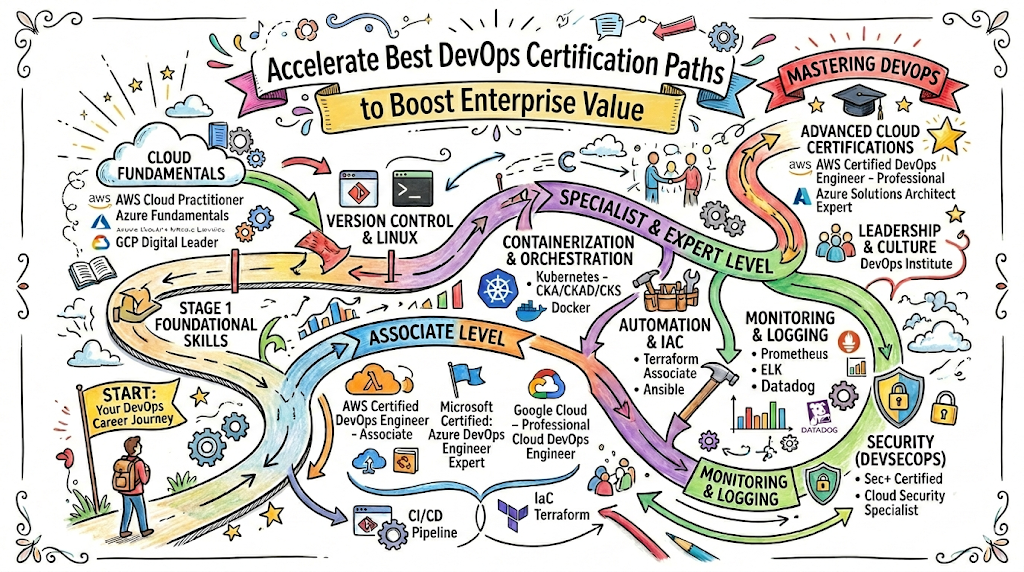
The DevOps Certification Roadmap
To build an adaptable, enterprise-ready skill set, structure your learning progressively rather than trying to memorize advanced tools out of order.
[Phase 1: Foundations] -> [Phase 2: Automation] -> [Phase 3: Orchestration] -> [Phase 4: Specialization]
   - Linux & Git            - Terraform               - Kubernetes (CKA)       - DevSecOps / SRE
   - Cloud Basics           - Basic CI/CD Pipelines   - Cloud Platforms        - Advanced Observability
Phase 1: Foundations (The Core Baseline)
Before writing automation scripts, you must understand the underlying operating system environment. Focus on:
- Linux Administration: Mastering file permissions, user groups, package management, process handling, and shell scripting (Bash).
- Version Control: Learning distributed development workflows using Git (branching, merging, resolving conflicts, pull requests).
- Basic Networking: Understanding IP addressing, subnetting, DNS configurations, routing protocols, and standard HTTP/HTTPS lifecycles.
Phase 2: Automation & Infrastructure as Code
Once you can manage a single server manually, learn how to treat infrastructure as software code:
- Infrastructure as Code: Learn declarative resource provisioning using tools like HashiCorp Terraform.
- Basic CI/CD Workflows: Set up linear automation pipelines using GitHub Actions or GitLab CI to test and validate your configurations automatically on every code push.
Phase 3: Containerization & Cloud Platforms
With basic infrastructure automated, shift your focus to packaging application code cleanly:
- Containerization: Learn to isolate application runtimes, optimize configurations, and build minimalist images using Docker or containerd.
- Container Orchestration: Master managing distributed production workloads at scale across clusters using Kubernetes (CKA framework).
- Public Cloud Platforms: Deepen your expertise in a major hyperscaler (AWS or Azure) to manage enterprise-grade managed services efficiently.
Phase 4: Advanced Specialization
Once your core infrastructure and delivery engine are secure, pivot into specialized engineering practices based on organizational scale:
- DevSecOps: Integrating automated security policy gates directly into code pipelines.
- Site Reliability Engineering (SRE): Implementing detailed application performance monitoring, structured incident response setups, and unified observability stacks.
Recommended Paths by Role
Tailor your education to your daily professional focus area rather than trying to study everything at once:
The DevOps Generalist Path
- Linux Foundation Certified IT Associate (LFCA) — Core Baseline
- HashiCorp Certified: Terraform Associate — Infrastructure Automation
- Certified Kubernetes Administrator (CKA) — Orchestration Layer
- AWS Certified DevOps Engineer – Professional — Cloud Engine Automation
The Cloud-Native / Kubernetes Specialist Path
- Certified Kubernetes Application Developer (CKAD) — Workload Configuration
- Certified Kubernetes Administrator (CKA) — Core Cluster Management
- Certified Kubernetes Security Specialist (CKS) — Advanced Runtime Protection
The Platform Engineering & Reliability Path
- HashiCorp Certified: Terraform Associate — Foundation Layer Factory
- Certified Kubernetes Administrator (CKA) — Compute Platform Baseline
- Specialized Observability Modules (Prometheus/Grafana workflows, OpenTelemetry instrumentation) — System Visibility
Real-World Career Scenarios
Scenario A: The Absolute Newcomer / Graduate
- Background: High familiarity with basic computing but no enterprise production environment experience.
- The Plan: Do not jump directly into advanced cloud-native architectures. Begin by earning the LFCA to establish systems familiarity, learn Git fundamentals thoroughly by pushing daily work to a public repository, and complete an entry-level cloud practitioner module to understand basic vendor services.
Scenario B: The Traditional System Administrator
- Background: Experience managing bare-metal configurations, local hypervisors, and manual operating system patching.
- The Plan: Focus heavily on shifting your mindset toward API-driven infrastructure. Skip basic system certification courses and focus on the Terraform Associate to automate your current workloads, followed by the CKA to migrate legacy applications into modern containerized environments smoothly.
Scenario C: The Application Developer Turning Toward Infrastructure
- Background: Confident writing application logic, handling database queries, and managing code repositories, but treats the underlying network and servers like a black box.
- The Plan: Focus on learning how application code behaves inside production environments. Study Docker/containerd to clean up local runtime setups, complete the CKA to understand how production platforms handle application scaling and service discovery, and implement automated multi-stage pipelines to manage deployments end-to-end.
Common Mistakes to Avoid
- Jumping into Advanced Kubernetes Prematurely: Attempting to study for the CKA without knowing how to configure basic Linux file systems, manage system daemons, or read standard IP routing tables will lead to frustration. Build a solid foundation first.
- Relying on Multiple-Choice Brain Dumps: Memorizing exact question-and-answer patterns might pass an associate-level multiple-choice exam, but it will fail you completely during a technical interview or a live production incident. Focus on understanding the concepts.
- Collecting Certificates Over Practical Portfolios: Having five certifications but zero public code repositories or architecture diagrams raises red flags for hiring managers. Always back up your credentials with verifiable projects.
- Ignoring Cost Management and Cloud Governance: Beginners often deploy elaborate cloud resources while studying, only to forget to clean them up and receive unexpected bills. Always integrate cost controls, alerting thresholds, and cleanup scripts into your study habits.
Hands-On Portfolio Projects
To stand out to engineering teams, build real systems that showcase your practical abilities. Document your architectural choices clearly in a public repository:
Project 1: Automated Multi-Tier Cloud Deployment
- Goal: Build a highly available web application architecture from scratch without clicking around a web console manually.
- Implementation: Use Terraform to provision a Virtual Private Cloud (VPC), configure public and private subnets, set up an Application Load Balancer, and deploy auto-scaling application nodes across multiple availability zones on AWS or Azure. Ensure all state configurations are stored securely in a remote bucket.
Project 2: High-Availability Container Workflow
- Goal: Build a reliable hosting platform for modern microservices applications.
- Implementation: Provision a multi-node Kubernetes cluster. Configure an Ingress Controller to route external traffic dynamically, implement persistent storage volumes to retain state, enforce strict namespace isolation using RBAC policies, and deploy a containerized application safely.
Project 3: Automated Secure Software Pipeline (CI/CD)
- Goal: Eradicate manual deployment processes completely by automating validation gates from code check-in to production.
- Implementation: Build a GitHub Actions or GitLab CI workflow that triggers automatically on every code push. The pipeline should lint your source files, run unit test suites, build an optimized container image, scan that image for known security vulnerabilities, and deploy the updated application smoothly to a testing environment.
Tools and Free Practice Resources
You don’t need expensive enterprise software suites to master cloud-native engineering. The entire ecosystem is built on accessible, open-source technology:
- Interactive Environments: Use platforms like Killercoda or Play with Kubernetes to practice complex terminal commands and cluster administration configurations directly inside a web browser for free.
- Local Infrastructure Labs: Install Minikube, Kind (Kubernetes in Docker), or K3s on your local computer to run lightweight, fully functional container environments without incurring cloud platform costs.
- Public Version Control: Use GitHub or GitLab free accounts to store your project code, experiment with built-in runner automation features, and build a clean, visible portfolio for recruiters.
- Vendor Trial Accounts: Leverage free-tier limits provided by AWS, Azure, or Google Cloud to practice provisioning real cloud infrastructure resources safely. Always set up billing alarms immediately upon creation.
How to Choose Your Path
Before committing time and money to an exam voucher, evaluate your options against your immediate career goals:
Assess Current Skills -> Identify Target Role -> Verify Tech Stack -> Select Certified Focus
- Analyze Your Experience Baseline: If you are still building confidence with the command line or core networking, start with foundational Linux and version control modules before tackling complex cloud platforms.
- Evaluate Your Target Market: Research active job listings within your geographic region or target industry sector. If the majority of companies you want to work for utilize Microsoft Azure, prioritize the Azure DevOps Expert track over AWS modules.
- Audit Your Available Resources: Performance-based exams like the CKA require hours of hands-on typing and system configuration practice. Ensure your weekly schedule allows for dedicated laboratory practice time, not just reading documentation.
Frequently Asked Questions
1. From an organizational perspective, what is the core ROI of investing in a platform-specific cloud DevOps certification?
Platform-specific tracks optimize vendor resource consumption and secure corporate competency tiers. For business decision-makers, having certified engineers ensures your team implements cloud infrastructure architectures according to the vendor’s strict security, cost-efficiency, and reliability baselines, preventing costly operational overhead.
2. How does a practical performance-based certification like the CKA mitigate hiring risk for modern tech companies?
Multiple-choice certificates can be passed via theoretical memorization, creating a skills gap on real infrastructure. Performance-based blueprints like the CKA force candidates to solve live cluster issues on a command line, validating that they can maintain uptime and handle system outages on day one.
3. What business factors should guide a company’s choice between training staff on Terraform versus native cloud templates like CloudFormation?
The primary drivers are vendor lock-in risk and personnel flexibility. Terraform offers a unified syntax across multiple public and private clouds, meaning your engineering talent can manage varied infrastructure without retraining, whereas native templates lock your operational lifecycle into a single cloud provider.
4. Why do engineering executives view a baseline understanding of Linux and Git as mandatory before pursuing complex automation tracks?
Automation tools are simply wrapper layers that manipulate underlying systems. If an engineer cannot navigate a Linux directory or trace a Git code conflict, they will write fragile automation scripts that break easily, creating complex technical debt across your delivery pipelines.
5. What is the strategic value of incorporating specialized DevSecOps paths into an engineering organization’s learning curriculum?
It shifts vulnerability management to the earliest phases of development, dropping remediation costs exponentially. Certifications focusing on secure CI/CD pipelines and container image compliance ensure your engineering staff automatically flags security flaws long before software hits production.
6. How do SRE and observability credentials impact a system’s long-term operational error budget?
They move operations from reactive fire-fighting to proactive scaling. Training teams in distributed logging, metric telemetry, and incident management frameworks gives engineers the visibility needed to optimize system performance and resolve anomalies before they degrade the end-user experience.
7. Why has the market value of traditional containerization badges declined relative to advanced orchestration platforms?
Basic container runtimes have become standardized utility layers. While building a single container is essential, modern enterprise infrastructure demands complex scaling, automated healing, and service mesh routing, which makes orchestration credentials much more relevant to hiring managers.
8. What hidden costs should architectural decision-makers anticipate when sponsoring team-wide advanced cloud tracks?
The biggest variable cost isn’t the test voucher—it is laboratory practice resources. Advanced tracks require engineers to deploy multi-region environments, high-availability load balancers, and active message queues, which can generate substantial cloud platform billing spikes if not tightly monitored.
9. How should a technical leader balance a team’s certification goals against open-source contributions and portfolio building?
Certifications provide a standardized training curriculum, but portfolios showcase original problem-solving. A balanced strategy requires engineers to utilize their certification preparation milestones to build, document, and open-source tangible infrastructure templates that benefit your internal workflows.
10. Is it strategic for a company operating purely on a single cloud to cross-train engineering staff in multi-cloud frameworks?
Only if you have an explicit roadmap for migration or disaster recovery. Cross-training teams on a separate cloud platform without an immediate business application causes skill atrophy and dilutes their deep expertise in your primary cloud footprint, driving down operational efficiency.
11. What operational risks emerge when a technical team scales out complex automated tools without certification baseline standards?
Without structural architectural standards, engineers write highly customized, fragmented automation code that only the original creator understands. Standardized certification pathways ensure the entire organization uses identical naming structures, security controls, and design patterns.
12. How does implementing an objective certification roadmap improve engineering talent retention across modern IT divisions?
It outlines a transparent, predictable path for technical career progression. When developers and systems operators see clear investment in their structural upskilling, it directly boosts team morale, reduces turnover, and organically builds a highly capable modern engineering organization.
Conclusion
Earning a DevOps certification is one of the most effective ways to break out of tutorial hell and force yourself down a structured, engineering-focused learning path. However, the true value of any credential lies entirely in your ability to apply that knowledge on a real command line. While multiple-choice certifications validate your understanding of cloud theory and architecture design, performance-based badges like the CKA prove to engineering teams that you can handle high-pressure infrastructure failures under a tight deadline. To maximize your long-term career growth, prioritize structural roadmap planning over collecting random digital badges. Begin by mastering system core baseline mechanics like Linux administration and Git version control before moving into modern cloud automation with Terraform. From there, scale your expertise outward by dominating container orchestration platforms and multi-account public cloud platforms.
