Introduction
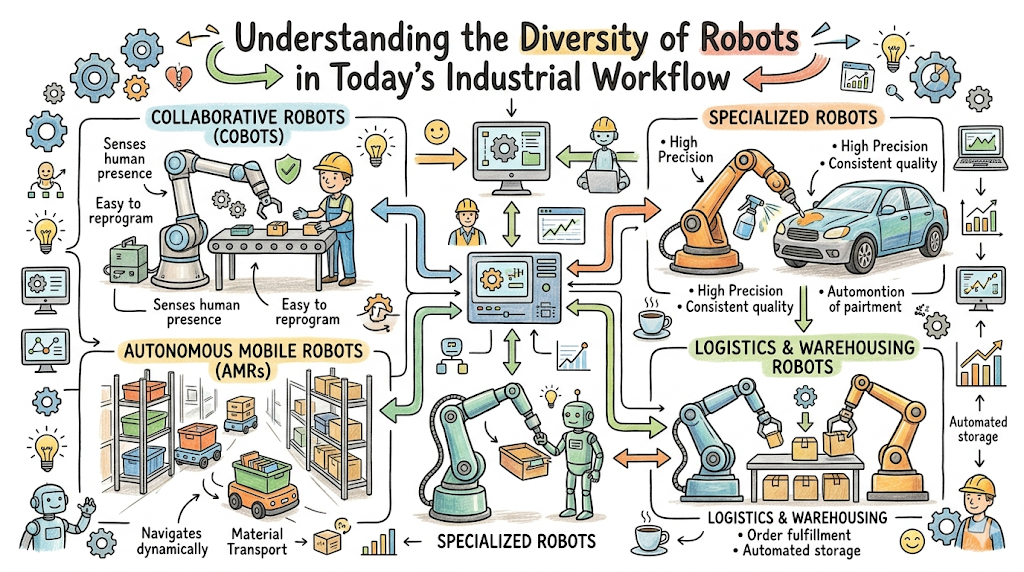
Modern manufacturing floors have evolved into sophisticated environments where efficiency and safety are paramount. On these floors, the sight of workers manually lifting heavy metal frames or sorting thousands of tiny components by hand is increasingly rare. Instead, industrial facilities are now powered by a diverse fleet of high-precision robotic arms, autonomous mobile systems, and collaborative machines that work alongside people to streamline production. Industrial robots serve as the backbone of global manufacturing, transforming traditionally slow, error-prone processes into high-speed, accurate, and scalable operations. Whether it is packing consumer goods or assembling complex automotive components, these machines are fundamental to maintaining a competitive edge. This guide explores the various types of robots driving modern industrial operations, how they function, and why they are essential for today’s fast-paced production demands. To master these automation concepts and explore practical training, you can visit RobotsOps.com for expert-led insights into the future of factory technology.
What are Industrial Robots?
An industrial robot is a reprogrammable, multifunctional manipulator designed to move materials, parts, tools, or specialized devices through variable programmed motions for the performance of a variety of tasks. Simply put, they are smart machines that take over repetitive, dangerous, or high-precision jobs that humans find difficult or tiresome.
Evolution of Robotics in Industry
Robotics has evolved from massive, isolated “cages” where early robots were kept away from humans due to safety concerns, to the smart, collaborative machines we see today. Initially, robots were only capable of simple, pre-programmed movements; now, they are equipped with artificial intelligence, vision systems, and touch sensors.
Why Industries Depend on Automation
Global competition demands lower costs, higher quality, and faster delivery. Manual labor simply cannot keep up with these requirements around the clock. Automation provides the consistency required for high-volume production, ensuring that every product—whether it’s a computer chip or a car door—meets exact quality standards.
Role of RobotsOps.com in Learning Robotics Concepts
Understanding robotics is not just about knowing names; it’s about understanding the logic behind machine motion, sensors, and programming. RobotsOps.com provides a structured approach to learning these industrial systems, ensuring that beginners and professionals alike can grasp the essentials of modern automation.
Major Types of Robots in Industrial Operations
1. Articulated Robots
Articulated robots are the most common industrial robots, consisting of a series of joints that mimic the movement of a human arm. They are incredibly flexible and can reach almost any point within their work envelope.
- Example: In an automotive factory, these arms are used to weld car frames, paint bodies, or assemble intricate interior parts with extreme repeatability.
2. SCARA Robots
SCARA stands for Selective Compliance Assembly Robot Arm. These robots are rigid in the vertical direction but flexible in the horizontal plane, making them incredibly fast at “pick-and-place” tasks.
- Example: In electronics manufacturing, SCARA robots excel at inserting tiny screws or placing chips onto circuit boards at high speeds.
3. Cartesian (Gantry) Robots
Cartesian robots operate on three linear axes (X, Y, and Z) that move at right angles to one another. Their design makes them very easy to program and highly reliable for heavy loads.
- Example: Large gantry systems are frequently used in CNC machining and 3D printing, where precision movement over a flat surface is required.
4. Delta Robots
Delta robots are fast, parallel-link robots that look like a spider. They are mounted overhead and use three arms to move an end-effector with lightning-quick speed and high precision.
- Example: You will find these in food packaging plants, where they sort and pack chocolates or cookies into boxes as they move along a high-speed conveyor belt.
5. Collaborative Robots (Cobots)
Cobots are a special breed of robot designed to work alongside humans. Unlike traditional robots, they are equipped with advanced sensors that detect human presence and stop instantly upon contact, ensuring safety without the need for cages.
- Example: A cobot might hold a heavy piece of equipment while a human worker performs delicate assembly, or assist in warehouse sorting tasks alongside employees.
6. Autonomous Mobile Robots (AMRs)
AMRs are self-navigating robots that use cameras, lasers, and sensors to move through a facility without needing pre-installed tracks or wires. They “map” their environment and find the most efficient path.
- Example: In large e-commerce logistics centers, AMRs automatically navigate aisles, pick up shelves, and deliver products to human packers.
7. Humanoid Robots
Humanoid robots are designed to mimic the shape and movement of a human. While still emerging in industrial settings, their structure allows them to use tools and environments originally designed for people.
- Example: These robots are currently used in research and service settings, testing their ability to handle dynamic tasks in human-centric spaces.
8. Cylindrical Robots
These robots have a work envelope that is cylindrical, moving using a mix of rotational and linear movements along a central column. They are perfect for applications where the robot needs to work in a circular area.
- Example: They are frequently used in simple assembly tasks, machine tool loading, and basic spot welding.
9. Polar (Spherical) Robots
These robots feature a waist rotation and two rotary joints that give them a spherical work envelope. They are known for their reach and ability to manage large, heavy payloads.
- Example: Often used in heavy-duty industrial applications such as die casting or material handling, where a long reach is required.
Core Components of Industrial Robots
Sensors and Perception Systems
Sensors are the robot’s eyes and ears. They include cameras for computer vision, laser scanners for distance measurement, and force sensors that allow the robot to “feel” how much pressure it is applying.
Actuators and Motion Control
Actuators are the muscles of the robot. These motors and hydraulic systems convert power into physical movement, allowing the robot to execute precise instructions from the control unit.
AI and Decision Systems
Modern robots use AI to adjust to changes in real-time. If a part on the assembly line is slightly out of position, AI allows the robot to “see” the misalignment and correct its path instantly.
Control Units and Programming Interfaces
The control unit acts as the “brain,” storing the software and executing the code. Programmers use interfaces (often called “teach pendants”) to guide the robot through its path.
Safety and Monitoring Systems
Safety is paramount in factories. These systems include emergency stop buttons, light curtains that detect human entry, and software limits that prevent the robot from moving outside its designated area.
How Industrial Robots Work in Real Environments
Task Identification and Programming
First, engineers identify the task—such as moving a box from Point A to Point B. They program this path into the robot, often by physically guiding the arm through the movement so it “learns” the path.
Motion Execution and Precision Control
Once programmed, the robot executes the path with high precision. It uses feedback loops from its sensors to ensure it hits the exact coordinate every time, regardless of how many thousands of times it repeats the task.
Real-Time Feedback and Adjustments
If an object is moved or a sensor detects an obstacle, the robot’s control system processes this information in milliseconds, allowing it to pause or adjust to avoid a collision or a missed item.
Human-Robot Interaction in Factories
Modern factories have “smart zones” where humans and robots share space. Collaborative systems monitor these zones, slowing down or stopping the robots when humans approach, then resuming when the area is clear.
Real-World Applications of Industrial Robots
Automotive Manufacturing
The automotive industry uses articulated robots for welding, painting, and assembling parts. These robots ensure that every car chassis is built to the same strict safety standards.
Electronics Production
Precision is everything in electronics. SCARA and delta robots handle the delicate work of soldering components onto motherboards or assembling tiny smartphone parts.
Food and Beverage Industry
Robots in this sector must be fast and sanitary. Delta robots sort fresh produce and package items into boxes at incredible speeds, often in cold or sterile environments.
Warehousing and Logistics
AMRs dominate this sector. They replace traditional conveyor belts by being flexible, moving throughout the facility to bring goods to sorting stations.
Pharmaceutical Industry
High levels of hygiene and accuracy are required here. Robots handle the filling of vials, labeling of medications, and packaging of sensitive supplies to prevent human contamination.
Benefits of Industrial Robots
- Increased Productivity: Robots work 24/7 without fatigue, breaks, or vacations.
- Higher Precision and Accuracy: They repeat movements with millimeter-level accuracy for years.
- Reduced Human Error: Consistent quality control eliminates the mistakes caused by distraction or exhaustion.
- Improved Workplace Safety: Robots take over dangerous tasks, such as handling heavy chemicals or sharp parts, keeping humans away from harm.
- Lower Operational Costs: While the initial cost is higher, the long-term efficiency and waste reduction significantly lower overall expenses.
Challenges in Industrial Robotics
High Initial Investment
The cost of purchasing and installing high-end robotic systems can be significant for small-to-medium businesses.
Maintenance Complexity
Robots require periodic maintenance from specialized technicians to keep actuators, sensors, and software running perfectly.
Integration with Legacy Systems
Fitting modern robotic solutions into older factories can be difficult if the facility’s existing data systems and machinery are outdated.
Workforce Adaptation
Employees need training to transition from manual tasks to supervising and managing robotic systems.
Technical Downtime Risks
If a robot breaks down, it can halt the entire production line. Robust backup plans and predictive maintenance are essential to mitigate this.
Best Practices for Deploying Industrial Robots
- Start with Repetitive Tasks: Always automate the “3D” tasks—Dull, Dirty, or Dangerous.
- Focus on ROI-Driven Automation: Measure the production gain to ensure the robot pays for itself within a few years.
- Ensure Proper Safety Systems: Never cut corners on safety barriers, sensors, or emergency protocols.
- Train Human Workforce: Upskill your team to become robot operators and troubleshooters.
- Continuously Monitor Performance: Use data analytics to track robot uptime, speed, and quality output.
Industrial Robots vs Manual Operations
| Feature | Manual Operations | Industrial Robots |
| Speed | Variable (fatigue-dependent) | Constant/High speed |
| Consistency | Low | Very High |
| Safety | Risk of injury | High (when properly safeguarded) |
| Cost | Hourly labor cost | High initial investment |
| Scalability | Limited by headcount | High (add more robots) |
Technologies Behind Industrial Robotics
- Artificial Intelligence: Allows robots to learn from data and improve their performance over time.
- IoT: Smart sensors connect the robot to the factory network, providing real-time health updates.
- Computer Vision: Cameras and software allow robots to “see” products, read labels, and identify defects.
- Cloud Robotics: Centralized cloud systems store data and share learning across multiple robots.
- Edge Computing: Processes sensor data right on the robot for instantaneous decision-making.
Career Opportunities in Robotics Industry
Skills Required for Robotics Engineers
You need a strong grasp of mechanical engineering, electrical systems, software programming (Python, C++), and a good understanding of industrial safety.
Popular Job Roles
- Robotics Technician: Maintains and repairs the robotic systems.
- Automation Engineer: Designs the layout and programming of the factory automation.
- Systems Integrator: Connects different robots and software into a single, cohesive system.
Certifications and Learning Paths
Industry certifications from robot manufacturers (like FANUC or ABB) or general automation degrees are excellent ways to start.
Learning Opportunities from RobotsOps.com
RobotsOps.com provides essential courses and guides to help you navigate the skills needed for these career paths, from programming basics to advanced factory integration.
Future of Industrial Robotics
AI-Driven Autonomous Factories
The factory of the future will be a “lights-out” operation, where machines make decisions, order their own parts, and adjust to production changes without human intervention.
Fully Automated Warehouses
Logistics will move toward dense, high-speed warehouses managed entirely by fleets of coordinated robots.
Human-Robot Collaboration Growth
Collaborative robots will become “coworkers,” taking over the heavy lifting and repetitive steps while humans handle complex decision-making.
Smart Manufacturing Ecosystems
Factories will be connected via 5G and IoT, allowing for “mass customization” where a factory can switch from making one product to another in minutes.
FAQ Section
1. Are robots going to replace all human jobs?
No, they replace tasks, not jobs. They take over the dangerous and repetitive work, allowing humans to move into more creative and managerial roles.
2. Which robot is best for high-speed sorting?
Delta robots are typically the fastest for picking and sorting small items in food or electronics assembly.
3. What is a “cobot”?
A cobot is a collaborative robot designed to work safely alongside human workers without the need for protective fencing.
4. How long do industrial robots typically last?
With proper maintenance, a well-built industrial robot can operate reliably for over 10 to 15 years.
5. Do I need a degree in robotics to work with them?
Not necessarily. Many technicians start with trade school certifications in electronics or mechanics.
6. Can robots learn to do new tasks?
Yes, thanks to AI and re-programming capabilities, robots can be repurposed for new tasks as your production needs change.
7. How do robots know where parts are?
They use sensors like cameras (computer vision), lasers, or mechanical guides to detect the position of parts.
8. Are industrial robots expensive to run?
They use electricity and require maintenance, but they are generally more cost-efficient than human labor over their long lifespan.
9. What is the most popular type of industrial robot?
Articulated arms are the most common because of their versatility and wide range of movement.
10. How can my small business get started with robotics?
Start by identifying one bottleneck in your process and consult an automation integrator for a pilot project.
Conclusion
The transition toward industrial robotics is no longer just a trend—it is a fundamental shift in how we manufacture and distribute goods. By integrating diverse robotic systems, from lightning-fast sorting units to versatile collaborative arms, modern facilities can achieve levels of speed, consistency, and safety that were once thought impossible. While this transformation requires significant investment and specialized training, the long-term benefits of an automated, resilient production environment are clear. As technology continues to evolve, the ability to effectively manage and deploy these machines will remain a cornerstone of industrial success. Embracing these advancements today ensures that your operations remain efficient, scalable, and prepared for the demands of tomorrow.
