Introduction
Modern industrial settings are undergoing a massive shift. In factories around the world, assembly lines that once relied purely on manual labor are being transformed by advanced automation systems. At the heart of this shift is a discipline known as robotics operations. In simple terms, this field focuses on how industrial robots are deployed, managed, monitored, and maintained to keep production lines running at peak performance. It is the bridge between complex mechanical hardware and the day-to-day software systems that drive actual factory output. To help professionals and newcomers navigate this evolving landscape, platforms like RobotsOps offer foundational insights, tutorials, and practical strategies tailored to modern automation systems. Whether you are an aspiring engineer, a factory manager looking to upgrade your assembly lines, or a technology enthusiast, mastering the basics of robotic workflows is your entryway into the high-growth world of smart manufacturing.
What Are Robotics Operations in Manufacturing?
To understand this field, we must define exactly what robotics operations mean. While robotics engineering focuses on designing, building, and wiring a physical machine, robotics operations deal with everything that happens after the robot arrives on the factory floor. It involves managing the entire lifecycle of that machine within a live production environment. This includes workflow orchestration, performance tracking, system integration, software updates, and predictive maintenance. The main goal is to keep the machines operating smoothly, reliably, and safely alongside human workers.
The Evolution of Industrial Robotics
Industrial automation did not happen overnight. It evolved through distinct stages:
- The Early Era (1960s–1980s): Early industrial robots were heavy, blind, and dangerous. They performed repetitive, isolated tasks like heavy lifting or basic spot welding. They required rigid safety cages because they had no awareness of their surroundings.
- The Integration Era (1990s–2000s): Sensors and basic computer programming entered the factory floor. Robots could switch between a few pre-programmed tasks, but setting them up required extensive downtime and proprietary coding languages.
- The Industry 4.0 Era (Present Day): Today’s robots are connected, intelligent, and highly adaptable. They communicate with other machines, adjust to changing conditions using advanced vision systems, and work directly next to human operators without physical safety barriers.
Manual vs. Robotic Manufacturing Workflows
The operational difference between a manual assembly line and an automated workflow is profound. Consider a standard packaging facility:
In a manual workflow, human operators stand along a conveyor belt, manually inspecting products, picking them up, placing them into boxes, taping the boxes closed, and stacking them onto pallets. This setup is highly flexible—humans can adapt instantly if a box size changes. However, it is limited by physical fatigue, shifts in human speed, injuries from repetitive motion, and higher error rates over long shifts.
In a robotic manufacturing workflow, an intelligent arm fitted with a machine vision camera identifies products on the line, screens out defective items, and places the good products into boxes with sub-millimeter precision. Automated systems handle the taping and pass the boxes to a mobile robot that builds the shipping pallets. This setup operates at a completely uniform speed 24 hours a day, generates zero physical strain injuries, and provides real-time digital logs of every item packed.
How Robotic Operations Work in Factories
Inside a modern factory, a robot does not operate as an isolated machine. It is integrated into a unified digital ecosystem. The physical hardware interacts constantly with software layers, creating a continuous loop of execution and data collection:
[Programmable Logic Controller (PLC)]
              │
              ▼ (Commands)
     [Industrial Robot] ──► (Performs Action)
              │
              ▼ (Data Feed)
     [Sensors & Vision]
              │
              ▼ (Telemetry)
[Factory Floor Monitoring Software]
A Central Control Unit or Programmable Logic Controller (PLC) sends precise operational instructions to the robot. The robot executes the action, such as welding a car door panel. Throughout the action, sensors and vision systems monitor the execution in real time. This telemetry data feeds back into the factory’s monitoring software, which verifies the quality of the work and alerts operators to any wear or performance drop before a mechanical failure can occur.
The Core Philosophy of Smart Manufacturing
The foundational philosophy of smart manufacturing is rooted in data-driven adaptability. Traditional factories operate on fixed schedules and rigid routines. If an unexpected change occurs—such as a delayed parts shipment or a sudden defect in a batch of raw materials—the whole production line often grinds to a halt while supervisors scramble to figure out what went wrong.
Smart manufacturing changes this entirely. By linking every piece of automation hardware to a central digital network, the factory gains structural visibility. If a component arrives with slightly different dimensions, the robot’s vision system detects the change instantly and automatically adjusts the machine’s grip or toolpath. This focus on continuous optimization, real-time adjustments, and proactive error prevention is what makes robotics operations an indispensable part of the modern industrial landscape.
Why Robotics Operations Matter in Modern Manufacturing
Implementing automation systems is a major strategic choice that reshapes the financial and operational health of an enterprise. Let us look closely at why factories must prioritize robotics operations to stay competitive.
Faster Production Cycles
Industrial robots do not experience physical fatigue, distraction, or drop-offs in focus. They maintain identical cycle times from the first minute of a shift to the last. For example, in an electronics assembly plant, a high-speed delta robot can pick and place microchips onto circuit boards at rates exceeding 150 components per minute. A human operator simply cannot match this speed over a sustained period. This constant, high-velocity output directly increases daily production volumes.
Improved Operational Efficiency
Efficiency is about maximizing output while minimizing waste. Automated workflows eliminate the common bottlenecks that slow down traditional factories, such as manual material handling, slow handoffs between departments, and lengthy changeovers when switching product lines. Robots can be reprogrammed or updated digitally in seconds, keeping equipment utilization rates exceptionally high.
Better Product Quality and Reduced Manual Errors
Even the most skilled human workers will eventually make mistakes due to exhaustion or simple repetition. In contrast, an industrial robot executing a programmed path will repeat that exact movement with a tolerance tighter than a fraction of a millimeter. Whether it is applying an even bead of adhesive to a smartphone display or tightening bolts on an engine block, the results are completely uniform. This drastic drop in defects means less scrap material, fewer product returns, and higher overall quality.
Increased Workplace Safety
Every year, thousands of manufacturing workers suffer injuries from heavy lifting, exposure to toxic chemical fumes, extreme heat, or dangerous cutting machinery. Moving human operators out of these high-risk zones is one of the biggest ethical and operational wins for automation. Robots excel at hazardous tasks like retrieving white-hot metal components from forging presses or spraying chemical paints in enclosed booths, allowing human teams to manage operations safely from a digital control room.
Cost Optimization and Scalability
While the upfront cost of deploying an industrial robot is significant, the long-term return on investment is clear. Automated systems drastically reduce the cost per unit produced by cutting down on waste, rework, and operational overhead. Furthermore, scaling production becomes straightforward. If an automotive parts manufacturer experiences a sudden surge in orders, they can run their automated lines through weekends and overnight shifts without needing to rapidly hire, onboard, and manage temporary labor.
Real-Time Monitoring and Analytics
Modern automated machinery provides constant data visibility. Every joint movement, motor temperature reading, and cycle time metric is logged and tracked. If an industrial arm begins drawing more electrical current than usual, the operations team is alerted immediately. This steady stream of data gives managers the clear, actionable insights they need to fine-tune workflows, eliminate production bottlenecks, and accurately forecast factory output.
Core Concepts of Robotics Operations
To successfully navigate the world of industrial automation, you need to understand the distinct technologies and workflows that make up a modern production ecosystem.
Industrial Robots
Industrial robots are programmable mechanical systems designed to execute manufacturing tasks with high speed and precision. They come in various physical designs depending on the job. Articulated arms feature rotating joints that mirror the movement of a human shoulder, elbow, and wrist, making them ideal for complex welding and assembly. SCARA (Selective Compliance Assembly Robot Arm) systems are rigid along the vertical axis but move quickly in horizontal planes, which is perfect for fast pick-and-place work. Delta robots use parallel arms suspended from a overhead base to achieve incredible speeds in packaging and sorting applications.
Automation Workflows
An automation workflow is the structured, step-by-step sequence of tasks executed by machines to manufacture a finished product. It dictates exactly how materials move from one workstation to another, how machines coordinate their actions, and what happens when an exception occurs. Mapping these workflows carefully ensures that no machine sits idle waiting for another to finish its task.
Smart Manufacturing
Smart manufacturing is the practice of embedding advanced technologies—like wireless sensors, cloud software, and interconnected devices—directly into the production line. This turns a traditional, isolated factory into an intelligent network where machines talk to one another, optimize their own performance, and share real-time status updates with enterprise systems.
Robotic Arms & Sensors
A robotic arm is only as capable as its tooling and sensors. End-effectors (the “hands” of the robot) can be mechanical grippers, vacuum suction pads, welding torches, or specialized cutting tools. To interact safely with their environment, these arms rely heavily on sensors. Proximity sensors tell the robot when an object is nearby, force-torque sensors let it feel how much pressure it is applying during assembly, and thermal sensors track internal component temperatures to prevent overheating.
Machine Vision Systems
Machine vision gives industrial robots the ability to see and interpret their surroundings. Using industrial cameras combined with specialized image-processing software, a vision-guided robot can scan a chaotic conveyor belt, identify specific parts, verify their orientation, check for surface defects, and guide the robotic arm to make a perfect pick. This removes the need for expensive, rigid mechanical fixtures to line up parts perfectly before a robot can touch them.
Workflow Orchestration
On a complex production floor, you might have dozens of robots, conveyor belts, and automated guided vehicles working at the same time. Workflow orchestration is the high-level software management layer that coordinates all these independent systems. It ensures that the welding robot doesn’t start its cycle until the conveyor system has locked the raw chassis into the correct position, preventing costly collisions and maintaining a smooth, balanced production flow.
Predictive Maintenance
Traditional maintenance is either reactive (fixing a machine after it breaks) or preventative (replacing parts on a fixed schedule, even if they are still perfectly fine). Predictive maintenance uses data analytics to find the sweet spot. By continuously monitoring vibration patterns, heat signatures, and acoustic data from robotic joints, software can accurately predict exactly when a bearing or motor is nearing failure, allowing maintenance teams to schedule repairs during planned weekend shutdowns.
Industrial IoT (IIoT)
The Industrial Internet of Things refers to the network of thousands of sensors, instruments, and autonomous machines connected together across a manufacturing facility. IIoT collects data from every corner of the factory floor and feeds it into central analytics dashboards, giving operational leadership total visibility into energy consumption, machine health, and real-time production numbers.
Human-Robot Collaboration
The industrial landscape has shifted away from keeping robots completely separated behind metal fences. Collaborative robots, or “cobots,” are designed with built-in force-limiting sensors, soft materials, and rounded edges. If a cobot makes contact with a human worker, it stops instantly to prevent injury. This allows humans and robots to work side-by-side: the cobot handles heavy lifting or tedious, highly repetitive tasks, while the human focuses on complex assembly, quality inspections, and strategic decision-making.
Autonomous Manufacturing Systems
This represents the highest tier of modern automation. An autonomous manufacturing system can manage its own operations with minimal human intervention. It monitors its own raw material levels, automatically schedules its own maintenance windows, reconfigures its workflows to accommodate different product variations, and runs optimization routines to maximize energy efficiency and throughput.
Robotics Operations Architecture & Workflow
A successful automated production environment relies on a structured, multi-layered architecture. This framework ensures that tiny sensors on the factory floor can communicate reliably with high-level business software.
┌─────────────────────────────────────────────────────────┐
│              Enterprise Layer (ERP / PLM)               │
└────────────────────────────▲────────────────────────────┘
                             │
┌────────────────────────────▼────────────────────────────┐
│               Execution Layer (MES / SCADA)             │
└────────────────────────────▲────────────────────────────┘
                             │
┌────────────────────────────▼────────────────────────────┐
│               Control Layer (PLCs / HMIs)               │
└────────────────────────────▲────────────────────────────┘
                             │
┌────────────────────────────▼────────────────────────────┐
│      Physical Edge Layer (Robots, Sensors, Vision)       │
└─────────────────────────────────────────────────────────┘
The Multi-Layer Industrial Architecture
- The Physical Edge Layer: This is where the physical work happens. It includes the robotic arms, pneumatic grippers, conveyor belts, vision systems, and raw environmental sensors that handle materials and build products.
- The Control Layer: This layer directly manages the physical hardware. It consists of Programmable Logic Controllers (PLCs) and Human-Machine Interfaces (HMIs). The PLC executes the real-time code that opens grippers, switches valves, and triggers robot movements, while the HMI allows factory floor operators to start, stop, and monitor individual machines.
- The Execution Layer: This layer oversees the entire production facility. It uses Manufacturing Execution Systems (MES) and Supervisory Control and Data Acquisition (SCADA) software. This software schedules production runs, tracks overall equipment effectiveness (OEE), logs batch quality data, and coordinates workflows across different production lines.
- The Enterprise Layer: The top of the pyramid. This layer runs Enterprise Resource Planning (ERP) and Product Lifecycle Management (PLM) software. It handles high-level business functions like customer orders, raw material purchasing, inventory logistics, and high-level financial reporting.
End-to-End Factory Workflows
To see this architecture in action, let us trace a product through a fully automated manufacturing workflow:
- Order Initiation: A customer order triggers the production run within the Enterprise Layer (ERP). The ERP updates inventory balances and passes the manufacturing instructions down to the Execution Layer (MES).
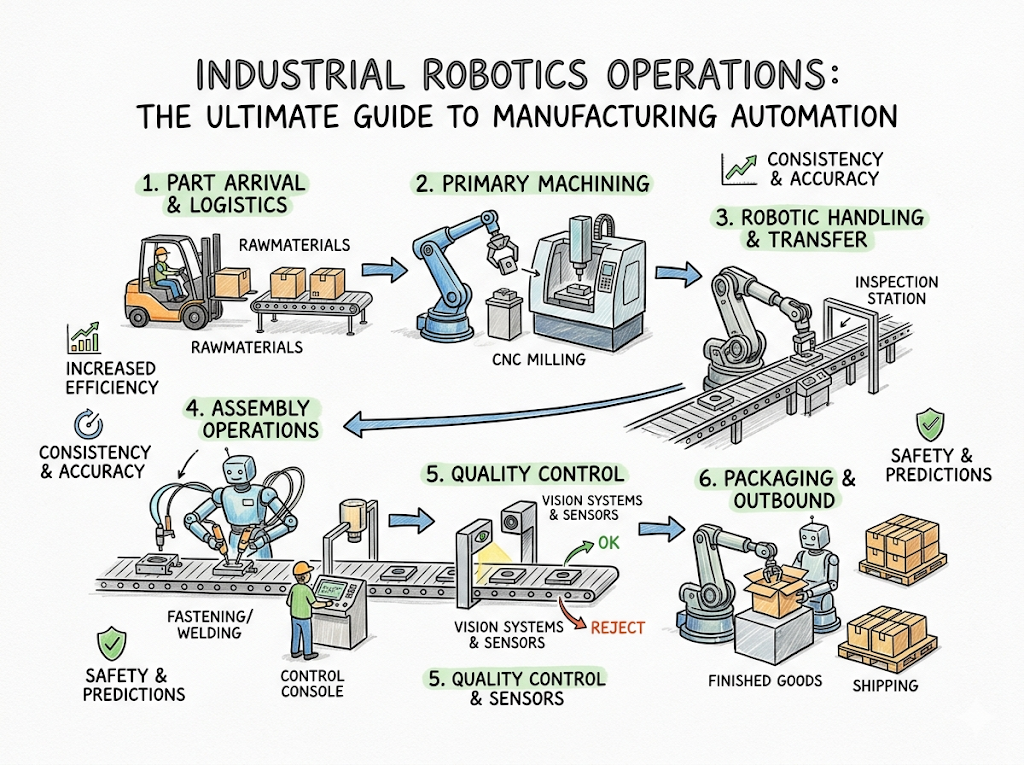
- Material Arrival & Sorting: Raw materials move onto the assembly line via automated conveyors. An industrial camera scans the incoming parts. The vision system processes the image, identifies the part orientation, and sends the coordinates to a robotic sorting arm.
- Robotic Assembly & Processing: The sorting robot picks up the component and loads it into a high-precision machining center. A PLC coordinates the movements: it clamps the part, runs the machining cycle, monitors motor torque, and commands a collaborative robot to perform a final finishing polish.
- Automated Inspection: The finished item passes under a high-resolution inspection camera. Machine learning algorithms analyze the part’s dimensions against technical blueprints. If a defect is found, a pneumatic actuator pushes the item onto a rework line. Passed items move directly to packaging.
- Data Harvesting & Feedback: Throughout this entire process, edge sensors continuously stream operational data—such as cycle times, tool wear indicators, and energy usage—back up to the SCADA system. This telemetry is archived for long-term predictive maintenance and process optimization.
Robotics Manufacturing Lifecycle
Managing automated production lines requires a clear, structured lifecycle approach. Every phase—from initial planning to continuous optimization—must be carefully executed to protect profit margins and maintain machine safety.
| Stage | Purpose | Technologies Used | Real-World Outcome |
| Production Planning | Define manufacturing goals, cycle time targets, space requirements, and total budget limits. | CAD software, ERP platforms, discrete event simulation tools. | A complete operational blueprint and a clear return-on-investment forecast. |
| Robotics Programming | Code precise movements, tool paths, safety zones, and logic rules for every machine. | ROS (Robot Operating System), manufacturer-specific languages (RAPID, KRL). | Working, validated software logic ready to drive physical mechanical arms. |
| Workflow Integration | Connect individual robots with conveyors, physical fixtures, PLCs, and safety barriers. | PROFINET, EtherNet/IP, OPC UA communication protocols, industrial wiring networks. | A completely interconnected, functional production line where devices talk to each other. |
| Automation Execution | Launch the live production run, manufacturing physical goods at scale under real conditions. | PLCs, HMIs, real-time edge control kernels. | Consistent, high-velocity output of finished products according to customer orders. |
| Monitoring | Watch machine health metrics, tracking cycle times, joint temperatures, and throughput in real time. | SCADA dashboards, cloud analytics tools, centralized control rooms. | Total operational visibility and immediate alerts when a machine strays from standard behavior. |
| Quality Control | Validate that every manufactured part meets strict engineering tolerances and design standards. | 3D laser scanners, high-resolution cameras, automated coordinate measuring machines. | Elimination of defective goods before shipping, protecting brand reputation and reducing waste. |
| Maintenance | Run routine care and replace worn parts before mechanical breakdowns cause expensive line stops. | Vibration sensors, oil analysis tools, CMMS (Computerized Maintenance Management Systems). | Maximum machine uptime, longer lifespan for expensive hardware, and safer operation. |
| Continuous Optimization | Analyze long-term data trends to shave seconds off cycle times and lower energy consumption. | Big Data analytics engines, Machine Learning models, Digital Twins. | Permanently lower production costs, higher daily throughput, and minimized factory waste. |
Popular Robotics & Manufacturing Automation Tools
To build and run modern automated systems, operations teams rely on a variety of specialized software platforms and hardware standards.
Tool Categories Explained
- Industrial Robotics Platforms: The core software systems used to program, configure, and operate industrial robotic arms. These are usually provided by the hardware manufacturers themselves or built on open-source frameworks.
- Manufacturing Automation Systems: The underlying control software and hardware architectures that manage field devices, handle real-time logic, and power the interface screens used by factory floor operators.
- Workflow Monitoring Tools: Centralized tracking software that gathers telemetry from across the production environment, allowing managers to monitor overall equipment effectiveness and identify bottlenecks.
- Industrial IoT Platforms: Cloud and edge computing environments designed to aggregate massive streams of data from thousands of scattered factory sensors, turning raw numbers into clean analytics dashboards.
- Predictive Maintenance Systems: Advanced analytical tools that process vibration, thermal, and acoustic data to spot internal component wear before an actual mechanical breakdown happens.
- Robotics Simulation Tools: Digital environments that let engineers design, program, and stress-test complete robotic workstations virtually before purchasing hardware or pausing production lines.
Tool Comparison Tables
Platforms & Control Systems
| Tool / Platform | Purpose | Difficulty | Industry Usage |
| ROS (Robot Operating System) | Open-source framework for advanced robot control and research. | High | Autonomous mobile robots, research labs, advanced logistics. |
| Siemens TIA Portal | Integrated engineering framework for programming PLCs and HMIs. | Medium to High | Global automotive, chemical processing, heavy manufacturing. |
| Rockwell Studio 5000 | Design environment for Allen-Bradley automation control architectures. | Medium to High | Food and beverage, consumer goods, North American manufacturing. |
| FANUC ROBOGUIDE | Robot simulation and offline programming software suite. | Medium | Aerospace, precision machining, material handling. |
Monitoring & Analytics Systems
| Tool / Platform | Purpose | Difficulty | Industry Usage |
| Ignition by Inductive Automation | Modern SCADA platform for industrial data gathering and HMIs. | Medium | Water treatment, energy grids, modern smart factories. |
| PTC ThingWorx | Industrial IoT platform for connecting devices and analyzing data. | Medium | Heavy equipment manufacturing, global supply chains. |
| ABB Ability | Digital solution suite for asset health monitoring and optimization. | Medium to High | Power generation, marine industries, robotics fleets. |
| MathWorks MATLAB/Simulink | Model-based design for simulating and analyzing control systems. | High | Automotive control design, aerospace engineering, R&D. |
Real-World Applications of Robotics Operations
Industrial automation is no longer an experimental luxury—it is the baseline requirement across major global manufacturing sectors. Let us look at how different industries apply these principles on their shop floors.
Automotive Manufacturing
The automotive industry was the earliest adopter of heavy industrial robots. In modern car plants, the chassis welding shop is almost entirely automated. High-capacity articulated robots manipulate heavy steel body panels, holding them in place while secondary robots execute spot welds with perfect precision. On assembly lines, collaborative robots work alongside technicians to install dashboards, apply uniform windshield adhesives, and torque critical suspension bolts to exact specifications.
Electronics Production
Precision, cleanliness, and speed define electronics manufacturing. Here, high-speed SCARA and delta robots handle delicate semiconductor wafers and microscopic surface-mount components. Since human skin flakes and dust particles ruin microchips, automated pick-and-place systems operate inside sealed cleanrooms. These robots use advanced machine vision to align components perfectly onto circuit boards before running them through automated soldering ovens.
Pharmaceutical Manufacturing
Pharmaceutical production demands total sterile compliance and absolute traceability. Robotic arms sort, fill, seal, and pack vials of life-saving medications inside sterile isolation booths. Automation systems log every step of the process, tracking ambient air quality, exact fluid measurements, and batch numbers. This ensures that the facility complies with strict regulatory standards while eliminating human contamination risks.
Food Processing and Packaging
In food production, sanitation and high throughput are the top priorities. High-speed delta robots fitted with food-safe vacuum grippers sort raw baked goods, meat products, or confectionery items into packaging trays at high speeds. Further down the line, automated cartoning systems pack individual items into master boxes, which are then passed to heavy palletizing robots that prepare large shipments for distribution warehouses.
Warehousing and Logistics
The rise of e-commerce has turned logistics into a high-tech field. Massive distribution centers utilize fleets of Autonomous Mobile Robots (AMRs) to move inventory. Instead of human pickers walking miles through warehouse aisles, these mobile platforms slide underneath multi-tier shelving units and bring the inventory directly to human packing stations, drastically cutting down fulfillment times.
[Incoming Pallet] ──► [AMR Fleet Transports Shelf] ──► [Human Packer at Station]
Textile Manufacturing
Textile manufacturing relies on automation to handle flexible, unpredictable fabrics. Automated cutting tables use laser-guided vision systems to scan rolls of cloth, detect imperfections in the pattern, and cut fabric pieces with zero material waste. Automated sewing systems use precise tension-sensing grippers to feed fabric through stitching machines, ensuring uniform seams on clothing, upholstery, and safety equipment.
Heavy Industrial Production
In steel mills, foundational foundries, and heavy machinery plants, robots take on tasks that are physically impossible or too dangerous for humans. Massive industrial arms lift, position, and machine heavy engine blocks or industrial structural beams weighing thousands of pounds. Robots also handle automated plasma cutting, high-volume sandblasting, and inspection of hot metal parts inside extreme environments.
Benefits of Robotics Operations in Manufacturing
Deploying automated systems delivers distinct advantages that improve both daily factory performance and long-term business profitability.
- Increased Productivity: Industrial robots operate continuously through lunch breaks, shift handovers, and overnight hours, keeping asset utilization high and ensuring production targets are consistently met.
- Improved Product Consistency: Eliminating manual variance ensures that every single unit produced matches strict design tolerances. This predictable quality builds brand trust and minimizes expensive warranty claims.
- Better Workplace Safety: Moving humans out of dangerous, ergonomically straining environments reduces workplace injuries, lowers workers’ compensation insurance costs, and improves team morale.
- Reduced Operational Costs: While initial capital costs are high, automation lowers the overall cost per part by reducing material waste, eliminating manual rework, and lowering utility costs in unheated or unlit robotic zones.
- Faster Production Scaling: Meeting sudden spikes in market demand becomes as simple as adjusting software settings and running automated lines for longer hours, removing the need for slow, costly seasonal hiring.
- Real-Time Operational Insights: Interconnected automation platforms stream continuous performance metrics to management, making it easy to track factory efficiency and spot line bottlenecks instantly.
- Predictive Maintenance Benefits: Catching minor mechanical wear early via sensor tracking prevents unexpected, catastrophic equipment breakdowns that can shut down an entire factory for days.
- Improved Supply Chain Efficiency: Predictable manufacturing cycle times allow enterprise procurement software to order raw materials exactly when needed, reducing expensive warehouse inventory storage costs.
Challenges & Limitations
While the benefits are clear, setting up a highly automated factory floor comes with its own set of real-world hurdles that operations teams must navigate.
High Implementation Costs
Purchasing industrial robotic arms, advanced end-effectors, precision vision sensors, and heavy safety guarding requires significant upfront capital. For small and medium enterprises, this initial financial barrier can be tough to clear.
- The Solution: Businesses can start small by automating a single bottleneck station using modular, affordable collaborative robots. They can then fund future automation steps using the savings generated by that first machine.
Integration Complexity
Integrating a brand-new, cutting-edge robot with a twenty-year-old mechanical milling machine or a legacy factory PLC system often leads to complex communication mismatches and frustrating configuration delays.
- The Solution: Use open, universally supported communication standards like OPC UA and MQTT. Working with experienced, certified systems integrators during the planning phase also prevents compatibility issues down the line.
Maintenance Requirements
While automated systems reduce manual assembly errors, they require highly specialized technical care. If a precision sensor gets dirty or a robotic joint loses its calibration, production quality can drop quickly.
- The Solution: Implement strict, data-driven preventative and predictive maintenance schedules. Installing automated sensor cleaning systems also keeps vision components clear in dusty industrial environments.
Workforce Skill Gaps
Traditional factory operators often lack the software programming, electrical troubleshooting, and data analysis skills needed to manage complex robotic workstations.
- The Solution: Invest heavily in upskilling programs for your existing workforce. Provide practical, hands-on training on simple HMI operation, fundamental robot troubleshooting, and basic safety protocols.
Cybersecurity Concerns
As soon as you connect industrial machines to a digital network to collect data, you open the door to cyber threats. A malicious network intrusion could alter robotic code, steal proprietary product designs, or lock down entire production lines.
- The Solution: Implement deep network segmentation. This means keeping critical machine control networks completely separate from the general corporate office internet, using industrial firewalls, and enforcing strict multi-factor authentication.
[Corporate Internet Network]
            │
    [Industrial Firewall] ◄── Enforces Strict Access Control
            │
[Isolated Factory Machine Network]
Infrastructure Upgrades
Modern precision robots require incredibly clean electrical power, stable industrial network cabling, high-speed local wireless connectivity, and perfectly level, vibration-isolated concrete flooring.
- The Solution: Conduct a comprehensive facility engineering assessment before purchasing hardware, ensuring the physical plant can support advanced automation without unexpected construction delays.
Operational Downtime Risks
When a human operator steps away from a manual station, a replacement can quickly step in. If a primary, highly integrated sorting robot experiences a sudden motherboard failure, the entire production line behind it can stall instantly.
- The Solution: Keep critical, high-wear spare parts directly on-site in the factory store. Build smart mechanical bypass lanes into your assembly line design so workers can temporarily route materials manually if a machine goes down.
Career Opportunities in Robotics Operations
The widespread adoption of automation has created a massive global job market for professionals who know how to keep these intelligent systems running smoothly.
Key Professional Roles
Robotics Engineer
Robotics Engineers focus on the design, physical assembly, deployment, and initial programming of robotic systems. They choose the right mechanical arms, design custom end-effectors, and program precise toolpaths for specific factory applications.
- Skills Needed: Mechanical design, CAD software, kinematics, programming (C++, Python), and robot control theory.
- Daily Responsibilities: Designing layout blueprints for new robotic workstations, writing core control logic, and troubleshooting complex mechanical issues during system deployment.
Automation Engineer
Automation Engineers focus on the broader control systems that run the entire factory floor. They integrate individual robots with conveyor networks, safety systems, and manufacturing execution software.
- Skills Needed: PLC programming (Structured Text, Ladder Logic), HMI design, industrial networking, and SCADA configuration.
- Daily Responsibilities: Writing code for industrial control panels, testing system safety interlocks, and building digital dashboards for plant floor operators.
Industrial Automation Specialist
A practical, hands-on role focused on the daily maintenance, calibration, and operational tuning of automated production machinery.
- Skills Needed: Electrical troubleshooting, fluid power systems (pneumatics, hydraulics), mechanical repair, and basic robot adjustment.
- Daily Responsibilities: Executing preventative maintenance checks, recalibrating machine vision cameras, and quickly repairing broken hardware to minimize factory downtime.
Manufacturing Systems Engineer
These professionals look at the production facility as a whole. They focus on optimizing workflow efficiency, balancing production lines, and cutting out operational waste.
- Skills Needed: Lean manufacturing principles, data analytics, discrete-event simulation, and overall equipment effectiveness (OEE) tracking.
- Daily Responsibilities: Analyzing production data to find line bottlenecks, redesigning workflow paths, and justifying the financial return on new automation investments.
Robotics Programmer
Specialized software experts who write, test, and fine-tune the high-level code that dictates exactly how advanced robotic arms move and interact with their surroundings.
- Skills Needed: Manufacturer-specific languages (ABB RAPID, FANUC KREL), ROS, path-planning algorithms, and vision system integration.
- Daily Responsibilities: Writing offline simulation programs, teaching precise pickup points to vision-guided arms, and optimizing cycle times on the live line.
Industrial IoT (IIoT) Engineer
The bridge between factory hardware and cloud data systems. They install sensors, set up communication gateways, and manage the data pipelines that power predictive maintenance platforms.
- Skills Needed: Network protocols (MQTT, OPC UA), cloud platforms (AWS, Azure), data engineering, and network security.
- Daily Responsibilities: Connecting old factory machinery to modern wireless data networks, configuring edge computing gateways, and building custom data pipelines.
Smart Factory Consultant
Strategic advisors who help manufacturing enterprises evaluate their current tech stack, design comprehensive automation roadmaps, and choose the right technology vendors.
- Skills Needed: Industrial operations expertise, business strategy, change management, and a deep understanding of Industry 4.0 trends.
- Daily Responsibilities: Conducting technology assessments on-site, building financial return-on-investment models for executive leadership, and managing large-scale digital transformations.
Salary Trends & Industry Demand
The demand for qualified automation professionals far outpaces the available talent pool. Across major hubs in North America, Europe, and rapidly growing industrial zones in India and Southeast Asia, companies are competing heavily for skilled workers. Entry-level specialists can expect strong starting compensation, while experienced systems engineers and architects command top-tier professional salaries along with significant career stability.
Beginner Roadmap for Learning Robotics Operations
Breaking into industrial automation requires a step-by-step approach. You need to build a solid foundation before moving on to complex multi-machine systems.
[1. Manufacturing & Math] ──► [2. Electronics Basics] ──► [3. Core Programming]
                                                                   │
┌──────────────────────────────────────────────────────────────────┘
▼
[4. Automation Foundations] ──► [5. PLCs & Networks] ──► [6. IoT & Optimization]
1. Manufacturing & Math Fundamentals
Before touching a robot, you need to understand the environment it operates in. Study standard manufacturing layouts, assembly sequences, and basic workshop safety protocols. Brush up on fundamental coordinate geometry and trigonometry, as robots move through three-dimensional space using X, Y, and Z axes.
2. Basic Electronics & Mechanical Systems
Learn how electricity moves through industrial circuits. Study Ohm’s law, AC/DC power distribution, and how switches, relays, and circuit breakers function. Get comfortable with basic mechanical hardware components like gearboxes, pneumatic cylinders, solenoids, and electric motors.
3. Programming Fundamentals
You do not need to be a software developer, but you must understand core coding logic. Start by learning Python, as it is widely used for industrial data analysis, machine learning applications, and working within the Robot Operating System (ROS) framework. Focus on understanding variables, loops, conditional IF-THEN logic, and structural data arrays.
4. Automation Foundations & Robotics Concepts
Study how industrial robots are built and classified. Learn the core operational differences between articulated arms, SCARA systems, and delta robots. Master the concept of coordinate systems (World, Tool, and Joint spaces) and learn how to use digital simulation software to move a virtual robotic arm safely.
5. PLCs, Sensors, & Industrial Networks
The Programmable Logic Controller is the brain of the factory floor. Learn how to read and write basic Ladder Logic or Structured Text programming. Connect these controllers to field sensors (like photo-eyes and inductive proximity switches) and study how devices exchange data over industrial networks using protocols like Modbus or EtherNet/IP.
6. Industrial IoT & Predictive Optimization
Move into high-level Industry 4.0 concepts. Learn how to collect data from edge devices using lightweight protocols like MQTT, and aggregate that data into central visualization platforms. Study how machine learning models look at vibration and thermal trends to run automated predictive maintenance routines.
Practical Action Steps for Beginners
- Get Hands-on with Affordable Hardware: Buy a basic Arduino or Raspberry Pi starter kit. Build simple circuits that use sensors to trigger small servo motor movements based on real-world inputs.
- Leverage Free Simulation Software: Download open-source platforms like RoboDK or use the educational versions of industrial suites like FANUC ROBOGUIDE or Siemens TIA Selection Tool. Practice programming robotic movements virtually without needing access to real, expensive factory hardware.
- Build a Practical Portfolio: Document your personal automation projects. Create simple videos showing your working simulations, write clear documentation explaining your code logic, and share your work on GitHub or LinkedIn to stand out to hiring managers.
Certifications & Training
Enrolling in industry-recognized certification programs is an excellent way to validate your skills, stand out to corporate recruiters, and fast-track your career.
| Certification | Level | Best For | Skills Covered |
| FANUC Robot Operations & Programming | Beginner | Field technicians, maintenance teams, entry-level programmers. | Jogging the arm, tool center point (TCP) setup, writing basic TP programs, error recovery. |
| Siemens Certified Automation Professional | Intermediate | Automation engineers, system integrators, PLC programmers. | TIA Portal configuration, advanced PLC programming, industrial network design, HMI integration. |
| Rockwell Automation Systems Technician | Intermediate | Factory maintenance personnel, industrial electricians. | Studio 5000 logic configuration, hardware diagnostics, variable frequency drive setup. |
| Certified Motion Control Professional | Advanced | Robotics design engineers, advanced system animators. | Servo motor sizing, multi-axis path synchronization, tuning high-speed electronic gears. |
Common Beginner Mistakes
- Ignoring Manufacturing Fundamentals: Many beginners jump straight into writing complex robot code without understanding the physical realities of the factory floor. If you do not understand material handling, cycle times, or physical fixture limits, your code will fail when deployed on real hardware.
- Focusing Only on the Robot, Not the Complete Workflow: A robot never works alone. It is part of a larger system. Designing a perfect robotic path means nothing if the upstream conveyor belt cannot feed parts quickly enough, or if the downstream packaging station becomes a bottleneck. Always optimize the entire workflow.
- Trying to Learn Too Many Tools at the Same Time: Do not overwhelm yourself by trying to learn FANUC, KUKA, ABB, Siemens, and Allen-Bradley programming all at once. Focus on mastering one major hardware ecosystem (like Siemens for PLCs or FANUC for robotics) first. The core principles you learn will easily transfer to other brands later.
- Skipping Industrial Automation Basics: Trying to build advanced machine vision or AI-driven robotic workflows before you understand basic electrical circuits, relay logic, and simple sensor wiring is a recipe for frustration. Build your foundation step by step.
- Relying purely on Book Learning Without Hands-on Projects: Reading textbooks and watching video tutorials is a good start, but true engineering skill is built when things go wrong. Spend time in simulation environments, build physical electronics kits, and learn how to diagnose and fix real system errors.
Best Practices for Robotics Operations
- Maintain an Automation-First Mindset: When designing or updating a factory process, look for ways to eliminate manual variance from the ground up. Standardize your part dimensions, feed mechanisms, and communication lines early to make future automation steps smooth and cost-effective.
- Enforce Continuous, Real-Time Monitoring: Never let your automated production lines run blindly. Set up real-time telemetry dashboards to track key performance metrics like cycle times and motor temperatures. Catching minor performance drops early keeps your production on track.
- Commit to Data-Driven Preventative Maintenance: Do not wait for a loud mechanical failure to take action. Use vibration, acoustic, and thermal sensors to monitor your machinery continuously, and schedule repairs during planned weekend maintenance windows.
- Enforce Strict Workflow Standardization: Keep your automation code, industrial wiring layouts, and operating procedures consistent across your entire facility. Standardizing your systems makes it much easier for maintenance teams to troubleshoot issues and speeds up new worker onboarding.
- Prioritize Multi-Layer Industrial Security: Treat your factory floor network with the same level of security as a financial system. Use dedicated industrial firewalls, isolate machine networks from office internet access, and disable unused physical USB ports on your control panels.
- Keep Complete, Up-to-Date Technical Documentation: Ensure your PLC code is well-commented, your electrical schematics are accurate, and your operational workflows are clearly mapped out. Good documentation saves hours of expensive troubleshooting time when a machine breaks down.
- Leverage Real-Time Predictive Analytics: Use edge computing platforms to analyze your factory data as it is generated. Spotting subtle patterns in tool wear or energy spikes allows you to optimize your processes on the fly and lower operational overhead.
- Plan Ahead for Long-Term Scalability: Choose modular, expandable hardware and software architectures when setting up your production lines. Designing flexible systems from the start allows you to easily add new robots or adjust workflows as your business grows.
Future of Robotics Operations
The world of industrial automation is moving fast. Driven by rapid advances in computing power, sensor technology, and artificial intelligence, the factories of tomorrow will look vastly different than those of today.
Key Evolving Trends
- AI-Driven Robotics: The next generation of industrial robots will no longer rely purely on rigid, pre-programmed paths. Powered by advanced machine learning models, these smart machines can automatically adjust their movements to handle highly irregular shapes, soft materials, or chaotic environments in real time.
- Truly Autonomous Factories: Often called “lights-out” manufacturing, these highly advanced facilities run completely independently without human operators on-site. They monitor their own supply chain balances, adjust production schedules based on incoming orders, and manage automated maintenance routines in complete darkness.
- The Exploding Growth of Cobots: Collaborative robots are becoming faster, stronger, and more affordable. They will soon be a standard tool in small-scale workshops, working directly next to craftsmen, technicians, and logistics staff without requiring bulky, expensive safety cages.
- Hyper-Connected Manufacturing Ecosystems: Cloud-native industrial platforms are linking global manufacturing networks together. If a factory in Europe finds a way to optimize a robotic path and save two seconds of cycle time, that software update can be instantly rolled out to identical machines in factories worldwide.
- Edge AI Integration: Moving heavy AI processing models directly onto local edge hardware—such as a smart sensor or a robotic controller—allows for instant decision-making. Robots can spot tiny manufacturing defects or adjust to sudden line shifts in fractions of a millisecond without waiting for cloud data returns.
- The Rise of Digital Twins: A Digital Twin is a highly accurate, real-time virtual copy of a physical factory floor. By feeding live sensor data directly into these digital models, engineers can safely run virtual tests, simulate new workflows, and predict maintenance issues before making changes to physical machinery.
[Live Physical Factory Floor Sensors] ──► (Real-Time Data Feed) ──► [Digital Twin Simulation Model]
- Advanced Predictive Industrial Analytics: As sensor technology evolves, predictive software will grow incredibly precise. Instead of simply warning operators about a generic motor issue, analytics suites will be able to pinpoint the exact bearing or gear tooth that is wearing out, providing precise timelines for repairs.
- Hyperautomation Across the Shop Floor: Hyperautomation is the practice of automating every possible process within an organization. On the factory floor, this means blending heavy industrial robotics, autonomous mobile warehouse fleets, smart inspection systems, and automated enterprise order systems into a single, fluid digital operation.
FAQs
1. What are robotics operations?
Robotics operations focus on how industrial robots are managed, monitored, and optimized within a live production environment. While traditional robotics engineering deals with designing and building the physical machine, operations center on everything that happens after installation: workflow integration, software management, performance tracking, and data-driven maintenance.
2. How do industrial robots improve manufacturing?
Industrial robots improve production lines by operating at high speeds with perfect consistency. They eliminate human errors, run continuously without fatigue, handle dangerous materials safely, and reduce factory waste. This steady performance lowers the overall cost per part and significantly increases daily factory output.
3. What is smart manufacturing?
Smart manufacturing is the practice of embedding advanced digital technologies—like wireless sensors, cloud computing, and automated data networks—directly into industrial machinery. This turns traditional production lines into an interconnected system that can analyze its own performance and adapt to changes automatically.
4. Is coding required for robotics operations?
Yes, a foundational understanding of coding logic is essential. Operations professionals use general programming languages like Python for data analysis, manufacturer-specific languages (such as ABB RAPID) to script arm movements, and specialized industrial control languages to program factory PLCs.
5. What industries use industrial robots?
Industrial robots are used across almost every major manufacturing sector, including automotive welding and assembly, high-speed electronics picking, sterile pharmaceutical filling, food packaging, large-scale warehouse logistics, and heavy metal fabrication.
6. Can beginners learn manufacturing automation?
Anyone can learn manufacturing automation with the right approach. By starting with basic electrical circuits, moving on to simple simulation tools, and building hands-on projects with affordable microcontrollers, beginners can build a strong foundation for a professional career.
7. What is Industry 4.0?
Industry 4.0 refers to the fourth industrial revolution, which integrates traditional manufacturing hardware with modern digital technologies. This includes the Industrial Internet of Things (IIoT), cloud analytics, edge computing, machine learning, and advanced robotics.
8. How long does it take to learn robotics operations?
With dedicated, consistent study, a beginner can grasp foundational automation concepts, basic PLC programming, and simple robot simulation workflows within six to nine months. Achieving master-level expertise as a systems engineer typically requires several years of hands-on factory floor experience.
9. What is a collaborative robot or cobot?
A cobot is a specialized robot designed with built-in force sensors, padded edges, and smart speed limits that allow it to work safely alongside human operators without traditional safety fences. They are ideal for shared tasks like manual assembly, packaging, and quality inspections.
10. What is a PLC and why is it important?
A Programmable Logic Controller (PLC) is a ruggedized industrial computer that controls the physical machinery on a factory floor. It reads data from sensors, processes control logic, and sends precise commands to robots, valves, and motors, serving as the central brain of the automation system.
11. What is predictive maintenance?
Predictive maintenance uses continuous sensor tracking—such as monitoring machine vibrations and temperatures—to identify internal component wear in real time. This allows maintenance teams to fix machinery before an unexpected breakdown halts production.
12. How do machine vision systems help robots?
Machine vision systems use industrial cameras and image processing software to give robots sight. This allows an automated arm to locate parts on a chaotic conveyor belt, inspect products for tiny surface defects, and adjust its movements automatically without needing rigid fixtures.
13. What is the difference between an AMR and an AGV?
An Automated Guided Vehicle (AGV) follows fixed, rigid paths along the factory floor using magnetic strips or wires embedded in the concrete. An Autonomous Mobile Robot (AMR) uses advanced onboard sensors and digital maps to navigate around obstacles independently, making it much more flexible.
14. What are the main challenges of factory automation?
The primary challenges include high upfront costs for hardware and engineering, complex integration between old and new systems, the need for specialized technical maintenance, cybersecurity risks, and a shortage of skilled workers to manage the systems.
15. How do I get my first job in robotics operations?
Focus on building a clean portfolio that highlights your practical skills. Complete recognized certification courses, build virtual workstation simulations, document your hands-on electronics projects, and share your technical journey on professional networks like LinkedIn to connect with industrial recruiters.
Final Thoughts
The transformation of global manufacturing is moving fast, and robotics operations sit at the center of this evolution. As factories around the world transition into highly automated, data-driven smart environments, the demand for traditional manual labor is decreasing, while the need for skilled automation professionals is skyrocketing. This shift represents a massive opportunity for anyone willing to invest time into learning how these advanced systems operate.
Breaking into this field requires a practical, hands-on mindset. While textbooks and theory provide a useful starting point, true engineering expertise is built on the factory floor, in simulation sandboxes, and through working with real hardware components. Do not be intimidated by the scale of modern industrial machinery. Start small: master basic electrical circuits, learn the foundational logic of PLC programming, and spend time fine-tuning movements in free simulation environments.
