Introduction
Today, we are witnessing the rise of robotics operations, a sophisticated evolution where machines are no longer just “blind” executors of code. Modern robotics systems are built to perceive, process, and react to their environment in real time. Unlike the static conveyor belts of the past, contemporary robots leverage sensor fusion, advanced control theory, and machine learning to make autonomous decisions. This shift from rigid machines to intelligent agents requires a new operational philosophy. Managing these systems—what we call “robotics operations”—is significantly different from maintaining legacy automation equipment. It involves managing data streams, software-driven feedback loops, and evolving behavioral models. By integrating these systems effectively, as discussed in professional resources like RobotsOps, enterprises can achieve unprecedented levels of precision and scalability.
What Are Robotics Operations?
Robotics operations, often referred to as “RobOps,” encompass the entire lifecycle of a robotic system, from the initial deployment and sensor calibration to ongoing software maintenance and behavioral tuning. Unlike traditional automation, which is “set it and forget it,” robotics operations treat the robot as a dynamic, evolving asset.
At the core of robotics operations is the integration of perception, logic, and actuation. These systems are designed to interact with a physical environment that is often unpredictable. For instance, an autonomous mobile robot (AMR) in a warehouse must navigate around people, dropped pallets, and changing floor layouts. It doesn’t just follow a magnetic strip; it builds a map, recognizes obstacles, and calculates the most efficient path—all in real-time.
This discipline requires a blend of mechanical engineering, computer vision, and data science. Operations teams must ensure that sensor data (like LIDAR or camera feeds) is accurately interpreted and that the robot’s software models are constantly updated to handle new environmental variables. It is the practice of maintaining “intelligence” in the field.
What Is Traditional Automation?
Traditional automation is characterized by fixed workflows and rule-based logic. Think of a high-speed assembly line in a beverage bottling plant: every bottle travels along the same conveyor belt, is filled for the exact same duration, and is capped at the same position. The machine does not “know” if a bottle is missing; it simply executes the cycle it was programmed to do.
These systems are inherently deterministic. A developer writes a set of instructions, and the machine follows them with extreme consistency. The logic is usually binary: “If X happens, then execute Y.” There is no room for ambiguity. If the input deviates from the expected parameters—such as a misaligned bottle—the system will typically continue its cycle, often causing a jam or a spill.
Legacy industrial systems, such as Programmable Logic Controllers (PLCs), are the backbone of this type of automation. They are incredibly reliable and fast for repetitive tasks, but their “intelligence” is limited to the constraints of their hard-coded programming. They are the epitome of high-speed, high-volume, but low-flexibility execution.
Core Differences Between Robotics Operations and Traditional Automation
| Feature | Traditional Automation | Robotics Operations |
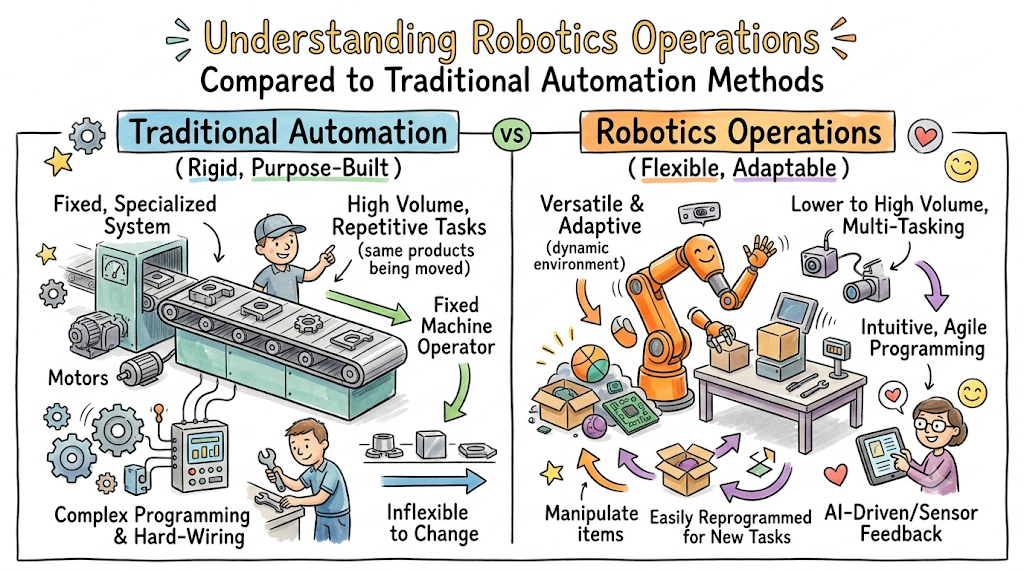
| Flexibility | Rigid; designed for specific, unchanging tasks. | Highly flexible; adaptable to different tasks. |
| Logic Basis | Rule-based (Deterministic). | Intelligence-based (Probabilistic/AI). |
| Execution | Static, pre-programmed execution. | Real-time adaptation to environmental changes. |
| Interaction | Isolated; requires safety fencing. | Collaborative; senses and responds to humans. |
| Data Usage | Simple inputs (on/off signals). | Complex sensor fusion (Vision, LIDAR, IMU). |
Architecture Comparison
Robotics Systems Architecture
A robotic system architecture is designed for “sense-think-act.”
- Sensors: Gather raw data about the environment (cameras, LIDAR, sonar).
- Controller: Processes this data, often using AI/ML to recognize objects or plan paths.
- Actuators: The physical motors and limbs that execute the move.
- Feedback Loop: A continuous, high-frequency stream of data that constantly checks if the action achieved the desired state and corrects it if it didn’t.
Traditional Automation Architecture
Traditional automation is generally “trigger-act.”
- Logic Controller (PLC): Stores a fixed sequence of operations.
- Fixed Output System: Triggers a relay or motor based on a simple input (like a proximity sensor).
- Lack of Perception: The system has no “vision” or “understanding” of the object it is moving; it simply knows that a signal was received, so it must trigger the next step.
Role of Feedback Systems
Feedback systems are the “nervous system” of robotics. In a traditional automated system, a conveyor belt motor might be instructed to run for five seconds. It doesn’t check if the belt is actually moving or if there is excessive resistance. It just runs.
In a robotics operation, however, a motor controller constantly monitors current draw, position encoders, and torque. If the robot arm hits an object, it senses an unexpected spike in resistance (torque). The feedback loop immediately tells the controller to stop the arm to prevent damage. This ability to “feel” and react is what separates a blind machine from an intelligent robot.
Intelligence and Decision-Making
Traditional automation operates on decision paths that are 100% defined by the engineer during the programming phase. If the system encounters a situation not in the code, it crashes or errors out.
Robotics operations utilize AI to handle the “unknown.” Computer vision models can identify a part even if it’s upside down or partially obscured—something a traditional proximity sensor could never do. Path-planning algorithms can recalculate a route in milliseconds if a new obstacle appears. This is the difference between a machine that follows instructions and a system that pursues a goal.
Hardware vs Software Integration
In traditional automation, software is usually a secondary “script” used to command the hardware. The hardware is the hero.
In robotics, the integration is so tight that the distinction is often blurred. The software (the “brain”) determines the capability of the hardware (the “body”). You could have the most expensive robotic arm in the world, but without a high-performance software stack for motion planning and perception, it remains a paperweight. Robotics operations emphasize “software-defined hardware,” where the robot’s capabilities can be upgraded or fundamentally changed through software updates alone.
Real-World Industrial Use Cases
- Manufacturing: A traditional system welds the same seam on the same car chassis for years. A modern robotic system uses vision to identify which model car is currently on the line and adjusts its welding path accordingly.
- Warehouse: Traditional automation uses a conveyor system to move boxes to a specific station. Robotics operations use AMRs to pick up goods from anywhere in the warehouse and navigate dynamically to the packing station.
- Inspection: A fixed sensor on a production line checks for label presence. An autonomous inspection drone flies around a refinery, using thermal cameras to detect pipe leaks that are invisible to the naked eye.
Advantages of Robotics Operations
- Adaptability: Robots can be repurposed for new products without physical retooling.
- Reduced Intervention: Intelligent systems resolve minor errors (like shifting parts) on their own.
- Precision: AI-driven vision allows for sub-millimeter accuracy in environments that are not perfectly structured.
- Scalability: You can add more robots to a fleet without redesigning the entire facility layout.
Limitations of Traditional Automation
- Rigidity: Any change in product design or floor layout requires expensive mechanical modifications.
- Single-Point Failure: A jam at one part of the conveyor line often stops the entire factory.
- Blindness: If a part falls, the system continues to operate, often wasting materials or causing damage.
- Programming Burden: Every possible scenario must be accounted for in the code; unexpected events are handled poorly.
Challenges in Robotics Operations
- Design Complexity: Building an intelligent, feedback-driven system is exponentially harder than building a linear one.
- Sensor Noise: Real-world environments are “noisy”—light changes, dust, and vibrations can confuse sensors.
- Maintenance: Robotics requires both mechanical repair and software/AI model updates.
- Cost: The initial investment for intelligent sensors and compute power is significantly higher than basic PLC-based systems.
Role of AI and Machine Learning in Robotics Operations
AI is the “force multiplier” in robotics. Computer vision allows robots to navigate unstructured environments. Machine learning enables predictive control: instead of waiting for a part to be misaligned, the robot learns to recognize the early signs of misalignment and corrects its path preemptively. Adaptive learning models mean the robot actually gets “better” and faster at its task over time as it collects more operational data.
Future of Robotics Operations vs Traditional Automation
The future is not about replacing traditional automation entirely, but about layering intelligence on top of it. We will see the decline of purely rule-based systems in favor of “hybrid” systems—where a high-speed, traditional conveyor handles the bulk transport, while intelligent robots handle the complex, variable tasks. The focus is shifting toward human-robot collaboration, where the robot acts as a teammate that can understand human gestures and voice commands.
Key Takeaways
- Robotics Operations are defined by their ability to perceive and adapt to changing environments through software and sensor fusion.
- Traditional Automation relies on fixed, deterministic logic that is efficient but incapable of handling ambiguity.
- Feedback Loops are the core mechanism that allows robots to self-regulate and perform with high precision in dynamic settings.
- AI Integration transforms robots from simple machines into intelligent systems capable of continuous improvement and autonomous decision-making.
FAQ Section
- What are robotics operations?
It is the ongoing management of a robot’s lifecycle, including software updates, sensor calibration, and behavioral optimization. - How is robotics different from traditional automation?
Robotics uses perception and feedback to adapt, while traditional automation follows a rigid, pre-programmed path. - What is traditional automation in simple terms?
It’s a “set of instructions” that a machine follows consistently, usually without any ability to check if the task was performed correctly. - Do robotics systems use AI?
Yes, modern robotics relies heavily on AI for tasks like object recognition, path planning, and predictive maintenance. - What is a feedback loop in robotics?
It’s the process where a robot constantly measures its actual performance against its goal and adjusts its motors or sensors to close that gap. - Where is traditional automation still used?
It is still the standard for high-speed, high-volume tasks where the environment and the task never change, such as bottling or basic stamping. - What are examples of robotics operations?
Examples include managing a fleet of autonomous warehouse robots or updating the vision models for a robotic pick-and-place arm. - Are robotics systems replacing traditional automation?
They are complementing it by handling the “complex” parts of the line that traditional machines cannot manage. - What industries use robotics operations the most?
Manufacturing, logistics, healthcare, and increasingly, agriculture and retail. - How can beginners learn robotics operations?
Start by learning ROS (Robot Operating System), basic Python, and understanding how sensors interact with control algorithms.
Conclusion
The distinction between robotics operations and traditional automation is the difference between a blind machine and a sensing, reacting agent. While traditional systems provide the speed and reliability necessary for the industrial age, robotics operations provide the agility required for the age of AI. As industries continue to demand more flexibility and higher degrees of autonomy, the ability to effectively manage, monitor, and optimize these intelligent systems will become a core competitive advantage. For those looking to master this field, RobotsOps serves as a vital resource for staying at the forefront of this industrial evolution.
