Introduction
Managing business finances manually creates severe operational friction. Modern organizations process hundreds of invoices monthly across various channels, but relying on manual data entry, physical follow-ups, and disconnected spreadsheets introduces high error rates and severe cash flow delays. Traditional accounts receivable processes suffer from persistent friction. Delayed invoice generation slows down customer payments, fragmented payment links lead to uncollected balances, and manual bank reconciliation burns hundreds of administrative hours every quarter. Finance teams often waste days trying to match incoming bank settlements with outstanding customer invoices. By replacing disjointed manual steps with centralized invoice and payment management software, growing enterprises accelerate collection cycles, eliminate human error, and gain complete visibility into their financial pipelines.
What is Invoice and Payment Management Software?
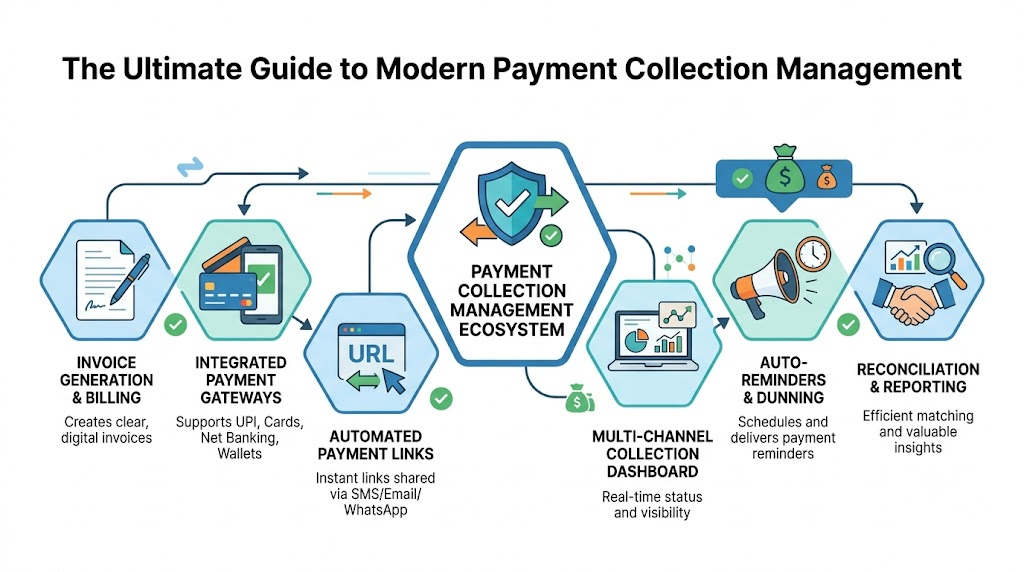
Invoice and payment management software is a centralized digital solution designed to automate the entire lifecycle of business billing, payment collection, and accounting reconciliation. Instead of handling invoicing and payments in separate, isolated tools, this software unifies both functions into one seamless operational environment.
Core Workflow Components
- Invoice Generation: Automatic creation of compliant tax invoices with dynamic payment links.
- Multi-Channel Distribution: Instant dispatch via email, WhatsApp, and customer portals.
- Payment Collection: Direct customer processing using integrated gateways (UPI, Credit/Debit Cards, Net Banking, NEFT/RTGS).
- Real-Time Settlement Tracking: Automated webhooks track payment statuses instantly.
- Ledger Reconciliation: Automated matching of incoming funds to specific open invoices.
This unified architecture eliminates data silos, ensures ledger accuracy, and gives finance leaders real-time control over corporate liquidity.
Why Modern Businesses Need Automated Payment Management
Manual payment handling creates significant blind spots that hinder business growth. As transaction volumes increase, traditional finance workflows scale poorly, leading to ballooning operational costs and strained customer relations.
+------------------+     +-------------------+     +------------------+     +-----------------------+
|  Draft Invoices  | --> | Send Payment Link | --> | Instant Gateway  | --> | Auto-Reconciliation &  |
| (GST Compliant)  |     | (WhatsApp/Email)  |     |    Collection    |     |  Ledger Update (ERP)  |
+------------------+     +-------------------+     +------------------+     +-----------------------+
Key Business Benefits
- Accelerated Cash Flow: Automated reminders and embedded payment links reduce Days Sales Outstanding (DSO) by up to 40%.
- Unmatched Financial Visibility: Live dashboards display real-time status updates for paid, pending, and overdue accounts.
- Drastic Reduction in Manual Effort: Finance teams save hundreds of hours by eliminating manual payment matching.
- Enhanced Customer Experience: Clients receive clear digital invoices with instant payment options.
Key Features of PayManagerPro
PayManagerPro is built specifically to address the complex payment operations of modern enterprises. It combines end-to-end payment tracking with automated billing workflows.
- GST Invoicing: Compliant tax invoice creation featuring structured line items, automatic HSN/SAC code lookup, and dynamic tax calculation.
- Sequential Invoice Numbering: Automated, customizable numbering schemes that enforce audit compliance.
- Smart Payment Links: Dynamic, itemized payment links supporting partial payments, custom expiration dates, and automated reminders.
- Centralized Collection Dashboard: A unified operational hub displaying total receivables, pending collections, and real-time settlement updates.
- Multi-Gateway Integrations: Native support for major Indian payment gateways like Razorpay, Cashfree, and Paytm.
- Advanced Financial Reporting: Detailed, downloadable reports covering collection ageing, ledger health, and transaction logs.
- Automated Reconciliation Engine: Real-time matching of bank settlements with pending accounts receivable records.
- Robust API Infrastructure: RESTful APIs for seamless two-way synchronization with existing ERPs, CRMs, and accounting platforms.
- Enterprise Approval Workflows: Customizable maker-checker permissions that safeguard corporate disbursements and billing changes.
- Immutable Audit Logs: Complete historical tracking of user activity, invoice changes, and payment status updates.
Explore our comprehensive feature set on the Invoice Management, Payment Links, Reconciliation, Reports, and Dashboard pages.
GST Invoice Software in India
Operating an enterprise in India requires strict compliance with tax guidelines mandated by the GST Council and monitored via the Ministry of Corporate Affairs. Manual tax calculations frequently result in incorrect filing, leading to penalties and delayed Input Tax Credit (ITC) claims for buyers.
Navigating Tax Structure Compliance
A robust enterprise platform automatically calculates and categorizes tax components based on transaction locations:
- CGST & SGST: Automatically applied to intra-state transactions.
- IGST: Calculated for inter-state commercial transactions.
Proper software ensures your invoices contain mandatory fields, including full GSTIN details, correct HSN/SAC codes, state codes, and proper e-invoicing signatures where required. Automated tax reporting simplifies monthly return filings (such as GSTR-1), reducing non-compliance risks and keeping your financial audit trail pristine.
Payment Link Management
Modern payment collection relies on speed and flexibility. Static bank details slow down transactions, whereas dedicated payment links allow customers to complete payments in seconds.
Dynamic Payment Link Features
- Multi-Channel Distribution: Share dynamic payment links instantly via WhatsApp, SMS, and Email.
- Flexible Payment Terms: Enable partial payment options for large enterprise contracts or upfront deposits.
- Expiration Management: Set strict link expiration windows to enforce payment schedules.
- Real-Time Status Tracking: Monitor link state changes from Created to Viewed, Attempted, and Settled.
Automated Payment Collection
Relying on a single payment gateway leads to collection bottlenecks when downtime occurs. Integrated automated payment collection management software lets businesses route payments through multiple gateways using a single interface.
By supporting UPI, Credit/Debit Cards, Digital Wallets, and Net Banking, PayManagerPro helps your customers pay through their preferred methods. Automated routing ensures maximum transaction success rates, instant payment capture, and low transaction failure fees.
Invoice Payment Tracking Software
Unpaid bills hurt corporate growth. Without centralized tracking software, account managers waste valuable time chasing overdue balances without knowing their exact payment status.
Optimizing Accounts Receivable Performance
- Real-time Balance Monitoring: View current outstanding balances by client, department, or business unit.
- Collection Ageing Analytics: Categorize unpaid invoices into 30, 60, and 90+ day buckets to prioritize collections.
- Automated Overdue Reminders: Schedule personalized notification sequences across email and messaging channels before and after due dates.
Automated Payment Reconciliation
Matching incoming payments against pending invoices is often the most time-consuming task for finance teams. Unidentified bank transfers create manual workloads and obscure real-time collection metrics.
Achieving High Match Rates
Automated payment reconciliation engines match settlement payouts with outstanding customer ledgers using unique transaction IDs, virtual account numbers, and dynamic invoice metadata.
When exceptions happen—such as short payments or unidentifiable bank transfers—the platform flags the issue for manual review without stopping the rest of your automated accounting workflow. This maintains complete financial accuracy and protects your ledger integrity.
Accounts Receivable Automation
Accounts receivable automation software turns manual, reactive billing into an efficient, predictable system.
+-----------------------------------------------------------------------------------+
|                            INVOICE-TO-CASH AUTOMATION                             |
+-------------------+     +-------------------+     +-------------------+     +-----+
| 1. Invoice        |     | 2. Multi-Channel  |     | 3. Instant        |     | 4.  |
|    Creation       | --> |    Payment Link   | --> |    Collection     | --> |     |
| (GST Validation)  |     | (WhatsApp/Email)  |     | (UPI/Cards/NetB)  |     |     |
+-------------------+     +-------------------+     +-------------------+     +-----+
                                                                                |
+-------------------+     +-------------------+                                 |
| 6. Reporting &    |     | 5. Automated      | <-------------------------------+
|    Analytics      | <-- |    Reconciliation |
| (Audit-Ready)     |     | (Ledger Sync)     |
+-------------------+     +-------------------+
By connecting invoice creation, smart reminder sequences, multi-channel payment options, and automated ledger updating, your finance department operates with minimal manual intervention. The result is lower administrative costs, faster collection cycles, and improved cash forecasting.
Invoice-to-Cash Automation
The invoice-to-cash lifecycle covers every step between issuing a bill and reconciling the final payment.
- Invoice Generation: Draft compliant digital invoices with automatic tax calculations.
- Payment Link Generation: Create itemized, secure payment links tied to the invoice ID.
- Multi-Channel Collection: Receive funds securely through integrated payment gateways or virtual bank accounts.
- Settlement Processing: Gateways settle collected funds directly into your corporate accounts.
- Automated Reconciliation: Match settled deposits to open invoices instantly.
- Financial Reporting: Update corporate financial dashboards and ledger accounts automatically.
Enterprise Payment Management
Large organizations operating across multiple divisions require enterprise-grade controls, granular user permissions, and scalable infrastructures.
An enterprise payment management platform provides central governance while giving local operational teams the flexibility they need. Features like Maker-Checker approvals ensure senior managers review critical transactions or invoice updates before dispatch.
By connecting disparate branch offices through centralized REST APIs, corporate finance leaders maintain complete control over global cash flows, payment routing rules, and enterprise risk parameters. Learn more about our technical foundation on the API, Pricing, and About Us pages.
Security & Compliance
Financial data management demands strict security protocols, complete privacy controls, and audit readiness.
Key Compliance Frameworks
- Data Encryption: End-to-end TLS 1.3 encryption for data in transit, paired with AES-256 encryption at rest.
- Access Control: Role-Based Access Control (RBAC) ensures employees access only authorized records.
- Audit Trails: Immutable logging of every invoice creation, editing action, payment attempt, and ledger change.
- Regulatory Alignment: Built in compliance with Indian financial guidelines set by the Income Tax Department and standard corporate accounting practices.
Integration Capabilities
Disjointed software stacks stall operational momentum. PayManagerPro integrates easily into your existing financial ecosystem via webhooks and developer-friendly RESTful APIs.
- Payment Gateways: Built-in connectors for Razorpay, Cashfree, Paytm, and traditional banking APIs.
- ERP Systems: Seamless data sync with platforms like SAP, Oracle, Microsoft Dynamics, and Tally.
- CRM Platforms: Native compatibility with Salesforce, HubSpot, and Zoho CRM to track payment statuses right from sales pipelines.
Industry Use Cases
Manufacturing
Automate large-scale distributor collections, handle structured milestone payments, and streamline inter-state IGST compliance across multiple factory branches.
Healthcare
Manage hospital billing workflows, process insurance co-pays securely, and offer patients easy mobile payment links for outstanding balances.
Education
Simplify fee collection for schools and universities through scheduled, recurring payment links sent directly to parents via WhatsApp and email.
Logistics & Supply Chain
Accelerate freight payments, collect COD settlements digitally, and reconcile complex vendor invoices automatically across logistics routes.
Retail & E-Commerce
Unify online payment gateway collections with offline store invoices into a single, real-time financial reporting platform.
SaaS & Subscription Businesses
Automate monthly recurring billing, handle subscription upgrades or downgrades, and manage churn with automated failed-payment reminders.
Agencies & Professional Services
Send detailed, project-based milestone invoices with embedded payment links to collect client fees faster.
Manual Process vs. PayManagerPro
| Feature / Metric | Manual Finance Processes | PayManagerPro Platform |
| Invoice Creation | Manual data entry in spreadsheets (15–20 mins/invoice) | Instant automated creation (< 30 seconds) |
| Payment Collections | Bank transfers via static account details | Multi-channel instant payment links |
| Reconciliation | Manual line-by-line bank statement matching | Real-time automated ledger matching |
| Financial Reporting | Delayed end-of-month manual preparation | Real-time interactive financial dashboards |
| Error Rate | High risk of human error and lost records | Virtually zero data entry and calculation errors |
| Processing Time | Days or weeks to settle and log payments | Immediate collection and automated settlement |
Key Business Benefits
Adopting dedicated invoice and payment management software offers clear operational advantages:
- Faster Payments: Reduce collection times by giving clients instant, multi-channel payment options.
- Optimized Cash Flow: Predictable collection cycles ensure stable operational liquidity.
- Reduced Operating Costs: Automating routine finance tasks cuts administrative overhead costs significantly.
- Fewer Human Errors: Automated tax calculations and ledger updates keep financial data clean.
- Actionable Financial Insights: Live analytics help management make informed cash flow decisions.
Best Practices for Payment Management
To maximize your accounts receivable automation software, implement these proven operational strategies:
- Send Invoices Immediately: Issue bills right after delivering products or completing service milestones.
- Provide Multiple Payment Methods: Let customers pay using UPI, cards, net banking, or direct transfers.
- Automate Payment Reminders: Set gentle automated follow-ups 3 days before and 1, 7, and 14 days after due dates.
- Reconcile Accounts Daily: Keep bank statements and receivables matched daily to maintain live cash flow visibility.
- Review Collection Analytics: Track aging metrics weekly to spot payment delays early and adjust terms accordingly.
Common Mistakes to Avoid
Finance teams often fall into operational traps that stall cash flow and complicate tax compliance.
- Manual Payment Tracking: Tracking payments in spreadsheets leads to missed follow-ups and uncollected debt.
- Ignoring Overdue Follow-ups: Inconsistent payment reminders encourage late payments from clients.
- Creating Duplicate Invoices: Poor invoice numbering management creates customer friction and accounting errors.
- Incorrect GST Calculations: Miscalculating HSN/SAC codes or SGST/CGST/IGST splits leads to tax compliance penalties.
- Delayed Reconciliation: Waiting until month-end to reconcile transactions hides cash flow bottlenecks and increases workload.
The Future of Digital Payment Management
Business payment operations are evolving rapidly. Organizations are shifting away from manual accounting toward real-time, API-driven finance architectures.
Modern platforms are introducing AI-driven reconciliation engines capable of matching complex, multi-item payments automatically. At the same time, embedded finance APIs allow software platforms to offer real-time credit checks, automated working capital loans, and dynamic payment options directly within invoicing workflows.
Adopting a modern, API-first enterprise payment management platform ensures your finance operations stay compliant, efficient, and ready to scale.
Frequently Asked Questions
What is accounts receivable automation software?
Accounts receivable automation software is a financial management platform that automates invoicing, payment reminders, multi-channel payment collection, and ledger reconciliation. It eliminates manual data entry, cuts down collection delays, and updates corporate accounting records in real time.
How does PayManagerPro simplify GST compliance?
PayManagerPro automatically calculates CGST, SGST, and IGST based on customer locations and HSN/SAC codes. It generates compliant invoice formats with custom numbering rules, dynamic payment links, and structured tax reports, simplifying monthly GST returns.
Can I share payment links via WhatsApp and Email?
Yes. PayManagerPro lets you generate dynamic payment links tied directly to specific invoice numbers and share them instantly via WhatsApp, Email, or SMS. Customers can click and complete payments using their preferred payment methods.
How does automated payment reconciliation work?
The reconciliation engine automatically matches incoming gateway settlements and bank transfers with open customer invoices using unique payment IDs, amounts, and virtual account details. This eliminates manual statement matching and keeps ledgers accurate.
Does the software integrate with existing ERPs and accounting tools?
Yes. PayManagerPro offers RESTful APIs and pre-built connectors that integrate smoothly with major ERPs, CRMs, and accounting platforms like SAP, Tally, Zoho, and Salesforce for bi-directional data updates.
How do multi-gateway integrations benefit my business?
Integrating multiple payment gateways like Razorpay, Cashfree, and Paytm through a single dashboard reduces transaction failures. If one gateway suffers downtime, payments automatically route through alternative options, keeping success rates high.
What payment methods can my customers use?
Customers can pay using UPI, Credit Cards, Debit Cards, Digital Wallets, Net Banking, and direct bank transfers (NEFT/RTGS/IMPS) via dynamic payment links or integrated customer portals.
Is automated payment collection secure for enterprise use?
Yes. Enterprise platforms use bank-grade security protocols, including TLS 1.3 data encryption in transit, AES-256 encryption at rest, Role-Based Access Controls (RBAC), immutable audit logs, and strict financial compliance checks.
How does invoice-to-cash automation improve cash flow?
By automating instant invoice delivery, multi-channel payment links, pre-scheduled payment reminders, and real-time reconciliation, businesses shorten payment cycles, reduce Days Sales Outstanding (DSO), and maintain stable operational liquidity.
What happens if a customer makes a partial payment?
PayManagerPro supports configurable partial payment settings. When a partial payment occurs, the software updates the outstanding balance on the invoice, logs the transaction in the ledger, and updates the payment link to reflect the remaining due amount.
What enterprise security features are included?
The platform includes Maker-Checker authorization workflows, full audit trail logging, fine-grained user permission controls, secure API key management, and complete data encryption standards designed for complex corporate finance operations.
How do dynamic payment links handle link expiry?
You can set explicit expiration windows on any generated payment link. Once expired, the link prevents further payment attempts, prompting the customer to request an updated invoice link or encouraging timely payment settlement.
Conclusion
Manual invoicing, delayed follow-ups, and tedious statement reconciliation slow down business growth and drain internal resources. Modern enterprises need speed, flexibility, and absolute precision across their payment workflows to protect their cash flow and maintain operational stability. Adopting a specialized accounts receivable automation software platform transforms your entire invoice-to-cash pipeline. By unifying tax-compliant GST invoicing, dynamic payment link distribution, multi-gateway collection tracking, and real-time bank reconciliation into a single dashboard, your finance team saves hundreds of operational hours while significantly reducing payment friction.
