Modern manufacturing is undergoing a massive transformation. Walk into a cutting-edge factory today, and you will see a bustling environment where automation drives the entire production line. In this rapidly changing landscape, industrial robots are no longer just optional tools; they are the backbone of high-volume production. To keep up with changing consumer demands, factories must produce items faster, minimize waste, and maintain flawless quality. For more insights on the latest automation trends, you can check out the educational resources available at RobotsOps.com. However, hardware alone is not enough. For a robot to be truly useful, it must execute its duties with flawless accuracy. A single misplaced weld or a misaligned smartphone screen can halt an entire assembly line, costing companies thousands of dollars per minute.
What Does It Mean for Robots to Learn?
When we talk about “robot learning,” it is easy to picture a sci-fi movie where a machine suddenly develops human-like consciousness. In reality, robot learning is much more grounded, practical, and fascinating.
Definition of Robot Learning
At its core, robot learning is the process by which an industrial machine improves its performance on a specific task over time by processing data, recognizing patterns, and adapting to new inputs, rather than relying solely on static, pre-written commands.
The Difference Between Programming and Learning
To understand this shift, imagine teaching a child how to navigate a room:
- Traditional Programming: This is like giving the child a strict, blindfolded map: “Take three steps forward, turn ninety degrees right, and take two steps forward.” If someone moves a chair into that path, the child will crash into it because they are simply following rigid, hardcoded rules.
- Robot Learning: This is like giving the child eyes and a goal: “Walk to the door without hitting anything.” The child uses their senses to see the chair, calculate a detour, and successfully reach the destination. Instead of relying on a human to write every single line of code for every possible scenario, the machine uses algorithms to figure out the best path forward.
Why Learning Matters in Manufacturing
In the past, factories set up assembly lines that stayed exactly the same for years. Today, manufacturing demands extreme flexibility. Companies now switch between different product models on the same day. If engineers had to manually rewrite thousands of lines of code every time a product design shifted by a few millimeters, production would grind to a halt. Learning allows robots to adjust to these minor variations autonomously.
Common Learning Approaches
Robots typically learn through a combination of data-driven methods. This includes watching human operators demonstrate a task, practicing movements in a virtual simulator, or using mathematical trial-and-error models to discover the most efficient way to pick up an object without dropping it.
How Robots Learn Manufacturing Tasks
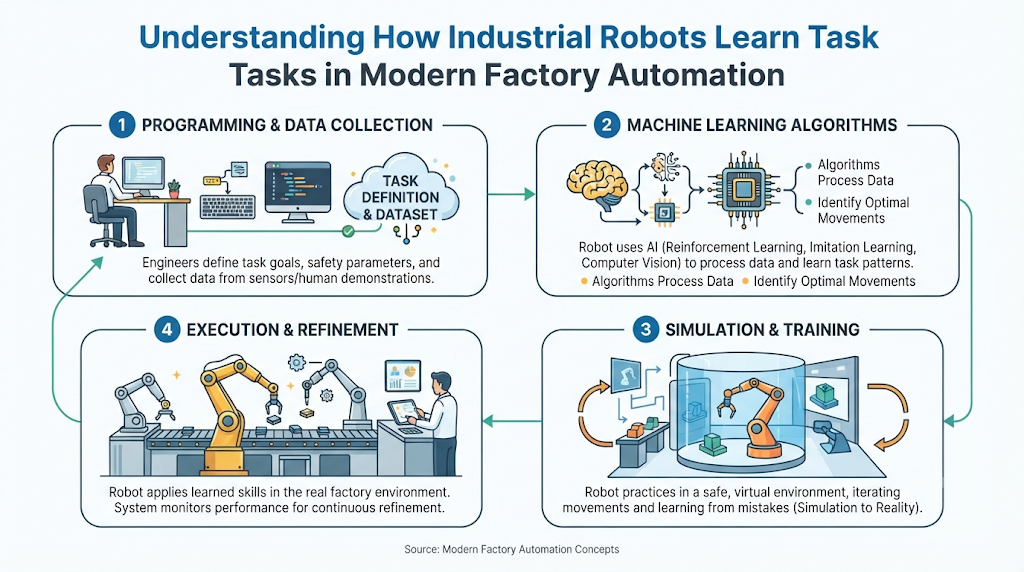
Teaching an industrial robot a new skill is a step-by-step journey that blends human guidance with advanced technology. Let us look at how this happens on the factory floor.
[Human Demonstration / Data Collection] ➔ [Basic Instructions] ➔ [AI & Machine Learning Processing] ➔ [Sensor & Vision Adjustments] ➔ [Continuous Self-Improvement]
1. Collecting Data
Before a robot can perform a task, it needs information. This step involves gathering data about the environment, the objects the robot will handle, and the goals it needs to achieve.
2. Human Demonstration
One of the most natural ways to teach a robot is through demonstration. A human worker might physically guide the robot arm through a precise path (a process called “lead-through programming”) or use a handheld joystick device to map out the movements. The robot records these coordinates into its memory.
3. Programming Basic Instructions
Engineers establish the baseline rules. They define the boundaries of where the robot can safely move, how much weight it can lift, and its ultimate objective. This gives the robot a safe sandbox to operate within.
4. Machine Learning
Once the baseline is set, machine learning algorithms take over. If a robot needs to sort good parts from defective parts, it is fed thousands of digital examples. Over time, the software learns to identify the subtle differences between a perfect item and a scratched one without a human explicitly defining every type of scratch.
5. Computer Vision
Think of computer vision as the robot’s eyes. Specialized industrial cameras take high-speed photos of the workspace. The robot’s brain analyzes these images in milliseconds, allowing it to locate a part on a moving conveyor belt, even if the part is upside down or crooked.
6. Sensor Feedback
Moving accurately requires a sense of touch. Built-in sensors constantly feed data back to the robot. If a robot is trying to push a delicate chip into a slot, force sensors tell it exactly how hard to push so it secures the part without snapping the plastic.
7. Continuous Improvement
The learning does not stop once production begins. As the robot repeats the task millions of times, it continuously analyzes its own performance data. It learns to optimize its acceleration, reduce friction, and fine-tune its paths to become faster and more energy-efficient every single day.
Technologies That Help Robots Learn
An industrial robot is a complex ecosystem of hardware and software working in perfect harmony. Several core technologies act as the building blocks for modern robot learning.
Artificial Intelligence (AI) and Machine Learning (ML)
AI serves as the overall cognitive framework, giving machines the ability to problem-solve. Machine learning is the specific engine inside AI that allows the robot to learn from past data. For instance, if a robot encounters a slightly heavier metal sheet than usual, ML algorithms help it calculate the extra grip force needed instantaneously.
Deep Learning
A specialized subset of machine learning, deep learning uses artificial neural networks inspired by the human brain. This technology is crucial for complex tasks like identifying microscopic cracks in airplane wings or sorting highly irregular objects, such as different types of fresh produce on a food packaging line.
Computer Vision and Cameras
High-definition, 3D, and infrared cameras map out the physical world into digital data that the robot can read. This allows the system to understand depth, distance, and orientation in real-time.
Force and Torque Sensors
These sensors give the robot a highly refined sense of touch. Located in the robot’s “wrist” or joints, they measure the resistance the robot encounters, allowing it to perform incredibly delicate tasks like polishing glass or buffing car doors without applying too much pressure.
Digital Twins
A digital twin is a perfect, virtual replica of the physical robot and the factory floor. Before a robot ever moves in the real world, engineers test its learning algorithms in this digital simulation. This saves time, protects expensive hardware from crashing during the trial phase, and ensures absolute safety.
Internet of Things (IoT)
Industrial IoT connects all machines on a factory floor to a centralized network. By sharing data across the network, a robot at one end of the factory can learn from the experiences and mistakes of a robot operating on the other side of the facility.
Common Manufacturing Tasks Robots Learn
Industrial automation relies on self-learning machines to execute a wide variety of labor-intensive tasks with extreme repetition and precision.
- Assembly: Robots learn to fit tiny, intricate parts together, such as threading a screw into a smartphone casing. Learning allows them to adjust if the casing is slightly out of position.
- Welding: In automotive plants, robots learn to trace complex seams on car frames. They use sensors to adjust the heat and speed of the weld in real-time based on the thickness of the metal.
- Painting: Robots learn the precise paths needed to apply uniform coats of paint without creating runs or thin spots, adapting immediately to different vehicle body styles.
- Pick-and-Place: This involves grabbing objects from one location and placing them in another. Learning helps the robot recognize and pick random objects piled haphazardly in a bin.
- Packaging: Robots learn to sort, orient, and stack products into boxes at lightning speeds, automatically adjusting their grip based on whether they are handling heavy cans or fragile potato chip bags.
- Quality Inspection: Equipped with computer vision, learning robots inspect products at the end of the line, instantly spotting microscopic defects that human eyes might miss after a long shift.
- Material Handling and Machine Tending: Robots learn to load raw metal bars into heavy stamping machines and retrieve the finished parts safely, adjusting their movements to avoid collisions with open machinery doors.
- Palletizing: Learning algorithms help robots calculate the most efficient way to stack boxes of various shapes and sizes onto a shipping pallet, maximizing space and stability like a high-speed game of Tetris.
Benefits of Robot Learning in Manufacturing
Transitioning from rigid programming to dynamic robot learning offers profound advantages for modern factories.
- Improved Accuracy: Learning systems constantly correct their own errors, ensuring movements are accurate down to fractions of a millimeter.
- Faster Production: By optimizing their own paths and avoiding unnecessary movements, self-learning robots cut seconds off cycle times, resulting in higher daily output.
- Better Product Quality: Consistency is the key to quality. Robots do not get tired, distracted, or suffer from muscle fatigue, meaning the millionth product looks exactly like the first.
- Reduced Human Error: Automating complex decision-making processes removes the risk of manual mistakes, drastically lowering scrap rates and material waste.
- Increased Workplace Safety: Dangerous tasks involving extreme heat, sharp edges, or toxic fumes are handed over to robots, protecting human workers from severe workplace injuries.
- Flexible Manufacturing: Factories can swiftly pivot to producing new designs simply by uploading new data models to the robots, avoiding expensive mechanical retooling.
- Lower Operational Costs: Higher speed, reduced waste, fewer safety incidents, and lower energy usage combine to significantly reduce the overall cost of running a factory.
Challenges of Teaching Robots
Despite the incredible advancements, deploying self-learning robots on the factory floor is not without its hurdles.
Complex Environments
Factories are noisy, dusty, and visually chaotic places. Forklifts drive by, lighting conditions change throughout the day, and dust can coat camera lenses. Teaching a robot to ignore these distractions and focus purely on its task is a major challenge.
Data Quality
Machine learning models are only as good as the data used to train them. If engineers feed the robot poor-quality images or incorrect coordinates during the training phase, the robot will learn to perform the task incorrectly—a concept known as “garbage in, garbage out.”
Sensor Limitations and Safety Requirements
Sensors can experience lag or malfunction in extreme environments. Furthermore, because these robots are massive, fast-moving machines, ensuring they stop instantly if a human steps into their workspace requires failsafe, highly complex safety algorithms.
Integration, Cost, and Maintenance
Merging modern, AI-driven robots with legacy factory equipment built decades ago can be technically frustrating. Additionally, the initial cost of advanced sensors and software is high, and maintaining these intelligent systems requires specialized technical expertise.
Real-World Industry Examples
Let us look at how different sectors utilize robot learning to revolutionize their daily production output.
Automotive
Car manufacturers use self-learning robots to handle multi-model assembly lines. A single robotic arm can spot an SUV chassis coming down the line, apply a specific bead of sealant, and then immediately adjust its path for a compact sedan right behind it without stopping the line.
Electronics
In smartphone and semiconductor production, components are too small for human fingers to assemble reliably. Robots use micro-vision systems to learn how to place processors onto circuit boards with perfect alignment.
Food and Beverage
Robots learn to handle delicate, irregularly shaped food items. For instance, bakery lines use vision-guided robots to pick up softly baked croissants without squishing them, placing them neatly into plastic trays.
Pharmaceutical Manufacturing
Precision is life-or-death here. Robots learn to sort, fill, and cap millions of medicine vials, using vision systems to verify that every single bottle contains the exact liquid dosage required.
Logistics and Consumer Goods
E-commerce fulfillment centers employ robots that have learned how to identify, grip, and box thousands of completely different consumer products—from heavy laundry detergent bottles to soft t-shirts—flawlessly.
Aerospace
Building airplanes requires working on massive scales with zero tolerance for error. Aerospace facilities use self-learning robots to drill thousands of perfectly straight rivetholes into curved carbon-fiber wings, measuring the depth and angle of each hole continuously.
Future Trends in Robotic Learning
The world of robotics is moving at an incredible pace. As we look toward the future, several exciting trends are set to redefine how factories operate.
[Industry 4.0: Connected Automation] ➔ [Industry 5.0: Human-Robot Collaboration & Autonomous Self-Learning Systems]
AI-Powered Collaborative Robots (Cobots)
The next generation of automation focuses heavily on Cobots. These are smaller, lighter robots designed to work directly alongside humans without safety cages. Advanced AI helps them learn human habits, allowing them to predict when a human worker needs a part handed to them.
Reinforcement Learning and Edge AI
Reinforcement learning allows robots to learn through virtual trial and error, receiving digital “rewards” when they perform a task correctly. By processing this data right on the machine using Edge AI, rather than sending it to a distant cloud server, the robot can make split-second decisions instantly.
Cloud Robotics and Autonomous Manufacturing
Cloud robotics allows factories worldwide to pool their operational data together. A robot in Germany that figures out a better way to weld aluminum can instantly upload that knowledge to the cloud, updating a robot in the United States overnight. This paves the way for truly autonomous manufacturing, where systems self-correct and optimize without human intervention.
Transitioning to Industry 5.0
While Industry 4.0 focused heavily on pure automation and machine connectivity, Industry 5.0 brings the human element back to the forefront. It emphasizes a harmonious partnership between human creativity and robotic precision, using self-learning machines to handle the mundane tasks so humans can focus on innovation and design.
Traditional Robot Programming vs. Robot Learning
| Feature | Traditional Programming | Robot Learning | Key Difference |
| Adaptability | None. Fails if variables change. | High. Adapts to new layouts and parts. | Learning handles real-world chaos; programming requires absolute consistency. |
| Setup Time | Weeks or months of manual coding. | Days of training and data feeding. | Learning relies on data models rather than manual, line-by-line coding. |
| Human Oversight | Required for every single modification. | Needed for initial training and supervision. | Learning shifts humans from strict coders to high-level supervisors. |
| Error Handling | Stops production and throws an error code. | Attempts to self-correct using sensor data. | Learning allows the machine to problem-solve through unexpected variations. |
Technologies Used for Robot Learning
| Technology | Primary Purpose | Manufacturing Application | Main Benefit |
| Machine Learning | Pattern recognition and prediction. | Sorting and predictive maintenance. | Minimizes downtime by spotting errors before they happen. |
| Computer Vision | Visual identification and mapping. | High-speed picking and inspection. | Gives the machine visual awareness of its surroundings. |
| Force Sensors | Measuring pressure and physical resistance. | Precision polishing and assembly. | Prevents part breakage through a delicate sense of touch. |
| Digital Twins | Virtual testing and simulation. | Pre-deployment software stress testing. | Drastically reduces real-world installation risks and damage. |
Frequently Asked Questions (FAQs)
What is the difference between an automated robot and a learning robot?
An automated robot follows a strict, repetitive script and cannot change its behavior if its environment changes. A learning robot uses sensors and AI algorithms to analyze its surroundings and adapt its movements to handle unexpected variations automatically.
Do manufacturing robots learn completely on their own?
No. Robots require initial human guidance, curated datasets, and strict behavioral boundaries set by engineers to learn safely and effectively. They excel at self-optimization within those human-defined rules.
What happens if a learning robot makes a mistake on the assembly line?
If a learning robot makes an error, its internal sensors register the deviation from the goal. The system logs this failure data, modifies its algorithmic path, and adjusts its next attempt to prevent the same mistake from happening again.
What technologies are most critical for robot learning?
The most critical technologies include machine learning algorithms for decision-making, computer vision cameras for sight, force-torque sensors for tactile feedback, and digital twins for risk-free virtual simulation training.
Will self-learning robots completely replace human workers in factories?
No. While they take over dangerous and repetitive physical tasks, they do not replace humans. Instead, they shift human roles toward high-level system supervision, data analysis, robot maintenance, and creative engineering design.
How long does it take to teach a robot a new manufacturing task?
Depending on complexity, it can take anywhere from a few hours to several days. Simple demonstration-based tasks can be learned quickly, while highly complex visual inspection tasks require days of training on thousands of image samples.
What is a digital twin and how does it help a robot learn?
A digital twin is a virtual replica of the physical robot and factory line. It allows engineers to train and test a robot’s learning software in a simulated environment, eliminating the risk of real-world equipment damage during the trial phase.
Can a robot trained in one factory share its knowledge with a robot in another?
Yes. Through cloud robotics and industrial IoT networks, the operational data and optimized paths learned by a robot at one facility can be instantly uploaded and deployed to identical robots worldwide.
What are the main challenges in deploying self-learning industrial robots?
The primary challenges include managing dirty, unpredictable factory environments, ensuring high-quality training data, high initial setup costs, and integrating new AI software with decades-old legacy machines.
What is the role of Industry 5.0 in robotic manufacturing?
Industry 5.0 focuses on a collaborative relationship where humans and intelligent, self-learning robots work side-by-side. It combines the high precision and speed of automation with unique human problem-solving and creativity.
Conclusion
The evolution of industrial automation has brought us to a point where robots are no longer just mechanical muscle—they are becoming intelligent, adaptive partners on the production floor. By leveraging the power of artificial intelligence, machine learning, high-tech sensors, and continuous feedback loops, modern robots can learn and master manufacturing tasks with unprecedented agility. Despite these incredible technological leaps, human expertise remains completely irreplaceable. The future of manufacturing relies on human engineers, programmers, and operators to design these advanced frameworks, supervise operations, and guide machine development safely. As technology moves forward, the synergy between human ingenuity and self-learning robotics will make the factories of tomorrow incredibly efficient, flexible, and intelligent.
