Imagine walking into a massive distribution center where a fleet of driverless vehicles moves smoothly along the aisles, stopping for pedestrians, picking up heavy loads, and delivering parts to assembly lines exactly when needed—a reality made possible by modern industrial automation. As global supply chains face mounting pressure to move goods faster, reduce operational costs, and keep workers safe, companies are rapidly turning to smart manufacturing solutions highlighted on RobotsOps.com. At the heart of this logistical shift are Automated Guided Vehicles (AGVs), which transform material handling and logistics operations by replacing manual labor with predictable, round-the-clock robotic efficiency.
What Are Automated Guided Vehicles (AGVs)?
Definition
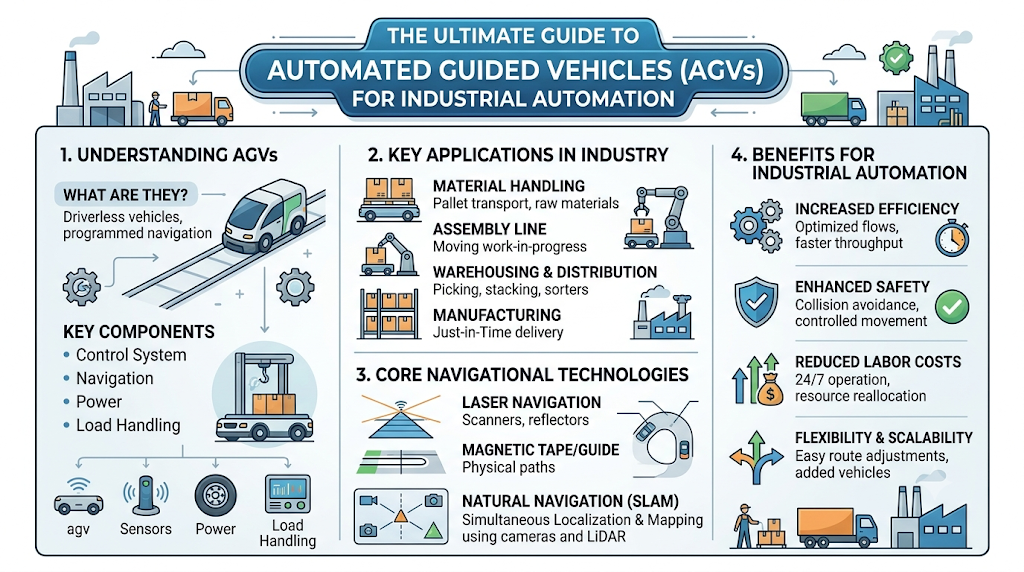
An Automated Guided Vehicle (AGV) is a portable, driverless robot used to transport materials within a warehouse, distribution center, or manufacturing facility. Unlike a traditional forklift operated by a human, an AGV moves automatically along predefined paths without a driver onboard.
Basic Working Principle
To understand how an AGV works, think of a commercial train. A train cannot steer wherever it wants; it must follow the physical tracks laid down on the ground. Similarly, a traditional AGV follows a specific path built into or marked on the facility floor.
The vehicle uses onboard sensors to detect these guidelines, a central controller to process the data, and an electric motor to move its wheels. When the AGV encounters an obstacle or reaches its destination, the system instructs it to stop, turn, or drop off its cargo.
History of AGVs
AGVs have been around much longer than most people realize. The very first AGV was invented in 1953 by Barrett Electronics. It was a modified towing tractor used to pull a trailer along a wire embedded in a grocery warehouse floor.
For several decades, these systems relied entirely on physical wires buried in concrete. As technology advanced through the 1970s and 1990s, invisible magnetic tape, optical lines, and laser navigation targets replaced buried wires. Today, modern AGVs are integrated into complex software networks, making them a cornerstone of smart manufacturing.
Why AGVs Are Important
Material handling—simply moving items around a facility—does not add direct value to a product, but it costs time and money. AGVs solve this problem by taking over repetitive, heavy-lifting tasks. By introducing robotics into daily logistics, companies can minimize human error, reduce workplace accidents, and ensure a continuous flow of goods.
How AGVs Work
To understand how an AGV operates without a driver, it helps to think of it like a smart car designed purely for indoor deliveries. It relies on a combination of navigation systems, sensors, controllers, communication networks, and safety mechanisms to do its job.
+-------------------------------------------------------------+
|                     Central Fleet Software                  |
+-------------------------------------------------------------+
                               | (Wi-Fi / Wireless)
                               v
+-------------------------------------------------------------+
|                          AGV Controller                     |
|  (The Brain: Processes instructions and coordinates movement)|
+-------------------------------------------------------------+
          ^                    |                    ^
          |                    v                    |
+-------------------+  +---------------+  +-------------------+
| Navigation System |  | Motor Drives  |  |  Safety Sensors   |
| (Follows tracks,  |  | (Controls the |  | (Detects barriers |
| lasers, or tape)  |  | wheels/speed) |  |  and pedestrians) |
+-------------------+  +---------------+  +-------------------+
Navigation Systems
The navigation system tells the AGV where to go. There are several ways an AGV can find its way around a facility floor:
- Magnetic Tape or Wire: The vehicle follows a physical strip of magnetic tape glued to the floor or a wire buried under the surface.
- Laser Guidance: The AGV emits laser beams that bounce off reflective targets placed on walls or pillars. By calculating the time it takes for the light to return, the vehicle determines its exact position.
- Optical Navigation: The vehicle uses cameras to follow painted lines or visual barcodes placed on the floor.
- Natural Navigation: Advanced AGVs map the environment using walls, pillars, and fixed structures as reference points, eliminating the need for tape or reflectors.
Sensors
Sensors act as the eyes and ears of the vehicle. For example, proximity sensors tell the AGV if it is getting too close to a wall, while payload sensors confirm whether a pallet is properly loaded onto its deck.
Controllers
The controller is the onboard brain of the AGV. It receives data from the navigation system and sensors, processes that information, and sends electrical signals to the steering and drive motors. If the sensors report an object in the path, the controller decides to halt the vehicle until the path is clear.
Communication Systems
AGVs do not work in isolation. They connect to a central fleet management software via Wi-Fi or secure wireless networks. This central system assigns tasks, updates paths, and prevents multiple vehicles from colliding at busy intersections.
Safety Mechanisms
Safety is the most critical aspect of industrial robotics. Every AGV is equipped with multiple layers of safety:
- LiDAR Safety Scanners: Laser scanners continuously check the area in front of the vehicle. If a person walks into the AGV’s path, the vehicle slows down or comes to a complete stop.
- Emergency Stop (E-Stop) Buttons: Physical buttons located on the outside of the vehicle allow human workers to stop the machine instantly if needed.
- Warning Lights and Audio Alarms: AGVs flash lights and emit beeping sounds to alert nearby workers of their presence.
Battery Management
AGVs run on rechargeable batteries, typically lithium-ion or lead-acid. When the battery runs low, the fleet management software automatically directs the vehicle to a charging station. Some systems use “opportunity charging,” where the AGV pulls into a charging dock for a few minutes during brief operational breaks to keep its battery topped up all day.
Types of Automated Guided Vehicles
Not all warehouse loads are the same, which is why there are several types of AGVs tailored for specific material handling tasks.
Tow AGVs
Think of a tow AGV as a mini locomotive. Its primary job is to pull one or more unpowered trailers behind it. Towing AGVs are commonly used to transport large quantities of parts over long distances within a factory, such as moving components from a receiving dock directly to an assembly line.
Unit Load AGVs
A unit load AGV features a flat deck or a built-in conveyor system on top. Instead of pulling a trailer, it carries a single large item—like a heavy roll of paper, a metal coil, or a palletized product—directly on its back. These are highly popular in distribution centers with automatic conveyor networks.
Forklift AGVs
Forklift AGVs look and act like traditional, human-operated forklifts, but they lack a driver’s seat. They feature mechanical forks that can lift pallets from the floor, place them onto high warehouse racks, or unload them from shipping trailers. They are ideal for standard pallet storage operations.
Assembly Line AGVs
These vehicles are integrated directly into manufacturing processes. Instead of a static conveyor belt, a product (like a car chassis or a large appliance) sits on top of an assembly line AGV. The vehicle moves slowly through various worker stations, allowing technicians to assemble the product step-by-step.
Heavy Load AGVs
For massive industrial loads, standard robots will not suffice. Heavy load AGVs are rugged, reinforced vehicles designed to transport objects weighing up to several tons, such as massive aerospace components, large steel plates, or entire machinery assemblies.
Hybrid AGVs
A hybrid AGV can operate in two modes: automated mode and manual mode. If a facility experiences an unusual layout change or an unexpected emergency task, a human worker can step in, grab the controls, and drive the vehicle manually just like a standard forklift.
Benefits of Using AGVs
Implementing factory automation through AGVs offers several distinct advantages for modern businesses.
- Improved Productivity: Unlike human workers, AGVs do not get tired, take lunch breaks, or lose focus. They move at a consistent speed, ensuring that parts arrive at production lines exactly when needed, which minimizes assembly line downtime.
- Better Workplace Safety: Human error is a leading cause of warehouse forklift accidents. AGVs are equipped with precise lasers and sensors that prevent collisions with walls, inventory, and people, creating a much safer work environment.
- Reduced Labor-Intensive Tasks: AGVs take over repetitive, physically demanding tasks, such as walking miles across a warehouse floor to move boxes. This allows human workers to move into more engaging, high-value roles like quality control or systems management.
- Higher Operational Accuracy: AGVs interface directly with inventory tracking software. They drop off loads in exact coordinates every single time, practically eliminating the problem of misplaced inventory.
- Lower Operating Costs: While the initial purchase cost is high, AGVs reduce long-term operational expenses. They lower labor costs, reduce product damage from careless handling, and require minimal power to run.
- 24/7 Operation: AGVs can run continuously through day, night, and weekend shifts. Facilities can keep their supply chain moving around the clock without paying overtime rates.
- Improved Inventory Movement: Because AGVs follow strict schedules and paths managed by software, tracking the flow of raw materials and finished goods becomes fully predictable.
Common Applications
AGVs are versatile tools utilized across many distinct industries to streamline operations.
Warehouses
In large warehouses, AGVs transport pallets from receiving docks to long-term storage areas. They handle the heavy lifting, allowing workers to focus on picking specific items for customer orders.
Manufacturing Plants
In factory automation, consistency is key. AGVs deliver raw materials, components, and fasteners directly to production cells, ensuring workers never have to stop waiting for parts.
Automotive Industry
The automotive sector was one of the earliest adopters of robotics. AGVs move heavy car bodies through welding, painting, and final assembly lines, keeping the manufacturing pace perfectly synchronized.
Food and Beverage
Food manufacturing often involves extreme environments, such as deep-freeze warehouses or high-heat processing zones. AGVs operate reliably in these harsh conditions where human comfort and safety are compromised.
Pharmaceutical Industry
Pharmaceutical production requires extreme cleanliness and precision. AGVs transport sensitive chemicals and cleanroom materials without risking the contamination that human contact can introduce.
Hospitals
In modern healthcare facilities, specialized AGVs transport heavy laundry carts, medical waste bins, sterile surgical supplies, and meal trays between floors using dedicated service elevators.
Airports
Airports rely on heavy-duty AGVs behind the scenes to transport luggage containers from check-in terminals out to tarmac sorting zones, ensuring baggage arrives at the correct aircraft.
Distribution Centers
High-volume distribution centers use unit load AGVs to bridge the gap between incoming delivery trucks and automated sorting systems, keeping the intake process completely fluid.
AGVs vs AMRs
When exploring mobile robots, you will frequently encounter two terms: Automated Guided Vehicles (AGVs) and Autonomous Mobile Robots (AMRs). While they sound similar, they utilize fundamentally different approaches to navigation.
To understand the difference, consider a simple analogy:
The AGV is like a train. It must stay on its fixed track (whether that track is physical magnetic tape or a preset laser path). If an obstacle like a box is left on the track, the train stops and waits for someone to move the box.
The AMR is like a smart car with a GPS. It knows its final destination, but it does not have a fixed track. If a box blocks its path, the AMR’s onboard software recalculates a new route, steers around the obstacle, and continues its journey without stopping.
Navigation
AGVs use fixed navigation routes (tape, wires, or predefined laser reflectors). AMRs use advanced software, built-in cameras, and LiDAR to build a live map of their surroundings, allowing them to navigate dynamically.
Flexibility
If you change your warehouse layout, an AGV system often requires you to move magnetic tape or reprogram fixed laser paths. An AMR system simply requires a new digital map uploaded to its software.
Cost
AGVs generally have a lower individual vehicle cost for simple tasks, but installing the required floor infrastructure can be expensive. AMRs have higher onboard technology costs per robot, but they require zero infrastructure modifications to the building.
Complexity
AGVs are simpler machines with straightforward tracking logic, making them highly reliable for predictable, unchanging routines. AMRs are complex computational devices that excel in dynamic environments where paths change constantly.
Best Use Cases
AGVs are best suited for consistent, repetitive tasks in large, predictable facilities. AMRs excel in chaotic, fast-paced ecommerce fulfillment centers where humans and robots share paths constantly.
Comparison Tables
AGVs vs AMRs
| Feature | AGVs | AMRs | Best Choice |
| Navigation Method | Fixed paths (magnetic tape, wires, laser targets) | Dynamic navigation (LiDAR, cameras, internal maps) | AMRs for environments that change frequently. |
| Obstacle Handling | Stops and waits until the path is cleared | Steers around the obstacle dynamically | AMRs for busy, shared human spaces. |
| Layout Flexibility | Low (requires rerouting physical tape or targets) | High (software map update only) | AMRs for agile, modular warehouses. |
| Installation Time | Medium to High (facility infrastructure prep needed) | Low (no floor alterations required) | AMRs for fast setup deployment. |
| Predictability | Extremely High (always follows the exact same line) | Variable (may take different paths to avoid clutter) | AGVs for high-speed assembly line precision. |
Types of Automated Guided Vehicles
| AGV Type | Primary Purpose | Common Industry | Main Advantage |
| Tow AGV | Pulls multiple unpowered trailers | Automotive, Manufacturing | High volume material transport per trip. |
| Unit Load AGV | Carries a single heavy item on its top deck | Distribution Centers, Print/Paper | Easily integrates with stationary conveyor belts. |
| Forklift AGV | Lifts and stacks standard pallets | Warehouses, Logistics | Automates vertical rack storage without human labor. |
| Assembly Line AGV | Carries products through assembly work stations | Automotive, Appliance Plants | Keeps production moving at a strict, controlled pace. |
| Heavy Load AGV | Transports multi-ton industrial cargo | Aerospace, Steel Milling | Safely moves massive items humans cannot lift. |
Challenges of AGV Implementation
While the benefits are significant, integrating industrial automation into a business presents specific challenges that operations teams must consider.
- High Initial Investment: Purchasing a fleet of AGVs, setting up navigation markers, and purchasing fleet software requires a large upfront capital investment.
- Infrastructure Requirements: Traditional AGVs require clean, flat, unobstructed floors. If a facility has cracked concrete, steep ramps, or highly uneven surfaces, the vehicles may struggle to operate correctly.
- Limited Route Flexibility: Because AGVs rely on fixed paths, they cannot easily detour around problem areas. If an entire aisle is blocked, the vehicle will stall, potentially creating a bottleneck in operations.
- Maintenance: Like any complex industrial machine, AGVs require regular upkeep. Sensors must be cleaned, wheels checked for wear, and software updated to prevent unexpected breakdowns.
- Battery Charging Constraints: Managing a fleet means tracking charging cycles. If battery management is poorly planned, multiple vehicles could run out of power simultaneously, stalling production.
- Integration with Existing Systems: Connecting AGV fleet software to an existing Warehouse Management System (WMS) or Enterprise Resource Planning (ERP) platform can be complex and require specialized software engineering.
Best Practices for Adopting AGVs
If an organization wants to successfully deploy AGVs, following these practical steps will ensure a smooth transition:
- Start with a Clear Pilot Project: Do not try to automate your entire facility overnight. Start by automating one simple, highly repetitive path—such as moving trash bins or carrying finished goods to the shipping dock—to learn how the technology works.
- Analyze Your Floors and Layout: Clean your facility floors and repair any deep cracks or uneven joints before deployment. Ensure path layouts have wide clearance zones for the vehicles.
- Train Your Human Workforce: Employees must understand how to work safely alongside robots. Teach workers not to leave random boxes on AGV tracks and show them how to use the emergency stop buttons.
- Prioritize Software Integration: Choose an AGV system that communicates easily with your existing warehouse tracking software so that inventory records update automatically.
Future Trends in AGV Technology
As technology progresses, Automated Guided Vehicles are becoming smarter, faster, and more integrated into the broader digital ecosystem.
AI-Powered AGVs
Artificial Intelligence is blurring the line between AGVs and AMRs. Future AGVs will use machine learning to optimize their speeds, predict high-traffic warehouse bottlenecks before they happen, and adjust their power consumption dynamically.
Smart Warehouses and Industry 4.0
In a fully realized Industry 4.0 environment, everything is connected. AGVs will communicate directly with manufacturing machines. For instance, when a CNC machine finishes cutting a batch of parts, it will automatically call an AGV to pick them up without any human intervention.
IoT Integration and Digital Twins
By using Internet of Things (IoT) sensors, companies can build a “Digital Twin”—a live, virtual 3D replica of their entire warehouse on a computer screen. Managers can monitor the exact location, speed, and battery health of every AGV in real-time.
Cloud Robotics and Predictive Maintenance
Cloud computing allows fleet managers to analyze data across hundreds of vehicles simultaneously. Cloud algorithms can spot minor mechanical irregularities, alerting maintenance teams to fix a failing motor before it breaks down on the job.
FAQs
What does AGV stand for?
AGV stands for Automated Guided Vehicle.
How does an AGV know where to go?
An AGV follows pre-programmed paths marked by magnetic tape, buried wires, painted lines, or mapped laser reflection points located around the facility.
What is the difference between an AGV and an AMR?
An AGV follows fixed paths and stops when it hits an obstacle. An AMR builds a digital map of the facility and uses onboard sensors to steer around obstacles dynamically.
Can AGVs work safely around human employees?
Yes. AGVs are equipped with advanced LiDAR scanners, proximity sensors, and warning alarms that slow down or stop the vehicle instantly if a human steps into its path.
What industries use AGVs the most?
AGVs are heavily used in automotive assembly, general manufacturing plants, large ecommerce warehouses, pharmaceutical factories, and food processing facilities.
What happens if an AGV encounters an obstacle?
A standard AGV will bring itself to a complete, safe stop before hitting the obstacle and will wait until a human worker clears the path before resuming its journey.
How long do AGV batteries last?
Depending on the battery size and load weight, most modern industrial AGVs can run for 8 to 12 hours on a single charge, often utilizing short opportunity charging sessions to run 24/7.
Are AGVs expensive to install?
Yes, the initial investment for the vehicles, software, and physical site modification can be high, but companies typically recoup the costs through long-term labor savings and reduced product damage.
Can an AGV operate outdoors?
Most standard AGVs are designed strictly for flat, indoor warehouse environments. However, specialized, heavy-duty weatherized AGVs do exist for specific shipping yard tasks.
Do AGVs completely replace human warehouse workers?
No. AGVs handle tedious, repetitive, and physically exhausting material transportation tasks. This allows human workers to focus on more complex, skilled jobs like quality control and system operations.
Conclusion
Automated Guided Vehicles (AGVs) have established themselves as a vital pillar of modern industrial automation. By removing the guesswork, human error, and physical strain from everyday material handling, these driverless machines allow factories and distribution centers to run with unprecedented efficiency, safety, and predictability.
As technologies like Artificial Intelligence, the Internet of Things (IoT), and smart manufacturing continue to advance, AGVs will grow even more intelligent, flexible, and accessible. For businesses stepping into the future of logistics, these robotic workhorses are no longer just an option—they are an essential tool for keeping pace with a rapidly changing world.
