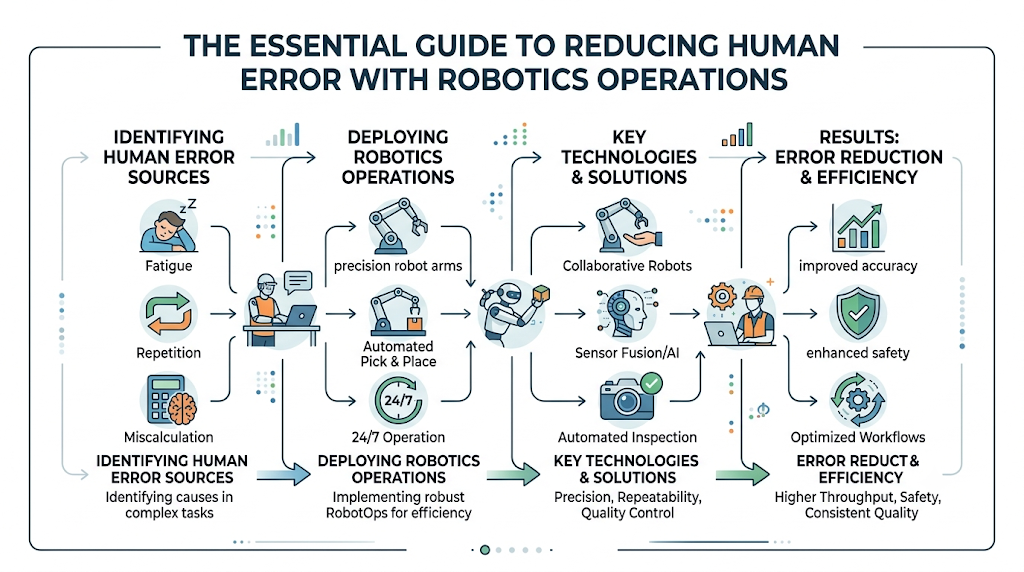
Every day, across thousands of factories, warehouses, and hospitals worldwide, minor slip-ups lead to major bottlenecks. A missed bolt on an assembly line, a misplaced medication in a clinic, or a mislabeled shipping box can trigger a cascading wave of delays, losses, and safety hazards. Human beings are incredibly creative, adaptive, and excellent at strategic problem-solving. However, our brains and bodies are not designed for flawless, high-speed repetition. When tasks become monotonous, exhausting, or hazardous, our attention slips. This is where modern robotics operations step in. By shifting repetitive, highly precise, and physically demanding workflows from human hands to automated systems, companies can drastically reduce human error reduction challenges, keeping human workers safe and focusing their talents where they matter most. Learn more about automated workflows on RobotsOps.com.
What Are Robotics Operations?
To understand how we can prevent errors, we must first define robotics operations (often referred to in the tech world as RobotOps).
At its core, robotics operations is the practice of deploying, monitoring, managing, and maintaining fleets of physical robots in real-world environments. Think of it as the brain, nervous system, and maintenance crew of an automated workforce.
While a single industrial robotics arm can perform a task, RobotOps ensures that a fleet of fifty robots works in perfect harmony with software systems, human operators, and changing factory floor conditions. It bridges the gap between hardware (the physical robot) and software (the code running it), ensuring continuous, reliable, and predictable performance.
What Is Human Error?
In an industrial or commercial setting, human error is defined as an unintentional action, omission, or decision that points a workflow away from its desired, safe outcome.
Common Types of Human Errors
- Slips and Lapses: These occur when a worker knows the correct procedure but suffers a brief distraction. For example, a worker might skip a step on a checklist or misread a digital screen.
- Mistakes: These happen when a worker follows an incorrect plan or lacks the proper training to handle a specific situation, leading to a flawed decision.
- Violations: These are deliberate deviations from safety protocols, often born out of extreme fatigue or unrealistic production quotas (e.g., bypassing a safety guard to speed up work).
Business Impact
When human errors occur, businesses suffer from ruined raw materials, expensive product recalls, damaged equipment, lost time, and, worst of all, workplace injuries.
Why Human Error Happens
It is easy to blame an individual worker for a mistake, but cognitive science shows that human errors are almost always the result of systemic stressors. Here is why mistakes are inevitable in manual setups:
- Physical and Mental Fatigue: After standing on a concrete floor for seven hours, a worker’s muscles tire, and their mental focus degrades.
- Monotony: Repeating the exact same five-second motion ten thousand times a day turns off active brain engagement, making lapses in attention guaranteed.
- Distractions: Noise, temperature fluctuations, and interruptions from colleagues break concentration.
- Complex Workflows: Modern products are highly complex. Expecting a human operator to remember dozens of micro-steps perfectly every single time is an unrealistic expectation.
- Manual Data Entry: Typing serial numbers, quantities, or tracking codes into a computer invites typos.
- Hazardous Environments: Working around extreme heat, chemical fumes, or heavy moving parts creates stress, which directly impairs decision-making.
How Robotics Operations Reduce Human Error
Implementing structured robotics systems directly addresses the root causes of workplace errors. Here is how they systematically eliminate slip-ups:
Task Automation
Robots do not get bored. By taking over repetitive physical tasks—such as picking parts up, turning them, and placing them down—robots perform the same action with identical force and angle on cycle number one and cycle number ten thousand.
Precision and Consistency
An industrial robot can move with sub-millimeter precision. Whether cutting metal, dispensing adhesive, or soldering circuit boards, automation ensures every millimeter of work matches the digital blueprint perfectly.
Real-Time Monitoring
Through RobotOps dashboards, operators can monitor every movement, motor temperature, and battery level of a fleet. If a robot begins to drift from its programmed pathway by even a fraction of a millimeter, the system flags the issue instantly, long before it results in a defective product.
Sensor-Based Decision-Making
Unlike humans, who rely on sight and touch, robots use advanced sensors. If a part is slightly out of alignment on a conveyor belt, proximity sensors and laser scanners allow the robot to adjust its grip or pause the line before a collision occurs.
AI-Assisted Control
By incorporating AI robotics, machines can adapt to minor variations on the fly. If a box is slightly dented, an AI-driven arm can calculate a new grip angle rather than dropping the box or halting the entire line.
[Sensors Detect Part] ➔ [AI Computes Grip Adjustment] ➔ [Robot Executes Flawless Pick]
Automated Quality Inspection
Using ultra-high-resolution cameras, automated inspection systems check every single product passing down a line. Human inspectors might miss a hairline crack due to eye strain, but a computer vision system inspects thousands of parts per minute with absolute accuracy.
Key Technologies Behind Robotics Operations
To understand how RobotOps achieves this level of reliability, let us look at the primary technologies involved:
- Industrial Robots: Heavy, stationary machines built for speed and power. They are typically enclosed in safety cages and handle high-volume tasks like welding or heavy lifting.
- Collaborative Robots (Cobots): These are lighter, highly sensitive robots designed to work safely side-by-side with humans. If a cobot touches a human worker, it stops instantly to prevent injury.
- Computer Vision: High-speed cameras paired with software that act as the “eyes” of the robot, allowing it to recognize shapes, colors, and defects.
- Artificial Intelligence and Machine Learning: Software algorithms that allow robots to learn from past actions, optimize their movements, and handle unpredictable scenarios.
- Sensors and IoT (Internet of Things): Micro-devices that measure temperature, pressure, distance, and vibration, feeding this data back to a central management system.
- Digital Twins: Virtual 3D replicas of physical factories and robots. Engineers can test new programs on a digital twin first, eliminating the human risk of trial-and-error coding on the physical floor.
- Autonomous Mobile Robots (AMRs): Smart, self-driving vehicles that navigate warehouse floors on their own, safely steering around unexpected obstacles to deliver parts.
Benefits of Robotics Operations
By replacing human vulnerability with mechanical precision, companies unlock massive improvements:
- Improved Accuracy: Reject rates and scrap material drops to near zero.
- Higher Productivity: Robots do not need lunch breaks, shift changes, or sleep, meaning production lines can run 24/7.
- Increased Worker Safety: Humans are removed from dangerous environments like extreme heat, chemical vats, and heavy-lifting zones, radically reducing workers’ compensation claims.
- Reduced Operational Costs: While robots require upfront capital, their predictable runtime and low error rates save millions in wasted inventory and recalled products.
- Consistent Performance: Businesses can forecast output down to the single unit, creating highly reliable supply chains.
Common Challenges
While the benefits are clear, adopting robotics operations does come with hurdle points:
- High Upfront Cost: Purchasing hardware, software, and hiring integration specialists requires a significant initial investment.
- Integration with Legacy Systems: Getting a brand-new robot to communicate smoothly with a twenty-year-old assembly machine can be technically difficult.
- Workforce Training: Employees must transition from physical labor to managing and monitoring the robotic systems, which requires technical training.
- Cybersecurity Risks: Because modern RobotOps platforms are connected to the cloud, they must be rigorously protected from hackers who might attempt to disrupt production.
- Limited Physical Flexibility: A robot programmed to weld car doors cannot suddenly switch to stitching leather seats without extensive reprogramming and hardware retooling.
Best Practices
To successfully deploy robotics operations and ensure human errors are minimized rather than shifted to software programming, follow these steps:
- Start Small: Do not try to automate your entire facility overnight. Begin with a single, highly repetitive bottleneck (like palletizing boxes) to prove the concept.
- Focus on Collaborative Systems: Use cobots to assist humans rather than fully replace them. Let the robot do the heavy lifting while the human does the fine-tuning.
- Invest in Robust Training: Teach your existing workforce how to operate, troubleshoot, and interact with the new robotics systems safely.
- Prioritize Regular Maintenance: Implement predictive maintenance programs. Use sensor data to replace a belt before it breaks and causes a mechanical error.
- Build a Strong Digital Infrastructure: Ensure your factory has a reliable, high-speed network so robots and control software can share real-time data without lag.
Manual Operations vs. Robotics Operations
| Feature | Manual Operations | Robotics Operations | Business Impact |
| Consistency | Variable; highly dependent on fatigue, mood, and skill level. | Absolute; executes tasks identically every cycle. | Lower scrap rates, predictable production timelines, and uniform quality. |
| Operating Hours | Limited by shifts, breaks, and labor laws. | Continuous (24/7/365) with scheduled downtime for maintenance. | Significantly increased throughput and faster order fulfillment. |
| Adaptability | High; humans can switch tasks instantly with minimal instruction. | Moderate to low; requires software updates or tool changes. | Humans remain best for creative custom work; robots excel at scale. |
| Workplace Safety | High exposure to repetitive strain, heavy lifts, and toxic environments. | Zero physical exposure; robots absorb high-risk tasks. | Dramatic reduction in injury claims and improved employee morale. |
Common Sources of Human Error and Robotics Solutions
| Human Error | Cause | Robotics Solution | Business Benefit |
| Miscounting parts in a shipment | Distraction or physical eye fatigue | Computer vision camera scans items on a moving conveyor line | 100% order accuracy, eliminating costly return shipping fees |
| Dropping heavy components | Hand fatigue or slippery surfaces | Heavy-payload robotic arms with custom pneumatic grippers | Zero dropped product inventory losses and safer floors |
| Skipping critical assembly bolts | Monotony or disruptions on the line | Programmed torque-screwdriving cobots that track every screw | High-quality products that avoid dangerous field failures |
| Typos in inventory logs | Manual keyboard entry or messy handwriting | RFID and barcode scanners attached to mobile transport robots | Perfect inventory visibility in real-time |
Real-World Use Cases
Manufacturing: The Automotive Assembly Line
- The Challenge: Installing windshields on cars requires heavy lifting and highly precise sealant application. Humans often applied too much or too little glue, causing water leaks or cracked glass.
- The Robotics Solution: Vision-guided robotic arms pick up the windshield, use laser sensors to scan the frame, and apply a flawless, uniform bead of adhesive before pressing the glass into place.
- The Outcome: Glue waste dropped by 40%, windshield installation errors were completely eliminated, and assembly line workers were freed from handling toxic adhesives.
Healthcare: Automated Pharmacy Dispensing
- The Challenge: Hospital pharmacists manually counting out high-volume medications face fatigue, which can lead to life-threatening prescription errors.
- The Robotics Solution: Enclosed robotic dispensing cabinets sort, bottle, and label medications using precise weight sensors and barcode verifications.
- The Outcome: Medication dispensing errors dropped to zero, ensuring patient safety and allowing pharmacists to spend more time consulting with patients.
Warehousing and Logistics: E-Commerce Sorting
- The Challenge: Warehouse workers walking miles every day to retrieve items frequently grabbed the wrong size or color item from shelves due to exhaustion.
- The Robotics Solution: Autonomous mobile robots (AMRs) navigate the warehouse to retrieve entire shelving pods and bring them directly to a stationary worker.
- The Outcome: Order picking speed tripled, and mispicked item errors dropped by over 95%.
Future Trends
As we look toward the future, the integration of robotics operations will only grow more seamless:
- AI-Powered Robotics: Future robots will not just follow rigid code. They will use advanced AI to figure out how to pick up highly irregular objects, such as organic farm produce or scrambled piles of wires.
- Autonomous Factories: Entire facilities will coordinate through unified RobotOps software, adjusting production speeds instantly based on supply chain delivery speeds.
- Human-Robot Symbiosis: Cobots will become as common as laptop computers, serving as smart assistants that anticipate a human technician’s physical needs on the assembly floor.
- Predictive Cloud Robotics: Cloud systems will analyze mechanical data from thousands of identical robots operating across the globe, warning a factory in Chicago that a specific motor part is likely to fail in three days based on data gathered from a factory in Tokyo.
FAQs
Q1: Will robotics operations completely replace human workers?
No. Robotics operations are designed to automate repetitive, physically draining, and dangerous tasks. By offloading these tedious chores to robots, human workers can transition into higher-value roles, such as robotics operators, maintenance technicians, quality analysts, and creative designers.
Q2: What is the main difference between a robot and robotics operations (RobotOps)?
A robot is a single piece of physical hardware designed to execute mechanical movements. Robotics operations (RobotOps) is the complete ecosystem of software, data flow, communication networks, and human management tools used to monitor, maintain, and optimize an entire fleet of robots.
Q3: Are collaborative robots (cobots) safer than traditional industrial robots?
Yes. Traditional industrial robots are incredibly powerful and fast, meaning they must operate inside protective safety cages to prevent human contact. Cobots are built with built-in force sensors, soft joints, and collision-detection systems that allow them to safely halt instantly if they gently bump into a human worker.
Q4: How do robots inspect products for quality without human eyes?
Robots use computer vision systems, which consist of high-resolution digital cameras and artificial intelligence algorithms. These systems can instantly compare an image of a freshly manufactured part against a perfect 3D digital model, identifying microscopic scratches, cracks, or misalignment in milliseconds.
Q5: Can small businesses afford to implement robotics operations?
Yes. While massive automotive robots are highly expensive, the rise of modular, low-cost cobots and “Robots-as-a-Service” (RaaS) subscription models has made it highly affordable for small-to-medium enterprises to automate single-step bottlenecks with minimal upfront capital.
Q6: What happens if a robot makes a mechanical error?
If a sensor fails or a mechanical part wears out, RobotOps tracking software will immediately identify that the robot is drawing too much electrical current, vibrating unusually, or missing its coordinates. The system will automatically pause the line and alert a human technician to perform maintenance.
Q7: How do autonomous mobile robots (AMRs) avoid hitting humans in warehouses?
AMRs are equipped with LiDAR (laser-based radar), ultrasonic sensors, and built-in cameras. These sensors constantly map the environment in real-time, allowing the robot to calculate a smooth detour path around humans, forklifts, or dropped packages instantly.
Q8: What industries benefit the most from reducing human error through robotics?
While manufacturing and heavy automotive industries remain the largest users, fields such as healthcare (for precise medication delivery), electronics assembly (for microscopic soldering), logistics (for accurate shipping packaging), and agriculture (for delicate weed management) are rapidly adopting RobotOps.
Q9: Do robots require a lot of energy to run?
Modern robotic systems are built to be highly energy-efficient, often using regenerative braking systems to recycle kinetic energy. When compared to the massive heating, cooling, and high-intensity lighting systems required to keep giant human-crewed factories comfortable, robotic lines often run with a lower overall carbon footprint.
Q10: What is a “digital twin” in robotics operations?
A digital twin is a virtual, high-fidelity 3D simulation of a physical robot and its work environment. It allows engineers to program, test, and troubleshoot a robot’s movements completely safely in a virtual sandbox, ensuring there are no programming bugs or physical crashes before deploying the code to the real-world machine.
Conclusion
At the end of the day, human error is not a workforce behavioral issue; it is a clear symptom of mismatched design. Human minds are built to adapt, create, and solve problems—not to act as mechanical gears in a repetitive, high-stress assembly machine. By implementing robotics operations, organizations can bridge the gap between human capability and mechanical precision. By handing the dull, repetitive, and dangerous tasks over to modern, sensor-driven automation, businesses do not just eliminate errors; they empower their workforce. Employees are freed from physical strain to focus on optimizing systems, managing data, and driving business growth.
