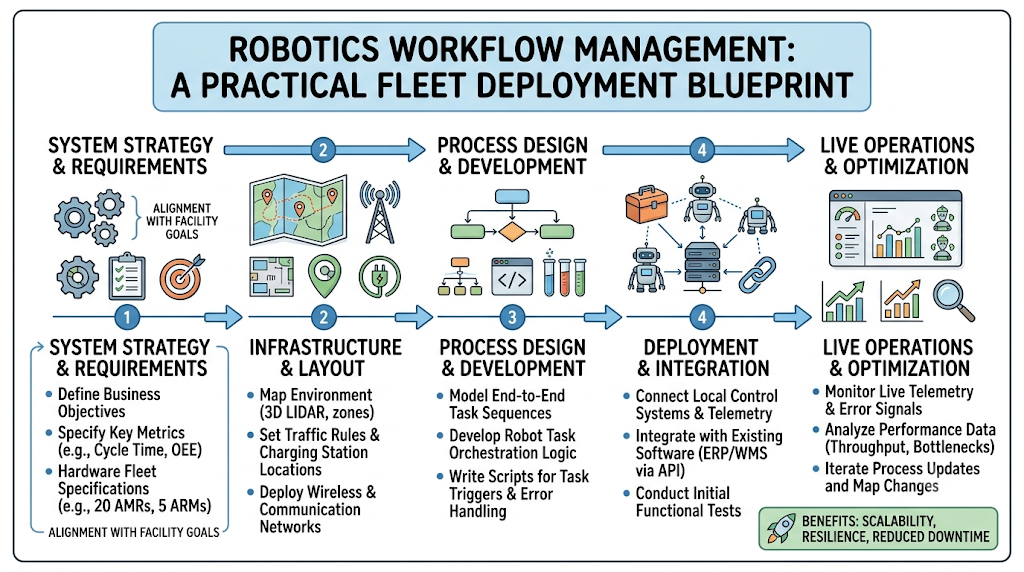
Introduction
Modern factory floors, distribution centers, and hospitals look vastly different than they did even a decade ago. Today, autonomous mobile robots (AMRs), collaborative robotic arms, and automated guided vehicles (AGVs) work alongside human teams to handle repetitive physical tasks. However, deploying hardware is only the first step. The true challenge lies in coordinating these diverse machines so they perform efficiently without colliding, idling, or creating production bottlenecks. To explore deep-dive resources on this evolution, you can visit RobotsOps.com, an educational platform dedicated to modern robot operations management. In this guide, you will learn the core concepts of managing robotic activities, the structural components required for deployment, and real-world orchestration strategies.
What Is Robotics Workflow Management?
Featured Snippet Definition:
Robotics Workflow Management is the systematic design, execution, monitoring, and optimization of end-to-end task sequences assigned to robotic hardware systems. It serves as an orchestration layer that translates high-level business goals into specific, synchronized machine actions across a facility.
In an active automation environment, robot operations management ensures that hardware does not function in an isolated silo. Instead, every machine connects to a centralized software framework. This system monitors state changes, balances operational loads, and coordinates real-time handoffs between different automation assets.
Understanding Robotics Operations
Achieving true operational efficiency requires a firm grasp on the four pillars of modern robotics operations:
Robotic Task Execution
This refers to individual actions performed by a specific machine, such as a robotic arm picking up a part or an AMR driving to a coordinate. Task execution relies on low-level control systems, sensor feedback loops, and precise motor trajectories.
Automation Processes
Processes are broader business sequences that encompass multiple tasks. For example, an entire kitting process involves an AMR picking up raw inventory, transporting it to a workstation, and a secondary robotic arm assembling the final package.
Multi-System Coordination
Industrial environments rarely rely on a single vendor. Facilities regularly run hardware from multiple manufacturers alongside legacy conveyor networks. Multi-system coordination bridges these compatibility gaps, allowing systems to talk to each other via standardized messaging protocols like ROS (Robot Operating System) or MQTT APIs.
Operational Efficiency
This metric tracks how effectively your automated assets perform over time. High efficiency means minimizing idle cycles, reducing energy consumption, preventing mechanical wear, and maximizing total throughput.
Why Workflow Management Matters in Robotics Operations
When facilities scale from three or four machines to a fleet of fifty, localized control methods completely break down. Implementing a structured robotics automation workflow architecture is crucial for several operational reasons:
- Improved Coordination: It prevents systemic friction, such as two AMRs locking up a narrow corridor because neither knows the other’s routing path.
- Higher Productivity: By synchronizing machine speeds and handoff times, materials flow seamlessly through assembly lines without mid-process waiting gaps.
- Reduced Downtime: If a single robotic cell encounters a mechanical error, the overarching workflow engine automatically reroutes surrounding material traffic to avoid an entire line stoppage.
- Better Resource Utilization: The system dynamically assigns tasks to the nearest available machine with sufficient battery life, eliminating uneven fleet wear.
- Enhanced Operational Visibility: Managers gain a single glass pan view of the entire operation, making it simple to spot process delays instantly.
Core Components of Robotics Workflow Management
Every enterprise-grade robot task orchestration framework relies on five fundamental software modules:
[Performance Analytics] <---> [Monitoring Systems]
                                      ^
                                      v
  [Task Scheduling] ----> [Process Orchestration] ----> [Resource Allocation]
1. Task Scheduling
The engine that queues incoming work orders based on facility priorities, delivery deadlines, and machine proximity.
2. Process Orchestration
The logical layer that defines dependency pathways. It ensures that Step B never executes until Step A sends an explicit confirmation signal.
3. Resource Allocation
The algorithm that matches specific assets to specific tasks based on payload capacities, mechanical tooling, and active battery percentages.
4. Monitoring Systems
Telemetric data pipelines that ingest live telemetry from machine sensors, tracking velocity, coordinates, error codes, and joint temperatures.
5. Performance Analytics
The historical database that processes telemetry into actionable metrics like overall equipment effectiveness (OEE) and mean time between failures (MTBF).
How Robotics Workflows Function
To understand how software guides hardware through an ordinary shift, let’s break down the execution cycle into five chronological phases:
1.Task Assignment:Phase 1: Logic Matching.
The central workflow engine receives an order from the Enterprise Resource Planning (ERP) database. It identifies an idle robot with a full battery and pushes a structured command packet down to the machine’s local controller.
2.Execution Management:Phase 2: Hardware Control.
The robot executes the physical movements, relying on its internal safety scanners and path planning tools to navigate safely through dynamic environments.
3.Real-Time Monitoring:Phase 3: Telemetry Feedback.
Throughout execution, the machine sends status packets back to the coordination layer. If an AMR encounters a temporary physical obstacle, it reports the slight delay but continues its pathing.
4.Error Detection:Phase 4: Exception Handling.
If a component slips or an optical sensor gets obscured, the local system flags an error. The workflow manager instantly isolates that unit and alerts human operations technicians.
5.Workflow Optimization:Phase 5: Iterative Refinement.
The engine analyzes the completed run. If a specific intersection consistently causes navigation slowing, the software updates historical routing paths to optimize future trips.
Types of Robotics Workflows
Because different industries face unique operating constraints, workflows are tailored to specific industrial environments:
Manufacturing Workflows
These workflows focus on highly repeatable, high-precision timing. A classic example is a welding arm synchronizing perfectly with a moving conveyor line, where microsecond errors can scrap expensive automotive parts.
Warehouse Automation Workflows
These systems prioritize fleet navigation and picking speed. AMRs navigate dynamic layouts to retrieve inventory pods, requiring smart traffic management to handle shifting aisle blockages.
Healthcare Robotics Workflows
These prioritize absolute biosecurity and safety compliance. Mobile units deliver sensitive medications or sterile surgical equipment across hospital wings, requiring strict cleanroom and elevator integration protocols.
Logistics and Delivery Workflows
These bridge internal factory floors with external supply chains. They manage the precise handoff of goods from cross-docking bays directly into autonomous shipping containers or heavy cargo trucks.
Service Robotics Workflows
Designed for public-facing or commercial spaces like hotels or retail stores. These systems focus heavily on slow, predictable obstacle avoidance and clear human-robot communication interfaces.
Benefits of Robotics Workflow Management
Implementing unified systems management software delivers direct, measurable improvements across operational metrics:
- Increased Efficiency: Eliminates empty travel runs by stacking complementary pickup and drop-off tasks sequentially.
- Improved Accuracy: Software integration eliminates manual data entry errors, ensuring the correct robot always delivers the exact part number requested.
- Faster Operations: Automated machine handoffs eliminate the typical communication friction seen when human operators manually flag down material handlers.
- Better Scalability: Onboarding a new batch of ten robots becomes a plug-and-play affair, as the central software treats them as additional nodes in an existing pool.
- Reduced Operational Costs: Maximizing asset lifespan and minimizing collision risks significantly drops annual maintenance overhead.
Popular Technologies Supporting Robotics Workflows
Modern automation ecosystems combine diverse software suites, edge compute hardware, and cloud data lakes to keep fleets running smoothly.
| Technology Category | Primary Purpose | Key Benefit | Typical Usage |
| Automation Platforms | Coordinates enterprise applications and business logic. | Connects physical equipment directly to high-level ERP systems. | Syncing factory floors with global warehouse inventories. |
| Robotics Control Systems | Runs localized kinematics calculations and motor adjustments. | Provides low-latency, millisecond-level physical movement safety. | Real-time trajectory planning for complex multi-axis robotic arms. |
| AI and Machine Learning | Analyzes video streams and detects subtle sensor deviations. | Dynamically adapts path planning around shifting layout changes. | Advanced camera-based picking of mixed, unorganized parts. |
| Monitoring & Analytics | Visualizes live fleet positions and tracks historical performance. | Pins down micro-stoppages before they bubble up into systemic failures. | Executive dashboards monitoring operational efficiency. |
| Cloud Robotics Solutions | Offloads demanding spatial calculations to distributed servers. | Allows lightweight, cost-effective hardware units to navigate huge complexes. | Fleet-wide updates of complex map files across separate facilities. |
Common Challenges in Robotics Workflow Management
Unifying physical machines with software layers brings unique hurdles. Below are the most common challenges along with practical solutions:
Integration Complexity
- The Problem: Mixing modern AMRs with 20-year-old legacy PLC (Programmable Logic Controller) assembly lines creates massive data formatting deadlocks.
- The Solution: Deploy standardized intermediate hardware middleware or custom API wrappers that convert legacy hardware signals into unified JSON data streams.
System Downtime
- The Problem: A central server glitch drops communication pipelines, leaving a fleet of mobile machines stranded in place mid-shift.
- The Solution: Build local fallback routines into your edge computing architecture so individual machines finish their current safe tasks even during network drops.
Resource Bottlenecks
- The Problem: Funneling twenty transport units through a single narrow corridor creates physical gridlock, halting factory throughput.
- The Solution: Program directional traffic rules, zone occupancy limits, and alternative bypass lanes into your central orchestration map.
Data Visibility Issues
- The Problem: Operators can tell a robotic arm has stopped moving, but raw log sheets make it nearly impossible to find the root cause error code quickly.
- The Solution: Standardize data logging frameworks to output clean, visual telemetry timelines through intuitive operator dashboards.
Scalability Constraints
- The Problem: Adding more machines causes centralized databases to lag under the heavy load of incoming telemetry packets.
- The Solution: Transition your fleet architecture to a distributed edge-computing model, processing raw sensor updates locally while sending summary updates to the cloud.
Best Practices for Implementing Robotics Workflows
To build a high-performing automation ecosystem, follow these deployment steps:
- Standardize Processes: Before automated code is even written, map out every step of your physical material workflow on paper to eliminate unnecessary processing steps.
- Automate Repetitive Tasks: Focus early automation efforts entirely on high-frequency, low-variability tasks to prove system reliability before tackling complex operations.
- Monitor Performance Continuously: Establish an unambiguous, automated metric baseline for machine speeds and idle cycles to spot subtle performance drifts early.
- Optimize Resource Allocation: Route tasks dynamically based on live battery levels and real-time path congestion rather than using rigid, hardcoded paths.
- Maintain Operational Documentation: Keep your system architecture maps, API endpoints, and safety recovery protocols updated so engineering teams can troubleshoot bugs fast.
Real-World Use Cases
Smart Manufacturing
In automotive assembly yards, robotic arms lift and position heavy frame components while overhead gantry tracks supply welding parts. Orchestration software ensures that the delivery platform arrives right as the welding cell finishes its cycle, keeping production smooth and continuous.
Warehouse Fulfillment
E-commerce sorting centers rely on thousands of small drive units beneath storage racks. A central workflow system coordinates these bots so they bring the right products to human pickers in the exact order needed, speeding up parcel shipments.
Autonomous Delivery Systems
Sprawling corporate campuses and commercial ports deploy driverless vehicles to move heavy payloads between separated buildings. These outdoor operations rely on cloud management platforms to safely coordinate paths with shifting pedestrian crossings and industrial traffic.
Medical Robotics
Hospital cleanrooms use mobile decontamination systems to sanitize operating theaters via ultraviolet light. The central management application checks room occupancy sensors first, ensuring the deep cleaning light cycles never activate while personnel are inside.
Industrial Inspection Operations
Oil refineries and offshore drilling platforms deploy automated crawling units to look for microscopic pipe cracks. The scheduling system automatically sends these units out during low-activity windows and uploads structural safety data directly to maintenance teams.
Robotics Workflow Management vs Traditional Process Management
| Capability | Traditional Process Management | Robotics Workflow Management |
| Execution Medium | Relies on manual human entry, paperwork, and digital spreadsheets. | Drives physical, mechanical hardware assets directly via code. |
| Data Update Speed | Updated in batches (hourly or at shift handoffs). | Processes streaming telemetry multiple times per second. |
| Error Remediation | Demands manual inspections, phone calls, and supervisor overrides. | Triggers automatic mechanical rerouting and instant software isolations. |
| System Adaptability | Modifying processes requires retraining entire teams over days. | Fleet adjustments are deployed instantly via over-the-air code updates. |
| Hardware Integration | Isolated from physical machinery, tracking only log data. | Built directly into physical safety circuits and local motor controllers. |
Key Metrics for Measuring Workflow Performance
To judge if your robotics process workflows are delivering real value, track these five operational metrics closely:
Task Completion Rate
The percentage of assigned jobs completed without human intervention or software errors. Consistently low scores mean your physical target zones or path boundaries need recalibration.
System Utilization
This tracks the exact percentage of time a machine spends doing active work versus time spent waiting for orders, sitting stuck in transit traffic, or charging batteries.
Downtime Reduction
The reduction in unscheduled system stops compared to your historic manual operations baseline.
Operational Throughput
The total volume of finished items processed through an automated zone during an average 8-hour shift.
Resource Efficiency
The average energy consumed and mechanical wear incurred per completed item, letting you calculate the exact ROI of your automation investments.
Future of Robotics Workflow Management
The industry is moving quickly past simple, pre-programmed pathing routines toward fully adaptive operational ecosystems:
- AI-Driven Workflow Optimization: Machine learning models will analyze months of factory movement patterns to dynamically redesign floor layouts and speed up pathing.
- Autonomous Operations: Fleets will handle unexpected floor changes entirely on their own, safely negotiating around new obstacles without needing manual supervisor updates.
- Predictive Maintenance Integration: Real-time telemetry tools will flag subtle increases in motor power draw, scheduling a service check before a mechanical joint breaks on the floor.
- Cloud Robotics Platforms: Shared cloud environments will let multi-facility organizations push software updates and map changes to separate global fleets with a single click.
- Human-Robot Collaboration: Safe sensor suites will let heavy industrial machines work directly alongside human pickers without protective metal safety fences.
Career Opportunities
As automation scales globally, the demand for professionals who understand both hardware integration and enterprise software is soaring. Key career paths include:
- Robotics Operations Engineer: Focuses on maintaining day-to-day fleet uptime, optimizing path files, and handling physical equipment recoveries.
- Automation Specialist: Evaluates manual workflows and designs automated alternatives using robotic arms and smart material handling lines.
- Robotics Systems Manager: Oversees large-scale automation projects, managing vendor relationships, budgets, and hardware deployments.
- Industrial Automation Engineer: Designs programmable logic controllers and hardware interfaces to connect factory floors to management applications.
- Robotics Workflow Analyst: Studies fleet telemetry logs to find operational bottlenecks and improve long-term facility throughput.
Common Misconceptions
Myth: Robotics workflows completely eliminate the need for human operators.
Reality: Automated systems simply shift human roles. Instead of performing dull, repetitive lifting tasks, operators transition into higher-value supervisor roles, managing system alerts and tracking telemetry dashboards.
Myth: Implementing workflow management requires replacing your entire legacy fleet.
Reality: Modern orchestration layers are built to connect with existing assets. By using open APIs, middleware adapters, and modern software wrappers, you can coordinate older machinery right alongside brand-new hardware.
Myth: Robotics workflow solutions are only suitable for multi-million dollar fulfillment centers.
Reality: Small and mid-sized manufacturing hubs benefit significantly from basic orchestration. Getting just two robotic arms and a single conveyor line communicating properly can jump overall production output by double digits.
FAQ Section
- What is the primary difference between a robot task and a robotics workflow?A task is a single isolated machine movement, such as tightening a specific bolt. A workflow is the entire sequence of related tasks that completes an overarching business goal, like assembling a full product chassis.
- Can software coordinate machines from different manufacturers in the same workflow?Yes. Modern management platforms use open communication interfaces like ROS or standardized APIs to bridge compatibility gaps, allowing diverse fleets to share physical spaces safely.
- How does a workflow system handle unexpected physical obstacles on a factory floor?The local machine uses safety scanners to stop or steer around the obstacle. If the delay lasts too long, it alerts the central software layer, which adjusts the wider fleet’s paths to prevent a traffic backup.
- Is robotics workflow management the same thing as Robot Process Automation (RPA)?No. RPA focuses entirely on software bots automating digital office tasks like entering numbers into spreadsheets. Robotics workflow management controls physical, mechanical machines moving through real-world spaces.
- What network infrastructure is required to run a real-time fleet orchestration framework?It requires a high-reliability, low-latency wireless network, typically built on industrial Wi-Fi networks or dedicated private 5G installations, ensuring constant communication with mobile units.
- How long does it typically take to deploy a standard industrial workflow system?Simple setups with uniform hardware can go live in a few weeks. Complex, multi-vendor deployments inside massive, fast-moving fulfillment facilities can take several months of planning and integration.
- Do these systems require a constant internet connection to the public cloud?Not necessarily. While cloud systems make large fleet updates easy, many critical manufacturing setups run entirely on local, on-premise servers to maintain data security and avoid internet dropouts.
- What happens to automated hardware if the central management server crashes entirely?Modern edge-computing configurations ensure that individual machines execute their immediate safety routines or finish their current task before stopping in place to await reconnection.
- How do you calculate the return on investment (ROI) for workflow management software?You calculate ROI by measuring your total throughput increase, tracking reductions in unscheduled machine downtime, and factoring in the lowered maintenance costs achieved via smart asset routing.
- What programming languages are most common in robotics systems management?The underlying machine logic usually relies on C++ or Python, while the high-level dashboard integrations, cloud databases, and API web layers are typically built with Python, TypeScript, and Go.
Final Summary
Successfully scaling an automated facility takes more than just deploying capable hardware. It requires an intelligent software layer to orchestrate movements, balance workloads, and eliminate operational bottlenecks. Implementing an end-to-end management strategy turns isolated machines into a unified, high-output production system. As technologies like cloud orchestration and predictive analytics continue to mature, staying ahead of software trends is a major competitive advantage for operations professionals.
