Introduction
Artificial intelligence is changing the way robots work, learn, and support modern industries. Traditional robots were mostly programmed to repeat fixed actions. Today, AI-powered robots can understand their environment, make decisions, adjust movement, recognize objects, and improve performance over time. This is why the Role of AI in Robotics Operations has become so important. From manufacturing floors and warehouses to hospitals, farms, logistics centers, and autonomous vehicles, intelligent robots are helping organizations improve speed, safety, accuracy, and productivity. For students, engineers, and technology learners, understanding AI in robotics is no longer optional. It is becoming a core skill for anyone interested in automation, machine learning, robotics workflow automation, industrial robotics, and autonomous systems. RobotsOps.com is an educational learning resource for people who want to understand robotics operations, intelligent automation, and AI-powered robots in a practical way. Readers can explore more at RobotsOps.com.
What Is AI in Robotics?
AI in robotics means using artificial intelligence technologies to help robots sense, understand, decide, act, and learn from their environment.
A robot without AI usually follows fixed instructions. It may repeat the same movement again and again, such as welding a car part or moving an object from one place to another.
A robot with AI can do more than follow instructions. It can analyze camera images, detect obstacles, understand speech, predict equipment failure, choose the best path, and improve through experience.
Core Concepts of AI in Robotics
AI in robotics usually includes:
- Perception: Helping robots see, hear, or sense the world.
- Decision-making: Helping robots choose the right action.
- Learning: Helping robots improve from data and experience.
- Automation: Helping robots complete tasks with less human control.
- Adaptability: Helping robots respond to changing environments.
Relationship Between AI and Robotics
Robotics focuses on building machines that can move, manipulate objects, and perform physical tasks. AI focuses on making systems intelligent enough to understand data, solve problems, and make decisions.
When both fields work together, robots become more capable. They are no longer only mechanical machines. They become intelligent systems that can interact with the real world.
Why AI Is Essential for Modern Robotic Systems
Modern robotics operations often happen in dynamic environments. A warehouse may have moving workers, changing inventory, and different package sizes. A hospital robot may need to move safely around patients and staff. A farming robot may need to identify crops, weeds, soil conditions, and weather patterns.
Fixed programming is not enough for these situations. AI helps robots handle uncertainty, variation, and complexity.
Understanding Robotics Operations
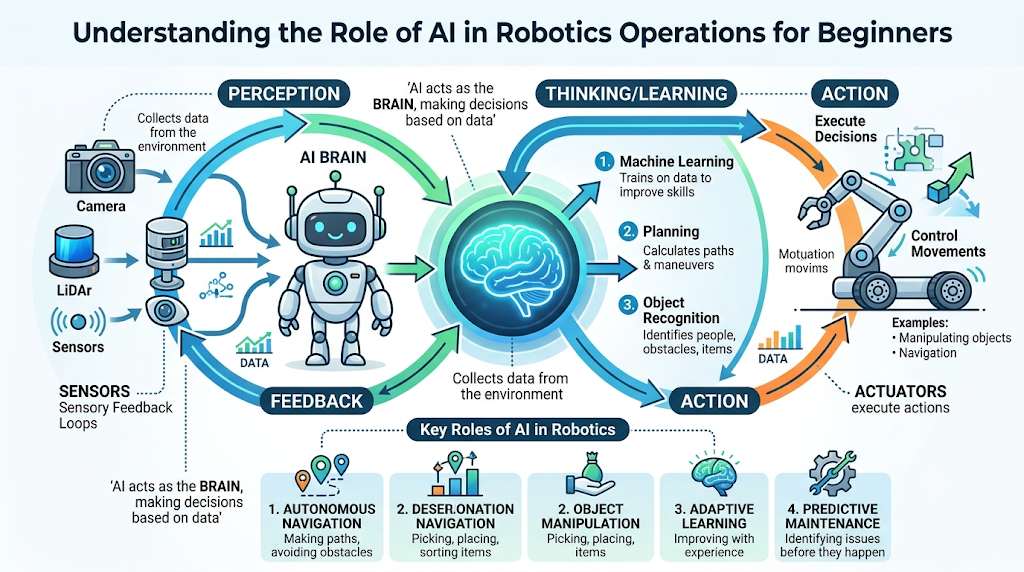
Robotics operations refer to the complete process of how robots perform tasks in real-world environments. This includes sensing, planning, decision-making, movement, execution, monitoring, and improvement.
A useful way to understand robotics operations is to think of a robot as a worker with five main abilities.
Robot Perception
Perception is how a robot understands its surroundings.
Robots use cameras, sensors, microphones, LiDAR, radar, force sensors, temperature sensors, and other devices to collect information. AI helps process this information and turn raw data into useful understanding.
For example, a warehouse robot may use cameras and sensors to identify shelves, packages, people, and open paths.
Decision-Making
Decision-making is how a robot chooses what to do next.
AI helps robots compare options and select the safest or most efficient action. For example, if a delivery robot sees an obstacle, it must decide whether to stop, move around it, wait, or choose another route.
Motion Planning
Motion planning means deciding how a robot should move.
This is important for robotic arms, mobile robots, drones, autonomous vehicles, and industrial robots. AI can help robots plan smooth, safe, and efficient movements.
For example, a robotic arm in a factory must move without hitting nearby equipment or damaging the product.
Task Execution
Task execution is the actual performance of the job.
This could include picking an object, welding a part, delivering medicine, inspecting a machine, harvesting crops, or assembling a product. AI improves execution by helping robots adjust during the task.
Continuous Learning
Continuous learning means improving performance over time.
AI-powered robots can learn from previous actions, errors, sensor data, and feedback. This helps them become more accurate, efficient, and reliable.
The Role of AI in Robotics Operations
The Role of AI in Robotics Operations is to make robots more intelligent, adaptive, and useful in real-world conditions. AI allows robots to move beyond repetitive automation and become systems that can observe, reason, and respond.
Computer Vision
Computer vision helps robots understand images and videos.
It allows robots to identify objects, detect defects, read labels, recognize people, inspect surfaces, and understand spatial arrangements.
Practical example:
In manufacturing, a robot with computer vision can inspect products on a conveyor belt. It can identify scratches, cracks, missing parts, or incorrect assembly faster than manual inspection.
Machine Learning
Machine learning allows robots to learn patterns from data.
Instead of being programmed for every possible situation, robots can use data to improve their decisions.
Practical example:
A warehouse robot can learn which routes are usually faster, which areas are crowded, and how to optimize movement during busy periods.
Deep Learning
Deep learning is a more advanced form of machine learning that uses layered models to understand complex data such as images, speech, and sensor signals.
Practical example:
Autonomous vehicles use deep learning to recognize road signs, pedestrians, lane markings, vehicles, traffic lights, and unusual road conditions.
Natural Language Processing
Natural language processing helps robots understand human language.
This allows humans to communicate with robots using spoken or written commands.
Practical example:
A service robot in a hotel may understand a guest’s request such as “Take this towel to room service” or “Guide me to the reception area.”
Reinforcement Learning
Reinforcement learning helps robots learn through trial, feedback, and reward.
A robot tries different actions and learns which actions produce better results.
Practical example:
A robotic arm can learn how to grasp objects of different shapes by practicing and improving its grip strategy.
Intelligent Automation
Intelligent automation combines robotics, AI, sensors, and software workflows to automate complex tasks.
Practical example:
In a smart factory, robots can assemble products, inspect quality, report issues, adjust speed, and coordinate with other machines.
RobotsOps.com Guide to AI-Powered Robotics Operations
RobotsOps.com focuses on helping learners understand robotics operations in a simple and practical way. AI-powered robotics can seem complex at first, but it becomes easier when learners follow a step-by-step path.
Understanding AI Fundamentals
Before learning advanced robotics, students should understand the basics of AI.
Important concepts include:
- Data
- Algorithms
- Machine learning
- Neural networks
- Computer vision
- Automation logic
- Prediction and classification
These fundamentals help learners understand how robots process information and make decisions.
Learning Robotics Step by Step
Robotics combines multiple fields, including mechanics, electronics, programming, control systems, and AI.
A beginner-friendly learning path may include:
- Basic robotics concepts
- Sensors and actuators
- Robot movement
- Control systems
- Programming logic
- AI and machine learning
- Real-world automation projects
Learning step by step helps avoid confusion and builds strong foundations.
Exploring Real-World Automation
AI-powered robotics is best understood through real examples.
Learners should study how robots are used in:
- Factories
- Warehouses
- Hospitals
- Farms
- Logistics centers
- Research labs
- Smart homes
- Autonomous vehicles
This helps connect theory with practical operations.
Building Practical Skills
Robotics is a hands-on field. Reading concepts is useful, but practice is essential.
Learners should build small projects such as:
- Line-following robots
- Object detection systems
- Robotic arm simulations
- Basic warehouse automation models
- Computer vision experiments
- Autonomous navigation demos
These projects help develop real confidence.
Preparing for Future Robotics Careers
AI-powered robotics is creating career opportunities across engineering, manufacturing, logistics, healthcare, agriculture, and automation.
RobotsOps.com can be positioned as a learning resource for students and professionals who want to understand robotics operations, AI-powered robots, and intelligent automation skills in a structured way.
AI Technologies Used in Robotics
AI-powered robots use several technologies together. These technologies help robots sense, think, move, and act.
Computer Vision Systems
Computer vision systems allow robots to process images and videos.
They are used for:
- Object detection
- Face recognition
- Quality inspection
- Defect detection
- Navigation
- Product sorting
- Medical image assistance
In industrial robotics, computer vision helps robots identify product position and orientation before picking or assembling parts.
Sensor Fusion
Sensor fusion combines data from multiple sensors to create a more accurate understanding of the environment.
A robot may use cameras, LiDAR, radar, ultrasonic sensors, and force sensors at the same time.
For example, an autonomous robot may use camera data to detect objects, LiDAR data to measure distance, and wheel sensors to track movement.
Predictive Analytics
Predictive analytics uses data to predict future events.
In robotics operations, this can help predict:
- Machine failure
- Maintenance needs
- Production delays
- Battery usage
- Task completion time
- Operational risks
For example, a factory robot may show vibration changes before a mechanical failure. AI can detect this pattern and alert the maintenance team early.
Autonomous Navigation
Autonomous navigation allows robots to move without constant human control.
This is used in:
- Warehouse robots
- Delivery robots
- Autonomous vehicles
- Drones
- Cleaning robots
- Inspection robots
AI helps the robot understand maps, avoid obstacles, choose routes, and adapt to changes.
Speech Recognition
Speech recognition allows robots to understand spoken commands.
This is useful in service robotics, healthcare, education, hospitality, and assistive technologies.
For example, a hospital assistant robot may respond to staff instructions and help deliver supplies to different departments.
Intelligent Control Systems
Control systems manage how robots move and behave.
AI improves control systems by making them more adaptive. Instead of only following fixed control rules, AI-powered systems can adjust based on real-time feedback.
For example, a robotic arm can adjust grip pressure when handling fragile objects.
Real-World Applications of AI in Robotics
AI in robotics is used across many industries. The goal is not only to replace manual work but also to improve safety, speed, accuracy, and consistency.
Manufacturing
Manufacturing is one of the most common areas for industrial robotics.
AI-powered robots are used for:
- Assembly
- Welding
- Painting
- Quality inspection
- Packaging
- Material handling
- Predictive maintenance
For example, an AI-powered inspection robot can detect tiny defects in products before they reach customers.
Warehouse Automation
Warehouses use robotic automation to move goods, sort packages, manage inventory, and support order fulfillment.
AI helps warehouse robots:
- Find the shortest route
- Avoid workers and obstacles
- Identify packages
- Coordinate with other robots
- Improve picking accuracy
This improves speed and reduces manual workload.
Healthcare Robotics
Healthcare robots support doctors, nurses, patients, and hospital operations.
They may be used for:
- Surgical assistance
- Medicine delivery
- Patient support
- Rehabilitation
- Disinfection
- Remote care support
AI helps healthcare robots become more precise and responsive.
Agriculture
Agricultural robots use AI to support farming operations.
They can help with:
- Crop monitoring
- Weed detection
- Fruit picking
- Soil analysis
- Irrigation planning
- Pest detection
For example, an AI-powered farming robot can identify weeds and target them more accurately than broad chemical spraying.
Autonomous Vehicles
Autonomous vehicles depend heavily on AI and robotics.
They use cameras, radar, LiDAR, GPS, and machine learning to understand roads, detect objects, predict movement, and make driving decisions.
This includes self-driving cars, autonomous trucks, delivery robots, and industrial transport vehicles.
Logistics
Logistics companies use AI-powered robots for sorting, loading, unloading, tracking, and delivery support.
Robotics workflow automation helps reduce delays and improve supply chain efficiency.
Service Robots
Service robots are used in hotels, restaurants, airports, malls, offices, and homes.
They can guide visitors, deliver items, clean spaces, answer basic questions, and support customer service operations.
AI makes these robots more interactive and useful.
Benefits of AI in Robotics Operations
AI brings many advantages to robotics operations, especially in environments where speed, accuracy, and adaptability matter.
Improved Accuracy
AI helps robots perform tasks with better precision.
In manufacturing, this means fewer defects. In healthcare, it can support more controlled movements. In warehouses, it improves picking and sorting accuracy.
Better Decision-Making
AI allows robots to analyze real-time data and choose better actions.
Instead of blindly repeating instructions, AI-powered robots can respond to current conditions.
Higher Productivity
Robots can work continuously, complete repetitive tasks, and reduce process delays.
When AI is added, robots can optimize workflows and improve task efficiency.
Enhanced Safety
Robots can perform dangerous tasks in environments that may be unsafe for humans.
AI also helps robots detect people, avoid collisions, and operate more safely around workers.
Continuous Improvement
Machine learning allows robots to improve from experience.
Over time, robots can become better at recognizing patterns, avoiding errors, and completing tasks.
Greater Scalability
AI-powered robotics systems can support large operations.
For example, a warehouse can use multiple robots that coordinate with each other to manage thousands of orders.
Challenges of AI-Powered Robotics
AI-powered robotics has great potential, but it also comes with challenges.
Data Quality
AI systems need good data.
If the data is incomplete, biased, outdated, or inaccurate, the robot may make poor decisions.
For example, a robot trained only on perfect product images may struggle to detect defects in real factory conditions.
Hardware Limitations
Robots depend on sensors, motors, processors, batteries, and mechanical parts.
Even if the AI model is strong, poor hardware can limit robot performance.
High Development Costs
Building AI-powered robots can be expensive.
Costs may include hardware, software, testing, safety systems, data collection, integration, and maintenance.
Safety Considerations
Robots often work near humans.
Safety must be carefully designed, especially in factories, hospitals, public spaces, and transportation systems.
Ethical Considerations
AI-powered robots raise ethical questions.
These include job impact, privacy, decision responsibility, surveillance, fairness, and safe human-robot interaction.
System Integration
Robots must often connect with existing systems such as factory machines, warehouse software, hospital systems, or logistics platforms.
Integration can be complex and requires careful planning.
Traditional Robotics vs AI-Powered Robotics
| Feature | Traditional Robotics | AI-Powered Robotics |
|---|---|---|
| Decision-Making | Rule-based | Data-driven and adaptive |
| Learning Ability | Fixed programming | Learns from data and experience |
| Flexibility | Limited | Highly adaptable |
| Environmental Awareness | Basic sensors | Advanced perception and reasoning |
| Automation Level | Task-specific | Intelligent and dynamic |
Best Practices for Learning AI in Robotics
Learning AI in robotics can feel challenging because it combines many technical areas. A structured approach makes the journey easier.
Build Strong Programming Fundamentals
Programming is essential for robotics.
Learners should start with programming logic, data structures, algorithms, and basic software development. Python is commonly used for AI and robotics learning.
Learn Robotics Basics Before Advanced AI
Before jumping into deep learning or autonomous systems, learners should understand basic robotics concepts.
These include:
- Sensors
- Actuators
- Robot movement
- Control systems
- Kinematics
- Robot safety
- Hardware-software interaction
Understand Machine Learning Concepts
Machine learning helps robots improve from data.
Beginners should learn:
- Supervised learning
- Unsupervised learning
- Classification
- Regression
- Training data
- Model testing
- Prediction
- Evaluation metrics
Practice Using Robotics Simulators
Robotics simulators allow learners to test robot behavior without expensive hardware.
Simulators are useful for practicing navigation, motion planning, robot control, object detection, and automation logic.
Develop Hands-On Automation Projects
Practical projects help learners understand how concepts work in real situations.
Good beginner projects include:
- Object recognition using a camera
- Basic robotic arm control
- Line-following robot
- Obstacle avoidance robot
- Voice-controlled robot
- Simple warehouse navigation simulation
Career Opportunities in AI and Robotics Operations
AI-powered robotics is creating career opportunities for students, engineers, researchers, and technology professionals.
Robotics Engineer
A robotics engineer designs, builds, tests, and improves robotic systems.
This role may involve mechanics, electronics, programming, sensors, automation, and control systems.
AI Engineer
An AI engineer builds models that help robots understand data, make predictions, and automate decisions.
This role requires machine learning, data processing, model training, and software engineering skills.
Automation Engineer
An automation engineer focuses on improving workflows using machines, software, and intelligent systems.
This role is common in manufacturing, logistics, energy, and industrial operations.
Robotics Software Developer
A robotics software developer writes the software that controls robot behavior.
This may include navigation, perception, communication, task planning, and system integration.
Computer Vision Engineer
A computer vision engineer builds systems that help robots understand images and videos.
This role is important in inspection, autonomous vehicles, healthcare robotics, agriculture, and security robotics.
Autonomous Systems Engineer
An autonomous systems engineer works on robots, vehicles, drones, or machines that can operate with limited human control.
This role requires knowledge of AI, sensors, navigation, control systems, and safety.
Future of AI in Robotics Operations
The future of robotics operations will be shaped by smarter, safer, and more collaborative robots.
Collaborative Robots
Collaborative robots, also called cobots, are designed to work safely near humans.
They are useful in factories, labs, warehouses, and small businesses because they can support workers instead of replacing entire workflows.
Autonomous Industrial Systems
Industrial systems are becoming more autonomous.
AI-powered robots may coordinate with machines, software platforms, sensors, and human teams to manage production more intelligently.
AI-Driven Predictive Maintenance
Predictive maintenance will become more important in robotics operations.
Robots and machines can use sensor data to detect early signs of wear, overheating, vibration issues, or performance changes.
Human-Robot Collaboration
Robots will increasingly work alongside people.
This requires better safety systems, natural communication, explainable AI, and trust between humans and machines.
Intelligent Manufacturing
Manufacturing will continue moving toward intelligent automation.
AI-powered robots will help factories improve quality, reduce downtime, manage resources, and respond quickly to production changes.
Common Misconceptions About AI in Robotics
Many beginners have misunderstandings about AI-powered robotics. Clearing these misconceptions helps learners build a more realistic view.
AI Will Replace Every Human Job
AI and robots may change some jobs, but they also create new roles.
Humans are still needed for design, supervision, maintenance, programming, safety, ethics, decision-making, and creative problem-solving.
Every Robot Uses Artificial Intelligence
Not every robot uses AI.
Some robots only follow fixed instructions. AI is usually used when robots need perception, learning, decision-making, or adaptability.
AI Makes Robots Completely Independent
AI can make robots more autonomous, but most robots still need human design, monitoring, maintenance, and control.
Complete independence is difficult because real-world environments are complex.
Robotics Is Only for Manufacturing
Robotics is widely used beyond manufacturing.
Robots are used in healthcare, agriculture, logistics, education, hospitality, defense, construction, research, and home automation.
FAQ Section
- What is the Role of AI in Robotics Operations?
AI helps robots sense their environment, make decisions, learn from data, and perform tasks more intelligently. It makes robotic operations more flexible, accurate, and adaptive. - How is AI different from traditional robotics programming?
Traditional robotics follows fixed rules, while AI-powered robotics can learn from data and adjust to changing situations. This makes AI robots more useful in dynamic environments. - Do all robots need artificial intelligence?
No. Some robots only perform simple repetitive tasks and do not need AI. AI is useful when robots need vision, learning, decision-making, or autonomous behavior. - What is machine learning in robotics?
Machine learning in robotics means teaching robots to improve from data and experience. For example, a robot can learn better ways to pick objects or avoid obstacles. - Why is computer vision important in robotics?
Computer vision helps robots see and understand objects, people, shapes, defects, and spaces. It is important for inspection, navigation, sorting, and autonomous movement. - Where are AI-powered robots used in real life?
AI-powered robots are used in manufacturing, warehouses, hospitals, farms, logistics, service industries, autonomous vehicles, and research environments. - Is AI in robotics difficult for beginners to learn?
It can look difficult at first, but beginners can learn step by step. Start with programming, robotics basics, sensors, machine learning, and small hands-on projects. - What skills are needed for a career in AI robotics?
Important skills include programming, robotics fundamentals, machine learning, computer vision, control systems, problem-solving, data analysis, and practical project experience. - Can AI-powered robots work safely with humans?
Yes, but safety must be carefully designed. Robots need sensors, safety rules, emergency controls, testing, and human-friendly interaction systems. - How can RobotsOps.com help robotics learners?
RobotsOps.com can help learners understand robotics operations, AI-powered automation, intelligent robots, and career-focused robotics concepts in a structured educational way.
Final Summary
The Role of AI in Robotics Operations is to make robots smarter, safer, more flexible, and more useful in real-world environments. AI allows robots to see, understand, decide, move, learn, and improve. Traditional robots are valuable for repetitive tasks, but AI-powered robots are better suited for dynamic operations where conditions change. With technologies such as computer vision, machine learning, deep learning, sensor fusion, predictive analytics, and autonomous navigation, robots can support industries like manufacturing, healthcare, agriculture, logistics, warehouses, and transportation.
