Introduction
Publishing high-quality content online is one of the most effective ways to build authority, attract organic traffic, and establish a lasting digital presence. Whether you are an independent blogger, a growing startup, or an experienced content marketer, getting your message in front of the right audience requires more than just publishing on a single website. However, identifying legitimate, high-authority websites where you can share your work without paying steep fees remains a significant hurdle. Creators often struggle with confusing submission guidelines, unverified directories, and hidden costs that hinder effective distribution. This comprehensive guide covers how content publishing ecosystems work, explores diverse platform categories, outlines best practices for online syndication, and demonstrates how tools like FreePostFinder help streamline your discovery workflow. By the end of this article, you will understand how to choose, evaluate, and leverage the best free content publishing platforms to maximize your online footprint ethically and strategically.
What Are Free Content Publishing Platforms?
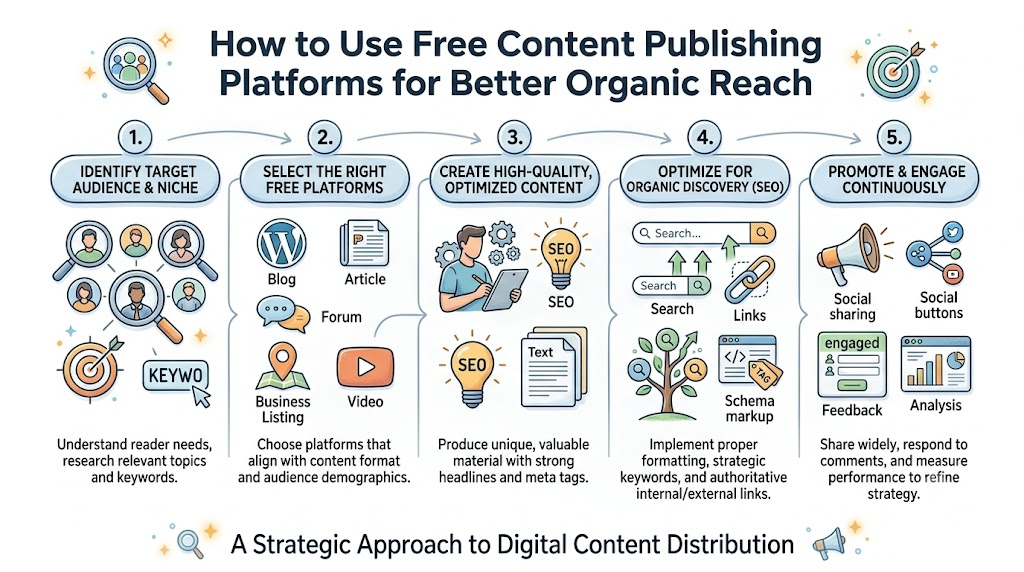
Free content publishing platforms are web-based channels, social networks, open community hubs, and structured business directories that allow individuals and organizations to upload, publish, and syndicate original content without paying subscription or hosting fees. These channels operate under varied business models, often monetizing through unobtrusive platform advertising, premium enterprise features, or optional seller add-ons while keeping foundational publishing tools completely accessible to the general public.
How these systems work depends on their structural design. Hosted platforms provide intuitive block editors and content management systems where users create standalone posts, long-form articles, or multimedia feeds. Open discussion forums and Q&A communities rely on community-moderated threads where users post insightful answers or start relevant industry discussions. Business directories collect standardized organization profiles, service lists, and NAP (Name, Address, Phone) details to help local customers discover reliable service providers.
Why Choosing the Right Platform Is Important
Selecting an appropriate distribution channel directly dictates how effectively your material reaches its intended audience. Publishing a technical software tutorial on a general broad-interest forum yields minimal engagement, whereas sharing the same tutorial on a developer-centric community yields meaningful discussions, peer feedback, and high click-through rates.
Aligning your content with the proper channel delivers multiple strategic benefits:
- Better Audience Reach: Tapping into existing, highly active user bases puts your brand immediately in front of targeted readers who are already seeking relevant knowledge.
- Improved Visibility & SEO Opportunities: Search engines regularly index high-authority publishing sites. Well-structured posts on reputable channels often secure favorable search engine result rankings for competitive keywords.
- Higher Engagement: When your subject matter matches the core interest of a community, readers interact more frequently through comments, shares, and direct feedback.
- Stronger Online Presence: Maintaining an active, consistent presence across several reputable web spaces builds overall brand trust and topical authority.
- Long-Term Content Value: Evergreen articles published on well-maintained public platforms continue attracting passive referral traffic and prospective leads for years after publication.
For example, a boutique accounting firm that posts local tax tips on regional business listing sites and professional network journals will attract qualified local clients far faster than by merely posting to an unindexed personal blog.
Types of Free Posting Sites
Understanding the unique characteristics of different web outlets allows you to deploy tailored distribution strategies for maximum impact.
Free Article Posting Sites
Article posting platforms focus primarily on long-form, informational, and educational text. They often feature clean, reader-first layouts, built-in audience recommendation algorithms, and strong domain metrics that help long-form essays rank quickly on search engines.
Free Blog Posting Sites
Free blogging channels offer hosted environments where creators establish personal or corporate weblogs without managing server infrastructure. These channels provide content management capabilities, customizable templates, and direct RSS feed generation for consistent publication schedules.
Free Forum Posting Sites
Forum platforms emphasize peer-to-peer discussion, collaborative problem solving, and topical Q&A threads. They excel at building genuine community trust when participants contribute thoughtful answers rather than promotional pitches.
Free Business Listing Sites
Business listing outlets enable companies to submit verified corporate profiles, geographic location data, operating hours, and official website links. They play a foundational role in local search visibility and local SEO campaigns.
Free Video Posting Sites
Video platforms host user-generated video content, live streams, and short clips. They serve as massive visual search engines, making them essential for visual tutorials, product demos, and brand storytelling.
Community Publishing Platforms
Community spaces combine social networking with long-form writing, allowing creators to join specific interest groups, share articles directly into thematic hubs, and cultivate dedicated follower groups.
Directory Submission Platforms
Directory platforms organize websites, online tools, software repositories, and industry services into searchable hierarchical categories, making it easy for prospective buyers to find specialized solution providers.
Knowledge Sharing Platforms
Knowledge-sharing outlets host whitepapers, slide decks, research summaries, and documentation. They are ideal for B2B organizations looking to demonstrate deep industry expertise and thought leadership.
How to Choose the Best Platform for Your Content
Selecting the right distribution outlet requires a balanced evaluation of your content format and overarching marketing goals. Avoid publishing indiscriminately on every site you discover; instead, apply a clear framework to identify channels that offer genuine long-term value.
First, assess Content Type and Format Compatibility. Long-form technical guides perform best on documentation platforms or markdown-supported developer communities, while visual infographics require image-heavy or document-sharing portals. Second, evaluate Target Audience Alignment. Study the platform’s active demographic to ensure its reader base overlaps with your ideal user persona.
Third, carefully review Publishing Guidelines and Moderation Policies. Established platforms enforce strict community standards regarding self-promotion, outbound links, author bios, and formatting rules. Adhering to these guidelines ensures your submissions remain published without risk of removal. Finally, consider technical factors like Domain Authority, indexing speed, canonical link support, and overall community engagement levels.
FreePostFinder as a Content Publishing Platform Finder
Navigating hundreds of potential publishing outlets manually is time-consuming and often leads to outdated or risky options. FreePostFinder functions as a dedicated content publishing platform finder, providing a centralized, structured database designed to simplify platform discovery.
+-------------------------------------------------------------------+
|                        FREEPOSTFINDER HUB                         |
|   Discover | Filter by Content Type | Compare | Publish Safely    |
+-------------------------------------------------------------------+
        |                           |                           |
        v                           v                           v
+---------------+           +---------------+           +---------------+
| Article & Blog|           | Forum & Q&A   |           | Directory &   |
| Platforms     |           | Communities   |           | Business      |
+---------------+           +---------------+           +---------------+
The tool indexes platforms across distinct content categories, enabling creators to filter channels based on specific needs—such as short posts, long-form articles, business profiles, or video uploads. Rather than relying on static, unverified lists, users can review key platform attributes, moderation guidelines, domain parameters, and account requirements in one organized view. This approach reduces research time, eliminates guesswork, and matches your content with appropriate, compliant distribution channels.
Best Practices for Publishing Content Online
To achieve sustainable organic visibility and build audience trust across public channels, maintain rigorous publishing standards.
- Create Original, High-Value Content: Never publish automated or low-effort text. Provide genuine insights, actionable tips, and original perspectives that solve real reader problems.
- Adhere Strictly to Community Rules: Every platform maintains distinct publishing terms. Respect link restrictions, formatting requirements, and self-promotion boundaries to maintain a clean publishing record.
- Avoid Duplicate Content Issues: When syndicating material across multiple sites, rewrite descriptions, use canonical tags where supported, or tailor the intro and conclusion to suit each platform’s unique audience.
- Write Audience-Focused Headlines: Craft clear, compelling titles that accurately represent your subject matter without resorting to clickbait tactics.
- Incorporate Quality Visuals: Enhance readability with well-formatted images, diagrams, or original infographics that support your text.
- Maintain and Update Content: Regularly review older posts to update outdated facts, broken links, or fresh statistics, ensuring ongoing search engine relevance.
Adhering to standards set by organizations like the Content Marketing Institute and developer guidelines from Mozilla Developer Network ensures your content remains authoritative, accessible, and compliant across all modern digital standards.
Common Mistakes to Avoid
Even well-intentioned creators often stumble into common distribution traps that harm their online reputation and search performance. Identifying these mistakes early protects your brand identity.
- Mass Syndication of Unaltered Content: Dropping identical text across dozens of sites triggers duplicate content filters and lowers overall search engine trust.
- Ignoring Platform Guidelines: Overlooking community rules regarding external links or promotional language often results in account suspension or immediate post deletion.
- Choosing Irrelevant Categories: Publishing content in misaligned categories confuses readers and signals poor quality to automated content moderators.
- Over-Promoting Products: Treating informative public spaces as billboard channels destroys credibility. Focus on educating first and presenting solutions second.
- Neglecting Audience Interactions: Failing to respond to user comments or thread replies ignores potential community building and networking opportunities.
Focusing on quality distribution rather than sheer submission volume produces superior long-term SEO benefits and authentic audience connections.
Comparison of Free Content Publishing Categories
To help you identify where to deploy your material, the following table compares key web publishing categories based on target audience, content format, and primary strategic benefits.
| Platform Type | Best For | Typical Content | Target Audience | Key Strategic Benefits |
| Article Sites | In-depth essays & guides | Long-form articles, industry analysis | General readers, researchers | Fast search indexing, built-in readership |
| Blogging Platforms | Brand blogs & ongoing series | Thought leadership, tutorials | Subscribers, niche enthusiasts | Full editorial control, feed integration |
| Forums & Q&A | Niche engagement & feedback | Answers, discussions, case studies | Specialized communities, peers | High interaction, direct trust building |
| Business Listings | Local SEO & brand awareness | NAP info, service descriptions | Local prospective buyers | Improved map rankings, local trust |
| Video Outlets | Visual tutorials & demos | Video guides, webinars, short clips | Visual learners, mobile users | High engagement, visual search visibility |
| Directories | Software & tool discovery | Profile listings, feature summaries | Buyers, tech procurement teams | Targeted referral leads, category presence |
Who Can Benefit from Free Content Publishing?
Public publishing channels offer versatile distribution options tailored to diverse professional goals across industries.
Bloggers
Bloggers use public article hubs to expand their reader reach beyond their personal domain, building backlinks and driving targeted referral traffic back to their primary site.
Writers
Independent authors and journalists use hosted writing spaces to showcase portfolio pieces, refine their unique voice, and build a dedicated reader subscriber base without technical hurdles.
Businesses
Companies publish educational insights on commercial directories and industry portals to establish brand authority, demonstrate domain expertise, and capture organic search traffic.
Startups
Early-stage startups leverage free business listings and community platforms to launch products, secure early feedback, and earn online visibility with minimal marketing budgets.
Content Marketers
Marketers incorporate public channels into multi-channel distribution strategies, ensuring gated assets and articles achieve broad syndication across relevant industry hubs.
Developers
Software developers share code snippets, technical documentation, and open-source project updates on developer platforms and forum networks to collaborate with peers.
Educators & Students
Academic professionals and students share research synopses, lecture notes, and learning materials on knowledge portals to foster collaborative learning.
Agencies & Freelancers
Service providers publish case studies and industry breakdowns on professional networks to demonstrate client success and attract inbound prospective clients.
Influencers
Digital creators repurpose video, image, and micro-blogging content across visual networks to maintain active touchpoints with their audience across multiple channels.
Future of Digital Publishing
The digital publishing landscape continues to evolve rapidly, driven by shifting creator models and changing search engine paradigms. A central driver is the growth of the independent creator economy, where writers and experts prioritize direct audience relationships over traditional media channels. Modern readers increasingly seek specialized, community-driven platforms where topic-specific discussions take precedence over generic mass media.
Simultaneously, multi-channel content distribution has evolved from a luxury into a operational necessity. Search engine architectures, guided by guidelines from sources like Google Search Central and web standards from the W3C, increasingly reward brands that maintain authentic, helpful, and multi-faceted digital footprints across diverse channels. Integrating structured discovery engines into your publishing workflows ensures your distribution strategy remains flexible, compliant, and sustainable over time.
How FreePostFinder Helps Users Publish Smarter
Navigating online publishing options without structural guidance can consume valuable creative energy. FreePostFinder accelerates distribution planning by serving as a centralized resource for platform research.
+-------------------------------------------------------------------+
|                  EFFECIENT PUBLISHING WORKFLOW                    |
+-------------------------------------------------------------------+
   [1. Identify Asset] ---> [2. Search FreePostFinder Directory]
                                          |
   [4. Publish & Track] <--- [3. Review Rules & Compare Options]
+-------------------------------------------------------------------+
By organizing platforms into verified categories and detailing specific publishing requirements, the directory helps creators make informed decisions prior to content submission. Users can easily review platform focus areas, account requirements, and content submission formats side-by-side. This structured visibility prevents wasted effort on unsuitable channels, improves guideline compliance, and supports an efficient, organized multi-channel content strategy.
Frequently Asked Questions (FAQ)
What are free posting sites?
Free posting sites are online platforms, directories, forums, and hosted content management hubs that permit users to upload, publish, and share written, visual, or audio content without paying hosting fees. These websites allow independent creators, businesses, and marketers to reach broader digital audiences without immediate financial investment.
Where can I post content for free?
You can publish digital content for free across a wide range of platforms depending on your specific media format and marketing goals. For written articles and stories, open publishing networks and hosted blog builders offer instant setup. For visual media, video-sharing portals and image repositories serve as global distribution networks.
What are free article posting sites?
Free article posting sites are public web platforms designed specifically for hosting long-form written articles, educational essays, news analyses, and opinion pieces. These platforms provide built-in content editors, automatic formatting tools, and existing readership bases that help user-submitted articles reach interested readers quickly.
Which free blog posting sites are best for beginners?
Beginner-friendly blogging sites provide hosted web environments with simple drag-and-drop editors, pre-designed templates, and zero technical maintenance requirements. Popular options allow new creators to sign up and publish a post within minutes without managing servers or custom code.
How do free business listing sites help SEO?
Free business listing platforms support search engine optimization by providing authoritative online citations that verify a company’s physical location, contact details, and core business offerings. Search engine algorithms utilize these directory listings to confirm organizational legitimacy and evaluate local search relevance. Consistent Name, Address, and Phone (NAP) information across reliable business portals strengthens local search rankings and improves map visibility.
What are free forum posting sites?
Free forum posting sites are discussion-focused online communities organized around specific topics, industries, or technical disciplines. These platforms allow registered members to ask questions, post detailed answers, share practical experiences, and start discussions with like-minded peers. Unlike promotional broadcasting channels, forums rely on authentic communication and community value.
Which free video posting sites are worth using?
Free video posting platforms are worth using if they provide reliable video streaming, responsive mobile performance, strong search indexing, and active global user communities. Top video hosting services allow creators to upload video tutorials, product demonstrations, webinars, and short visual clips at no cost.
How do I choose the right publishing platform?
Choosing the right publishing channel requires matching your content format with your primary audience and strategic goals. Start by defining your objectives, such as building local search rankings, generating industry leads, or establishing creative brand authority. Next, research potential platforms to evaluate their user demographics, content rules, domain strength, and active engagement levels.
Is FreePostFinder suitable for businesses and creators?
Yes, FreePostFinder is designed specifically to serve businesses, independent creators, marketers, developers, and writers seeking efficient content distribution outlets. The platform provides a categorized directory indexing hundreds of public publishing options across various content formats, including articles, forums, video platforms, and business listings.
How can I avoid content rejection on publishing platforms?
To avoid content rejection on public platforms, always review and follow each site’s published editorial policies and community guidelines prior to submission. Ensure your content is completely original, well-written, and structured to offer genuine educational or entertaining value to readers. Avoid heavy promotional language, aggressive affiliate links, keyword stuffing, and duplicate text distribution across multiple channels.
Conclusion
Distributing your material across authoritative free content publishing platforms is a fundamental component of a modern, resilient digital marketing strategy. Rather than depending exclusively on a single website or costly ad campaigns, distributing original content across well-chosen public channels expands your reach, builds valuable backlink diversity, and strengthens organic search visibility. Utilizing organized platform indexes streamlines this entire process. By providing structured access to verified public outlets, category filters, and clear publishing guidelines, tools like FreePostFinder empower creators, marketers, and businesses to make strategic, data-informed distribution choices.
