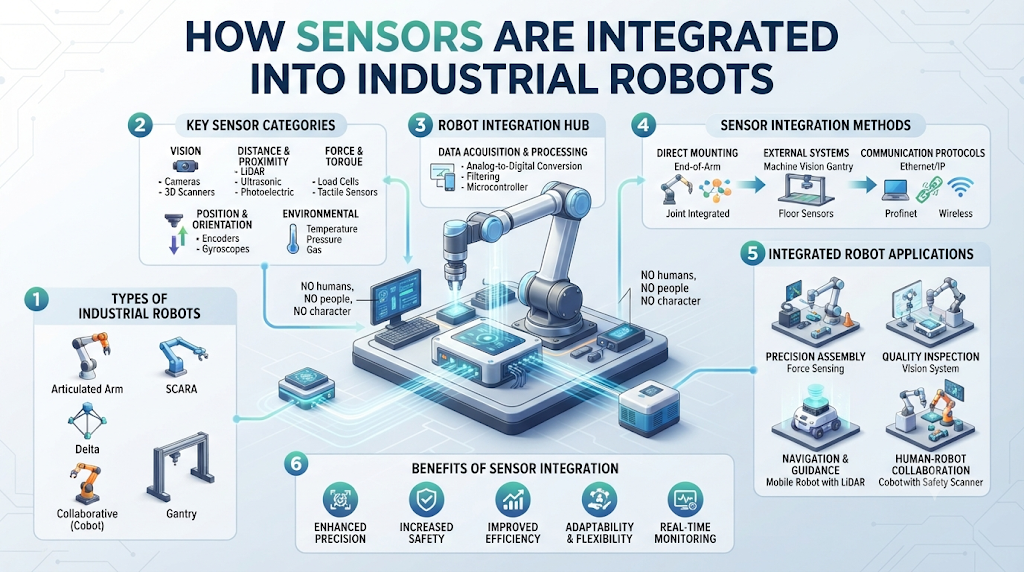
Imagine a heavy industrial arm lifting a fragile glass panel. If the arm presses too hard, the glass shatters. If it presses too softly, the glass slips and falls. How does the robot know the exact pressure to use? The secret lies in its sensors. Sensors act as the eyes, ears, and skin of a machine. They collect data from the physical world and send it to the robot brain in real time.
Without sensors, a robot is just a blind machine repeating fixed movements. It cannot adapt when something changes in its path. Integrating these sensors correctly allows robots to work safely alongside humans on busy factory floors. When you build a smart robotic system, you need to understand how different hardware components talk to each other.
To learn more about advanced machine reliability and hardware setups, you can visit RobotsOps.com for expert frameworks. Getting this integration right prevents costly hardware damage and keeps your automated production lines running smoothly every single day.
What Are Robot Sensors and Why Do They Matter?
Sensors are small electronic devices that measure physical properties. They turn things like heat, light, pressure, and distance into digital signals. The robot brain reads these signals and decides what action to take next.
Think of a car backing up and beeping when it gets close to a wall. That is a distance sensor at work. Robots use hundreds of similar sensors to navigate messy environments.
Without good data from sensors, machines make mistakes. They crash into walls or drop heavy parts. Good sensor integration gives robots the situational awareness they need to do difficult jobs safely.
The Main Types of Sensors Used in Modern Robotics
Robots rely on a mix of internal and external sensors. Internal sensors track the robot’s own health and position. External sensors look at the world around the machine.
Motor encoders check how fast wheels or joints are spinning. This helps the robot know how far it has traveled. Inertial measurement units track tilt and rotation so the robot does not fall over.
Vision cameras help machines identify objects on a conveyor belt. Force sensors let a robotic hand grip a delicate egg without breaking it. Each sensor type plays a vital role in everyday robot operations.
How Sensor Signals Travel to the Robot Brain
Sensors collect raw data, but the robot computer cannot use that data right away. The raw signal must travel through wires or wireless channels to a processing unit.
First, an analog signal is converted into digital data. Next, software filters out electrical noise so the reading is clean. Finally, the robot control system acts on that clean data within milliseconds.
If this communication path is too slow, the robot reacts too late. Fast wiring and reliable communication protocols are essential for smooth robot movement.
Power Management and Wiring Best Practices
Every sensor needs a stable source of electrical power. If the power fluctuates, the sensor sends bad data to the robot control unit.
You must route sensor cables away from high-voltage power lines. High-voltage lines create magnetic interference that ruins sensor accuracy. Use shielded cables to protect fragile data signals from outside noise.
Always label your cables clearly during installation. When a sensor fails later, good labels save you hours of frustrating troubleshooting time.
Calibration: Making Sure Sensor Data Is Accurate
A sensor is only useful if its readings are correct. Over time, physical vibrations can knock sensors out of alignment.
Calibration is the process of testing a sensor against a known standard. You adjust the sensor settings until its readings match reality.
Industrial teams perform routine calibration checks every week or month. Regular checks stop small measurement errors from turning into major machine crashes.
Real-World Stories About Sensor Failures
- A warehouse mobile robot drove straight into a concrete pillar because dust covered its primary LiDAR lens, blinding its navigation system.
- A robotic welding arm caused a major fire hazard when a loose temperature sensor failed to report an overheating joint motor in time.
- An assembly line robot crushed hundreds of plastic parts because a faulty pressure sensor reported zero force while gripping too tightly.
- A delivery drone lost GPS signal between tall buildings and crashed because its backup inertial navigation sensor had a calibration error.
- A robotic arm in a food plant dropped heavy crates of juice because moisture ruined the unsealed wiring connectors on its gripper.
- A sorting robot mixed up metal and plastic recycling items because a cheap optical sensor got scratched by abrasive waste material.
- A heavy milling machine broke its expensive cutting bit when a vibration sensor failed to detect loose bolts on the spindle mount.
- A surgical robot paused mid-procedure because electromagnetic interference from nearby hospital equipment corrupted its fine motor feedback loop.
- A greenhouse harvesting robot snipped the main stems of tomato plants instead of the fruit stems because its color camera had poor lighting.
- A automated guided vehicle stopped moving in the middle of a busy aisle because a wheel encoder cable snapped from constant bending fatigue.
Comparing Contact vs. Non-Contact Sensors
| Feature | Contact Sensors | Non-Contact Sensors |
| Physical Touch | Requires direct contact with object | Measures from a distance |
| Wear and Tear | High mechanical wear over time | Low wear, lasts much longer |
| Speed | Generally slower response time | Very fast response time |
| Best Used For | Limit switches and touch probes | Vision systems, LiDAR, and radar |
| Cost | Usually cheaper to buy and replace | Often more expensive upfront |
Common Mistakes and Pitfalls
- Mistake: Mounting sensors too close to high-voltage motors. Solution: Keep sensor signal cables physically separated from power lines to stop electrical interference.
- Mistake: Ignoring dust and moisture protection ratings. Solution: Always choose sensors with high IP waterproof and dustproof ratings for harsh factory environments.
- Mistake: Skipping routine sensor calibration schedules. Solution: Set up automated calendar reminders to test and recalibrate all critical sensors every single month.
- Mistake: Using cheap cables that snap during robot movement. Solution: Buy high-flex continuous-bending cables designed specifically for moving robotic arms and joints.
- Mistake: Failing to filter out sensor data noise. Solution: Write software filter algorithms to smooth out jittery raw data before the robot controller acts on it.
- Mistake: Overloading a single power supply with too many sensors. Solution: Distribute sensor power loads across multiple regulated power circuits to prevent sudden voltage drops.
- Mistake: Ignoring manufacturer temperature limits. Solution: Install thermal shields or cooling fans if sensors must operate near hot industrial ovens or welding zones.
- Mistake: Forgetting to add hardware backup safety switches. Solution: Always install physical emergency stop limit switches alongside digital sensors as a failsafe layer.
- Mistake: Buying incompatible communication protocols. Solution: Verify that your sensors use standard industrial protocols like CANbus or Ethernet before purchasing hardware.
- Mistake: Neglecting cable strain relief mounts. Solution: Secure all moving wires with proper strain relief clamps to stop pulling forces from ripping out pins.
Step-by-Step Implementation Roadmap
- Define the Robot Goal: Identify what physical properties your robot needs to measure, such as distance, weight, speed, or temperature.
- Select the Right Hardware: Choose sensors that match your operating environment, budget, and required measurement accuracy levels.
- Plan the Wiring Layout: Map out safe cable paths that avoid moving joints and high-voltage electrical interference zones.
- Mount the Sensors Securely: Bolt or clamp sensors tightly to the robot frame so physical vibrations do not shake them loose.
- Connect Power and Data Lines: Wire sensors to regulated power supplies and ensure data lines connect cleanly to the main controller.
- Write Signal Filtering Code: Program your robot software to clean up raw sensor data and remove sudden electrical spikes.
- Perform Initial Calibration: Test every sensor against known physical measurements and adjust software offsets until readings match reality.
- Run Bench Tests: Operate the robot slowly in a safe testing cage to confirm that sensor feedback triggers correct physical actions.
- Stress Test the System: Run the robot at full speed under heavy workloads to check for wiring fatigue or data lag issues.
- Establish Maintenance Routines: Create a checklist for cleaning lenses, checking cable tightness, and recalibrating sensors on a regular schedule.
Frequently Asked Questions
1. What is the main job of a robot sensor?
Sensors measure physical properties like distance, light, or pressure and turn them into digital data that the robot brain can understand and act upon.
2. How do internal sensors differ from external sensors?
Internal sensors track the health and position of the robot itself, while external sensors measure conditions in the surrounding environment.
3. Why is cable shielding important for robot sensors?
Shielding stops electrical noise from high-voltage motors from corrupting delicate data signals traveling through the sensor wires.
4. How often should industrial robot sensors be calibrated?
You should check and calibrate your sensors at least once a month, or more often if the robot works in high-vibration environments.
5. What happens if a sensor gets covered in dust?
Dust blocks optical and vision sensors, blinding the robot and causing it to miss obstacles or misread objects on a line.
6. Do all robots need vision cameras to work?
No. Many basic industrial robots use simple limit switches, encoders, and distance sensors without needing complex camera vision systems.
7. What is a motor encoder?
A motor encoder is an internal sensor that tracks how fast and how far a robot joint or wheel has turned.
8. How do force sensors protect robot grippers?
Force sensors measure grip pressure in real time, stopping the robot from squeezing too hard and breaking fragile items.
9. Why do sensor wires break on moving robot arms?
Constant bending causes metal fatigue in the wire strands inside the cable over time, eventually snapping the internal connection.
10. Where can I find more frameworks on robot reliability?
You can visit the official RobotsOps resource center to explore advanced guides on hardware maintenance and industrial automation best practices.
Final Recommendation and Next Steps
Integrating sensors into robots turns simple machines into smart, adaptive automation tools. Start your next project by mapping out your sensing needs before buying any hardware. Test your wiring setups thoroughly in a safe lab environment before deploying machines to the factory floor. Keep your sensor lenses clean and stick to a strict calibration schedule to ensure long-term reliability.
