Introduction
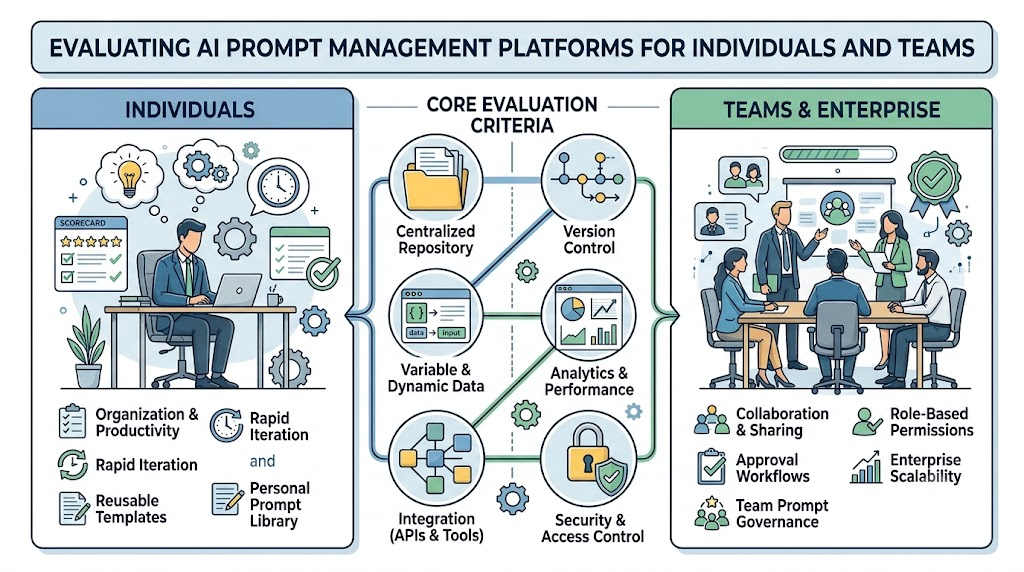
Generative Artificial Intelligence has rapidly shifted from a novelty into an essential operational infrastructure across tech, marketing, research, and design. However, as individuals and enterprise teams expand their rely on models like GPT-4, Claude 3, and Gemini, a quiet bottleneck has emerged: managing the instructions that power these systems. Millions of high-performing prompts remain scattered across personal note applications, ephemeral chat histories, local code repositories, and unstructured text documents. When teams fail to treat AI prompts as structured, versioned digital assets, productivity plummets. Inconsistent output formatting, lost contextual nuances, redundant trial-and-error, and zero visibility across team workflows waste hundreds of working hours every month. Solving this challenge requires moving beyond ad-hoc text file storage toward a structured AI prompt management tool framework. By treating prompts as modular, testable, and reusable intellectual property, creators and businesses unlock predictable AI outcomes.
What is an AI Prompt Management Tool?
An AI prompt management tool is a purpose-built software environment designed to store, organize, refine, evaluate, and deploy instructions for artificial intelligence models. Rather than relying on static text documents or scattered browser history tabs, a prompt platform turns loose text strings into searchable, dynamic digital assets equipped with variables, metadata, and versioning.
+-----------------------------------------------------------------------------------+
|                        AI PROMPT MANAGEMENT WORKFLOW                              |
+-------------------+     +-------------------+     +-------------------+     +-----+
|  Creation & Input | --> | Categorization &  | --> | AI Optimization & | --> |     |
|  (Raw Prompt)     |     | Tagging (Library) |     | Quality Checking  |     |     |
+-------------------+     +-------------------+     +-------------------+     +-----+
                                                                                |
+-------------------+     +-------------------+                                 |
| Deployment &      |     | A/B Testing &     | <-------------------------------+
| Version History   | <-- | Output Evaluation |
| (Reusable System) |     | (Analyzer)        |
+-------------------+     +-------------------+
Why Prompt Management Matters
When AI adoption accelerates, organizational knowledge fragments. A dedicated platform solves this fragmentation by consolidating prompt engineering across teams. Centralizing prompt architectures ensures that when a engineer or copywriter creates a high-performing system prompt, the entire organization can immediately discover, reuse, and build upon that success.
Common Prompt Challenges
- Prompt Loss: Losing effective prompt strings inside cleared chat sessions or buried chat logs.
- Inconsistent Results: Running variations of a prompt without tracking which specific instructions produced superior output.
- Redundant Labor: Reinventing instructions that team members have already built and perfected elsewhere.
- Variable Fragility: Manually editing hardcoded text variables instead of using dynamic placeholder systems.
Benefits of Organized Prompt Libraries
Establishing a centralized AI prompt library transforms chaotic AI usage into a predictable operational engine. Teams gain instant search capability, structured variables, standardized output formats, and collaborative sharing. As detailed in the Microsoft Learn AI Documentation, structured prompt orchestration is vital for reducing cognitive overhead and maintaining operational consistency across complex enterprise applications.
Understanding Prompt Engineering
Prompt engineering is the strategic discipline of designing, structuring, and refining textual inputs to guide large language models (LLMs) toward accurate, contextually relevant, and deterministically formatted outputs. Treating prompt engineering as an engineering discipline—rather than intuitive writing—is the cornerstone of effective AI adoption.
Using an enterprise prompt engineering platform enables teams to isolate and adjust the individual functional components that govern model behavior:
- Role Definition: Assigning a specific persona or behavioral frame (e.g., “Act as a Senior System Architect”).
- Instruction Set: Clear, explicit command sequences directing the AI on the exact actions to execute.
- Contextual Grounding: Background data, reference documents, or domain constraints that inform the task.
- Variables: Dynamic placeholders (e.g.,
{{target_audience}}or{{code_language}}) that allow a single prompt to serve dozens of distinct execution runs. - Output Formatting Constraints: Structural rules defining the exact output schema, such as JSON structures, Markdown tables, or strict character boundaries.
- Negative Constraints: Explicit declarations detailing what the AI must not include or execute.
Practical Example: Unstructured vs. Engineered Prompt
Unstructured Input:
“Write a blog post about email marketing tips for small businesses.”
Engineered Input (Structured Architecture):
Role: You are a B2B SaaS Growth Marketer.
Task: Write an educational blog section explaining email list segmentation.
Audience: Non-technical small business owners.
Context:
{{business_context}}Formatting Rules: Use clear H3 subheadings, active voice, short paragraphs, and zero corporate jargon.
Negative Constraint: Do not recommend paid enterprise tools like Salesforce Marketing Cloud.
Building an Organized AI Prompt Library
A poorly organized library quickly becomes an unused graveyard of text files. Building a functional, high-velocity library requires intuitive taxonomies, structured tags, and robust search capabilities.
Using an intuitive AI prompt organizer ensures that team members find the exact instruction set they need within seconds:
Key Library Building Blocks
- Taxonomy & Categories: Classify prompts by operational domain—such as Software Development, Copywriting, Customer Support, Data Analytics, or Executive Operations.
- Tagging Architecture: Layer descriptive metadata tags onto assets (e.g.,
#GPT4,#JSONOutput,#CustomerFacing,#CodeRefactoring). - Dynamic Variable Management: Define standard variable inputs so team members can fill out simple form fields rather than editing core prompt code manually.
- Instant Search & Collections: Utilize semantic search engines to locate prompts based on intent, output goal, or variable type.
Organized libraries eliminate duplicate effort, protect intellectual property, and turn individual team breakthroughs into permanent institutional assets.
AI Prompt Optimization
Prompt engineering is an iterative process. A raw initial prompt rarely delivers optimal performance across edge cases. Systematically optimizing prompts improves clarity, reinforces logic, and enforces structural boundaries.
Leveraging a automated AI prompt optimizer lets users transform ambiguous queries into precise, bulletproof prompt systems:
+-----------------------------------------------------------------------------------+
|                            PROMPT OPTIMIZATION PIPELINE                           |
+-------------------+     +-------------------+     +-------------------+     +-----+
| Raw Draft         |     | Context & Role    | --> | Variable & Schema | --> |     |
| (Vague Request)   | --> | Enhancement       |     | Injection         |     |     |
+-------------------+     +-------------------+     +-------------------+     +-----+
                                                                                |
+-------------------+     +-------------------+                                 |
| Bulletproof Asset |     | Ambiguity & Error | <-------------------------------+
| (Deployable)      | <-- | Elimination       |
+-------------------+     +-------------------+
Strategies for Effective Optimization
- Eliminating Ambiguity: Replacing vague directives like “make it persuasive” with measurable criteria like “include three social proof statements and a direct call to action.”
- Context Enhancement: Injecting explicit domain framing so the model avoids making broad, generic assumptions.
- Role Reinforcement: Establishing clear expert boundaries to align tone, technical depth, and vocabulary.
- Formatting Standardization: Enforcing rigid output structures to ensure seamless down-stream parsing by software APIs or human readers.
Refer to the official OpenAI Prompt Engineering Guide for foundational research on how precise structural formatting reduces token consumption while dramatically boosting output accuracy.
AI Prompt Analysis
Before executing a complex prompt across production environments, creators must evaluate its structural integrity, variable security, and logical flow.
Utilizing a comprehensive AI prompt analyzer allows users to inspect prompt architecture before running live queries, identifying potential execution bottlenecks or missing instructions early.
Core Analysis Dimensions
- Goal Identification: Does the prompt explicitly state what success looks like?
- Variable Verification: Are all dynamic placeholders correctly formatted and accounted for?
- Constraint Completeness: Are safety parameters, negative constraints, and output lengths clearly defined?
- Token Efficiency: Is the prompt free from bloated filler phrases that consume context window space unnecessarily?
Detailed prompt analysis prevents model drift, minimizes hallucination risks, and lowers API costs by removing unnecessary context padding.
Prompt Quality Checking
Measuring prompt quality should not depend on subjective intuition. Maintaining high operational standards across enterprise workflows requires structured, objective scoring models.
Integrating a built-in prompt quality checker establishes a transparent score for every prompt asset based on core structural metrics:
| Metric | Evaluation Focus | Ideal Score Indicator |
| Clarity | Directness of instructions and lack of vague phrasing | Zero ambiguous terminology |
| Context Strength | Depth of background guidance and role definition | Explicit background and persona |
| Structural Rigidity | Precision of output schemas and negative constraints | Clear schema (e.g., JSON/Markdown) |
| Variable Safety | Proper isolation of dynamic inputs | Clear variable boundary syntax |
| Reusability | Versatility across different operational inputs | Parameterized inputs without hardcoding |
Applying automated quality checking ensures that only validated, high-performing prompts are published to shared enterprise libraries.
Version Control for AI Prompts
Large language models change over time, and prompt inputs evolve alongside business requirements. Changing a single sentence in a system prompt can drastically alter output quality, tone, or formatting. Without version history, diagnosing why a prompt suddenly underperforms becomes nearly impossible.
Implementing a dedicated prompt version control tool provides complete historical tracking across every prompt iteration:
+-----------------------------------------------------------------------------------+
|                           PROMPT VERSION CONTROL HISTORY                          |
+-----------------------------------------------------------------------------------+
|  v1.0 - Initial Baseline (Basic Instructions)                                     |
|  v1.1 - Added Role Definition & Markdown Formatting                               |
|  v2.0 - Major Overhaul: Injected Dynamic Variables {{industry}}, {{tone}}         |
|  v2.1 - Current Production: Enforced Negative Constraints & Output Token Limit    |
+-----------------------------------------------------------------------------------+
Key Versioning Advantages
- Iterative Experimentation: Test bold instruction changes without losing previous functional configurations.
- Audit Trails: Track which team member edited specific instructions and why.
- Instant Rollbacks: Restore a verified baseline prompt immediately if a new variation causes unexpected output regressions.
- Branching Experiments: Fork standard prompts to build specialized variations for distinct departments or customer niches.
As emphasized in the Anthropic Interactive Prompt Engineering Documentation, rigorous version control is essential for maintaining deterministic model behavior across continuous deployment pipelines.
Testing AI Prompts
Validating prompt performance requires empirical testing across multiple scenarios, parameter configurations, and model versions.
Using a dedicated AI prompt testing tool empowers creators to conduct side-by-side output comparisons, evaluate consistency, and run systematic A/B experiments across competing model engines.
Practical Testing Scenarios
- Cross-Model Comparisons: Run the identical prompt through GPT-4, Claude 3.5 Sonnet, and Gemini 1.5 Pro to compare accuracy, reasoning speed, and output formatting.
- Variable Edge-Case Testing: Inject boundary-pushing variable inputs (e.g., extremely long text, non-English strings, or incomplete data) to test prompt resilience.
- Consistency Sampling: Execute the exact same prompt ten consecutive times to measure output variance and deterministic reliability.
Systematic prompt testing eliminates guesswork, guaranteeing that deployed prompts perform reliably under real-world operational conditions.
Reusable AI Prompt Templates
Creating high-quality prompts from scratch for every task is inefficient. Building a rich library of reusable AI prompt templates allows teams to standardize complex workflows instantly.
High-Value Template Domains
- Software Development: Code refactoring, automated unit test generation, pull request summaries, and API documentation.
- Content & Marketing: SEO article outline generation, email newsletter sequences, social copy variations, and brand voice alignment.
- Business Operations: Executive meeting summarization, contract clause extraction, proposal drafting, and customer ticket routing.
- Research & Analysis: Academic paper synthesis, competitive intelligence extraction, and qualitative survey thematic coding.
Standardized templates turn prompt engineering from a individual skill into a shared team capability.
Promptosia for Different User Types
Promptosia offers a flexible, enterprise-grade environment tailored to the unique operational workflows of diverse professional user groups:
Writers & Content Creators
Organize creative brainstorming frameworks, maintain strict brand style guides, generate structured outlines, and store specialized editing prompts that preserve unique human tone.
Developers & Systems Engineers
Manage complex system prompts, maintain rigid API JSON schema templates, automate technical documentation, and version control code generation workflows across engineering teams.
Marketers & Growth Teams
Deploy standardized copy frameworks, manage multi-channel campaign templates, analyze audience messaging variations, and build consistent brand messaging prompt stacks.
Students & Educators
Design interactive study guides, create customized tutoring personas, organize research synthesis prompts, and build structured educational grading rubrics.
Researchers & Data Analysts
Store precise data extraction templates, structure literature review prompts, maintain rigorous qualitative coding frameworks, and automate report summaries.
Businesses & Enterprise Agencies
Establish centralized prompt governance, enforce brand and compliance rules across departments, protect proprietary prompt IP, and track team AI usage metrics.
Best Practices for Prompt Management
To maximize the long-term value of your AI workflows, adopt these core operational best practices:
- Parameterize Every Input: Never hardcode specific names, dates, or topics into core instructions—always use dynamic variables (
{{variable_name}}). - Standardize Naming Conventions: Adopt structured asset titles (e.g.,
[Marketing] - SaaS Email Sequence Generator - v2). - Enforce Structural Constraints: Always declare explicit output formats (Markdown, JSON, or CSV) to guarantee downstream parsing reliability.
- Document Intended Model Context: Explicitly note which model engine and temperature settings yield optimal results for a given prompt asset.
- Conduct Regular Quality Audits: Periodically prune outdated, redundant, or underperforming prompt variations from shared libraries.
- Decouple System Rules from User Data: Keep system instructions, persona definitions, and background context logically separated from user inputs.
Common Prompt Engineering Mistakes
Avoiding operational pitfalls is just as important as implementing best practices.
- Vague Directives: Expecting accurate outputs from broad instructions without clear success parameters or constraints.
- Context Overload: Stuffing unnecessary filler into prompt inputs, causing model distraction and consuming context window limits.
- Ignoring Negative Constraints: Telling the AI what to do while failing to specify what it must strictly avoid.
- Zero Testing Across Edge Cases: Assuming a prompt works universally after testing it with only one simple example.
- Unstructured Asset Storage: Storing mission-critical system prompts in local text files or unindexed personal notebooks.
Addressing these common mistakes elevates prompt quality and secures consistent, production-grade AI outputs.
Comparison Table: Manual Storage vs. Specialized Management Platform
| Feature / Metric | Manual Storage (Notes, Docs, Code Comments) | Promptosia AI Prompt Platform |
| Asset Organization | Unstructured text files, scattered folders | Centralized taxonomy, tags, and dynamic metadata |
| Version History | Manual file copying (prompt_v2_final.txt) | Automated version logging, diffing, and rollbacks |
| Variable Injection | Manual find-and-replace text editing | Dynamic form fields with parameterized variables |
| Quality Evaluation | Subjective human guessing | Automated quality scoring & structural analysis |
| Cross-Model Testing | Manual copy-pasting across browser windows | Side-by-side multi-model comparison tools |
| Team Collaboration | Fragmented sharing via chat or email | Shared enterprise workspaces, permissions, and IP protection |
| Searchability | Basic local text search | Semantic intent search across categories and tags |
The Future of Prompt Engineering
Prompt engineering is rapidly maturing from a trial-and-error skill into a standardized software discipline. As generative models become more capable, the focus is shifting toward autonomous prompt optimization, programmatic context orchestration, and integrated prompt registries.
Industry research hosted on Hugging Face Documentation highlights a growing trend toward standardized prompt registries and evaluation frameworks. Future AI architectures will rely heavily on programmatic prompt versioning, automated quality scoring, and seamless API-first deployment. Establishing a disciplined prompt management infrastructure today prepares individuals and organizations for the next era of enterprise AI automation.
How Promptosia Helps Users Build Better Prompts
Promptosia provides an all-in-one environment built specifically to streamline the entire prompt management lifecycle. Rather than treating prompts as disposable queries, Promptosia equips users with the tools necessary to transform instructions into durable, high-value assets.
Core Platform Capabilities
- Centralized Library Architecture: Organize prompts with custom categories, tags, dynamic variables, and robust semantic search.
- AI-Assisted Optimization Engine: Instantly refine raw prompt ideas into precise, structured instructions equipped with clear constraints.
- Deep Structural Analysis: Inspect prompt clarity, variable boundaries, and safety parameters prior to production execution.
- Full Version History: Track changes, compare historical iterations, and restore previous baselines with a single click.
- Multi-Model Testing Grounds: Conduct side-by-side output evaluations across competing model engines to select the best configuration.
- Prompt Passports & Duels: Evaluate prompt performance transparently, benchmark quality scores, and participate in community evaluation challenges.
Frequently Asked Questions (FAQ)
What is an AI prompt management tool?
An AI prompt management tool is a dedicated software platform designed to store, organize, optimize, test, version, and share prompts for generative AI models. It turns loose text queries into searchable, structured, and reusable digital assets, eliminating scattered text files and unorganized chat logs across individual and team workflows.
Why should I save and manage my AI prompts systematically?
Saving AI prompts systematically prevents loss of effective instructions, eliminates redundant trial-and-error, and builds a searchable library of intellectual property. Systematically managed prompts allow individuals and teams to achieve consistent, high-quality AI outputs in a fraction of the time required by manual rewriting.
What is prompt engineering?
Prompt engineering is the strategic process of designing, structuring, and refining text inputs to guide artificial intelligence models toward accurate, contextually relevant, and properly formatted outputs. It involves structuring role definitions, clear task instructions, dynamic variables, contextual data, and negative constraints.
How does automated prompt optimization work?
Automated prompt optimization analyzes draft text inputs to identify ambiguities, missing context, weak instructions, or missing output boundaries. It then restructures the draft into a precise, professional prompt framework equipped with role definitions, clear task steps, structural schemas, and negative constraints to maximize model performance.
Why is prompt testing necessary before deployment?
Prompt testing validates how instructions perform across different model engines, parameter settings, and variable edge cases. Side-by-side output comparisons ensure that a prompt delivers deterministic, accurate, and properly formatted results consistently, preventing unexpected hallucinations or formatting errors during live deployment.
What is prompt version control?
Prompt version control is the practice of tracking and logging every historical revision made to a prompt string. It allows creators to view change histories, understand why quality metrics shifted, compare output diffs across iterations, and roll back immediately to a previous baseline if a new modification degrades quality.
How does an AI prompt analyzer evaluate prompt quality?
An AI prompt analyzer evaluates structural dimensions such as instructional clarity, role clarity, variable isolation, constraint completeness, and token efficiency. It identifies missing structural parameters and provides actionable scoring metrics to help users improve prompt reliability prior to execution.
What components make up a high-quality prompt?
A high-quality prompt contains an explicit role definition, clear task directives, background context, dynamic variable placeholders, rigid output formatting parameters (such as JSON or Markdown tables), and explicit negative constraints detailing what the model must avoid generating.
Can teams collaborate on shared prompt libraries?
Yes. Modern prompt platforms allow teams to build centralized, shared workspaces where members can discover verified prompt templates, collaborate on version improvements, enforce brand governance rules, and deploy standardized prompts across departments without reinventing solutions independently.
Who benefits most from using Promptosia?
Promptosia is designed for writers, software developers, marketers, researchers, educators, students, content creators, enterprise teams, and AI professionals who rely on generative models and require a centralized, organized, and testable platform to manage their prompt engineering assets.
Conclusion
As generative artificial intelligence continues to redefine modern workflows, the quality of your AI outputs remains directly tied to the structure, clarity, and management of your prompt inputs. Relying on unorganized text files, unindexed notes, and unverified trial-and-error limits operational speed and degrades work quality. Adopting a specialized AI prompt management tool framework transforms chaotic, isolated AI queries into structured, version-controlled, and testable digital assets. By consolidating your prompt engineering workflows, applying objective quality scoring, systematically testing inputs across models, and organizing reusable prompt libraries, you empower yourself and your organization to achieve consistent, production-grade results every time.
