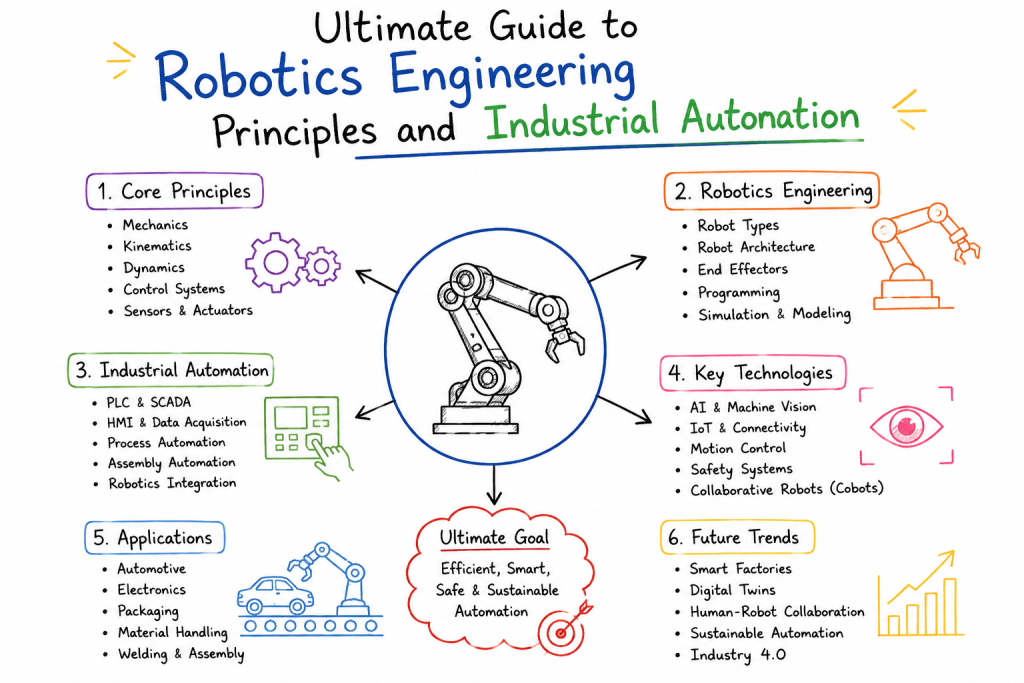
Introduction
The global robotics and automation industries are experiencing unprecedented growth. From automated assembly lines to autonomous delivery vehicles, intelligent machines are transforming how modern businesses operate. Today, the rise of intelligent machines and AI-driven systems means companies no longer rely solely on static hardware. Instead, they require dynamic, adaptable systems capable of sensing, thinking, and acting in complex environments.
To build these next-generation machines, professionals must master foundational engineering concepts. Understanding core robotics engineering principles is essential because it allows developers to build systems that are safe, reliable, and efficient. Whether you are an electronics engineer, a software developer, or a technology student, learning how to integrate mechanics, electronics, and software is incredibly valuable today.
As industries shift toward smart manufacturing, the demand for skilled professionals who can design and maintain these systems continues to climb. Navigating this landscape requires access to high-quality educational frameworks and expert guidance. Industry platforms like RobotsOps provide the necessary operational insights and resources to help engineers bridge the gap between theoretical engineering and real-world industrial application. Mastering these fundamentals is the first step toward building impactful automation technologies.
What Is Robotics Engineering?
Robotics engineering is a multidisciplinary branch of engineering and science that focuses on the design, construction, operation, and application of robots. It sits at the exact intersection of mechanical engineering, electrical engineering, and computer science.
The relationship between hardware and software in this field is deeply intertwined. The hardware serves as the physical body of the robot, encompassing structural frames, links, joints, and gears. The software acts as the brain and nervous system, translating data into physical movement. A robotics system cannot function effectively if the hardware cannot support the precision required by the software, or if the software cannot interpret the signals sent by the hardware.
Robotics systems are vital because they bridge the gap between digital data and physical execution. Unlike traditional computers that process information for human consumption, a robot interacts directly with its physical surroundings.
The evolution of robotics technology has progressed through three major phases:
- First Generation: Simple, repetitive industrial arms executing pre-programmed paths without external awareness.
- Second Generation: Systems equipped with basic sensors that allow them to adjust to minor changes in their environment.
- Third Generation: Modern AI robotics systems that use machine vision, real-time edge processing, and complex feedback loops to make autonomous decisions.
The core philosophy behind robotics automation is to extend human capability, optimize production workflows, and eliminate human error in hazardous or highly repetitive environments.
Why Robotics Engineering Matters Today
The rapid expansion of industrial automation growth has made robotics a cornerstone of modern global commerce. Factories are transitioning from isolated machinery into fully realized smart manufacturing hubs, where interconnected systems share data in real time to optimize production outputs.
AI-powered robotics represents a massive shift in industry capabilities. Traditional robots could only perform tasks in highly structured environments. Today, integrated artificial intelligence allows systems to handle variability, such as sorting randomly arranged packages or navigating dynamic warehouse floors.
The real-world impact of these systems includes:
- Precision and Efficiency Improvements: Machines operate with sub-millimeter accuracy, drastically reducing material waste in automotive painting, welding, and electronics assembly.
- Automation of Repetitive Tasks: Relieving human workers from monotonous, physically exhausting, or dangerous duties.
- Healthcare and Service Robotics: Assisting surgeons with high-precision minimally invasive procedures and managing logistics inside hospitals.
- Enterprise Operational Benefits: Lower operational overhead, increased throughput, and predictable production timelines that protect supply chains from disruption.
Key Principles Every Robotics Engineer Should Know
Sensors and Perception
Sensors gather data from the physical environment, acting as the eyes and ears of a robot. To design an effective system, you must understand how to select and implement components like LiDAR, ultrasonic sensors, infrared sensors, and IMUs (Inertial Measurement Units). Perception involves filtering this raw data to build a reliable model of the surrounding world.
Actuators and Movement Systems
Actuators convert electrical or fluid energy into physical force, driving the movement of joints and wheels. Engineers choose between DC stepper motors for precise positioning, brushless DC motors for high speed and durability, and pneumatic or hydraulic systems for heavy lifting in industrial setups.
Control Systems
Control systems govern how a robot reacts to sensor feedback to achieve a desired outcome. This involves implementing control loops, such as PID (Proportional-Integral-Derivative) controllers. For example, a PID controller ensures a robotic arm slows down smoothly as it approaches a fragile object, preventing overshooting or impact damage.
Embedded Systems
Embedded systems are the dedicated microcontrollers and microprocessors that execute control algorithms directly on the machine. Engineers work with low-level hardware architectures, memory constraints, and real-time operating systems (RTOS) to ensure that code runs with minimal latency.
Artificial Intelligence in Robotics
Artificial intelligence gives robots the power to learn from data and adapt to new scenarios. Instead of hard-coding every single movement, engineers apply machine learning models that help a robotic gripper learn the optimal way to pick up objects of varying shapes, sizes, and textures.
Machine Vision
Machine vision combines cameras with image processing algorithms to give robots visual awareness. This principle enables applications like industrial quality inspection, where a system can instantly spot microscopic defects on a fast-moving assembly line, or autonomous navigation, where a robot identifies obstacles in its path.
Automation Workflows
Automation workflows define the logical sequence of events a robotic system follows to complete an overarching task. Engineers must design these workflows to handle errors gracefully, ensuring that if one step fails, the robot can safely stop, re-try, or alert a human operator.
Human-Robot Interaction
As robots move out of isolated cages, human-robot interaction focuses on making machines safe and intuitive to work alongside. This principle guides the development of collaborative robots (cobots) that detect human presence, reduce their speed automatically, and respond to simple manual guidance or visual gestures.
Safety and Reliability
Safety is a foundational pillar of robotics design. Engineers must follow strict international standards, incorporating redundant fail-safes, physical emergency stops, and deterministic software safety zones to prevent hardware damage or human injury during a system malfunction.
System Integration
System integration is the practice of combining disparate subsystems—mechanical structures, power electronics, embedded firmware, and high-level software protocols—into a single, cohesive operational unit. A successful engineer focuses heavily on data communication protocols like CAN bus, Ethernet, or serial communication to keep all parts synchronized.
Robotics Workflow Explained
A successful robotics system operates on a continuous loop of sensing, thinking, and acting. Understanding this workflow helps engineers diagnose system bottlenecks and optimize performance.
- Data Collection Through Sensors: The workflow begins when the robot scans its environment. For instance, an automated mobile robot (AMR) uses LiDAR and wheel encoders to gather data regarding its current position and nearby obstructions.
- Processing and Decision-Making: The gathered sensor data is sent to the central controller or edge computing unit. Here, algorithms filter out noise, calculate spatial coordinates, and determine the safest, most efficient path forward.
- Movement and Control Execution: Once a decision is reached, the controller sends specific electrical signals to the motor drivers. The actuators engage, moving the wheels or robotic joints along the calculated trajectory.
- Real-Time Monitoring: Throughout the movement, internal telemetry data—such as motor current draw, temperature, and velocity—is constantly monitored to track the health of the hardware.
- Feedback Loops and Optimization: The system continuously compares its actual position against its intended path. If an unexpected slip occurs, the feedback loop immediately adjusts the power output to the motors, correcting the error within milliseconds.
Popular Robotics Tools & Technologies
Designing modern robotics systems requires a mix of specialized software frameworks, simulation environments, and physical hardware components.
Robotics Operating Systems
The Robot Operating System (ROS) is the industry standard open-source framework for building robot software. It provides hardware abstraction, device drivers, message-passing capabilities, and package management, allowing developers to avoid rewriting foundational code from scratch.
Simulation Platforms
Simulation tools allow engineers to test algorithms and structural designs in a virtual environment before deploying code to physical hardware. Platforms like Gazebo and NVIDIA Isaac provide high-fidelity physics engines and photo-realistic rendering to simulate sensor inputs and mechanical physics accurately.
AI and Machine Learning Tools
Frameworks like TensorFlow and PyTorch are heavily utilized in AI robotics systems to train neural networks for object detection, semantic segmentation, and reinforcement learning tasks.
Embedded Systems & Industrial Automation Platforms
For physical prototyping and low-level control, developers use accessible microcontroller boards like Arduino and single-board computers like Raspberry Pi. In heavy industrial environments, engineers rely on Programmable Logic Controllers (PLCs) due to their rugged design, deterministic timing, and high industrial reliability.
| Tool | Purpose | Difficulty Level | Common Usage |
| ROS / ROS 2 | Middleware & communication | Advanced | Autonomous navigation, data routing, modular software design |
| Gazebo | 3D physical simulation | Intermediate | Testing control algorithms and sensor physics safely |
| NVIDIA Isaac | AI simulation & deployment | Advanced | High-performance synthetic data generation and AI training |
| Arduino | Low-level hardware control | Beginner | Reading basic sensors, driving small motors, prototyping |
| Raspberry Pi | High-level edge computing | Beginner | Running light ROS nodes, handling computer vision scripts |
| PLC Systems | Industrial process control | Intermediate | Factory automation, assembly lines, safety interlock management |
| TensorFlow | Machine learning & vision | Advanced | Training robots to recognize objects and adapt to environments |
Architecture of Modern Robotics Systems
The internal architecture of a modern robot resembles a tiered ecosystem, where data flows efficiently from raw physical inputs up to high-level cloud coordination.
- Sensor Networks: Distributed sensors communicate via lightweight industrial buses like I2C, SPI, or CAN bus, ensuring raw environmental data reaches processing units with zero delay.
- Embedded Controllers: Microcontrollers process low-level control loops, managing safety interlocks and driving actuators based on incoming trajectory commands.
- AI Processing Systems: Powerful onboard computers run machine vision and local path-planning models, allowing the machine to alter its behavior instantly when encountering unexpected objects.
- Cloud and Edge Robotics: Robots connect to centralized cloud networks for large-scale fleet management, remote diagnostic monitoring, over-the-air software updates, and heavy computational tasks.
- Safety and Operational Controls: Dedicated hardware lines run parallel to standard data lines, ensuring emergency shutdown signals override software operations in hazardous situations.
Roles and Responsibilities in Robotics Engineering
Because robotics is highly multidisciplinary, professionals often specialize in specific domains within the industry.
Robotics Engineer
- Skills: CAD design, kinematics, system integration, core robotics engineering principles.
- Responsibilities: Designing physical robot structures, calculating structural stresses, and assembling subsystems.
- Career Growth: Progresses to Lead Systems Engineer or Robotics Hardware Architect.
Automation Engineer
- Skills: PLC programming, SCADA systems, industrial networks, workflow design.
- Responsibilities: Integrating third-party robotic arms into existing factory assembly lines and programming industrial sequences.
- Career Growth: Leads to Automation Project Manager or Factory Director.
Embedded Systems Engineer
- Skills: C/C++, RTOS, microcontrollers, PCB design, debugging tools.
- Responsibilities: Writing low-level firmware to read sensor data, control motor drivers, and ensure real-time execution.
- Career Growth: Advances to Firmware Architect or Embedded Systems Director.
Robotics Software Developer
- Skills: C++, Python, ROS/ROS 2, Linux, path-planning algorithms.
- Responsibilities: Developing navigation nodes, creating communication protocols, and building backend software architecture.
- Career Growth: Evolves into Senior Software Architect or Principal Robotics Engineer.
AI Robotics Specialist
- Skills: Machine learning, computer vision, neural networks, Python, TensorFlow.
- Responsibilities: Designing and deploying vision models, training manipulation networks, and optimizing AI models for edge hardware.
- Career Growth: Leads to Chief AI Officer or Robotics Research Scientist.
Beginner Roadmap for Learning Robotics Engineering
Breaking into this complex field requires a structured, step-by-step approach to avoid feeling overwhelmed by the sheer volume of technologies.
1. Mathematics Fundamentals
Begin by learning linear algebra, trigonometry, and calculus. These topics form the backbone of coordinate transformations, robot kinematics, and 3D rotational matrices.
2. Electronics Basics
Understand Ohm’s law, circuit design, breadboarding, and how to use basic tools like digital multimeters and oscilloscopes to troubleshoot electronic circuits safely.
3. Programming Fundamentals
Master Python for rapid prototyping and AI development, then transition to C++ to handle memory management and low-latency code optimization.
4. Embedded Systems
Work with an Arduino or a similar microcontroller. Learn how to write firmware to toggle GPIO pins, read analog sensor signals, and generate PWM signals to control small motors.
5. Sensors and Actuators
Experiment with interfacing ultrasonic sensors, encoders, and servo motors, learning how to interpret physical data and translate it into controlled movement.
6. Robotics Frameworks
Install Linux and learn the basics of ROS 2. Focus on understanding nodes, topics, services, and the internal messaging protocols that connect individual software modules.
7. AI and Automation Basics
Study computer vision fundamentals using libraries like OpenCV, moving on to simple machine learning models for image classification and object detection.
8. Robotics Simulations
Learn to use Gazebo or another simulation engine to build a virtual version of a robot, testing navigation and control scripts without risk of damaging physical parts.
9. Practical Robotics Projects
Build an actual physical robot, such as a self-balancing two-wheeled cart or a small 3-axis desktop robotic arm, applying all the skills learned along the roadmap.
Certifications & Learning Resources
Earning recognized industry certifications helps validate your technical knowledge, structuring your educational journey while showing prospective employers a clear commitment to the field.
To complement standard academic routes, the RobotsOps learning ecosystem provides clear, practical guides that help beginners apply engineering theory directly to real-world industrial workflows and automated fleet deployments.
| Certification | Level | Best For | Skills Covered |
| Certified ROS Developer (ROSIN/Industry Programs) | Beginner to Inter. | Software Developers | ROS 2 nodes, workspace management, communication protocols |
| Professional Engineer (PE) License | Advanced | Hardware/Civil Engineers | Compliance, structural calculations, legal engineering design |
| FANUC / KUKA Programming Certification | Intermediate | Factory Automation Techs | Industrial arm manipulation, teach pendant usage, path safety |
| Siemens Certified PLC Professional | Intermediate | Automation Engineers | Ladder logic, industrial networking, factory workflow control |
Real-World Use Cases of Robotics Engineering
Robotics engineering principles are driving major performance gains across a wide variety of global industries.
- Manufacturing Automation: Automotive production lines utilize large robotic arms to execute precise welding, spot assembly, and heavy lifting with round-the-clock consistency.
- Healthcare Robotics: Surgical systems enable doctors to operate with extreme precision through tiny incisions, speeding up patient recovery times significantly.
- Warehouse Automation: E-commerce fulfillment hubs use fleets of autonomous mobile robots to transport entire inventory racks directly to human picking stations.
- Autonomous Vehicles: Self-driving delivery pods and agricultural tractors use sensor fusion to navigate complex environments without human intervention.
- Agriculture Robotics: Automated weeding systems and fruit-picking robots identify ripe produce via computer vision, harvesting delicate crops without bruising them.
Benefits of Robotics Engineering
- Increased Automation Efficiency: Machines operate at a highly consistent speed without stopping for breaks, vastly increasing daily production output.
- Improved Operational Accuracy: Eliminating manual mistakes ensures products are built to exact dimensions, minimizing factory waste and product defects.
- Reduced Repetitive Labor: Shifting dangerous, repetitive, or ergonomic-straining tasks to robots allows human workers to focus on high-level problem solving.
- Safer Industrial Operations: Deploying machines into hazardous areas—like deep mines, high-voltage rooms, or chemical plants—protects human lives.
- Scalable Automation Systems: Modern modular software frameworks allow companies to quickly clone successful robot setups and deploy them across new facilities globally.
Challenges in Robotics Engineering
Despite significant technology improvements, engineers still face real-world design limitations and deployment constraints.
- High Infrastructure Costs: Designing, purchasing, and installing advanced robotics systems requires substantial upfront capital investment.
- Hardware Complexity: Mechanical components wear out over time, requiring routine maintenance, calibration, and part replacements to prevent unexpected downtime.
- Sensor Limitations: Dusty factory environments, extreme glaring sunlight, or heavy downpours can confuse optical sensors and LiDAR networks.
- AI Decision-Making Challenges: Training an AI model to handle every possible real-world scenario perfectly remains incredibly difficult, occasionally leading to edge-case errors.
- Skill Shortages: The rapid evolution of robotics has created a global talent gap, making it tough for enterprises to find engineers proficient in mechanics, electronics, and AI software.
Common Beginner Mistakes
- Ignoring Electronics Fundamentals: Trying to write complex control software without understanding voltage drops, grounding issues, or basic circuit protections.
- Learning Too Many Technologies Together: Attempting to learn ROS, PLC programming, CAD design, and machine learning all at once, leading to burnout.
- Skipping Practical Projects: Spending months reading engineering textbooks without ever wiring a physical sensor or testing code on real hardware.
- Focusing Only on Theory: Memorizing advanced mathematical kinematic proofs while failing to understand how a physical motor driver actually operates.
- Ignoring System Integration Concepts: Designing individual software modules in complete isolation without planning how they will communicate with the rest of the machine.
Best Practices for Learning Robotics Engineering
- Build Small Robotics Projects First: Start with a basic obstacle-avoidance car before trying to design an advanced drone or a complex bipedal walking robot.
- Practice Simulations Regularly: Use virtual tools to iron out software bugs safely, saving time and avoiding expensive hardware damage.
- Learn Programming Fundamentals Well: Focus on writing clean, modular, and deeply documented code in C++ and Python.
- Understand Hardware Basics Deeply: Always check your component datasheets to understand the exact current limits, voltage requirements, and communication protocols of your hardware.
- Follow Project-Based Learning: Base your educational milestones around solving concrete challenges, like automating a small conveyor belt or building a basic robotic arm.
Future of Robotics Engineering
The future of automation points toward increasingly decentralized and cooperative machine ecosystems. We are moving away from isolated industrial arms toward collaborative robots (cobots) designed to work hand-in-hand with human operators without physical safety fences.
Edge AI in robotics will allow individual machines to process complex computer vision data locally, reducing latency and allowing instant reactions to dynamic environments. Simultaneously, cloud robotics will enable massive fleets of machines to share maps, operational telemetry, and learned behaviors instantaneously across the globe. As these systems become smarter and more adaptable, mastering core design principles will remain essential for the engineers shaping tomorrow’s technology.
FAQs
- What is robotics engineering in simple words?
Robotics engineering is the practice of designing, building, and programming physical machines that can sense their environment, process data, and perform physical tasks autonomously or semi-autonomously. - Does robotics engineering require coding?
Yes, coding is an essential part of robotics engineering. Software is what tells the physical hardware how to move, process sensor readings, and make decisions based on environmental data. - Which programming languages are used in robotics?
C++ and Python are the most widely used programming languages in modern robotics. C++ is preferred for low-level control and real-time operations, while Python is used for rapid prototyping, data analysis, and AI implementation. - Is robotics difficult for beginners?
It can be challenging because it combines mechanics, electronics, and software. However, following a structured roadmap and starting with simple microcontroller projects makes the learning curve highly manageable. - What industries use robotics systems?
Robotics systems are heavily utilized in automotive manufacturing, e-commerce warehouse logistics, healthcare, precision agriculture, defense, aerospace, and commercial service hospitality. - Can AI improve robotics systems?
Yes, AI allows robots to adapt to unpredictable environments, recognize complex objects through computer vision, and optimize their movement patterns over time without manual reprogramming. - What skills are important for robotics engineers?
Key skills include proficiency in programming (C++/Python), a solid grasp of electronics and circuit design, familiarity with CAD software, and an understanding of control systems and robotics frameworks like ROS 2. - How long does it take to learn robotics?
Acquiring a solid grasp of the foundational basics typically takes 6 to 12 months of consistent, hands-on practice. Mastering advanced systems integration and industrial automation workflows is an ongoing, multi-year journey. - What is the difference between automation and robotics?
Automation is the broader practice of using technology to streamline processes with minimal human intervention. Robotics is a specific branch of automation that involves physical, programmable machines executing those tasks. - Why should I use a simulation tool like Gazebo?
Simulation tools allow you to test code, path planning, and physical designs in a risk-free virtual environment, preventing expensive hardware damage and speeding up development cycles.
Conclusion
Entering the field of robotics engineering is an incredibly rewarding journey, but it requires patience and a commitment to continuous learning. As a mentor, my best advice is to embrace the multidisciplinary nature of this field. Do not isolate yourself in just software or just hardware; the most valuable engineers are those who understand how these domains connect.
Focus heavily on hands-on project experience. Books and simulations are excellent foundational tools, but nothing teaches you system integration quite like debugging a physical machine that isn’t behaving as expected. The career opportunities ahead are vast and varied. By building a strong foundation in core principles, you position yourself to make a lasting impact on the future of automation technology.
