Introduction
Modern industries are changing rapidly as automated machinery steps in to handle repetitive, heavy, and precise tasks. From fast-paced automotive assembly lines to sprawling logistics centers, robots are no longer just tools of the future—they are fundamental parts of the modern workforce. However, as these powerful machines share more physical space with human workers, maintaining a secure operating environment becomes a top priority for engineers, managers, and business owners alike. Deploying automated systems involves much more than programming them to move parts from one point to another. It requires a deep commitment to industrial automation safety to protect team members and preserve valuable equipment. To help professionals, students, and enthusiasts navigate this evolving landscape, RobotsOps.com serves as a dedicated educational learning resource covering the foundational concepts of automation, engineering best practices, and robotic systems development.
What Are Robotics Safety Standards?
Robotics safety standards are structured frameworks, guidelines, and technical documents developed by international committees to ensure the safe design, construction, installation, and operation of robotic systems. Think of them as a universal playbook that engineers and manufacturing facilities use to minimize operational hazards.
The primary purpose of these standards is to establish clear criteria for reducing the risks associated with moving machinery. Because industrial robots operate with high levels of force, speed, and autonomy, they present unique hazards that differ from traditional stationary machinery. A standard acts as a formal agreement on what constitutes a safe system, defining specific technical parameters for control circuits, protective barriers, and sensory detection devices.
Understanding robotics safety standards is crucial for maintaining robotics workplace safety. Rather than waiting for an incident to occur and reacting afterward, these standards emphasize proactive prevention. They provide a predictable, reliable baseline that helps organizations safeguard human life, meet regional regulatory compliance goals, and avoid costly operational downtime.
Core Principles of Robotics Safety
Every effective safety protocol relies on foundational principles that guide how robots interact with their environment and human operators.
Risk Assessment
Before a robot ever powers up on a factory floor, engineering teams must look at the entire application to judge potential dangers. A risk assessment evaluates how the robot moves, what materials it handles, and where human operators might need to intervene. By examining these factors, teams can calculate the likelihood of an accident and determine what safety measures are required to lower that risk to an acceptable level.
Hazard Identification
This principle involves pinpointing exactly what could go wrong during operation. Hazards can stem from sharp edges on a robotic gripper, the crushing force of a heavy mechanical arm, or electrical risks within the main control cabinet. Identifying these hazards involves looking at every phase of the robot’s lifecycle—including programming, regular operation, cleaning, and maintenance.
Safe System Design
The most effective way to handle a hazard is to eliminate it during the design phase. Safe system design means building safety directly into the architecture of the automation cell. This can include using lighter materials, shaping parts with rounded corners, or incorporating safety-rated control systems that automatically slow down or stop the machine if an anomaly is detected.
Human-Robot Collaboration
As factories move away from rigid physical fences, humans and machines are working closer together than ever before. Collaborative robot safety relies on specialized sensors, force-limiting technologies, and speed-monitoring systems. These tools allow a machine to work side-by-side with a human, slowing its movements or stopping completely if the operator gets too close.
Emergency Stop Systems
An emergency stop (E-stop) is a dedicated, highly reliable control circuit designed to immediately remove power or halt dangerous motion when an operator presses a prominent red button. These systems bypass normal software controls, ensuring that the machine comes to a complete, safe stop even if the main programming crashes or freezes.
[Normal Operation] ---> (Sensor Detects Human Closer) ---> [Robot Slows Down]
                                                                   |
[Emergency Stop Pressed] <-----------------------------------------+
         |
         v
[Immediate Power Cut / Safe Stop State]
Operator Training
Even the most advanced safety hardware can fail if the people using it are untrained. Operator training ensures that every team member understands how the machinery behaves, where the danger zones are, and how to use built-in safety controls. A well-informed workforce is the strongest line of defense against workplace accidents.
Understanding Robotics Safety Standards
Implementing robot safety requires looking at how a machine behaves from its initial design all the way through its daily operation and maintenance.
Safety During Robot Design
Safety begins at the manufacturer’s drawing board. Designers use high-performance control systems, reliable structural components, and redundant safety circuits to ensure the robot behaves predictably. For instance, if a primary sensor fails, a secondary system should immediately take over or put the machine into a safe state, preventing uncommanded movements.
Installation Considerations
When a robot arrives at a manufacturing facility, its physical layout matters immensely. Engineers must consider the robot’s maximum reach—including the tools attached to its arm—to establish a secure perimeter. This stage involves positioning physical fencing, light curtains, or laser scanners so that a human operator cannot accidentally step into the path of a moving machine without triggering a stop signal.
Safe Operation
During day-to-day production, the system must maintain its safety boundaries automatically. For example, in an electronics assembly plant, a robot picking up small circuit boards might run at high speed while enclosed in a protective cabinet. If an operator opens the cabinet door to reload parts, interlocking safety switches immediately pause the robot’s movement to keep the operator safe.
Maintenance Awareness
Robots require periodic service, such as gear greasing, software updates, or component replacements. Maintenance awareness means ensuring that technicians have clear visibility and control over the machine while servicing it. This involves using lockout/tagout procedures to isolate energy sources, preventing the robot from accidentally restarting while someone is working inside the cell.
Collaborative Robot Safety
Collaborative robots, or cobots, are uniquely built to interact with humans without traditional safety cages. They use built-in force sensors that detect even slight resistance. If a cobot accidentally bumps into an operator’s arm, it senses the friction instantly and stops its motion within milliseconds, preventing injury.
Continuous Safety Monitoring
Safety is not a one-time setup. Over time, sensors can drift, mechanical components wear down, and factory layouts change. Continuous safety monitoring involves using intelligent software networks and regular inspections to verify that all safety circuits, presence-sensing mats, and emergency buttons function exactly as intended throughout the operational life of the system.
RobotsOps.com Guide to Robotics Safety Standards
As an educational learning platform, RobotsOps.com emphasizes structured knowledge to help readers build a clear framework for automation compliance.
Understanding Safety Fundamentals
Before working with automated machinery, it is important to understand that safety is an interconnected system, not an afterthought. A secure workplace combines reliable hardware, smart software, clear warning signs, and well-defined operational policies. Viewing safety as an essential core requirement ensures that automation projects protect personnel while hitting production targets.
Building Safety Awareness
Safety awareness means learning to observe how automated machinery interacts with its environment. It requires understanding concepts like:
- The Envelope: The total physical space a robot can reach.
- The Safeguarded Space: The area protected by interlocks, light curtains, or fences.
- The Restricted Space: The precise portion of the stroke used during a specific task.
Recognizing these zones helps teams design better layouts and move around machinery with greater confidence.
Learning Risk Management Concepts
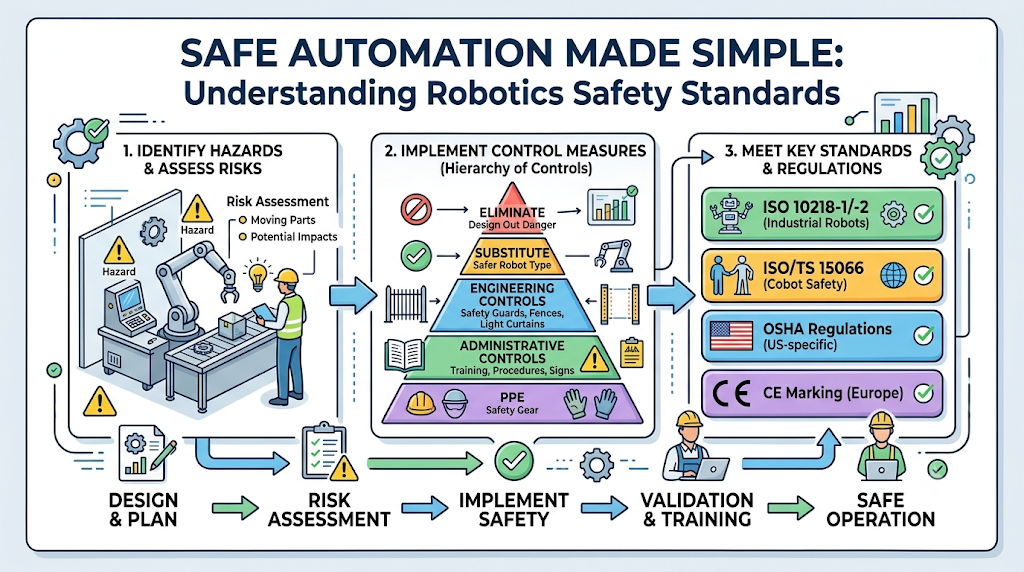
Risk management is the practice of evaluating potential dangers and taking systematic steps to lower them. In robotics workplace safety, this follows a clear hierarchy of controls:
1. Elimination / Substitution (Design out the hazard)
   └── 2. Engineering Controls (Add guards, light curtains, scanners)
       └── 3. Administrative Controls (Create signs, train operators)
Learning this hierarchy allows engineering students and developers to address dangers at the source rather than relying solely on warning labels or personal protective equipment.
Supporting Safe Automation
Safe automation relies on clear communication across different teams. When manufacturing engineers, safety professionals, and system integrators share a common understanding of safety parameters, projects proceed smoothly. Using standardized terminology reduces misunderstandings and ensures that control panels, safety logic, and mechanical barriers work together seamlessly.
Developing Responsible Robotics Knowledge
As automation technology evolves, developing responsible engineering habits becomes incredibly important. Responsible robotics means designing systems that prioritize human well-being, support workforce upskilling, and maintain predictable behaviors. By grounding technical skills in a solid understanding of robotics compliance, future developers contribute to a safer, more sustainable industrial landscape.
Common Applications
Robotics safety standards apply across many different sectors, each with its own unique operational challenges.
Manufacturing
In heavy manufacturing, large industrial arms weld car frames, lift heavy sheet metal, and stamp parts. Because these machines move with incredible force and speed, safety systems rely on robust physical fencing, interlocking access doors, and long-range laser scanners to ensure workers stay completely clear of active work zones.
Warehousing
Modern fulfillment centers use mobile automated guided vehicles (AGVs) and autonomous mobile robots (AMRs) to move pallets and inventory bins. These mobile platforms use onboard LiDAR sensors, ultrasonic proximity detectors, and touch-sensitive bumpers to navigate dynamic aisles, slowing down or changing path whenever a worker or an obstacle is detected.
Healthcare
Robots in healthcare assist with tasks ranging from surgical procedures to pharmacy dispensing and hospital logistics. In these environments, safety focuses heavily on precise force control, sterile material handling, and redundant software checks to ensure absolute accuracy and protect patients and medical professionals.
Logistics
In large sorting and distribution hubs, high-speed robotic arms sort, stack, and palletize mixed goods. Because these spaces handle a wide variety of package sizes and weights, safety systems must adapt dynamically to changing payloads, ensuring the robot maintains structural stability and secure grip control at all times.
Electronics Production
The electronics industry utilizes high-speed delta and SCARA robots for precise pick-and-place, soldering, and inspection tasks. While these machines are generally smaller, their rapid acceleration requires light curtains and transparent interlocking enclosures to protect assembly workers from fast, sudden movements.
Automotive Industry
As a pioneer in industrial automation, the automotive sector relies on large, interconnected lines of robots working together. Safety systems here use advanced network safety protocols, allowing groups of machines to communicate their operational status with one another and stop safely in sequence if an unexpected breakdown or interruption occurs.
Benefits of Robotics Safety Standards
Adhering to recognized standards provides clear advantages that extend across all levels of an organization.
- Improved Workplace Safety: The most vital benefit is the prevention of injuries, ensuring that every team member goes home safely at the end of their shift.
- Reduced Operational Risks: Following clear standards prevents accidents that can cause major machine damage, costly factory repairs, and unexpected line stoppages.
- Better Productivity: High-quality safety systems prevent nuisance trips. When a system is well-designed, operators can perform tasks efficiently without triggering unnecessary emergency stops that disrupt production flow.
- Increased Worker Confidence: When operators know they are working around well-guarded, predictable, and compliant machinery, they can perform their duties with greater focus, confidence, and peace of mind.
- Regulatory Compliance: Meeting international benchmarks protects organizations from legal liabilities, heavy regulatory fines, and insurance issues, simplifying the deployment of new lines.
- Long-Term Reliability: Designing systems around standardized, high-quality safety components ensures that control systems last longer, perform predictably, and are easier to troubleshoot or upgrade later.
Traditional Automation Safety vs Modern Robotics Safety
Safety engineering has evolved from simple physical segregation to intelligent, software-driven collaboration.
| Feature | Traditional Automation | Modern Robotics Safety |
| Human Interaction | Limited; machine stops completely if fence is opened | Designed for safe, close-proximity human collaboration |
| Risk Monitoring | Periodic; dependent on manual inspections and hardware checks | Continuous; real-time software diagnostics and monitoring |
| Safety Systems | Basic; simple hardwired relays and physical limit switches | Intelligent and integrated; safety-rated networks and PLCs |
| Workplace Flexibility | Lower; difficult to reconfigure heavy fixed fencing layouts | Higher; easily adaptable zones using software and laser scanners |
| Operational Awareness | Limited; machine has no awareness of objects outside its path | Enhanced; advanced vision, proximity, and force detection systems |
Common Challenges
Deploying secure robotic systems involves overcoming technical and operational challenges.
System Complexity
Integrating multiple sensors, safety controllers, and mechanical interlocks can create complex configurations that are difficult for teams to design and program.
- Recommendation: Use modular, safety-rated programmable logic controllers (PLCs) and follow clean, structured programming practices to keep safety logic simple and easy to maintain.
Workforce Training
As safety hardware becomes more sophisticated, keeping floor operators, technicians, and engineering staff updated on how things work can be a challenge.
- Recommendation: Implement regular, bite-sized training sessions and clear visual signage on the shop floor to reinforce core safety habits.
Integration with Existing Equipment
Bringing a modern robotic arm into an older facility with legacy machinery can create compatibility issues between different generations of safety components.
- Recommendation: Utilize safety interface relays or fieldbus conversion modules to bridge the gap between old control systems and modern safety networks.
Continuous Compliance
Maintaining an accurate record of safety checks, risk assessments, and system modifications over several years requires consistent organization.
- Recommendation: Create a digital safety logbook to track regular inspections, device testing, and firmware updates for quick audits.
Technology Evolution
As new technologies like advanced vision tracking and mobile manipulation emerge, static safety guidelines can sometimes feel outdated.
- Recommendation: Focus on foundational risk assessment methodologies and keep up with technical reports issued by leading standards organizations.
Best Practices
Building a safe working environment requires consistent habits and a proactive approach.
- Build a strong safety culture: Encourage open communication where team members feel comfortable reporting near-misses, worn safety components, or potential operational hazards without hesitation.
- Conduct regular risk assessments: Re-evaluate safety setups whenever you change a robot’s tool, adjust its operating speed, alter its programming path, or update the surrounding factory floor layout.
- Keep operators informed and trained: Ensure that every team member working near automation understands the machine’s behavioral patterns, knows where the E-stop buttons are located, and knows how to react if an anomaly occurs.
- Review safety procedures regularly: Set aside dedicated time each year to inspect physical safeguards, test light curtains, and verify that all safety-rated control circuits function perfectly under test conditions.
- Monitor robotic systems continuously: Leverage built-in diagnostic software to watch for sensor calibration drift, communication lag, or mechanical wear before these issues turn into safety concerns.
Career Opportunities
A strong background in automation safety opens doors across many high-demand industrial sectors.
- Robotics Engineer: Focuses on designing, programming, and deploying robotic systems while ensuring the underlying control code meets strict safety parameters.
- Automation Engineer: Specializes in building integrated factory production lines, optimizing workflows, and configuring safety-rated PLCs.
- Machine Safety Engineer: Focuses entirely on evaluating machinery layouts, calculating safety distances, and verifying compliance with global technical standards.
- Industrial Safety Specialist: Oversees workplace environmental health and safety (EHS) programs, leads risk management audits, and trains personnel on safe operating methods.
- Robotics Systems Integrator: Works as a consultant or contractor to combine components from different manufacturers into unified, safe, and productive production cells.
- Manufacturing Engineer: Optimizes production processes, designs workplace layouts, and ensures that automated machinery supports human operators efficiently and securely.
Future of Robotics Safety
As technology advances, safety systems are becoming more proactive, adaptable, and integrated into daily operations.
AI-Assisted Safety Monitoring
Future safety systems will utilize artificial intelligence and advanced vision systems to analyze human movement patterns near machinery. Instead of triggering a sudden, jarring stop when someone steps near a cell, an AI-monitored system can predict human paths and smoothly alter the robot’s trajectory, keeping operations moving safely.
Collaborative Robotics
The line between traditional industrial robots and collaborative systems will continue to blur. Heavy industrial arms will increasingly adopt skin-like tactile sensors and long-range proximity radars, allowing large-payload machines to operate in open, fence-free environments when humans are around.
Smart Factory Safety
In fully connected smart factories, machines will share safety information instantly across an entire facility network. If a mobile robot encounters a spill or a blocked aisle on one side of a warehouse, it will broadcast that information to all other automated units, allowing them to reroute safely long before they reach the hazard zone.
Digital Twins for Safety Analysis
Engineers are increasingly using “digital twins”—exact digital replicas of physical factory floors—to simulate and test safety systems before purchasing or installing real hardware. This allows teams to check stop distances, find blind spots in laser scanners, and fix design flaws in a risk-free virtual world.
Predictive Safety Systems
By tracking real-time data from vibration sensors, motor temperature indicators, and joint encoders, predictive systems will identify components that are about to fail. If a joint begins to show signs of mechanical fatigue, the system can automatically lower the robot’s maximum speed and notify maintenance technicians, preventing unexpected breakdowns.
Common Misconceptions
Clarifying common misunderstandings helps teams implement automation projects with greater clarity and realism.
Robots Are Always Dangerous
While industrial machinery carries inherent risks due to its speed and power, modern robots are not randomly unpredictable. When combined with appropriate engineering controls, safety-rated sensors, and solid risk management practices, automated systems can operate with an exceptionally high level of safety and reliability.
Safety Standards Slow Innovation
Some believe that strict guidelines place creative limits on engineering teams. In reality, safety standards provide a clear, structured framework that helps engineers innovate with confidence. Knowing the exact safety boundaries allows developers to focus on building faster, smarter, and more creative applications without worrying about design rework later.
Only Large Companies Need Robotics Safety
Safety is not a luxury reserved for multi-national corporations. Small and mid-sized manufacturing shops deploying their very first automated systems must follow the exact same safety principles. Protecting workers and maintaining machinery is essential for businesses of every size.
Safety Is Only Required After Installation
Waiting until a robot is bolted to the factory floor to think about safety is a costly mistake. Safety must be integrated into the project from day one. Addressing hazards during the initial design and layout phase saves significant time, reduces hardware costs, and prevents difficult structural modifications later on.
FAQ Section
- What is the primary goal of understanding robotics safety standards?The main objective is to establish a systematic framework that eliminates or minimizes hazards to human operators working near moving automated machinery, ensuring high workplace safety and system reliability.
- How does a risk assessment improve robot safety?A risk assessment systematically evaluates potential dangers throughout a machine’s lifecycle, allowing engineers to implement appropriate protective measures before an automated system goes live.
- What is the difference between a collaborative robot and a traditional industrial robot?Traditional industrial robots rely on physical separation like fencing because of their high speeds and forces, while collaborative robots use built-in force sensors and speed monitoring to work safely near humans without cages.
- Can safety standards improve a factory’s production efficiency?Yes. Well-designed, compliant safety systems prevent nuisance trips and unnecessary emergency stops, which reduces unexpected downtime and keeps the manufacturing line running smoothly.
- What is an emergency stop system?An emergency stop is a dedicated, highly reliable control loop that immediately cuts off power or stops dangerous movement when a user presses an easily accessible red button during a hazardous situation.
- Who is responsible for ensuring robotics compliance in a production facility?Ensuring compliance is a collaborative effort shared by the robot manufacturer, the system integrator who installs the cell, and the safety professionals and plant managers within the operating facility.
- How often should a company review its robotics safety procedures?Safety procedures and physical hardware should be checked regularly, especially whenever a machine’s tooling is altered, its programming path is changed, or its surrounding layout is modified.
- What role do laser scanners play in industrial automation safety?Laser scanners monitor designated floor areas around a robot, creating dynamic warning and stopping zones that slow down or halt the machine if a person steps inside the guarded boundary.
- Are small businesses required to follow international robotics safety standards?Yes. Adhering to standards is critical for businesses of all sizes to protect workers, avoid regulatory penalties, and minimize liabilities from machine damage or workplace accidents.
- What is the hierarchy of controls in robotics workplace safety?It is a step-by-step framework for reducing risks, prioritizing hazard elimination during design first, followed by engineering guards (like light curtains), and finally administrative measures (such as operator training).
Final Summary
As industrial automation continues to expand across diverse global industries, understanding robotics safety standards remains a cornerstone of successful system integration. Prioritizing human safety through structured risk assessment, collaborative design, and rigorous compliance checks ensures that advanced technology serves as a secure, empowering tool for the modern workforce. Building a safer, more productive industrial environment requires a continuous commitment to learning, open communication, and proactive maintenance habits. By blending reliable technical engineering with a supportive internal safety culture, organizations can maximize the performance of their robotic systems while fully safeguarding their most valuable asset—their people.
