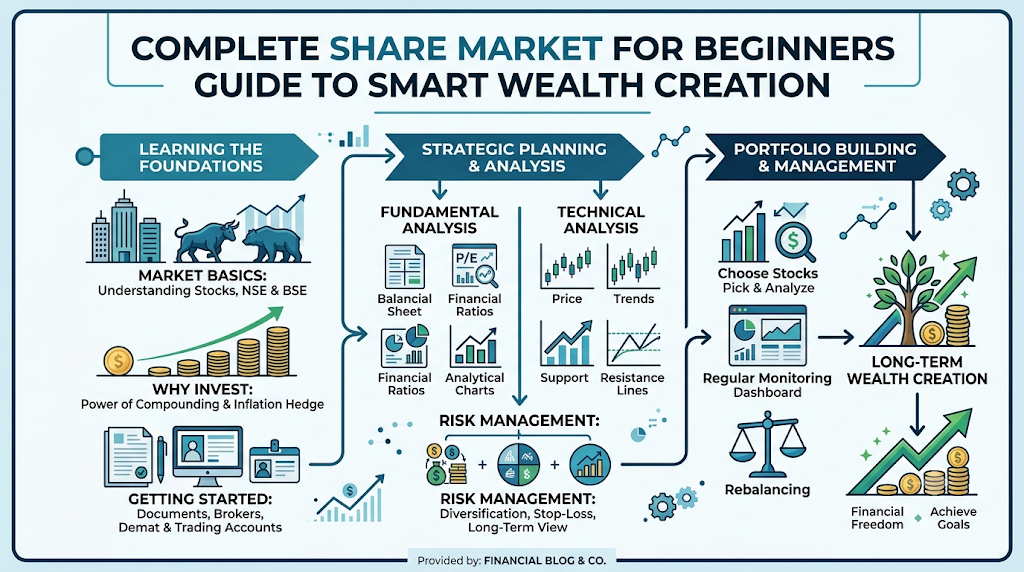
For many retail participants, entering the financial markets feels like managing risk in the dark. The constant flood of financial news, volatile price movements, and conflicting market analysis can easily lead to decision paralysis. Yet, successful equity investing is not reserved for institutional insiders or mathematical geniuses. It is the natural result of executing a repeatable, logical process, maintaining strict emotional control, and committing to continuous stock market education. This guide provides a structural foundation designed to transition you from passive observing to active, informed decision-making. By understanding the inner mechanics of the stock exchange and shifting your focus toward systematic research, you can build a portfolio that stands up to volatile economic shifts.
The Infrastructure of Public Equities
To invest with clarity, you must first understand the infrastructure that keeps the financial ecosystem moving. When you buy a share of a listed company, you are not simply trading a digital ticker symbol; you are acquiring a fractional ownership stake in an active commercial enterprise. Your financial returns are directly linked to that business’s long-term operational efficiency, competitive moat, and capital allocation strategies.
In the Indian stock market context, trading is handled securely by two main platforms: the National Stock Exchange (NSE) and the Bombay Stock Exchange (BSE). These institutions operate under strict regulatory oversight to maintain transparent pricing and immediate liquidity. To manage capital effectively, you need to understand the distinct roles of the primary and secondary markets.
[Primary Market: Capital Raising via Initial Public Offerings (IPOs)]
                                │
                                ▼
[Secondary Market: Continuous Price Discovery among Public Participants on NSE/BSE]
The primary market acts as the entry point where private businesses raise public capital by issuing new equity via an Initial Public Offering (IPO). Once this initial issuance concludes, the shares move directly to the secondary market. Here, continuous price discovery takes place as participants buy and sell existing shares based on changing valuations and macroeconomic trends.
Core Disciplines of Comprehensive Investment Research
Developing topical authority as an investor requires a balanced approach to market evaluation. Relying on speculative trends or unverified chatroom tips undermines your long-term financial security. Instead, disciplined learners rely on two primary research methodologies: fundamental analysis of stocks and technical analysis for beginners.
Fundamental Analysis of Stocks
Fundamental analysis is the process of calculating a company’s true intrinsic value by auditing its operational and economic foundations. Think of it as reviewing a business’s internal ledger before deciding to buy out a partner. This practice relies heavily on verifying three interconnected financial reports:
- Income Statement: Reveals top-line revenue growth, operational overhead, and bottom-line net profitability over a specific financial quarter or year.
- Balance Sheet: Outlines the structural stability of the firm by contrasting its total assets against its outstanding debts and liabilities.
- Cash Flow Statement: Monitors the actual movement of cash, showing whether a business generates true liquid capital or simply books paper profits.
Analyzing these documents helps you calculate crucial performance indicators, such as the PE ratio, helping you determine whether a stock’s current price accurately reflects its real earning power.
Technical Analysis for Beginners
If fundamental analysis helps you identify what asset holds long-term value, technical analysis provides the frameworks needed to manage when to execute your trades. This discipline studies historical price movements and trading volumes to map out shifting patterns in market psychology.
Rather than looking at corporate balance sheets, technical analysts use candlestick charts to evaluate the balance of power between buyers and sellers. Two foundational concepts in this space are support and resistance zones. A support level marks a structural price floor where historical buying interest has consistently halted downward trends, while a resistance level serves as a price ceiling where selling pressure routinely caps upward momentum.
Key Distinctions in Market Strategy
Structuring your portfolio requires a clear understanding of different trading styles, research methodologies, and asset structures. The following three comparison tables break down these core categories across key operational metrics.
Table 1: Investing vs. Trading
| Features | Investing | Trading |
| Core Objectives | Compounding multi-year wealth by supporting business expansion. | Capturing short-term price swings to generate quick cash flow. |
| Time Horizon | Multi-year to multi-decade horizons. | Seconds, minutes, days, or weeks. |
| Analysis Focus | Deep operational review and long-term economic trends. | Real-time chart patterns, volume data, and momentum indicators. |
| Advantages | Requires less screen time; benefits directly from corporate growth. | High capital velocity; ability to profit in both rising and falling markets. |
| Limitations | Capital remains illiquid; requires long-term patience. | Higher transactional costs; significant exposure to daily stress. |
| Best For | Long-term savers, working professionals, and planners. | Disciplined individuals comfortable with high risk and fast execution. |
| Risk Level | Controlled to Moderate (via broad asset allocation). | High to Extreme. |
Table 2: Fundamental Analysis vs. Technical Analysis
| Features | Fundamental Analysis | Technical Analysis |
| Primary Data Source | Regulatory corporate filings, industry whitepapers, macroeconomic reports. | Live price feeds, volume metrics, and historical chart formations. |
| Core Goal | Calculate the true underlying economic value of a business. | Identify high-probability entry and exit zones based on price trends. |
| Underlying Philosophy | Public market prices eventually match the business’s real financial value. | All known information and sentiment are already reflected in the chart. |
| Advantages | Ideal for building stable, compounding, long-term portfolios. | Highly effective for optimizing precise trade timing and risk containment. |
| Limitations | Disconnects between price and intrinsic value can last for years. | Sudden market noise can trigger false chart patterns and stops. |
| Best For | Long-term value investors and growth allocators. | Swing traders, day traders, and momentum market learners. |
| Risk Level | Moderate. | High. |
Table 3: IPO vs. Listed Stocks
| Features | IPO (Initial Public Offering) | Listed Stocks (Secondary Market) |
| Purchase Origin | Bought directly from the company prior to public exchange trading. | Swapped between market participants on the open NSE or BSE boards. |
| Pricing Mechanism | Set as a rigid price band by corporate underwriters. | Determined second-by-second by competitive supply and demand. |
| Data Availability | Limited to the data inside the initial Red Herring Prospectus (RHP). | Accessible historical chart trends and years of audited financial history. |
| Advantages | Opportunity to acquire shares at ground-floor valuations. | Immediate execution liquidity and clear historical price baselines. |
| Limitations | High uncertainty; retail share allocations are never guaranteed. | Exposure to broad market corrections and systemic macro risk. |
| Best For | Aggressive allocators focused on meticulous IPO analysis. | Risk-aware retail investors and conservative beginners. |
| Risk Level | High. | Controlled to Moderate. |
A Strategic Execution Roadmap for New Investors
Transitioning from theory to practice requires a methodical approach. Skipping foundational compliance or risk checks can lead to structural setbacks or unmanaged losses. Use this clear sequence to set up your accounts and execute your first trade with confidence.
1.Secure Your Financial Baseline:Prerequisite Verification.
Before deploying capital, verify you have an active PAN, a verified bank account, and a dedicated emergency fund. Never commit capital that is required for short-term living expenses.
2.Select a Regulated Brokerage Platform:Platform Selection.
Open an account with a SEBI-registered broker that offers an integrated trading engine, linkable bank access, and a Demat account to securely store your assets digitally.
3.Finalize the KYC Verification:Compliance Integration.
Complete your Know Your Customer (KYC) requirements by submitting your verified identity and address proofs. This step ensures full regulatory compliance.
4.Apply Rigorous Stock Research Filters:Analytical Screening.
Filter the market for resilient enterprises that show robust return on equity, manageable debt service ratios, and consistent market capitalization growth.
5.Execute a Controlled Capital Order:Trade Allocation.
Fund your trading balance, select your screened asset, and utilize a Limit Order to buy shares at your exact preferred value without paying slippage costs.
Traps That Deplete Retail Capital
The road to financial independence is filled with common pitfalls. Recognizing these behavioral traps early is the best way to safeguard your capital and build sustainable habits.
- Acting on Emotional Tips: Base your trades on balance sheets and verified trends rather than unverified chatroom rumors or hype.
- Trading Without Stop-Loss Boundaries: Failing to set clear exit parameters can quickly turn a small, manageable loss into a large, long-term portfolio drag.
- Over-Diversifying Small Accounts: Spreading limited capital across dozens of micro-cap tickers minimizes your returns and makes your portfolio overly difficult to manage.
- Panic Selling During Market Pullbacks: Normal market pullbacks are part of healthy economic cycles. Selling high-quality assets out of fear simply locks in temporary losses.
Actionable Best Practices for Wealth Preservation
Building a robust portfolio requires systematic, institutional-grade habits. Incorporate these core rules into your routine to navigate market cycles smoothly:
- Maintain True Asset Allocation: Diversify across uncorrelated economic sectors to protect your total portfolio from a single industry downturn.
- Automate with a Systematic Investment Plan (SIP): Deploy fixed capital amounts at set intervals to benefit from rupee-cost averaging, smoothing out market highs and lows.
- Reinvest Corporate Dividend Distributions: Let your compounding engine run efficiently by using cash dividends to buy more shares of high-performing assets.
- Log Trades in an Investment Journal: Write down the clear reasoning behind every buy and sell decision to spot and correct behavioral patterns over time.
Professional Insights for Long-Term Strategy
True market survival relies more on managing risk than trying to predict the exact top or bottom of a cycle. Professional asset managers know that protecting your capital on the downside is the most reliable way to secure sustainable upside over time.
“Managing risk successfully means focusing entirely on what you can control—your asset choices, your entry pricing, and your structural discipline.” — Market Logic Principle
When evaluating a company, look closely at its structural competitive advantage—its operational ability to maintain profitability even when facing aggressive competition. Keep your transaction overhead low, and focus your strategy on time in the market rather than trying to time its unpredictable swings.
Elevate Your Market Knowledge with Stocks Mantra
Navigating modern financial markets requires an educational foundation that prioritizes objective data over hype. Stocks Mantra provides clear, structured stock market education designed to cut through confusing financial jargon.
Whether you are looking to master fundamental analysis, understand technical analysis for beginners, or evaluate new listings through IPO analysis, our platform delivers clear, actionable frameworks. We help you move past speculative guesswork so you can make informed, independent investment decisions.
Frequently Asked Questions
What is the baseline capital required to begin stock market investing for beginners?
There is no high financial barrier to entry. Digital brokerage platforms allow you to start your stock market for beginners journey by buying a single share of a company, making it accessible even with minimal initial savings.
How do you determine if a particular asset is trading at an excessive valuation?
You can check a stock’s valuation through fundamental analysis of stocks. By analyzing its historical PE ratio relative to its direct peers and its net profit growth margins, you can spot overvalued or undervalued shares.
What distinguishes the NSE from the BSE in terms of market execution?
The BSE holds a historic corporate footprint with a high number of listed businesses. The NSE leads in daily trading volumes and liquidity, making it the preferred hub for active execution and modern risk management.
Is it possible to end up owing money beyond my initial equity deployment?
If you stick to cash delivery investing—buying actual corporate shares without leverage—your downside is capped at the exact capital you invested. Your portfolio balance cannot drop below zero into a debt position.
What key indicators should guide an investor’s initial IPO analysis?
A sound IPO analysis focuses on the Red Herring Prospectus (RHP). Look for a clear, productive plan for the raised capital, consistent net profit growth, and a strong track record among the core management team.
How long does it take to confidently read candlestick charts and trends?
Learning the basic geometry of charts can take a few weeks of consistent study. However, developing the discipline to read support, resistance, and market sentiment accurately in real time takes months of practice.
Is active swing trading inherently superior to a long-term buy-and-hold strategy?
Neither strategy is a one-size-fits-all solution. Active trading offers fast profit opportunities but requires daily screen time and incurs higher transaction costs. Long-term investing relies on compounding growth and carries lower tax drag.
How does SEBI protect individual retail investors from market malpractice?
SEBI enforces strict financial disclosure rules, monitors unusual trading activity to prevent fraud, and regulates brokers to ensure a fair, transparent environment for all participants.
Does every publicly listed corporation distribute dividends to shareholders?
No. Dividends are completely discretionary distributions of profit. Younger companies often choose to retain 100% of their net earnings to fund rapid operational growth and R&D instead of paying out cash.
How do international interest rate adjustments impact the local share market?
Global markets are closely linked. When major central banks adjust interest rates, it triggers a reallocation of institutional capital worldwide, which can lead to sudden fund inflows or outflows across emerging markets.
Why is portfolio diversification called the only free lunch in investing?
Diversification spreads your risk across unrelated business sectors. It ensures that a sudden crisis or regulatory setback in one specific industry won’t cause severe damage to your entire financial portfolio.
What visual data do candlestick charts offer that standard line charts miss?
Candlestick charts show the opening, closing, high, and low prices for a specific time frame. This detailed view highlights the intraday battle between buyers and sellers, which standard line charts often flatten.
Can a busy professional invest successfully without monitoring live tickers?
Absolutely. By using a disciplined Systematic Investment Plan (SIP) focused on diversified assets, you can build long-term wealth steadily while checking your portfolio just a few times a year.
What is market capitalization and how does it alter risk profiles?
Market cap represents the total market value of a company’s shares. Large-caps offer stability during market downturns, while mid-caps and small-caps offer higher growth potential but come with increased price volatility.
Where should an individual access reliable, unbiased stock market research?
New investors should rely on structured, clear educational platforms like Stocks Mantra. Using objective, step-by-step guides helps you build practical research skills before you deploy real capital in the market.
Conclusion
Building real wealth through the share market is a process built on steady consistency rather than quick speculation. The key to long-term success lies in your willingness to build a solid financial education. By focusing on fundamental analysis of stocks, setting clear risk management rules, and avoiding common beginner mistakes, you can construct a resilient, compounding portfolio. The markets don’t reward guesswork; they reward patience, process, and clear analysis. Take control of your financial planning today by focusing on a data-driven path to learning.
