Introduction
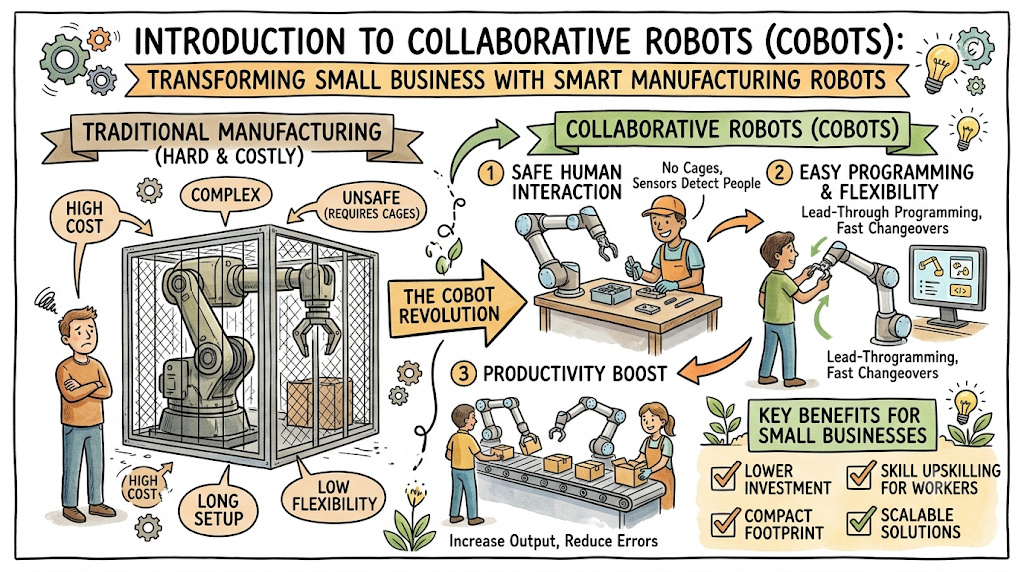
The landscape of industrial manufacturing is undergoing a profound shift. For decades, automation was defined by massive, high-speed machines bolted to factory floors, isolated from human operators by heavy steel fencing and light curtains. While highly efficient, these traditional systems lacked flexibility and required expensive, permanent floor space. This seamless blend of human dexterity and robotic precision is exactly why cobots are transforming global industries. This guide, curated by the automation experts at RobotsOps, will walk you through the fundamental mechanics, safety standards, industrial applications, and business value of collaborative robotics.
Featured Snippet
What Are Collaborative Robots (Cobots)?
A collaborative robot (cobot) is an industrial robot explicitly designed to work safely alongside humans in a shared workspace. Unlike traditional robots isolated by safety cages, cobots utilize advanced internal force-sensing, speed monitoring, and rounded designs to prevent injuries, making automated tasks highly flexible, accessible, and easily programmable.
Understanding Robotics Basics
To appreciate the value of collaborative systems, we must first look at where industrial robotics started.
What Is a Robot?
At its core, a robot is an autonomous or semi-autonomous physical machine designed to perform a series of complex tasks automatically. Robots interact with the physical world using sensors to perceive their environment, control software to make decisions, and actuators (such as motors and gears) to execute precise physical movements.
Evolution of Industrial Robotics
The journey of industrial automation began in 1961 with the installation of the Unimate robot on a General Motors assembly line.
- First Generation: These early machines were rigid, blind, and deaf. They excelled at repetitive, heavy-lifting tasks like spot welding but were completely unaware of their surroundings.
- Second Generation: Built around the 1980s, these systems incorporated basic external sensors, like primitive vision and limit switches, allowing them to adapt to minor environmental changes.
- Third Generation (The Present): Today’s landscape features highly integrated, data-driven machines. These units utilize advanced programming interfaces, artificial intelligence, and network connectivity to respond dynamically to changing production needs.
Rise of Smart Automation
Modern production lines are no longer static. Smart automation combines physical robotics with real-time data analytics, cloud computing, and machine learning. This integration allows automated systems to optimize their own paths, predict mechanical failures before they happen, and easily switch between different product lines without requiring massive hardware overhauls.
Why Human-Robot Collaboration Matters
While traditional automation handles high-volume, repetitive tasks exceptionally well, humans still possess unmatched adaptability, problem-solving skills, and fine motor skills. Human-robot collaboration merges these two sets of strengths. By assigning repetitive, ergonomically straining tasks to a robot and leaving complex decision-making to human operators, factories can achieve higher quality standards and improved workplace safety.
What Are Collaborative Robots?
The concept of the cobot was born out of a simple question: How can we make industrial robots safe enough to operate without protective cages?
Definition of Cobots
A collaborative robot is a specialized robotic system engineered with built-in safety mechanisms—such as force-feedback sensors, low-inertia motors, and power-limiting software—that allow it to operate safely near human workers within a shared, uncaged environment.
History of Cobot Development
The term “cobot” was coined in 1996 by Northwestern University professors J. Edward Colgate and Michael Peshkin. Their early prototypes focused on passive devices that guided human movement rather than moving autonomously.
The major industry breakthrough occurred in 2008 when the Danish company Universal Robots released the UR5. This was the first commercially successful autonomous robot arm designed to work safely alongside humans, establishing a brand-new segment in the automation market.
[1996: Cobot Concept Invented] ──► [2004: KUKA LBR3 Developed] ──► [2008: Universal Robots UR5 Launched] ──► [Present: AI-Integrated Smart Cobots]
Core Characteristics
- Inherent Safety: Equipped with rounded edges, minimized pinch points, and internal force-torque sensors.
- Ease of Programming: Features intuitive hand-guiding mechanisms and graphical user interfaces, eliminating the need for complex coding knowledge.
- Lightweight and Modular: Designed with a small footprint, allowing them to be moved around factory floors and redeployed to different tasks quickly.
Why Cobots Were Created
Traditional robotic cells require a large amount of dedicated floor space, weeks of professional engineering programming, and expensive safety guarding. This high barrier to entry effectively locked small- and medium-sized enterprises (SMEs) out of the automation revolution. Cobots were created to democratize automation, offering a cost-effective, flexible, and safe alternative that fits directly into existing manual production lines.
How Cobots Differ from Traditional Industrial Robots
Understanding the fundamental design differences between these two types of automation is essential for making informed deployment decisions.
Comparison Table
| Feature | Traditional Industrial Robots | Collaborative Robots (Cobots) |
| Safety Infrastructure | Requires physical fencing, light curtains, and safety interlocks. | Works safely alongside humans without physical cages (subject to risk assessment). |
| Operating Speed | Extremely fast (often exceeding $2000\text{ mm/s}$); dangerous up close. | Intentionally limited and regulated (typically under $250\text{ mm/s}$ in collaborative mode). |
| Flexibility & Mobility | Permanent, heavy installation; difficult and costly to relocate. | Lightweight, compact, and easily moved to different workstations. |
| Deployment Complexity | High; requires specialized system integrators and weeks of setup. | Low; can often be unboxed, mounted, and running basic tasks within a single day. |
| Human Interaction | Prohibited during operation; triggers an emergency stop if interrupted. | Designed for continuous, direct interaction and shared-workspace tasks. |
| Programming Requirements | Requires advanced knowledge of proprietary, text-based code. | Simple visual programming interfaces and hand-guided teaching methods. |
| Average Payload Capacity | Very high (from $10\text{ kg}$ up to several tons). | Low to moderate (typically ranging from $3\text{ kg}$ to $35\text{ kg}$). |
How Collaborative Robots Work
Cobots operate through a tightly integrated loop of perception, processing, and physical execution.
[Image diagram showing the feedback loop of a cobot: Sensor Input -> Controller Processing -> Motor Actuation -> Environmental Feedback]
1. Sensors and Perception Systems
Before a cobot can move safely, it must understand its own physical state and its immediate surroundings. Built-in joint encoders track the precise angle of every axis, while advanced force-torque sensors measure the resistance met by the arm. Many modern systems also integrate 2D or 3D vision systems to identify part locations and detect human presence within the workspace.
2. Motion Control Systems
The controller acts as the brain of the cobot. When a trajectory is programmed, the controller runs inverse kinematics algorithms to calculate exactly how much each joint motor must spin to move the end-of-arm tool along a specific path. It continuously monitors motor current draw; a sudden spike in current indicates that the arm has encountered an obstacle, prompting the system to adjust its movement instantly.
3. Safety Mechanisms
Cobots feature multiple layers of hardware and software safety redundancies. Dual-channel architectures monitor all safety-rated functions. If any single component fails, the secondary channel immediately flags the error. Built-in software features allow operators to define electronic boundaries (safety planes) that prevent the arm from moving into unauthorized zones.
4. Human Detection Systems
To maintain high productivity, many advanced cobots utilize area scanners, safety mats, or overhead 3D cameras. This allows the system to operate at high speeds when the workspace is clear. When a human operator enters a designated warning zone, the cobot automatically slows down to a safe, collaborative speed. If the operator steps into the inner workspace, the cobot pauses its motion entirely without cutting motor power, allowing it to resume work instantly once the operator leaves.
5. Programming and Task Execution
Programming a cobot rarely requires writing lines of code. Instead, operators typically use two methods:
- Hand-Guiding: The operator presses a button on the arm to release the brakes, then physically guides the robot through the desired path. The controller records these points in space.
- Visual Programming: Using a touchscreen tablet, the operator drags and drops functional blocks (e.g., “Move to Point A,” “Open Gripper,” “Wait 2 Seconds”) into a visual flowchart.
Key Components of a Cobot System
A functioning collaborative workstation relies on a complete ecosystem of interconnected components.
┌────────────────────────────────────────────────────────┐
│                   COBOT SOFTWARE                       │
├───────────────┬────────────────────────┬───────────────┤
│   Robot Arm   │   End Effectors (EOAT) │ Vision System │
├───────────────┼────────────────────────┼───────────────┤
│ Joint Sensors │   Central Controller   │ Safety Modules│
└───────────────┴────────────────────────┴───────────────┘
- Robot Arm (The Manipulator): The physical, multi-jointed structure (usually featuring 6 or 7 degrees of freedom) that moves through space. It is built from lightweight aluminum or carbon fiber composites to keep its physical inertia low.
- End Effectors / End-of-Arm Tooling (EOAT): The mechanical “hand” attached to the end of the robot arm. Examples include vacuum suction cups, mechanical adaptive grippers, welding torches, and screwdriving spindles.
- Vision Systems: Smart cameras mounted either on the wrist of the cobot or directly above the workstation. They provide the visual data needed for part localization, quality inspection, and barcode scanning.
- Sensors: Internal joint encoders, torque sensors, and external proximity scanners that feed structural and environmental data back to the central processing unit.
- Controllers: The dedicated computer cabinet housing the power supplies, servo drives, safety relays, and main microprocessors.
- Software Platforms: The operating system and user interface that allow operators to program movements, configure safety settings, and monitor system performance metrics.
- Safety Modules: Specialized, safety-rated hardware components (such as emergency stop buttons, enabling devices, and safety-rated I/O modules) that ensure the system complies with international industrial standards.
Safety Features in Collaborative Robots
Safety is not just an add-on feature for cobots—it is foundational to their entire design philosophy.
Force Limiting
Power and force limiting (PFL) is the most common safety method used by cobots. Internal joint torque sensors constantly monitor the physical force exerted during movement. If the arm impacts an object or person, the measured force will cross a pre-configured safety threshold, causing the robot to stop within milliseconds to prevent bruising or injury.
Collision Detection
Advanced collision detection algorithms differentiate between the natural forces required to perform a task (like pushing a pin into a slot) and an unexpected impact (like hitting a worker’s arm). When an unexpected collision profile is detected, the robot can be programmed to stop immediately or actively reverse its trajectory to release any trapped limbs.
Emergency Stop Systems
Every cobot system includes a hardwired, high-reliability emergency stop button (E-stop). Pressing this button immediately cuts power to the joint motors and engages mechanical brakes, bringing the arm to a complete halt.
Safe Speed Monitoring
In collaborative mode, the maximum speed of the cobot is limited by safety software. According to industrial standards, speeds are kept low enough to ensure that if a collision does happen, the kinetic energy transferred remains well below the pain and injury thresholds of the human body.
Workspace Monitoring
By defining digital safety zones, engineers can configure cobots to alter their behavior based on where they are in the room. For example, a cobot can move at full speed when working in a rear zone away from operators, but will automatically slow down when its arm crosses into a shared human workspace.
International Safety Standards
Cobot safety is governed by strict international standards:
- ISO 10218-1 & 10218-2: Establishes the foundational safety requirements for industrial robots and integrated robotic systems.
- ISO/TS 15066: A crucial technical specification that defines explicit, quantifiable human pain and injury thresholds for different parts of the body, providing clear mathematical limits for power and force-limiting deployments.
Types of Collaborative Robots
Cobots are highly versatile tools configured to excel across a wide range of specific tasks.
Assembly Cobots
- Purpose: Joining, fastening, screwing, and snapping parts together on an assembly line.
- Industry Usage: Electronics, automotive sub-assemblies, medical devices.
- Benefits: Maintains highly consistent torque values, eliminates repetitive wrist strain for workers, and fits cleanly into compact workstations.
- Limitations: Struggles with highly flexible materials like fabric or unguided wire routing.
Material Handling Cobots
- Purpose: Picking up parts from one location and transferring them to another (e.g., palletizing, machine tending, kitting).
- Industry Usage: Warehousing, logistics, injection molding, metal stamping.
- Benefits: Reduces heavy lifting injuries, operates continuously through breaks, and easily integrates with CNC machinery.
- Limitations: Maximum payload capacity is lower than traditional heavy-duty handling industrial robots.
Inspection Cobots
- Purpose: Automating quality control checks using high-resolution cameras, lasers, or surface probes.
- Industry Usage: Aerospace, automotive, pharmaceuticals.
- Benefits: Eliminates human fatigue in quality control checks, records objective digital inspection logs, and scans complex 3D surfaces accurately.
- Limitations: Inspection accuracy depends entirely on lighting conditions and camera calibration.
Welding Cobots
- Purpose: Performing highly consistent MIG, TIG, or laser welding operations.
- Industry Usage: Metal fabrication shops, automotive tier-1 suppliers.
- Benefits: Delivers incredibly consistent weld beads, easily accommodates small batch runs, and helps fill the gap left by specialized welder shortages.
- Limitations: Requires specialized protective sleeves to safeguard the robot’s joints from sparks, heat, and intense UV glare.
Packaging Cobots
- Purpose: Erecting cardboard boxes, packing finished products into cases, and preparing pallets for transport.
- Industry Usage: Food and beverage, consumer packaged goods, e-commerce fulfillment.
- Benefits: Prevents repetitive strain injuries, easily adapts to seasonal product changes via quick software updates, and optimizes box layout spacing.
- Limitations: High-speed packaging lines can sometimes outrun the safe speed limits of a standard power-limited cobot.
Medical Cobots
- Purpose: Assisting surgeons during precise procedures, compounding medications in pharmacies, or handling hazardous bio-samples in laboratories.
- Industry Usage: Hospitals, clinical labs, pharmaceutical manufacturing.
- Benefits: Exceptional path accuracy, completely sterile operation, and eliminates the risk of human hand tremors.
- Limitations: Requires extremely rigorous regulatory certification processes, and setup software is highly complex.
Leading Collaborative Robot Manufacturers
Selecting the right hardware platform is critical to a project’s long-term success. Here is an overview of the industry’s major players:
Universal Robots (UR)
- Product Focus: The pioneer of modern collaborative arms, famous for their UR and newer high-performance UR20/UR30 e-Series families.
- Strengths: Massive third-party accessory ecosystem (UR+), exceptionally intuitive user interface, and huge global support network.
- Typical Applications: Machine tending, palletizing, assembly, screwdriving.
FANUC
- Product Focus: The green CR and CRX series, built by one of the largest industrial robotics companies in the world.
- Strengths: Combines industrial-grade durability and reliability with collaborative safety features; excellent lifetime support.
- Typical Applications: Heavy-duty palletizing, automotive part assembly, material removal.
ABB Robotics
- Product Focus: The YuMi dual-arm precision robot, alongside the GoFa and SWIFTI collaborative product lines.
- Strengths: Incredible precision for small-parts handling; deep integration with advanced factory automation architectures.
- Typical Applications: Delicate electronics assembly, laboratory kitting, educational training.
KUKA
- Product Focus: The LBR iisy and LBR iiwa series.
- Strengths: Highly sophisticated torque sensor integration in every single axis, making them incredibly sensitive to external forces.
- Typical Applications: Human-robot research, delicate assembly, precision quality inspection.
Yaskawa
- Product Focus: The HC (Human Collaborative) series, including the HC10 and HC20 models.
- Strengths: Cast aluminum builds designed for harsh environments; IP67-rated washdown capabilities available for food or cleanroom setups.
- Typical Applications: CNC machine tending, welding, food packaging.
Doosan Robotics
- Product Focus: An expansive portfolio spanning the M, A, H, and E series cobots.
- Strengths: High payload capacities (up to $25\text{ kg}$) paired with excellent force-sensitivity across all axes.
- Typical Applications: Heavy palletizing, logistics handling, advanced custom automation.
Techman Robot
- Product Focus: TM series cobots.
- Strengths: Features built-in smart vision hardware and software directly integrated into the robot arm out of the box.
- Typical Applications: Visual inspection, pick-and-place with part alignment, barcode sorting.
Kawasaki Robotics
- Product Focus: The unique duAro dual-arm collaborative SCARA robot.
- Strengths: Coaxial twin-arm design that easily replaces a human worker directly at an existing assembly bench without changing workspace layouts.
- Typical Applications: Electronics testing, dual-handed packaging, PCB assembly.
Cobot Applications Across Industries
Cobots have moved past niche deployments and are now used across almost every major industry.
Manufacturing
General manufacturing environments deploy cobots for a wide array of everyday shop-floor tasks. They sand down molded parts, buff polished surfaces, drill precise holes, and deburr raw machined edges. By taking over these dirty and ergonomically straining tasks, cobots help lower worker compensation claims and improve final product consistency.
Automotive
In the automotive sector, tier-1 suppliers and major auto manufacturers use cobots to optimize sub-assembly lines. Cobots mount heavy tires onto wheel hubs, apply windshield adhesive beads uniformly, and use vision cameras to verify that interior clips are fully seated. Working side-by-side with assembly technicians ensures that cycle times are maintained without compromising worker ergonomics.
Electronics
The electronics industry relies on high precision and rapid adaptations to short product lifecycles. Cobots excel at picking up tiny surface-mount components, inserting circuit boards into housings, soldering connections, and executing automated functional tests. Their small footprint allows them to fit onto existing assembly lines without requiring a complete line redesign.
Healthcare
In modern hospitals and diagnostic facilities, cobots assist medical staff with precision-dependent tasks. They handle and track bio-hazardous test tubes, prepare precise oncology medication doses in sterile environments, and support physical therapy patients by guiding limbs through repetitive rehabilitation exercises.
Warehousing and Logistics
With the massive growth of e-commerce, fulfillment centers deploy cobots to streamline material flows. Cobots work alongside logistics workers by picking items out of inventory bins, sorting packages by zip code, and stacking heavy cardboard boxes onto outgoing shipping pallets.
Food and Beverage
Food-safe cobots feature specialized high-ingress ratings and smooth, corrosion-resistant housings that withstand strict daily washdown chemical treatments. They slice baked goods, arrange chocolates into retail trays, and pack sealed food pouches into bulk shipping boxes.
Pharmaceuticals
Pharmaceutical operations require high levels of sterility and meticulous digital traceability. Cobots operate in cleanroom spaces to fill vials, package delicate blister packs, and transport raw chemical materials between processing stations, keeping contamination risks low.
Small and Medium Businesses (SMEs)
For small machine shops and contract manufacturers, cobots are a highly versatile asset. An SME can deploy a cobot to tend a CNC mill for a two-week parts run, then easily move it over to a packaging station the following week. This flexibility makes automation viable even for low-volume production runs.
Human-Robot Collaboration Models
Human-robot collaboration is not a one-size-fits-all approach. The industry categorizes interaction into four distinct operational models:
[Image illustrating the 4 models of collaboration: Coexistence (separate spaces), Sequential (separate times, same space), Cooperative (shared space and time), Responsive (real-time synchronized interaction)]
1. Coexistence
In this model, the human operator and the robot work in the same factory area but have entirely separate, non-overlapping workspaces. There is no shared task or direct interaction. The cobot’s safety systems act as a protective layer in case a worker accidentally steps into its operating space.
- Example: A cobot palletizes finished cases on the left side of an aisle while a worker unloads a completely separate pallet conveyor on the right.
2. Sequential Collaboration
Here, the human and the robot share part of the same workspace, but they do not work on a part at the same time. The process is sequential: one actor finishes their step, leaves the shared zone, and then the other actor takes over.
- Example: A worker manually places raw metal brackets into a fixture, steps back, and presses a start button. The cobot then moves into that same fixture space to weld the joints together.
3. Cooperative Collaboration
In a cooperative model, both the human and the cobot work on the exact same part or sub-assembly simultaneously within a shared workspace.
- Example: A cobot firmly holds a heavy dashboard assembly in position while an assembly technician carefully routes the internal electrical wiring harnesses.
4. Responsive Collaboration
This represents the most advanced level of integration. The cobot senses the human operator’s actions in real-time and dynamically adapts its movements to assist them, creating a synchronized workflow.
- Example: A cobot tracks an operator’s assembly progress via vision systems and automatically picks up and hands over the exact tool or fastener required for the next step.
Benefits of Collaborative Robots
Investing in a cobot project offers clear operational and financial benefits.
- Increased Productivity: Cobots don’t take breaks, call in sick, or slow down due to fatigue. Running a cobot through lunch breaks or overnight shifts expands total factory throughput.
- Improved Workplace Safety: By taking over high-risk tasks like machine tending, heavy lifting, and material removal, cobots reduce repetitive strain injuries and exposure to harsh chemicals or flying debris.
- Reduced Labor Shortages: Manufacturers worldwide struggle to find workers for repetitive, low-wage roles. Cobots automate these entry-level tasks, allowing business owners to upskill their existing team into more engaging, higher-value positions.
- Flexible Automation: Traditional industrial robots are single-purpose machines. Cobots can be reprogrammed, fitted with a new gripper, and rolled to a completely new station in a matter of hours.
- Lower Total Cost of Ownership: Because they don’t require expensive safety fencing or specialized engineering teams, cobots have a low initial capital cost. Many businesses see full return on investment (ROI) within 6 to 12 months.
- Faster Deployment Times: Most cobot models are designed for plug-and-play installation. A factory technician can typically unbox a cobot, mount it, and program its first pick-and-place loop within a single day.
- Higher Product Quality: Digital control ensures that every movement, screw torque value, and dispense path is executed with sub-millimeter consistency, keeping scrap rates down.
Challenges and Limitations of Cobots
While cobots are highly versatile tools, it is important to understand their technical limitations to avoid common deployment pitfalls.
- Payload Restrictions: Most common cobots are designed for payloads under $20\text{ kg}$. If your application involves moving heavy cast-iron engine blocks or full sheets of drywall, a traditional heavy industrial robot remains the right choice.
- Speed Limitations: To ensure human safety, cobots operate at restricted speeds when working alongside operators. If your production line demands ultra-high-speed processing, the slow cadence of a safe cobot could create a bottleneck.
- Initial Setup Investment: While cheaper than traditional automation cells, a cobot project still requires upfront capital for the arm, custom grippers, vision sensors, and initial risk assessments.
- Employee Training Requirements: Cobots are easier to use than traditional systems, but shop floor teams still need basic training on safety principles, restarting procedures, and switching between programs.
- Complex Task Handling Challenges: Human hands have incredible dexterity. Tasks that require tactile feel, like handling loose cables, sorting mixed parts by touch, or working with highly flexible fabrics, remain difficult for standard cobot systems to master.
- System Integration Hurdles: A cobot arm does not work in isolation. It must communicate with existing PLC networks, pneumatic supplies, and factory safety lines, which can sometimes introduce unexpected software integration hurdles.
Cobots and Industry 4.0
Cobots serve as an ideal entry point and physical foundation for modern Smart Factory initiatives.
Smart Factories
In a smart factory environment, production systems are fully networked. Cobots feed continuous operational data up to cloud MES (Manufacturing Execution Systems), allowing managers to monitor cycle times, line efficiencies, and output metrics from anywhere in the world.
Industrial IoT (IIoT)
Equipped with edge-computing capabilities, cobots function as intelligent nodes on the Industrial Internet of Things. They share live performance telemetry across the local factory network, allowing them to coordinate with autonomous mobile robots (AMRs) to schedule part deliveries or pick-ups without human intervention.
AI Integration
By integrating artificial intelligence and machine learning with cobots, these systems move past static programming. AI vision models enable cobots to inspect random, unsorted parts arriving on a conveyor belt, identify defects in real-time, and dynamically adjust their gripper orientation to pick up randomly oriented items.
Predictive Maintenance
Cobots track operational data like motor currents, temperatures, and gear play. Machine learning models analyze this data to spot signs of wear early on. This allows maintenance teams to schedule repairs before a component fails, keeping unplanned downtime to a minimum.
Digital Twins
Engineers use digital twins—highly accurate 3D software models of the physical cobot cell—to test out programming changes, run cycle-time simulations, and optimize layout configurations virtually before making changes on the real factory floor.
Cobots vs Automation Alternatives
To choose the right approach for your factory floor, it helps to see how cobots stack up against other common production methods.
Comparison Table
| Technology | Flexibility | Cost | Safety Infrastructure | Scalability | Best Use Case |
| Collaborative Robots | High (Easily reprogrammed and relocated) | Moderate (Low entry cost, minimal integration fees) | Minimal (Relies on power/force limits; no cages) | High (Modular, easy to add arms as needed) | High-mix, low-volume production; assembly; packing. |
| Traditional Industrial Robots | Low (Fixed in place; complex recoding needed) | High (Expensive hardware, engineering, and guarding) | Extensive (Requires heavy safety cages and interlocks) | Moderate (Expanding requires major floor space redesign) | High-volume, low-mix production; heavy lifting; fast welding. |
| Manual Labor | Extremely High (Humans learn new tasks instantly) | Variable (Low initial cost, high ongoing recurring wages) | Standard (Requires ergonomic support and basic PPE) | Low (Dependent on local hiring pools and shifts) | Highly complex visual tasks; dextrous assembly; variable setups. |
| Dedicated Automated Machines | None (Hardwired to perform one single function) | Very High (Custom-engineered tooling and mechanics) | High (Enclosed sheet metal and guard switches) | Low (Requires building a new machine to scale) | Ultra-high volume mass production (e.g., bottling lines). |
Real-World Industry Case Studies
These detailed, practical case studies show how collaborative automation drives business value across different sectors.
1. Automotive Assembly Optimization
- Problem: A tier-1 automotive supplier faced high employee injury rates and inconsistent quality when workers manually applied heavy torque screws to vehicle door sub-assemblies.
- Cobot Solution: The company installed a 10kg payload cobot equipped with an electric torque-driving tool and a vision alignment camera on the manual assembly line.
- Results: The cobot handles the heavy torque-driving work while a human operator finishes the delicate wire-routing steps alongside it.
- ROI Achieved: Full project payback was achieved in 8 months through a 92% reduction in door assembly scrap rates.
- Lessons Learned: Involving the shop-floor operators early in the programming phase helped reduce anxieties about working next to a robotic arm.
2. Electronics Manufacturing Automation
- Problem: A contract electronics manufacturer needed to scale up its circuit board functional testing but lacked floor space for a traditional caged robotic cell.
- Cobot Solution: A compact, table-top cobot was integrated directly into the existing manual testing bench to handle PCB loading and unloading.
- Results: The cobot runs continuously, loading boards into the tester and sorting them into “pass” or “fail” bins based on digital test results.
- ROI Achieved: 11 months, driven by a 40% increase in daily testing capacity without expanding the factory’s physical footprint.
- Lessons Learned: Using lightweight, 3D-printed end-of-arm grippers kept the overall system cost low and ensured the arm stayed within safe force limits.
3. Warehouse Picking Assistance
- Problem: An e-commerce fulfillment center was losing productivity because workers spent hours walking across the warehouse floor to transport picked goods to packing stations.
- Cobot Solution: Mobile cobots (a collaborative arm mounted on top of an Autonomous Mobile Robot) were deployed to travel between inventory aisles and packing lines.
- Results: Human pickers stay inside their assigned aisles and load items onto the mobile cobot’s tray; the unit then automatically navigates to the packing zone.
- ROI Achieved: 14 months, achieved by cutting human transit walking time in half and speeding up order shipment cycles.
- Lessons Learned: Fleet management software integration is essential for coordinating mobile cobot paths and avoiding factory floor traffic jams.
4. Medical Laboratory Automation
- Problem: A diagnostic laboratory faced a severe backlog of blood sample vials that needed constant sorting, scanning, and racking for chemical analysis.
- Cobot Solution: A cleanroom-rated, high-precision collaborative robot arm was installed on the central lab bench next to technicians.
- Results: The cobot handles the repetitive work of picking vials from incoming boxes, scanning barcodes, and placing them into precision centrifuge trays.
- ROI Achieved: 18 months, justified by eliminating sample misplacement errors and improving laboratory data tracking.
- Lessons Learned: Medical deployments require strict end-of-arm tool sterilization protocols, which must be factored into your early design choices.
5. Food Packaging Productivity Improvement
- Problem: A commercial bakery was struggling to find workers for its hot, high-speed end-of-line bread pan packaging operation.
- Cobot Solution: A washdown-rated cobot equipped with a wide vacuum-suction gripper was installed to lift bread loaves out of cooling trays and pack them into boxes.
- Results: The cobot works safely alongside workers who close and label the finished boxes, maintaining a steady packaging pace.
- ROI Achieved: 9 months, driven by the ability to run the packaging line at a consistent speed across multiple consecutive shifts.
- Lessons Learned: Selecting food-safe, non-toxic suction cups is a critical compliance step for any direct food contact applications.
Common Misconceptions About Cobots
Let’s clear up some of the most common myths surrounding collaborative automation.
Cobots Replace Human Workers
- The Myth: Deploying a cobot means cutting headcount on the factory floor.
- The Reality: Cobots rarely replace workers entirely. Instead, they take over repetitive and strenuous tasks, freeing up human operators to focus on higher-value jobs like quality control, process troubleshooting, and operations management.
Cobots Require No Training
- The Myth: Anyone can set up and run a cobot perfectly with zero instruction.
- The Reality: Cobots are highly accessible, but basic operator training is still essential. Teams must learn how to configure safety boundaries, clean grippers, and clear simple error faults safely.
Cobots Are Only for Large Enterprises
- The Myth: Only large companies with massive engineering budgets can afford cobot technology.
- The Reality: Cobots are specifically designed to be affordable for small- and medium-sized enterprises. Their low entry cost and simple setup requirements make them a practical choice for businesses with limited capital budgets.
Cobots Can Perform Every Task
- The Myth: A cobot can easily handle any assembly or material processing task you give it.
- The Reality: Cobots have real constraints when it comes to payload capacities, maximum speeds, and fine motor skills. Tasks requiring complex sensory touch or high-speed processing are still better handled by humans or specialized industrial machines.
Skills Needed to Work with Cobots
The growth of collaborative robotics is opening up new career paths. If you want to work with cobots, here is a helpful learning roadmap:
[Level 1: Fundamentals] ──► [Level 2: Basic Programming] ──► [Level 3: Safety Standards] ──► [Level 4: Advanced Systems]
1. Robotics Fundamentals
Start by learning the core mechanics of robotics. Understand how coordinate systems (Cartesian, Joint) work, learn about degrees of freedom, and get familiar with how different parts of a robot move.
2. Automation Concepts
Learn how modern factories operate. Study how programmable logic controllers (PLCs) communicate, how industrial sensors track data, and how digital input/output (I/O) lines connect different machines.
3. Programming Basics
Get comfortable with visual flowchart logic and script-based languages. While cobots use drag-and-drop interfaces, knowing basic programming logic makes it much easier to build complex routines and troubleshoot errors.
4. Safety Awareness
Study international industrial safety standards like ISO 10218 and ISO/TS 15066. Learning how to perform a thorough workplace risk assessment is a highly valued skill for automation engineers.
5. Industrial Processes
Develop a deep understanding of the manufacturing processes you want to automate, whether it’s MIG welding, CNC machine tending, or precision electronics assembly.
6. Problem Solving
Cultivate a structured approach to troubleshooting. When a robot stops moving, you need to be able to isolate the issue systematically, checking everything from hardware sensors to network communication links.
Future of Collaborative Robotics
Collaborative robotics is evolving rapidly, driven by breakthrough technological advancements.
- AI-Powered Cobots: Future cobots will rely heavily on advanced AI models. Instead of following rigid pre-programmed paths, they will adapt to their environments, learn new tasks by watching human demonstrations, and optimize their own movements over time.
- Autonomous Collaboration: Cobots will blend seamlessly with autonomous mobile robots (AMRs) to create untethered, mobile automation units. These systems will navigate factory floors independently, moving between different workstations to assist human teams wherever they are needed most.
- Advanced Vision Systems: Next-generation 3D cameras will give cobots deep spatial awareness, allowing them to instantly identify fine surface defects, read variable text labels, and navigate busy work environments safely.
- Human Intention Recognition: By utilizing wearable sensors and AI vision analytics, future cobots will read human body language and predict an operator’s next move, automatically handing over tools or stepping back to give them space.
- Smart Factory Integration: Cobots will become completely plug-and-play nodes within broader industrial networks, sharing real-time performance data with cloud systems to help optimize entire factory operations.
- Robotics-as-a-Service (RaaS): This emerging business model allows companies to lease cobots on a monthly subscription basis rather than buying them upfront. This lowers the financial risk for small businesses looking to add automation to their lines.
Cobot Adoption Framework
Bringing a cobot onto your factory floor requires a structured, step-by-step approach. Following this simple framework ensures a smooth deployment:
┌────────────────────────┐
│ 1. Assess Business Needs│
└───────────┬────────────┘
            ▼
┌────────────────────────┐
│ 2. Identify Tasks      │
└───────────┬────────────┘
            ▼
┌────────────────────────┐
│ 3. Select the Cobot    │
└───────────┬────────────┘
            ▼
┌────────────────────────┐
│ 4. Train Your Team     │
└───────────┬────────────┘
            ▼
┌────────────────────────┐
│ 5. Deploy & Test       │
└───────────┬────────────┘
            ▼
┌────────────────────────┐
│ 6. Continuous Ops      │
└────────────────────────┘
Step 1: Assess Business Needs
Clearly define what you want to achieve with automation. Are you trying to speed up production, lower scrap rates, or reduce workplace injuries? Setting clear goals upfront gives you a reliable metric for measuring project success.
Step 2: Identify Suitable Tasks
Audit your production lines to find tasks well-suited for a cobot. Look for simple, repetitive jobs that fall within typical cobot payload limits and don’t require complex manual dexterity.
Step 3: Select the Right Cobot
Choose a cobot model that matches your specific operational requirements. Carefully evaluate reach, payload limits, accuracy needs, ingress protection ratings, and the availability of compatible end-of-arm tools.
Step 4: Train Employees
Provide comprehensive training for your shop floor operators. Focus on safety rules, basic programming adjustments, and clear troubleshooting steps to build confidence and help your team embrace the new technology.
Step 5: Deploy and Test
Start with a small, manageable pilot deployment. Set up the cobot, program your primary paths, run a thorough safety risk assessment, and test the cell at lower speeds to work out any bugs before ramping up to full production.
Step 6: Optimize Continuously
Monitor your cobot’s performance metrics regularly. Use real-time operational data to adjust your cycle times, refine paths, and update your software routines to maximize efficiency over the long term.
FAQ Section
- What is a collaborative robot?
A collaborative robot, or cobot, is an industrial robot engineered with specialized safety features—like force sensors and collision detection—that allow it to operate safely next to human workers without protective fencing.
- How is a cobot different from a traditional industrial robot?
Traditional industrial robots are high-speed, heavy machines that must be isolated inside safety cages to protect workers. Cobots are lighter, operate at safe, regulated speeds, and are designed to work directly alongside humans.
- Are cobots completely safe?
Cobots are built with advanced safety systems, but their ultimate safety depends on the application. A thorough risk assessment must always be completed for every deployment to ensure the end-of-arm tool and the part being handled don’t create hazards.
- Which industries use cobots most often?
Cobots are deployed widely across manufacturing, automotive, electronics assembly, healthcare laboratories, warehousing, logistics, and food packaging industries.
- Do cobots replace human workers?
No, cobots are designed to assist workers rather than replace them. They take over repetitive, strenuous, and dangerous tasks, allowing human employees to focus on more complex, higher-value jobs.
- How much does a standard cobot cost?
A typical industrial cobot arm can range from $20,000 to $50,000. However, the total system cost—including grippers, sensors, and custom software integration—usually falls between $35,000 and $80,000.
- Can small businesses benefit from using cobots?
Yes, cobots are an excellent fit for small- and medium-sized enterprises (SMEs) thanks to their low initial cost, small physical footprint, and flexibility to be reprogrammed for multiple tasks.
- What technical skills do you need to operate a cobot?
Modern cobots feature simple drag-and-drop visual software interfaces, meaning you don’t need advanced coding skills to run them. A basic understanding of factory logic and automated workflows is usually plenty to get started.
- What are the main limitations of cobots?
Cobots generally have lower payload capacities (typically under 30kg) and slower operating speeds than traditional caged industrial robots, and they can struggle with tasks requiring high manual dexterity.
- What is the future of collaborative robotics?
The future of collaborative robotics lies in deeper artificial intelligence integration, better 3D vision systems, autonomous mobile configurations, and predictive maintenance technologies.
- What is ISO/TS 15066 and why does it matter?
ISO/TS 15066 is an international technical specification that outlines clear force and pressure limits for collaborative robots, helping engineers design systems that prevent human pain or injury.
- Can a cobot be used for welding applications?
Yes, cobots are frequently used for MIG, TIG, and spot-welding tasks, offering consistent weld quality while remaining simple to set up for small production runs.
- How long does it take to deploy a cobot?
A basic pick-and-place cobot application can often be unboxed, mounted, and running simple loops within a single day. More complex integrations involving vision systems and PLCs usually take a few weeks.
- What is an end effector (EOAT)?
An end effector, or End-of-Arm Tooling, is the attachment mounted to the end of a robot arm—such as a gripper, vacuum cup, or welding torch—that allows it to interact with parts.
- How do cobots sense collisions?
Cobots detect unexpected contact by using built-in force-torque sensors or by constantly monitoring motor current draw for sudden, unexpected spikes.
- Can cobots work in sterile or cleanroom environments?
Yes, many manufacturers offer specialized cleanroom-certified or washdown-rated cobots built specifically for medical, pharmaceutical, and food-packaging applications.
- What is hand-guided programming?
Hand-guided programming allows an operator to manually move the cobot arm through a desired path by hand while the software records those spatial coordinates for future playback.
- What is the average ROI for a cobot project?
Most industrial cobot installations achieve full return on investment (ROI) within 6 to 12 months, driven by increased throughput and lower scrap rates.
- Can a cobot be mounted on a wall or ceiling?
Yes, because cobots are lightweight and modular, they can be mounted horizontally on walls, upside down on ceilings, or placed on mobile carts to save floor space.
- How do I get started with my first cobot project?
Start by assessing your production line to find a simple, highly repetitive task with a manageable payload, and then reach out to a specialized automation platform like RobotsOps to help select the right system components.
Final Summary
Collaborative robots have fundamentally redefined how modern factories approach automation. By eliminating the need for bulky safety cages and complex programming languages, cobots bridge the gap between human ingenuity and automated precision. They offer high flexibility, easy programming, and an exceptional safety profile, making them a practical and powerful tool for both global manufacturers and small-scale machine shops.
While cobots have real limits when it comes to maximum payload and speed, their business value is undeniable. They consistently drive higher productivity, improve workplace ergonomics, and deliver rapid return on investment. As artificial intelligence and advanced sensor networks continue to mature, cobots will become even more autonomous, responsive, and central to the global transition toward Industry 4.0 smart factories.
