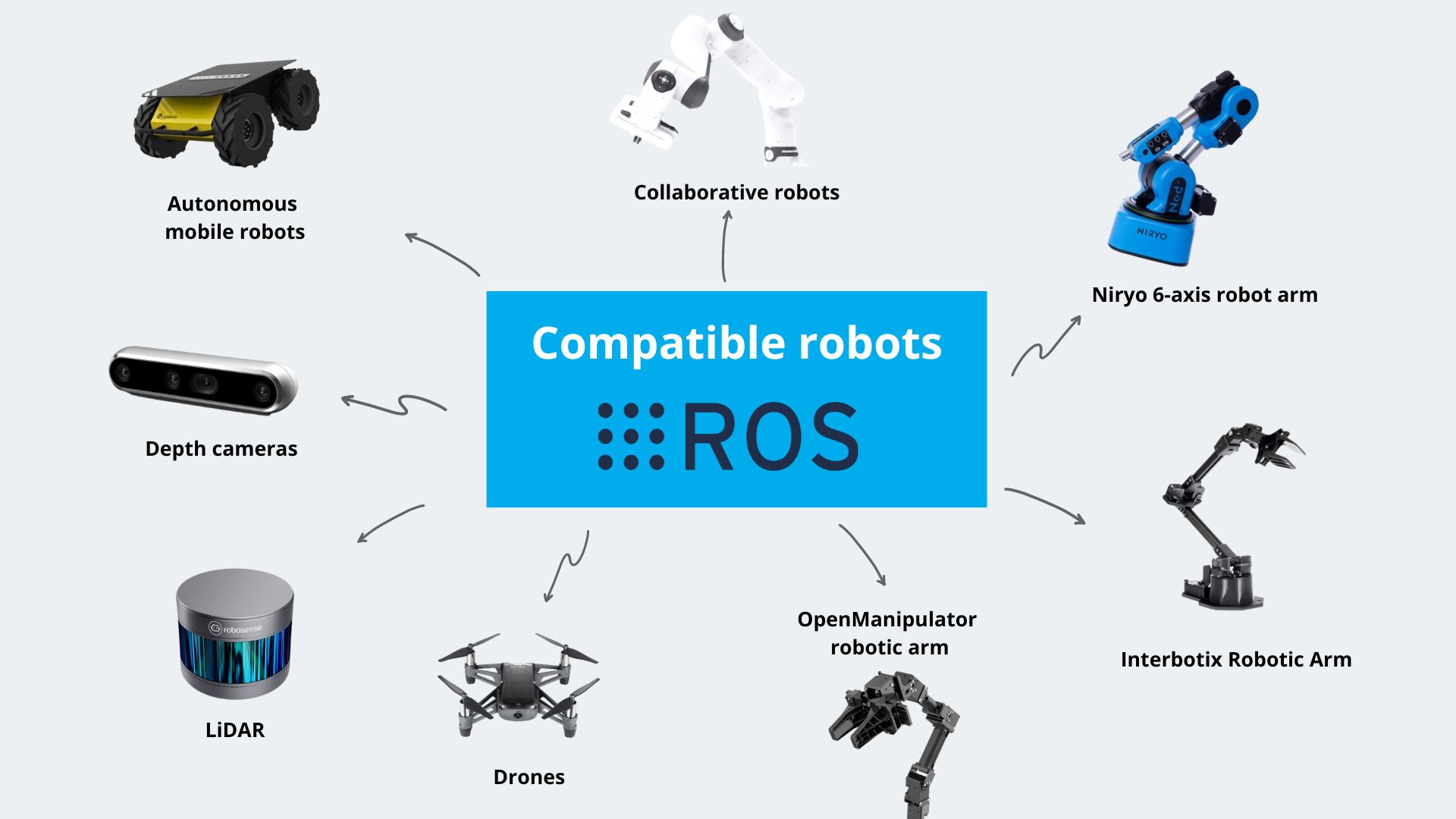
ROS (Robot Operating System) is a middleware framework for developing and deploying robot software systems. Despite the term “Operating System,” ROS runs on top of traditional OSes (like Ubuntu or macOS) and provides essential robotics libraries and tools for communication, control, simulation, and deployment.
ROS is not an OS in the traditional sense—it acts as a flexible framework for writing robot software.
History or Background
2007 – Initiated by Willow Garage for robotic R&D.
2010 – Open-sourced and adopted by academia and industry.
2017+ – ROS 2 introduced to address security, real-time, and distributed computing challenges.
Backed by the Open Source Robotics Foundation (OSRF).
Why is it Relevant in DevSecOps?
DevSecOps practices are crucial for modern robotic systems, especially with:
Autonomous systems (e.g., drones, AGVs)
Cyber-physical systems in critical environments
Security and compliance in safety-critical robotics
CI/CD pipelines for robotic code deployment
ROS fits DevSecOps by:
Supporting modular development
Providing runtime introspection tools
Enabling simulation-first development
Integrating with cloud-native CI/CD and monitoring tools
🧠 Core Concepts & Terminology
Term
Description
Node
A process that performs computation.
Topic
Message bus for inter-node communication (pub/sub model).
Service
Request/response-style RPC communication.
ROS Master
Name service that manages node registration and topic information.
Bag File
File format for recording ROS message data streams.
Launch File
XML file for starting multiple nodes.
TF
Transform library for keeping track of coordinate frames over time.
How It Fits into the DevSecOps Lifecycle
DevSecOps Phase
ROS Integration Use
Plan
Define robot requirements via structured nodes and services
Develop
Modular code via ROS packages and reusable nodes
Build
CI pipelines using catkin or colcon + Docker
Test
Use Gazebo, Rviz, rostest for integration and sim-based testing
Release
Versioned packages, containerized deployments
Operate
Logging with rosout, monitoring with Prometheus or RQT
Secure
Secure DDS in ROS 2, signed messages, sandboxing nodes
Security and compliance audits are integrated into CI.
ROS bag files used for post-op review.
✅ Benefits & Limitations
Benefits
🔄 Modular & reusable codebase
🔬 Built-in testing, simulation, and visualization tools
🔐 ROS 2 offers enhanced security via DDS
☁️ Integration with cloud-native DevSecOps platforms
📦 Large ecosystem of packages
Limitations
❌ Steep learning curve
⚠️ ROS 1 lacks native security (fixed in ROS 2)
💽 Simulation may not always match real-world behavior
🧪 Complex debugging in distributed systems
🛠️ Best Practices & Recommendations
Security
Use DDS Secure in ROS 2
Enforce access controls on topics and services
Monitor node health and logs with Prometheus/Grafana
Automation & Maintenance
Automate builds with colcon + CI tools
Run nightly tests using simulators (Gazebo)
Maintain package versions with lockfiles and Docker
Compliance
Log everything (ROS bag files + system logs)
Run static analysis and security scanning in CI
Document node responsibilities for audits
🔄 Comparison with Alternatives
Feature
ROS 2
LCM
OPC UA
MQTT + Custom
Modular Design
✅
❌
✅
❌
Realtime Support
✅ (partial)
✅
✅
✅
Built-in Simulation
✅
❌
❌
❌
DevSecOps Integration
✅
❌
✅
✅
Community/Ecosystem
🔥 Large
Small
Enterprise
Custom
Choose ROS when: You need robotics-specific tools, community support, simulation, and cloud DevSecOps compatibility.
🔚 Conclusion
ROS is more than just middleware—it’s the foundation for building secure, scalable, and modular robotic applications in DevSecOps contexts. With the advent of ROS 2, it has become increasingly compatible with cloud-native and secure development practices.
Future Trends
Full DevSecOps lifecycle automation for robots
AI/ML integration into ROS nodes
ROS + Kubernetes for large-scale robot orchestration
Modern digital markets move fast, and businesses in Japan must release software quickly to remain competitive. However, many enterprise leaders face severe tech skill shortages within their…
Introduction Nobody prepares you for how overwhelming fertility research can feel. One day you’re hopeful. The next, you’re drowning in unfamiliar terms and mismatched numbers. Every source…
Hyderabad never sits still. The city buzzes with new cafes, live shows, and weekend fun. But this fast pace makes planning tricky. You blink, and a great…
Introduction Programming a robot feels a lot like giving directions to a helpful friend. You write down clear steps, and the machine follows them one by one….