Introduction
The Certified MLOps Professional is a comprehensive program designed to bridge the gap between machine learning development and large-scale production operations. This guide is crafted for engineers and technical managers who need to move beyond experimental notebooks and into the world of reproducible, automated, and scalable AI systems. In the current landscape of cloud-native computing and platform engineering, understanding how to manage the lifecycle of a model is as critical as building the model itself.
As a professional navigating this field, making the right career decisions requires a clear understanding of where your skills sit within the broader DevOps and SRE ecosystem. This roadmap, hosted by aiopsschool.com, provides a structured look at how to master the intersection of data engineering, machine learning, and software operations. By the end of this guide, you will have a definitive blueprint for evaluating the ROI of this certification and how it fits into your long-term professional growth.
What is the Certified MLOps Professional?
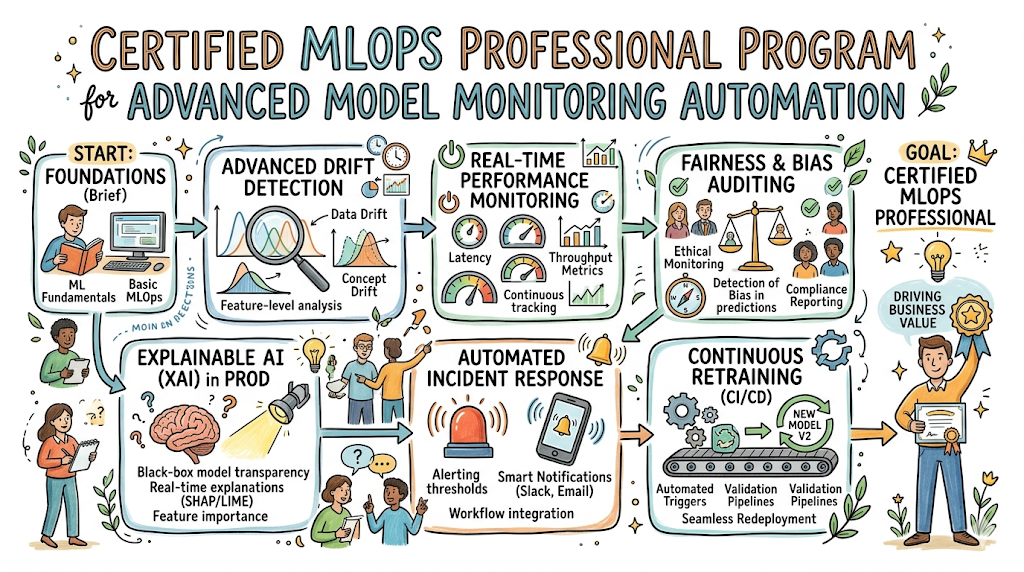
The Certified MLOps Professional represents a specialized standard for engineering excellence in the deployment and maintenance of machine learning systems. It exists because the industry has realized that building a model is only a small fraction of the total effort required to run AI in production. This certification focuses on the technical debt and operational challenges unique to ML, such as data drift, model decay, and complex pipeline orchestration.
Rather than focusing purely on theoretical mathematics or data science research, this program emphasizes real-world, production-focused learning. It is designed to teach professionals how to apply DevOps principles—such as continuous integration, continuous delivery, and continuous monitoring—directly to machine learning workflows. It aligns perfectly with modern engineering workflows and enterprise practices where reliability, speed, and scalability are the primary metrics for success.
Who Should Pursue Certified MLOps Professional?
This certification is highly beneficial for software engineers who find themselves increasingly tasked with supporting data science teams or managing ML-heavy applications. System administrators, SREs, and cloud architects will find immense value in learning the specific infrastructure requirements of high-performance ML workloads. It is also an essential path for data engineers who want to automate their workflows and ensure their data pipelines are production-ready.
For experienced engineers and managers, the program provides the high-level perspective needed to lead cross-functional teams and make informed decisions about tool selection and architectural patterns. Whether you are working in a major global tech hub or a rapidly growing tech sector, this certification is relevant. It addresses the global demand for professionals who can effectively manage the “Ops” side of the AI revolution, making it a versatile asset for anyone in the modern technical stack.
Why Certified MLOps Professional is Valuable and Beyond
The demand for MLOps expertise is skyrocketing as enterprises move from the experimentation phase to full implementation. Companies are no longer satisfied with models that only work on a scientist’s laptop; they require systems that are resilient, auditable, and cost-effective. This certification ensures you have the longevity to stay relevant in the job market, as the principles of pipeline automation and model monitoring remain constant even as specific tools change.
Investing time in this track offers a significant return on career investment by positioning you at a high-value intersection of three massive fields: DevOps, Data Science, and Cloud Engineering. As enterprise adoption of AI becomes the standard, professionals who can prove they understand the nuances of production ML will be the ones leading the most critical projects. It provides a level of job security and salary potential that few other specialized tracks can offer in the current engineering climate.
Certified MLOps Professional Certification Overview
The Certified MLOps Professional program is delivered via the official program pages and is hosted on the aiopsschool platform. This program is structured to provide a logical progression from foundational concepts to expert-level architecture and implementation. Unlike traditional academic courses, the assessment approach is practical and designed to mirror the challenges faced by engineers in a production environment.
The ownership and structure of the certification are rooted in industry-standard practices, ensuring that the skills learned are immediately applicable to enterprise environments. It covers the entire lifecycle of a machine learning model, including data versioning, model tracking, automated testing, and deployment strategies like A/B testing and Canary releases. By completing this program, professionals gain a recognized credential that validates their ability to manage complex, multi-stage AI pipelines.
Certified MLOps Professional Certification Tracks & Levels
The program is organized into three distinct levels: Foundation, Professional, and Advanced. The Foundation level is designed to introduce the core vocabulary and concepts of MLOps, making it ideal for those transitioning from traditional software roles. The Professional level dives deep into the implementation of CI/CD pipelines for ML, model monitoring, and infrastructure management using specialized platforms.
The Advanced level focuses on specialized tracks such as MLOps for SREs, which emphasizes high availability and performance, or MLOps for FinOps, which focuses on optimizing the high costs associated with cloud resources. These tracks allow professionals to align their certification journey with their specific career progression. By moving through these levels, an engineer can transition from a supporting role to a lead architect role within an organization’s AI division.
Complete Certified MLOps Professional Certification Table
| Track | Level | Who it’s for | Prerequisites | Skills Covered | Recommended Order |
| Core MLOps | Foundation | Beginners, Managers | Basic IT knowledge | MLOps Lifecycle, Terminology | First |
| Engineering | Professional | DevOps & Data Engineers | Python, Linux, Docker | CI/CD, Pipeline Automation | Second |
| Architecture | Advanced | Lead Engineers, SREs | Professional Level | Scaling, Security, Monitoring | Third |
| Specialized | Expert | Principal Architects | Advanced Level | Multi-cloud ML, FinOps for AI | Optional |
Detailed Guide for Each Certified MLOps Professional Certification
Certified MLOps Professional – Foundation
What it is
This certification validates a candidate’s understanding of the fundamental principles that define MLOps. It ensures the professional understands the difference between traditional software DevOps and the specific requirements of machine learning systems.
Who should take it
It is suitable for project managers, junior engineers, and data scientists who want to understand how their work fits into the broader operational context. It is an entry-level gate for anyone starting their MLOps journey.
Skills you’ll gain
- Understanding the MLOps lifecycle from data ingestion to model retirement.
- Familiarity with common MLOps terminology and industry standards.
- Knowledge of the various roles and responsibilities within an MLOps team.
- Basic understanding of version control for both code and data.
Real-world projects you should be able to do
- Create a high-level architectural diagram of an ML pipeline.
- Identify potential bottlenecks and failure points in a basic model deployment.
- Define service level objectives for a simple machine learning service.
Preparation plan
- 7 Days: Focus on reading the official curriculum and understanding the core terminology.
- 30 Days: Review case studies of successful MLOps implementations in various industries.
- 60 Days: Engage with community forums and take multiple practice assessments.
Common mistakes
- Treating MLOps exactly like traditional DevOps without accounting for data variability.
- Ignoring the cultural shifts required between data science and operations teams.
Best next certification after this
- Same-track option: Certified MLOps Professional – Professional level.
- Cross-track option: Certified DataOps Professional.
- Leadership option: Technical Project Management for AI.
Certified MLOps Professional – Professional
What it is
This level validates the ability to implement and manage technical pipelines for machine learning. It proves the candidate can use industry-standard tools to automate the movement of data and models through various stages.
Who should take it
Mid-level DevOps engineers, SREs, and Data Engineers with at least two years of experience should pursue this. It is intended for those who will be doing the actual work of building and maintaining pipelines.
Skills you’ll gain
- Mastery of CI/CD for ML using tools like Jenkins, GitLab CI, or GitHub Actions.
- Deep knowledge of containerization and orchestration for ML workloads.
- Implementation of automated model testing and validation frameworks.
- Configuration of model registries and experiment tracking systems.
Real-world projects you should be able to do
- Build a fully automated pipeline that triggers a model retrain when new data is detected.
- Deploy a model as a scalable microservice on a Kubernetes cluster.
- Implement a centralized dashboard for tracking model performance metrics.
Preparation plan
- 7 Days: Intensive hands-on labs focusing on Docker and Kubernetes basics.
- 30 Days: Build and document a complete end-to-end ML pipeline on a local machine.
- 60 Days: Scale the local pipeline to a cloud provider and implement automated security checks.
Common mistakes
- Over-complicating the initial pipeline architecture with too many tools.
- Failing to implement adequate logging and error handling within the pipeline.
Best next certification after this
- Same-track option: Certified MLOps Professional – Advanced level.
- Cross-track option: Certified DevSecOps Professional.
- Leadership option: MLOps Team Lead.
Certified MLOps Professional – Advanced
What it is
This certification validates the ability to design large-scale, enterprise-grade MLOps architectures. It focuses on the high-level concerns of security, scalability, and long-term sustainability of AI systems.
Who should take it
Senior engineers, lead architects, and principal consultants are the primary audience. It requires a deep technical background and the ability to think strategically about infrastructure.
Skills you’ll gain
- Designing multi-region and multi-cloud MLOps strategies.
- Implementing advanced security and compliance measures for data and models.
- Optimization of large-scale infrastructure for cost and performance.
- Managing model governance and ethical AI monitoring at scale.
Real-world projects you should be able to do
- Architect a global model deployment strategy that handles millions of requests per second.
- Design a system that automatically audits every step of the ML lifecycle for regulatory compliance.
- Implement a FinOps strategy that reduces resource waste across a large engineering department.
Preparation plan
- 7 Days: Deep dive into cloud provider whitepapers on high-scale machine learning.
- 30 Days: Design and present an architecture for a hypothetical global enterprise.
- 60 Days: Conduct performance tuning and cost analysis for a large-scale ML environment.
Common mistakes
- Focusing too much on specific tool features rather than broad architectural principles.
- Neglecting the long-term maintenance costs of a highly complex system.
Best next certification after this
- Same-track option: Expert-level specialization in AI security.
- Cross-track option: Certified SRE Professional.
- Leadership option: Director of Platform Engineering.
Choose Your Learning Path
DevOps Path
The DevOps path focuses on the seamless integration of machine learning into existing software delivery pipelines. Engineers on this path will learn how to apply their existing knowledge of CI/CD and infrastructure as code to the unique challenges of ML models. The goal is to make model deployment as predictable and automated as a standard web application. This path is ideal for those who want to serve as the bridge between development teams and production environments.
DevSecOps Path
The DevSecOps path emphasizes the security and compliance aspects of the machine learning lifecycle. Given the sensitivity of training data and the potential for model tampering, security is a primary concern in modern MLOps. This track covers data encryption, secure model serving, and automated security scanning for ML libraries and containers. It is designed for security-conscious engineers who want to specialize in protecting AI-driven infrastructure.
SRE Path
The SRE path focuses on the reliability and availability of machine learning services in production. This path applies the principles of Site Reliability Engineering—such as error budgets and service level objectives—to the world of ML. Engineers will learn how to monitor for model drift, handle high-concurrency inference requests, and automate the recovery of failed ML services. This path is perfect for those who prioritize system uptime and performance over all else.
AIOps Path
The AIOps path is unique because it involves using machine learning to improve IT operations themselves. Professionals on this path learn how to build models that can predict system failures, automate incident response, and analyze large volumes of log data. This is a meta-level application of MLOps where the target of the ML model is the very infrastructure it runs on. It is an excellent choice for those looking to innovate within the operations field.
MLOps Path
The MLOps path is the core specialized track dedicated entirely to the machine learning lifecycle. It covers every stage from data engineering and feature stores to model registry and automated deployment. This path is the most direct route for those who want to call themselves MLOps Engineers. It provides a deep, comprehensive look at the specific tools and methodologies that have evolved to manage the unique characteristics of AI software.
DataOps Path
The DataOps path focuses on the “Data” part of the machine learning equation. Without high-quality, reliable data pipelines, MLOps cannot succeed. This track teaches engineers how to apply DevOps principles to data management, ensuring that data is clean, versioned, and delivered to models on time. It is the ideal path for data engineers who want to ensure their upstream work perfectly supports the downstream ML requirements.
FinOps Path
The FinOps path addresses the massive costs associated with modern machine learning, particularly regarding expensive GPU resources and cloud storage. Engineers on this path learn how to monitor, forecast, and optimize the spend related to training and serving models. This track is becoming increasingly important as companies look to scale their AI initiatives without breaking their budgets. It is designed for professionals who want to combine technical expertise with financial accountability.
Role → Recommended Certified MLOps Professional Certifications
| Role | Recommended Certifications |
| DevOps Engineer | Certified MLOps Professional – Professional |
| SRE | Certified MLOps Professional – Advanced |
| Platform Engineer | Certified MLOps Professional – Professional |
| Cloud Engineer | Certified MLOps Professional – Foundation & Professional |
| Security Engineer | Certified MLOps Professional – Advanced (Security Focus) |
| Data Engineer | Certified MLOps Professional – Professional |
| FinOps Practitioner | Certified MLOps Professional – Foundation |
| Engineering Manager | Certified MLOps Professional – Foundation |
Next Certifications to Take After Certified MLOps Professional
Same Track Progression
Deepening your specialization within the MLOps track often involves moving into specialized domains like generative AI operations or edge computing for ML. These advanced certifications focus on the unique constraints of running large language models or deploying models to resource-constrained IoT devices. Continued progression in this track ensures you remain a subject matter expert in the most cutting-edge areas of machine learning operations.
Cross-Track Expansion
Broadening your skills often means looking toward the SRE or DevSecOps domains to become a more well-rounded platform engineer. By gaining certifications in reliability or security, you can architect systems that are not only automated but also highly resilient and impenetrable. This cross-pollination of skills is highly valued by elite engineering organizations that require lead engineers to have a holistic view of the entire technical stack.
Leadership & Management Track
For those looking to move into people management or high-level strategy, certifications in IT governance and technical leadership are the logical next steps. These programs focus on team dynamics, budget management, and aligning technical initiatives with business goals. Transitioning to leadership requires a shift from doing the work to enabling others and setting the long-term vision for the organization’s AI and infrastructure capabilities.
Training & Certification Support Providers for Certified MLOps Professional
DevOpsSchool
DevOpsSchool is a leading global training provider that offers an extensive curriculum focused on DevOps, cloud computing, and automation. With over a decade of experience, they have trained thousands of professionals from top-tier organizations. Their training methodology emphasizes hands-on labs, real-world projects, and interactive sessions led by industry experts. They provide comprehensive support, from foundational learning to advanced certifications, ensuring that candidates are well-prepared for industry challenges. Their focus on the latest tools and methodologies makes them a preferred choice for corporate training and individual skill development. They maintain a strong community presence, offering resources that help engineers stay updated with the rapidly evolving technical landscape and market demands.
Cotocus
Cotocus is a specialized consulting and training firm that excels in providing niche technical education in the areas of SRE, DevSecOps, and cloud-native technologies. They are known for their high-quality delivery and personalized approach to student success. Their programs are designed by practitioners who bring deep industry insights into the classroom, ensuring that the training is both relevant and practical. Cotocus focuses on bridging the skill gap in modern engineering teams, helping organizations adopt complex technologies with ease. They provide a robust learning environment with access to cutting-edge tools and scenarios. Their commitment to excellence has made them a trusted partner for many professionals looking to advance their careers in highly specialized technical domains.
Scmgalaxy
Scmgalaxy is a prominent community and training hub dedicated to software configuration management, DevOps, and build automation. It serves as a vast repository of knowledge, providing tutorials, guides, and certification support for various engineering tracks. Their training programs are practical and grounded in the actual needs of software development teams. Scmgalaxy fosters a collaborative environment where learners can interact with experts and peers, sharing best practices and troubleshooting real-world issues. They offer structured courses that guide candidates through the complexities of CI/CD, automation, and infrastructure management. Their focus on community-driven learning makes them an excellent resource for professionals seeking continuous growth and up-to-date information in the DevOps and MLOps space globally.
BestDevOps
BestDevOps focuses on delivering top-tier training for engineers who aim to master the most in-demand skills in the modern IT market. They offer a range of specialized certifications and workshops that prioritize career transformation and technical proficiency. Their instructors are seasoned professionals who provide mentorship and guidance beyond standard curriculum delivery. BestDevOps is known for its result-oriented approach, helping students achieve their certification goals while gaining the confidence to lead technical projects. They provide a comprehensive suite of learning materials and hands-on environments that simulate enterprise-grade infrastructures. Their focus on quality and career outcomes makes them a significant player in the professional certification and technical training industry for global engineering audiences.
devsecopsschool.com
This institution is entirely dedicated to the discipline of DevSecOps, integrating security into every facet of the development lifecycle. They offer specialized programs that cover security automation, compliance as code, and vulnerability management. Their curriculum is designed to help engineers shift security to the left, ensuring that protection is built-in rather than bolted-on. The school provides in-depth training on the latest security tools and architectural patterns. Their instructors are security experts who bring a wealth of experience in protecting large-scale enterprise environments. For professionals looking to specialize in the intersection of security and operations, this school offers the most focused and relevant training available today, emphasizing practical, real-world security implementation.
sreschool.com
SRESchool is a premier training provider focusing on the principles and practices of Site Reliability Engineering. They help engineers transition from traditional operations to an engineering-driven approach to system reliability and performance. Their programs cover essential SRE topics such as error budgets, service level objectives, and the reduction of operational toil. The school emphasizes the use of data and automation to build scalable and resilient systems. Their training is designed for professionals responsible for the uptime of high-concurrency applications. By providing a structured path to mastering SRE concepts, they empower engineers to lead reliability initiatives within their organizations. Their focus on practical application and industry standards makes them a leading choice for SRE training.
AIOpsSchool is a forward-thinking training platform that specializes in the application of artificial intelligence to IT operations and the management of ML lifecycles. They are the primary host for the Certified MLOps Professional program, offering a deep dive into model orchestration, monitoring, and infrastructure management. Their curriculum is designed to address the specific technical challenges of running AI at scale. They provide hands-on training that covers everything from data versioning to automated model retraining. AIOpsSchool is recognized for its focus on the next generation of automation, helping professionals stay ahead in a market increasingly dominated by AI. Their programs are essential for engineers who want to master the “Ops” of machine learning and AIOps.
dataopsschool.com
DataOpsSchool addresses the critical need for automated and reliable data management in the modern technical stack. They provide training on DataOps principles, helping engineers build robust data pipelines that support machine learning and analytics. Their courses emphasize the application of DevOps rigors to data movement, quality, and versioning. The school provides the skills needed to reduce data cycle times and improve collaboration between data and operations teams. Their instructors are experts in data engineering and automation, providing students with the tools to solve complex data delivery problems. This school is a vital resource for anyone looking to ensure that their data infrastructure is production-ready and fully aligned with modern MLOps and AIOps requirements.
finopsschool.com
FinOpsSchool is dedicated to the growing field of cloud financial management, helping technical professionals master the economics of the cloud. They provide training that bridges the gap between engineering, finance, and business leadership. Their programs focus on cost transparency, forecasting, and optimization, particularly for resource-heavy workloads like machine learning. The school teaches engineers how to take accountability for cloud spend while maintaining technical performance. They offer a structured approach to implementing FinOps frameworks within large organizations. As cloud costs become a primary concern for enterprise leadership, the training provided here is increasingly essential for architects and managers. They are the leading provider for those looking to combine technical architectural skills with financial stewardship.
Frequently Asked Questions (General)
- How long does it take to get certified?
Depending on your starting level, it can take anywhere from two weeks to several months. A foundation level is achievable in 14 days, while expert levels require more hands-on practice. - Are there any prerequisites for the foundation level?
No strict technical prerequisites exist, but a basic understanding of cloud computing and software development will help you grasp the concepts much faster. - Does this certification help in getting a salary hike?
Specialized certifications in high-demand fields like MLOps are frequently tied to higher salary bands and better negotiation leverage during job transitions. - Is the exam theoretical or practical?
The assessment approach focuses on practical scenarios and problem-solving to ensure you can apply the concepts in a real production environment. - Can a manager benefit from this certification?
Yes, managers gain the high-level technical context needed to lead teams, allocate resources, and make informed tool selections for their departments. - What is the validity period of the certification?
Most professional certifications are valid for two to three years, after which a renewal or advancement to the next level is recommended. - Is there a community or alumni network?
Yes, the program provides access to a network of professionals where you can share insights, find job opportunities, and stay updated on industry trends. - How does MLOps differ from standard DevOps?
MLOps includes the additional complexities of data versioning, model retraining, and monitoring for statistical drift, which are not present in standard software. - Which cloud provider is used for the training?
The principles are cloud-agnostic, but labs typically use popular providers like AWS, Azure, or Google Cloud to demonstrate real-world implementation. - Do I need to be a data scientist to take this?
No, this program is designed specifically for the engineering and operations side of the house, although data scientists will find it very useful for productionizing their work. - Is the certification recognized globally?
The skills and standards taught are based on global industry practices, making the credential valuable in any tech market worldwide. - Can I skip the foundation level?
If you have significant prior experience in DevOps and machine learning, you may be able to jump directly to the professional level, though the foundation is recommended for a complete perspective.
FAQs on Certified MLOps Professional
- What specific tools are covered in the Certified MLOps Professional program?
The program focuses on industry-standard tools for every stage of the lifecycle. This includes containerization with Docker, orchestration with Kubernetes, and CI/CD with Jenkins or GitLab. You will also explore specialized ML tools such as MLflow for experiment tracking, Kubeflow for pipeline orchestration, and various cloud-native ML services. The goal is to provide a broad understanding of the tool landscape so you can choose the right solution for any environment. By mastering these tools, you ensure your ability to build robust, automated pipelines that can handle the complexities of modern machine learning workloads effectively. - How does this certification address the issue of model drift?
Model drift is a core focus of the curriculum. You will learn how to implement automated monitoring systems that track the statistical properties of incoming data and compare them against the training set. The program teaches you how to set up alerts and automated retraining triggers that activate when performance falls below a certain threshold. This proactive approach ensures that your models remain accurate and reliable even as the real-world data they process changes over time. Understanding drift is essential for maintaining the long-term value of any AI implementation in a production setting. - Is there a focus on the ethical and compliance side of MLOps?
Yes, the advanced levels specifically cover model governance and ethical monitoring. You will learn how to build pipelines that include bias detection and explainability checks. This ensures that your ML systems are not only technically sound but also compliant with increasingly strict data protection and AI regulations. Learning how to audit your models and maintain a transparent record of how decisions are made is a critical skill for senior engineers and architects. This focus on responsibility helps protect organizations from legal risks and ensures that AI is used in a fair and transparent manner. - What are the primary challenges of scaling MLOps in an enterprise?
Scaling MLOps involves managing large-scale data pipelines, high-concurrency inference requests, and multi-team collaboration. The certification teaches you how to use cloud-native architectures to handle these demands efficiently. You will explore strategies for managing GPU resources at scale and how to build a centralized platform that serves multiple data science teams across an organization. By addressing these challenges, the program prepares you to lead large-scale digital transformation initiatives. You will learn how to reduce friction between teams and ensure that the infrastructure can grow alongside the company’s AI ambitions without becoming unmanageable. - How does the program handle the high cost of ML infrastructure?
Cost management is integrated into the curriculum through the lens of FinOps. You will learn how to monitor the spend associated with different stages of the ML lifecycle and how to optimize resource usage to prevent waste. This includes techniques like using spot instances for training and rightsizing inference clusters. By understanding the financial impact of your technical decisions, you become a more valuable asset to your organization. The program ensures that you can build high-performance AI systems that are also cost-effective, which is a major priority for modern enterprise leadership. - Can this certification help me transition from a legacy background?
The program is excellent for those looking to transition from traditional systems administration to modern cloud-native roles. It builds on your existing knowledge of infrastructure and operations while introducing the new paradigms of containerization and automated pipelines. While the focus is on machine learning, the skills you learn in Kubernetes, Linux, and CI/CD are broadly applicable across the entire DevOps landscape. It provides a structured way to modernize your skill set and move into some of the most exciting and high-paying roles in the current technology market. - What is the role of Kubernetes in the MLOps curriculum?
Kubernetes is a central component of the professional and advanced tracks. You will learn why Kubernetes has become the standard for MLOps due to its ability to manage complex, multi-stage workflows and scale resources dynamically. The labs will guide you through deploying model servers as microservices and using Kubernetes operators to manage ML jobs. Mastery of Kubernetes is essential for any MLOps professional, as it provides the underlying platform that allows for the portability and scalability of machine learning systems across different cloud environments and data centers. - Does the program include training on Data Version Control?
Yes, versioning data is just as important as versioning code in the world of MLOps. The program teaches you how to use tools to track changes in large datasets and ensure that every model can be traced back to the exact version of the data used to train it. This is critical for reproducibility and debugging. You will learn how to integrate data versioning into your CI/CD pipelines so that your entire experimental setup is documented and repeatable. This focus on rigorous versioning is what separates a professional MLOps environment from a casual data science project.
Final Thoughts
When evaluating any certification, the primary question is whether it provides a practical edge in a competitive market. The Certified MLOps Professional is not just another badge; it is a validation of a very specific and highly valuable skill set. The industry has plenty of people who can build models, but it has a severe shortage of engineers who can keep those models running reliably and cost-effectively in a production environment. If you want to be the person who bridges that gap, this certification is a logical and high-impact choice. As a mentor, my advice is to look past the hype and focus on the fundamentals. This program forces you to grapple with the messy reality of production systems—data drift, infrastructure failures, and cost overruns. These are the problems that real companies face every day. By mastering the methodologies taught in this program, you position yourself as a problem solver in one of the most critical areas of modern technology. It is a solid investment for anyone serious about a long-term career in cloud-native engineering and AI.
