Introduction
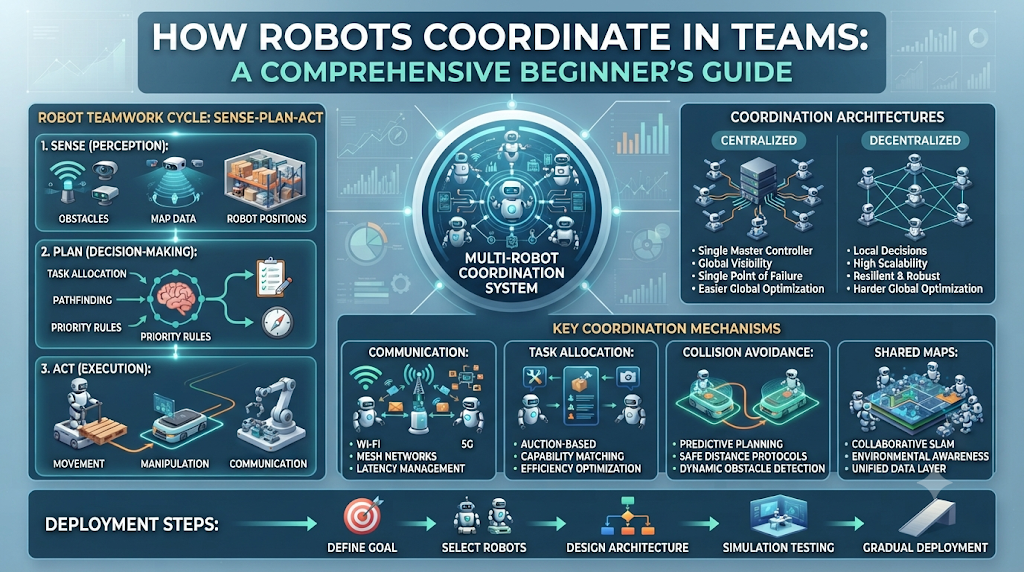
Imagine several warehouse robots working in the same facility, where one robot collects an item, another delivers it, and others navigate the same aisles. If every robot acts independently, they may choose the same task, block each other’s paths, waste energy, duplicate work, collide, or miss important information. Multi-robot coordination gives the team mechanisms for deciding who does what, where robots should move, what information they should share, and how they should respond when conditions change, bridging core concepts explored across advanced technical platforms like RobotsOps. Modern multi-robot research focuses on exactly these issues, including task allocation, communication, planning, decision-making, and scalability.
What Is Multi-Robot Coordination?
Multi-robot coordination is the process through which multiple robots organize their tasks, movements, information, resources, timing, and decisions to achieve a shared objective.
Plaintext
Robot A ──┐
Robot B ──┼── Coordination ── Shared Goal
Robot C ──┘
It is important to distinguish between working near each other and actually coordinating. Two vacuum cleaners operating in different rooms of a house are merely working near each other. Two robots passing an object back and forth in a manufacturing line must actively coordinate their timing, positioning, and force to succeed.
Why Robots Work in Teams
Several robots can often accomplish goals much faster or more safely than a single machine. Key benefits include:
- Faster task completion through parallel execution.
- Larger area coverage in search and monitoring operations.
- Redundancy and resilience if an individual unit fails.
- Specialization via diverse robot capabilities.
- Better resource utilization across complex environments.
Real-world applications span warehouse automation, search and rescue, precision agriculture, environmental monitoring, aerial drone teams, and space exploration. However, more robots do not automatically mean better performance. Poor coordination can create severe congestion and additional computational complexity.
Basic Multi-Robot Coordination Architecture
Plaintext
              Shared Mission
                    ↓
            Task Allocation
                    ↓
        ┌───────────┼───────────┐
        ↓           ↓           ↓
     Robot A     Robot B     Robot C
        ↓           ↓           ↓
   Perception   Perception   Perception
        ↓           ↓           ↓
    Planning     Planning     Planning
        ↓           ↓           ↓
      Action       Action       Action
        └───────────┼───────────┘
                    ↓
             Team Feedback
The exact architecture varies depending on the application, balancing high-level mission control with decentralized local execution.
How Robots Communicate
Robots may exchange information such as position, velocity, battery status, current task, sensor observations, planned route, detected obstacles, and map updates.
- Explicit communication: Robots directly exchange digital messages over a network.
- Implicit coordination: Robots infer what others are doing by observing environmental changes or physical movements.
Communication design involves balancing bandwidth, connectivity, latency, and reliability.
Robot Communication Methods
Broad communication options include Wi-Fi, mesh networking, cellular networks, radio frequencies, Ultra-Wideband (UWB), and optical communication. No single technology is universally best; the choice depends on range, environment, bandwidth, latency, power consumption, reliability, and cost.
What Information Should Robots Share?
Sharing every single raw sensor stream is inefficient. Robots should follow a core principle: share enough information to coordinate effectively without creating unnecessary communication overhead.
Typically, a robot only needs to broadcast essential state variables like its ID, position, current task, velocity, battery level, and nearby obstacles.
Task Allocation
Multi-Robot Task Allocation (MRTA) answers a fundamental question: Which robot should perform which task?
- Tasks: T1 (Inspect Area A), T2 (Carry Package), T3 (Scan Area B)
- Robots: R1 (assigned to T1), R2 (assigned to T2), R3 (assigned to T3)
Allocation depends heavily on robot capabilities, distance, battery life, task priority, availability, and time constraints.
Centralized Task Allocation
In a centralized model, a single coordinator manages the entire team:
Plaintext
           Central Planner
          /       |       \
       Robot A  Robot B  Robot C
- Advantages: Easier global planning, central visibility, and straightforward optimization.
- Limitations: Single point of failure, communication dependency, computational bottlenecks, and scaling challenges.
Decentralized Coordination
In decentralized systems, robots make local decisions based on local observations and neighbor communication:
Plaintext
Robot A ↔ Robot B
   ↕          ↕
Robot C ↔ Robot D
- Advantages: Better scalability, greater local autonomy, and no single central controller.
- Challenges: Harder global optimization, communication inconsistencies, and complex distributed decision-making.
Hierarchical Coordination
Hierarchical systems provide a middle ground:
Plaintext
        Mission Planner
              ↓
       Regional Planner
        ↓     ↓     ↓
      R1      R2     R3
A higher-level system manages broad objectives while individual regional units or robots retain local autonomy, making it ideal for large warehouse fleets and agricultural setups.
Auction-Based Task Allocation
Market-based approaches use auctions to distribute work. Suppose a team needs to inspect three locations. Each robot calculates a cost based on distance, travel time, battery, capability, and current workload, submitting bids so tasks are assigned efficiently.
Consensus-Based Coordination
Consensus algorithms allow robots to exchange information iteratively until their decisions or estimated states become sufficiently aligned, enabling distributed agreement on targets and plans.
Motion Coordination
Task assignment alone is not enough; robots must also solve path planning, motion planning, collision avoidance, formation control, and traffic management challenges simultaneously.
Collision Avoidance
When multiple robots share physical spaces, conflict management is critical:
Plaintext
Robot A → → →
             X
Robot B ← ← ←
Robots must detect potential conflicts, apply velocity adjustments, follow priority rules, or calculate alternative routes dynamically.
Shared Maps and Localization
Teams often share environmental data through collaborative SLAM (Simultaneous Localization and Mapping), allowing multiple robots to contribute observations to a unified map while navigating.
Formation Control
Formation control requires robots to maintain precise geometric relationships (lines, columns, or grids) while moving, which is vital for drone fleets and environmental monitoring arrays.
Swarm Robotics
Swarm robotics uses large numbers of relatively simple robots inspired by biological systems (like ant colonies or bird flocks) to produce sophisticated collective behaviors without central oversight.
Centralized vs Decentralized vs Swarm Coordination
| Approach | Decision Making | Strength | Challenge |
|---|---|---|---|
| Centralized | Central planner | Global visibility | Single point of failure |
| Decentralized | Individual robots | Scalable and resilient | Harder global optimization |
| Hierarchical | Multiple levels | Balanced approach | More complex architecture |
| Swarm | Local rules | Highly scalable | Unpredictable emergent behavior |
Heterogeneous Robot Teams
Teams do not have to consist of identical machines. A heterogeneous team might combine aerial drones for mapping, ground robots for transport, and robotic arms for manipulation, complicating task allocation due to differing capabilities.
Coordination Through Shared Goals
Successful multi-robot coordination aligns individual actions with a common objective, whether that is minimizing warehouse delivery times or maximizing search-and-rescue coverage areas.
Robot Team Decision-Making
Dynamic environments require teams to adapt. When an obstacle blocks a path or a task changes, robots must replan locally and update the wider team to maintain synchronization.
Failure Handling
Robust robot teams expect component failures, communication drops, and sensor errors, incorporating fallback behaviors to reassign tasks and continue operations safely.
What Happens When Communication Fails?
Plaintext
Robot A ──X── Robot B (Communication Lost)
       ↓
Local Decision Making
       ↓
Safe Behavior
       ↓
Reconnect / Replan
When networks drop, robots switch to local autonomy, rely on last known information, or execute safe fallback behaviors until reconnection occurs.
Synchronization and Timing
Cooperative tasks like multi-robot lifting or drone formations require strict clock and action synchronization to prevent physical instability.
Cooperative Manipulation
When multiple robots handle a single heavy object together, they must coordinate position, force, velocity, and timing simultaneously.
Communication vs Coordination
Communication is simply exchanging information; coordination is using that information to organize behavior. High communication does not automatically guarantee good coordination.
AI and Machine Learning in Robot Teams
Artificial intelligence supports task allocation, path planning, and Multi-Agent Reinforcement Learning (MARL). However, classical optimization and heuristic methods remain essential for safety-critical reliability.
Role of Digital Twins and Simulation
Simulations allow developers to test task allocation, communication drops, and failure scenarios safely before deploying software onto physical hardware (sim-to-real testing).
Common Challenges in Robot Team Coordination
| Challenge | Why It Matters |
|---|---|
| Communication delays | Information may become outdated |
| Network failure | Robots may lose team awareness |
| Task conflicts | Multiple robots may choose the same task |
| Collision risk | Robots share physical space |
| Scalability | More robots increase coordination complexity |
| Battery limits | Robot availability changes |
| Sensor uncertainty | Decisions may use imperfect information |
| Heterogeneous robots | Different capabilities complicate planning |
| Dynamic environments | Plans can become obsolete |
| Security | Compromised data can disrupt operations |
Beginner Example: Warehouse Robot Team
- The system receives package requests.
- Tasks are evaluated.
- Robots determine which tasks they can perform.
- Tasks are assigned.
- Robots calculate safe routes.
- Robots share relevant location information.
- If one robot fails, its tasks are reassigned.
- The team continues operating.
Plaintext
Orders → Task Allocation → Route Planning → Robot Coordination → Execution → Monitoring → Replanning
Beginner Example: Search-and-Rescue Robots
Plaintext
        Search Area
 ┌────────┬────────┐
 │ Robot A│ Robot B│
 ├────────┼────────┤
 │ Robot C│ Robot D│
 └────────┴────────┘
Robots divide disaster zones into grids, share discovered hazards, avoid duplicate coverage, and reassign tasks dynamically if a unit malfunctions.
Beginner Example: Drone Team
Drone teams coordinate flight altitudes, formations, and battery management dynamically, utilizing centralized planning or decentralized behaviors depending on operational scale.
How to Design a Simple Multi-Robot Coordination System
- Step 1 — Define the Goal: What must the team accomplish?
- Step 2 — Define Robot Capabilities: What can each robot do?
- Step 3 — Define Information Sharing: What must robots know about each other?
- Step 4 — Choose Coordination Architecture: Centralized, decentralized, or hybrid?
- Step 5 — Create Task Allocation: Who does what?
- Step 6 — Add Motion Planning: Where should each robot move?
- Step 7 — Add Collision Avoidance: How will conflicts be prevented?
- Step 8 — Add Failure Handling: What happens if a robot or link fails?
- Step 9 — Simulate: Test different conditions thoroughly.
- Step 10 — Deploy Gradually: Start small and scale carefully.
Practical Learning Project
Build a Multi-Robot Area Coverage Simulation featuring 5 virtual robots in a 2D environment with target areas, task allocation, communication, and collision avoidance logic to master multi-agent programming concepts.
How RobotsOps.com Helps Beginners
RobotsOps.com provides educational resources to help readers build foundational knowledge around robotics programming, robot software, autonomous systems, sensors, decision-making, and multi-robot coordination workflows.
Future of Robot Team Coordination
Emerging research explores LLM-based planning, reinforcement learning, collaborative perception, distributed mapping, and communication-aware coordination, bridging the gap between theoretical models and robust production systems.
Common Beginner Mistakes
- Giving every robot the identical task.
- Ignoring communication delays and network drops.
- Forgetting battery constraints and physical limitations.
- Planning routes independently without collision checks.
- Assuming centralized controllers never fail.
Robot Team Coordination Checklist
- I understand multi-robot coordination.
- I understand task allocation.
- I know the difference between centralized and decentralized systems.
- I understand robot communication.
- I understand collision avoidance.
- I know why shared maps matter.
- I understand formation control.
- I know what swarm robotics means.
- I understand heterogeneous robot teams.
- I know how communication failures affect coordination.
- I understand why scalability matters.
- I can design a simple multi-robot simulation.
Frequently Asked Questions
What is multi-robot coordination?
Multi-robot coordination is the organizational process where multiple autonomous machines synchronize their tasks, movements, and decisions to achieve a shared goal efficiently.
How do robots coordinate with each other?
Robots coordinate by exchanging status information explicitly over a network or by implicitly inferring intentions through environmental observations and shared rules.
How do robots communicate in a team?
Teams use wireless options like Wi-Fi, mesh networks, or radio signals to exchange vital state data such as positions, battery levels, and active tasks.
What is multi-robot task allocation?
It is the computational process of assigning specific jobs or waypoints to the most suitable robots in a team based on capabilities and distance.
What is centralized robot coordination?
A system where a single master controller processes all team data, assigns tasks, and oversees global planning for every robot.
What is decentralized robot coordination?
An architecture where individual robots make local decisions autonomously using neighbor communication without relying on a central master server.
How do robots avoid collisions with each other?
Robots use real-time sensor feedback, predictive path planning, velocity adjustments, and right-of-way rules to steer clear of dynamic obstacles.
What is swarm robotics?
A decentralized approach inspired by nature where large numbers of simple robots use local rules to generate complex collective behavior.
What challenges affect robot team coordination?
Key hurdles include communication latency, network dropouts, task conflicts, limited battery life, and unpredictable dynamic environments.
How can beginners learn multi-robot coordination?
Beginners can start by studying robotics software frameworks, building simple multi-agent simulations, and exploring educational guides on RobotsOps.com.
Conclusion
Robots coordinate in teams by combining communication, task allocation, planning, perception, decision-making, and control to successfully accomplish shared objectives. Communication helps robots share information, task allocation determines who does what, motion planning determines where robots move, and collision avoidance keeps the team safe while handling failures and dynamic changes. Whether utilizing centralized architectures for global visibility, decentralized systems for resilience, or swarm behaviors for scale, mastering these collaborative mechanisms is essential for modern autonomous engineering.
