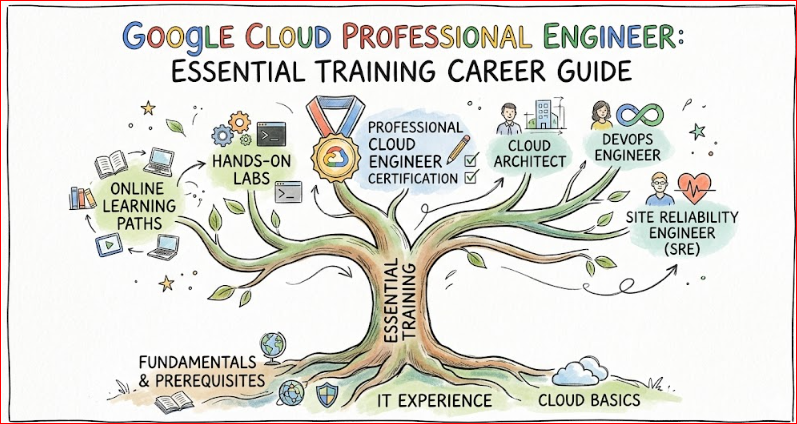
Introduction
Transitioning your career into the cloud or leveling up your current engineering role is a journey that requires both hands-on grit and a clear roadmap. Having navigated the shifts from physical data centers to the current cloud-native era, I have seen how specialized knowledge changes careers and creates new opportunities for growth. Google Cloud Platform (GCP) has become a powerhouse for businesses that value data, speed, and reliability. This guide is designed to help software engineers, DevOps practitioners, and managers understand the landscape of Google Cloud Professional Engineer, with a focus on the Professional Cloud DevOps Engineer path.
Why Google Cloud Certifications Matter Today
In the current market, simply knowing how to write code is no longer enough to stay ahead. Companies need engineers who understand how to build systems that are scalable, secure, and cost-effective for the long term. These certifications prove you can handle high-pressure environments and use modern tools to keep business-critical applications running smoothly.
For managers, these certifications provide a reliable benchmark when hiring new talent for their teams. For engineers, they offer a structured way to learn complex topics like Site Reliability Engineering (SRE) and managed Kubernetes. Having this validation makes you a much more attractive candidate for top-tier global companies.
Master Table: Google Cloud Certification Ecosystem
| Track | Level | Who it’s for | Prerequisites | Skills Covered | Recommended Order |
| Cloud DevOps | Professional | DevOps & SREs | 3+ years industry exp | CI/CD, SRE, Monitoring, Logging | After Cloud Engineer |
| Cloud Architect | Professional | Solutions Architects | Cloud Fundamentals | Design, Plan, Manage Infra | After Associate |
| Cloud Security | Professional | Security Engineers | Identity & Compliance | IAM, Network Security, Encryption | After Cloud Engineer |
| Data Engineer | Professional | Data Scientists/Engineers | Big Data Basics | ML, BigQuery, Data Pipelines | After Associate |
| Cloud Developer | Professional | App Developers | Programming knowledge | Cloud-native apps, Debugging | After Associate |
| Cloud Engineer | Associate | Junior/Mid-level Engineers | 6 months+ GCP | Deployment, Monitoring | Start Here |
Deep Dive: Google Cloud Professional Cloud DevOps Engineer
What it is
This certification focuses on the intersection of software development and platform operations in a cloud-native world. It validates your ability to balance the need for service reliability with the constant pressure for fast feature delivery. You will learn how to use Google’s specific tools to automate every part of the software lifecycle.
Who should take it
This is ideal for Senior Software Engineers, DevOps Engineers, and SREs who want to master automation and Google’s specific flavor of Site Reliability Engineering. If you are already managing servers or writing deployment scripts, this will help you formalize your knowledge. It is also great for anyone moving from on-premise systems to a modern cloud setup.
Skills you’ll gain
- CI/CD Mastery: You will learn how to build and manage automated pipelines using Cloud Build to ensure code moves safely from developers to users.
- SRE Principles: You will gain a deep understanding of Site Reliability Engineering, including how to set Service Level Objectives and manage Error Budgets.
- Infrastructure as Code: You will learn to manage cloud resources using tools like Terraform and Config Connector to keep your environments consistent.
- Monitoring and Logging: You will master advanced monitoring and alerting with Cloud Monitoring to find and fix issues before your users ever notice them.
Real-world projects you should be able to do
- Automated Rollouts: You will be able to set up Canary or Blue/Green deployment strategies for microservices applications running on Google Kubernetes Engine.
- Self-Healing Systems: You can build automated alerting systems that trigger Cloud Functions to fix common production issues without manual intervention.
- Cost Optimization: You will be able to implement automated scripts that shut down non-production environments during off-hours to save your company money.
- Log Analysis: You will gain the ability to create complex log sinks and dashboards that give your team a clear view of how the entire system is performing.
Preparation Plan
- 7–14 Days (The Fast Track): This timeline is only for those who are already using Google Cloud tools every single day at work. Focus heavily on taking practice exams and reviewing the core concepts in the official Google SRE books. Use this time to fill in any small gaps in your technical knowledge before the test.
- 30 Days (The Balanced Pace): Dedicate about two hours every day to your study routine to ensure the concepts really stick. Spend the first 15 days doing hands-on labs to get comfortable with the interface and the next 15 days on theoretical deep dives. This approach is best for working engineers who want a solid understanding without rushing.
- 60 Days (The Comprehensive Route): This is the best path for those who are relatively new to the Google Cloud ecosystem. Spend the first month mastering the Associate Cloud Engineer material to build a strong foundation. Use the second month to focus strictly on DevOps-specific services and advanced automation techniques.
Common Mistakes
- Ignoring the SRE Books: Many people fail because they only focus on the technical tools and forget the cultural philosophy of Site Reliability Engineering.
- Over-focusing on Coding: This exam tests your knowledge of operations and monitoring just as much as it tests your ability to write deployment scripts.
- Not Practicing IAM: Security is baked into almost every question, so failing to understand how permissions work will likely lead to a failing grade.
- Skipping Hands-on Labs: Reading the documentation is helpful, but you need to actually spend time in the GCP console to understand how things work in practice.
Best next certification after this
1. Same Track (Technical Specialization)
Next Step: Google Cloud Professional Cloud Network Engineer This is the most logical step if you want to become the ultimate technical authority on how your systems communicate. While DevOps focuses on delivery and reliability, the Network Engineer certification dives into the complex plumbing of the cloud—VPC design, hybrid connectivity, and advanced load balancing. Mastering this area ensures that your automated pipelines are backed by a high-performance, low-latency infrastructure that can scale globally.
2. Cross-Track (Broadening your Skillset)
Next Step: Google Cloud Professional Cloud Security Engineer In the modern landscape, security is no longer a separate department; it is a core part of the engineering process, often referred to as DevSecOps. This certification teaches you how to bake security directly into your CI/CD pipelines through automated scanning, identity management, and compliance as code. It is an excellent choice for engineers who want to make themselves indispensable by protecting their company’s data without slowing down the speed of innovation.
3. Leadership (Strategic Growth)
Next Step: Google Cloud Professional Cloud Architect If you are looking to move away from day-to-day technical execution and toward high-level strategy, the Professional Cloud Architect is the gold standard. This certification shifts the focus from “how we build” to “what we should build” to solve specific business problems. It prepares you to lead large engineering teams and make the critical decisions that define a company’s long-term technology roadmap, making it perfect for aspiring Lead Engineers and Engineering Managers.
Choose Your Path: 6 Specialized Learning Paths
1. The DevOps Path
This path is all about speed and automation in the software delivery process. You should start with the Associate Cloud Engineer exam and then move directly into the Professional Cloud DevOps Engineer level. The goal here is to master tools like Cloud Build, Artifact Registry, and Google Kubernetes Engine to keep deployments moving smoothly.
2. The DevSecOps Path
In this path, you learn that security is not an afterthought but a core part of the development process. You begin with the standard DevOps track but quickly follow it up with the Professional Cloud Security Engineer certification. This will teach you how to automate security scanning and manage identity policies within your automated pipelines.
3. The SRE Path
This path focuses on reliability and making sure that your applications are always available for your users. You should focus heavily on the DevOps certification while adding deep dives into Cloud Monitoring, Cloud Trace, and Error Reporting. It is perfect for engineers who love solving complex problems related to system uptime and performance.
4. The AIOps/MLOps Path
This is a modern path that combines the power of artificial intelligence with standard operations. You will need to combine the Cloud DevOps track with the Professional Machine Learning Engineer certification. This helps you learn how to automate the training, deployment, and monitoring of machine learning models at scale.
5. The DataOps Path
Data is the lifeblood of most modern companies, and this path ensures that data stays accurate and accessible. You should start with the Professional Data Engineer track and then follow up with DevOps training. This helps you build reliable, automated data pipelines that do not break when they are moved into a production environment.
6. The FinOps Path
Cloud costs can quickly spiral out of control if they are not managed properly. This path teaches you how to balance technical needs with financial responsibility. You should focus on the Cloud Architect track to understand infrastructure, then specialize in Cloud Billing and cost optimization tools to keep budgets on track.
Role → Recommended Certifications
| Current or Target Role | Recommended Google Cloud Certifications |
| DevOps Engineer | Associate Cloud Engineer → Professional Cloud DevOps Engineer |
| Site Reliability Engineer (SRE) | Professional Cloud DevOps Engineer → Professional Cloud Architect |
| Platform Engineer | Professional Cloud DevOps Engineer → Professional Cloud Network Engineer |
| Cloud Engineer | Associate Cloud Engineer → Professional Cloud Developer |
| Security Engineer | Associate Cloud Engineer → Professional Cloud Security Engineer |
| Data Engineer | Professional Data Engineer → Professional Database Engineer |
| FinOps Practitioner | Associate Cloud Engineer → Professional Cloud Architect |
| Engineering Manager | Digital Cloud Leader → Professional Cloud Architect |
Next Certifications to Take
- Same Track (Specialization): The Professional Cloud Network Engineer is a great choice if you want to master the complex networking that sits behind all DevOps work. It helps you understand how data moves between services and how to keep those connections stable and fast.
- Cross-Track (Broadening): The Professional Cloud Security Engineer is perfect for those who want to transition into a DevSecOps role. It broadens your skillset by adding a layer of security expertise to your existing knowledge of automation and delivery.
- Leadership (Growth): The Professional Cloud Architect is the best option if you want to move from technical execution to high-level system design. It prepares you to lead large projects and make strategic decisions about which cloud services a business should use.
Top Institutions for Training and Certification
DevOpsSchool
DevOpsSchool is a leading provider that offers very deep technical training for engineers. Their courses focus on hands-on labs and real-world scenarios, making them a top choice for those who want to clear the exam while gaining actual job skills. They are well-known for their practical approach and expert mentors.
Cotocus
Cotocus provides specialized training that is driven by real-world consulting experience. Their approach is unique because they bring actual industry problems into the classroom, helping you understand the “why” behind cloud architecture. This makes their training very valuable for senior engineers and managers.
Scmgalaxy
This is a community-driven platform that offers a huge amount of resources on configuration management. They are excellent for those who want to master the automation side of the software supply chain and Google Cloud. It is a great place to find deeply technical guides and community support.
BestDevOps
BestDevOps is known for high-quality video content and very structured bootcamps for busy professionals. They provide a streamlined path that helps working engineers balance their learning with a full-time job. Their materials are designed to get you ready for the certification in a very efficient way.
Specialized Online Schools
- devsecopsschool.com: This school is dedicated entirely to merging security practices with modern operations. They provide the specific knowledge needed to build secure pipelines that protect company assets without slowing down development teams.
- sreschool.com: This institution focuses exclusively on the principles of Site Reliability Engineering. They teach you how to apply Google’s own reliability methods to your own projects to ensure maximum uptime and performance for your users.
- aiopsschool.com: This is the best place to learn how artificial intelligence can be used to improve IT operations. They focus on using data and machine learning to find and fix system issues before they become major problems for the business.
- dataopsschool.com: This school specializes in the operational side of managing data at a very large scale. They teach you how to build automated data pipelines that are reliable, scalable, and easy for data scientists to use every day.
- finopsschool.com: This institution teaches the art and science of cloud financial management. They show you how to track spending, optimize your cloud resources, and make sure that every dollar spent on the cloud is providing real value to the company.
Master FAQ: Google Cloud Professional Engineer
1. How difficult is the Google Cloud Professional DevOps Engineer exam?
It is widely considered one of the more challenging professional exams because it tests both technical tools and philosophical concepts. You need to understand how Google views reliability as much as you need to know how to use their specific cloud services.
2. How much time do I need to prepare for this certification?
Most working professionals should plan for about 4 to 8 weeks of consistent study depending on their background. If you already have experience with tools like Kubernetes and Jenkins, you might be able to move through the material a bit faster.
3. Are there any official prerequisites for taking the exam?
There are no formal requirements to take the test, meaning anyone can sign up at any time. However, Google highly recommends having at least three years of industry experience and one year of hands-on work with their cloud platform.
4. Should I take the Associate Cloud Engineer exam before the Professional one?
Yes, it is highly recommended to start with the Associate exam unless you have been working on GCP for several years. The Associate level builds the necessary foundation that you will need to understand the much more complex topics covered in the Professional exam.
5. How long does this certification stay valid?
Google Cloud professional certifications are valid for two years from the date you pass the exam. To maintain your status, you will need to take the updated version of the test every two years to prove your skills are still current.
6. Do I need to be an expert coder to pass this exam?
You do not need to be a full-stack developer, but you must be able to read and understand code. You should be comfortable working with YAML files, shell scripts, and basic Python, as these are common in modern cloud environments.
7. How will this certification impact my salary and career?
Cloud DevOps professionals are currently among the highest-paid individuals in the tech industry. Holding this certification validates your skills to employers and can lead to significant salary increases and more senior job titles in global companies.
8. Is it possible to take the certification exam from my home?
Yes, Google offers the option to take the exam through remote proctoring or at an authorized physical testing center. If you choose the online option, you will need a stable internet connection and a private room to complete the test.
9. What is the actual format of the examination?
The exam consists of 50 to 60 questions that are either multiple-choice or multiple-select. You are given exactly two hours to complete the test, which is usually enough time if you have prepared well and know the material.
10. What is the minimum score needed to pass the exam?
Google does not publish the exact passing score for any of their certifications to keep the process fair. However, industry experts generally estimate that you need to answer about 70% of the questions correctly to earn your badge.
11. Are there actual hands-on labs during the testing process?
Most GCP exams are currently multiple-choice and do not include a live lab environment. However, many questions describe a specific scenario and ask you to choose the correct steps to solve a problem, which tests your practical knowledge.
12. Is it really necessary to read the official Google SRE books?
Yes, reading the SRE books is essential because about a third of the DevOps exam is based on these concepts. Without a firm grasp of SLIs, SLOs, and error budgets, it will be very difficult to pass the professional level test.
Google Cloud Professional Engineer: General FAQs
1. Who provides the most reliable training for these certifications?
Institutions like DevOpsSchool and Cotocus are highly recommended because they focus on practical, hands-on learning. They don’t just teach you how to pass the test; they teach you how to do the job in a real production environment.
2. What is the main technical focus of the DevOps certification?
The primary focus is on automation, system reliability, and the efficient delivery of software updates. It covers everything from building CI/CD pipelines to monitoring complex distributed systems using Google’s modern toolset.
3. Do I need to learn Terraform for the Google Cloud exam?
While the exam mentions Google’s own Deployment Manager, knowing Terraform is absolutely essential for a real-world career. Most companies use Terraform to manage their infrastructure, so it is a skill you should definitely prioritize during your studies.
4. How much of the exam covers Google Kubernetes Engine (GKE)?
GKE is a core part of the DevOps Engineer certification and shows up in many different questions. You should have a very strong understanding of how to deploy, scale, and manage containers within the Google Cloud environment to be successful.
5. How much does it cost to take the professional level exam?
The registration fee for a Professional level Google Cloud certification exam is currently $200 USD. This fee must be paid each time you take the test, so it is important to be fully prepared before you schedule your appointment.
6. Can I get a discount or a voucher for the exam fee?
Many training providers like DevOpsSchool offer special bundles that include the cost of the exam as part of their training package. Sometimes Google also offers discounts during special events or through their official learning partners.
7. How do I keep my certification active over the years?
You will need to register for and pass the latest version of the exam every two years to keep your certification active. This ensures that all certified professionals are up to date with the latest changes in the Google Cloud platform.
8. Is the Google certification better than those from AWS or Azure?
It really depends on the specific needs of your company, but Google’s certifications are highly respected for their focus on SRE and culture. Many engineers find that the GCP DevOps track offers the most modern approach to building and managing software.
Testimonials
“Coming from a traditional operations background, the transition to the cloud felt like a huge mountain to climb. The structured path and the hands-on labs helped me clear the Professional DevOps Engineer exam in just six weeks. It has completely changed the way I think about automation and my daily work.”
— Animesh S.
“The focus on SRE principles in the Google Cloud track is what makes it stand out from other certifications. It is not just about knowing which buttons to click; it is about learning how to build systems that are truly resilient. I highly recommend the training at DevOpsSchool for anyone who is serious about their career.”
— Priya R.
“As an Engineering Manager, I needed to understand the technical side of the cloud to better support my team. Getting certified allowed me to speak the same language as my engineers and make much better decisions for our platform. It was a challenging process but worth every hour of study.”
— Vikram K.
Conclusion
The path to becoming a Google Cloud Professional Engineer is challenging, but the rewards are well worth the effort. In an industry that never stops moving, having a deep understanding of how to build, scale, and secure applications is the best insurance for your professional future. Whether you are an individual contributor or a manager leading a large team, these certifications provide the framework you need to succeed. Start with the foundations, choose the path that fits your goals, and don’t be afraid to dive into the hands-on labs. The cloud offers incredible opportunities for those willing to put in the work to master it.
