Introduction
Welcome to RobotsOps. Imagine walking onto a busy warehouse floor where an autonomous mobile robot tirelessly transports heavy inventory from one aisle to another. Day after day, it repeats the same precise path, executing hundreds of picks and placements without a single pause. While this continuous operation keeps productivity high, it also places immense physical stress on the robot’s motors, gearboxes, bearings, joints, cables, sensors, batteries, controllers, and end-effectors. Over time, friction, vibration, and electrical load begin to take their toll. If ignored, this daily wear and tear can gradually degrade reliability, positioning accuracy, safety, and overall system uptime. This is why viewing maintenance as a structured operational process rather than something done only after a sudden breakdown is critical for anyone working with modern automation.
What Is Robotics Maintenance?
Robotics maintenance is the structured process of inspecting, servicing, testing, monitoring, and repairing robotic systems to maintain safe and reliable operation. Unlike traditional machinery, a robot combines complex hardware with advanced software and digital controls.
Therefore, maintenance involves both physical systems and digital systems. Physical systems include motors, gearboxes, bearings, joints, cables, sensors, batteries, and end-effectors. Digital systems include firmware, software, configuration files, error logs, diagnostics, and communication interfaces.
Within modern operational frameworks, maintenance is a core pillar of the robot lifecycle. Rather than acting as an isolated repair task, structured upkeep integrates seamlessly into deployment, monitoring, regular updates, and eventual system retirement.
Why Robotics Maintenance Is Important
Implementing regular robotics maintenance offers several major operational advantages:
- Safety: Routine checks help identify worn components or wiring faults before they create hazardous operating conditions or unpredictable robot behavior.
- Reliability: Regular inspections catch early signs of mechanical wear or electrical degradation before they escalate into major failures.
- Accuracy: Over time, mechanical wear and sensor drift can impact positioning. Maintenance and calibration preserve the precision required for delicate tasks.
- Availability: Scheduled servicing minimizes unexpected interruptions, keeping production lines or warehouse fleets running smoothly.
- Equipment Life: Proper servicing and lubrication help physical components perform closer to their intended operating lifespan.
- Cost Management: Planned maintenance helps reduce the likelihood of expensive emergency repairs, although actual financial savings depend heavily on the specific operating environment and strategy.
Types of Robotics Maintenance
Understanding the different categories of maintenance helps teams build a balanced and effective operational strategy.
Corrective Maintenance
Corrective maintenance refers to repairs performed after a fault or failure has already occurred. Examples include replacing a failed sensor, repairing a severed communication cable, or swapping out a burned-out motor component.
Preventive Maintenance
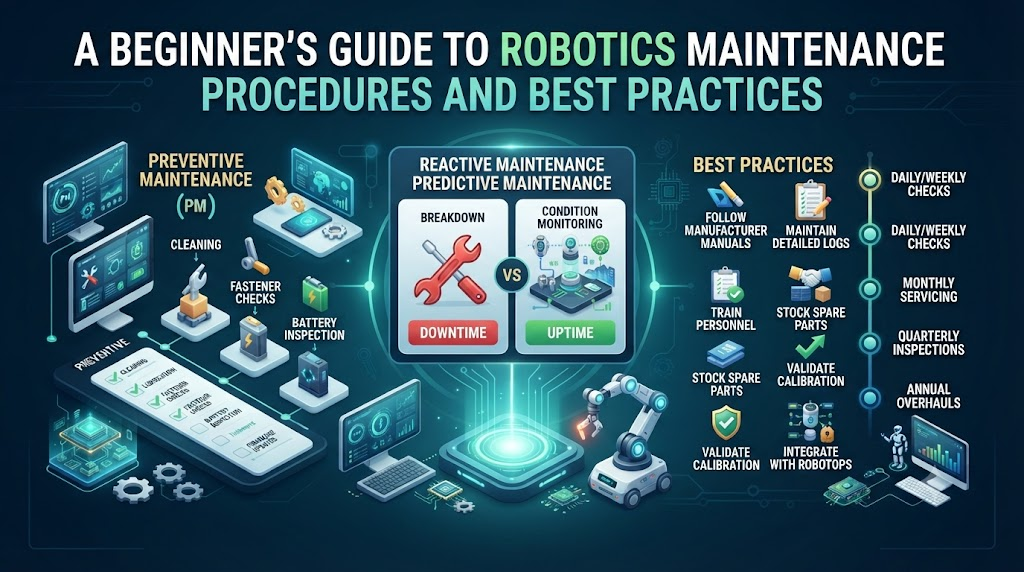
Preventive maintenance is planned servicing performed at defined intervals or operating conditions to reduce the likelihood of unexpected failures. Common examples include lubrication, cleaning, fastener inspections, battery health checks, calibration, and filter replacements.
Predictive Maintenance
Predictive maintenance relies on operational data, telemetry, trends, and analytics to identify potential problems before an actual failure occurs. By observing changing metrics over time, engineering teams can intervene proactively.
Condition-Based Maintenance
Condition-based maintenance is triggered when monitored operational parameters cross defined threshold limits or show concerning behavioral trends. Telemetry, fault diagnosis, and condition monitoring play a vital role in identifying when this specialized attention is required.
Basic Robotics Maintenance Procedures
Executing maintenance efficiently requires a structured, step-by-step workflow:
- Step 1: Review Robot Status: Check recent fault codes, active alarms, runtime statistics, and maintenance history.
- Step 2: Follow Safety Procedures: Place the robot into a designated safe maintenance state according to manufacturer instructions and workplace rules. Ensure proper power isolation, lockout/tagout where applicable, and verification of emergency stops.
- Step 3: Perform Visual Inspection: Look for visible wear, damaged cable insulation, loose housing parts, or leaking fluids.
- Step 4: Clean Relevant Components: Remove accumulated dust, debris, oil, or industrial contamination from sensitive surfaces and housings.
- Step 5: Inspect Mechanical Components: Check for unusual noises, excessive play in joints, fluid leaks, or loose hardware.
- Step 6: Check Electrical Components: Inspect cables, connectors, power supplies, and cooling fans for signs of overheating or degradation.
- Step 7: Check Sensors: Verify that camera lenses, LiDAR covers, and proximity sensors are clean and securely connected.
- Step 8: Perform Calibration When Required: Run necessary calibration routines to restore precise alignment.
- Step 9: Review Software and Diagnostics: Check error logs, firmware status, and communication interfaces.
- Step 10: Document the Maintenance: Record the date, robot ID, work performed, replacement parts, and technician notes for future tracking.
Mechanical Maintenance of Robots
Mechanical components endure high physical stresses during daily operation. Maintaining them requires focusing on several key areas:
- Joints: Regularly check robot joints for unusual movement, grinding noises, or excessive mechanical play.
- Gearboxes: Inspect gearboxes for wear, backlash, and proper lubricant levels to prevent premature gear failure.
- Bearings: Listen and feel for unusual resistance, rough rotation, or abnormal bearing heat during manual or low-speed movement.
- Lubrication: Follow manufacturer specifications precisely regarding lubricant types, quantities, and application intervals.
- Bolts and Mounting: Verify that base bolts, motor mounts, and structural fasteners remain tight to prevent vibration and loss of accuracy.
- End-Effectors: Inspect grippers, suction cups, welding tools, and tool changers for wear, secure mounting, and clean connection points.
Electrical and Electronic Maintenance
Electrical systems supply the power and communication signals that keep robots functioning. Key areas to inspect include:
- Cables: Look for pinching, sharp bends, chafing, or fatigue along cable tracks, especially in multi-axis robotic arms.
- Connectors: Ensure plugs and terminal blocks are fully seated, clean, and free of corrosion.
- Power Supplies and Controllers: Check for proper voltage levels, secure wiring, and clear ventilation paths.
- Cooling Systems: Clean dust filters and verify that internal fans operate smoothly to prevent overheating.
- Communication Interfaces: Inspect network cables and wireless antennas for intermittent signal loss or high latency.
Safety Note: Electrical maintenance, wiring repairs, and high-voltage component handling should only be performed by trained personnel wearing appropriate personal protective equipment and following established safety protocols.
Sensor Maintenance and Calibration
Modern robots rely heavily on accurate sensory input to understand their surroundings. Sensors like cameras, LiDAR units, encoders, inertial measurement units (IMUs), and force/torque sensors require diligent care.
Dirty optics, physical impacts, environmental vibrations, or natural electronic drift can distort sensor data and alter robot behavior. Maintaining sensors involves a clear progression: cleaning surfaces, inspecting physical mounts, performing necessary calibration routines, and validating accuracy through test runs.
For mobile robots operating in dynamic warehouses, maintaining accurate maps and calibrating navigation sensors are vital operational best practices.
Software and Firmware Maintenance
Robots are fundamentally software-driven machines. Keeping their digital environment healthy is just as important as tightening mechanical bolts.
Regularly managing firmware updates, security patches, configuration files, and diagnostic tools ensures optimal performance. Version tracking, backup creation, and recovery planning prevent catastrophic downtime during unexpected software corruptions.
In fleet environments, systematic version control, continuous integration pipelines, and over-the-air updates help maintain consistency across multiple robotic units.
Battery Maintenance for Mobile Robots
For autonomous mobile robots, delivery units, and drones, battery management directly impacts operational range and fleet availability.
Operators must monitor charging behavior, battery temperature, overall cell health, unexpected discharge rates, and charging errors. Battery maintenance requirements vary significantly based on internal chemistry, robot design, manufacturer guidelines, and ambient operating temperatures.
Implementing smart charging strategies—such as opportunity charging during idle periods—helps sustain high fleet availability throughout long shifts.
Preventive Maintenance Schedule
| Frequency | Example Checks |
|---|---|
| Every Shift / Daily | Visual inspection, fault review, checking for obvious damage |
| Weekly | Sensor condition, cable routing, mounting security, operational trends |
| Monthly | Detailed mechanical and electrical subsystem inspection |
| Periodic | Lubrication, calibration, component-specific servicing |
| As Recommended | Major component overhaul based on manufacturer operating hours |
Actual maintenance intervals must never be treated as universal. They must always be tailored based on the specific robot model, manufacturer documentation, operating environment, duty cycle, and workload severity.
Role of Robot Health Monitoring
Physical maintenance is greatly enhanced by continuous digital health monitoring. By collecting real-time telemetry—such as motor temperatures, battery status, CPU utilization, vibration metrics, motor current draw, and localization confidence—teams gain deep visibility into internal conditions.
The typical monitoring workflow flows from the robot’s onboard sensors to telemetry streams, centralized monitoring platforms, automated alerts, and finally, targeted maintenance actions. This continuous observability allows engineers to catch micro-anomalies before they manifest as catastrophic hardware failures.
Predictive Maintenance in Robotics
Predictive maintenance takes health monitoring a step further by using historical data, threshold analysis, and trend evaluation to forecast potential equipment trouble.
For instance, if a robot arm’s motor current gradually increases over several weeks while performing the exact same payload task, it signals growing mechanical resistance inside a gearbox. Engineering teams can then schedule an inspection before the part seizes entirely.
While predictive systems provide invaluable risk signals and early warnings, they indicate probabilities rather than absolute failure predictions.
Common Robotics Maintenance Mistakes
- Waiting until a complete system failure occurs before inspecting components.
- Ignoring subtle warning signs, unusual noises, or recurring minor error codes.
- Skipping service documentation and failing to log completed repairs.
- Using incorrect lubricants or unapproved replacement parts.
- Neglecting periodic sensor calibration and environmental checks.
- Applying software updates directly to production robots without prior testing.
- Failing to keep critical spare parts in stock.
- Treating mechanical maintenance and software management as completely separate silos.
Practical Example
Consider a busy fulfillment center operating a fleet of autonomous mobile robots. One specific robot begins exhibiting shorter battery runtimes, elevated motor temperatures, and repeated minor localization warnings during its shift.
Following a structured maintenance procedure, the engineering team first reviews the robot’s recent telemetry logs and fault history. Next, they safely power down the unit and perform a physical inspection of the drive wheels, chassis, and charging contacts.
They discover a buildup of debris wrapped tightly around the drive axle, causing increased mechanical drag that forced the motor to draw higher current and drain the battery faster. The team clears the debris, cleans the wheel encoders, validates sensor calibration, and runs a diagnostic test in a controlled staging zone.
Once performance returns to baseline parameters and passes validation checks, the robot is documented and smoothly returned to active fleet service.
Best Practices for Robotics Maintenance
- Strictly follow the manufacturer’s maintenance manual and technical specifications.
- Establish customized maintenance schedules tailored to your facility’s exact workload.
- Maintain comprehensive service logs and historical maintenance records for every robot in your fleet.
- Leverage real-time health monitoring and telemetry dashboards where practical.
- Provide ongoing technical training for maintenance personnel and robot operators.
- Keep a well-managed inventory of critical spare parts to reduce repair lead times.
- Test all software updates and configuration changes in a staging environment prior to fleet-wide deployment.
- Routinely review maintenance data trends to continuously refine your operational procedures.
Robotics Maintenance and RobotOps
In modern automated environments, maintenance does not happen in a vacuum. It forms a vital segment of the broader operational lifecycle:
Deploy→Monitor→Detect→Diagnose→Maintain→Validate→Resume→Learn
By connecting robot health monitoring, fleet management software, telemetry pipelines, and rapid incident response into a centralized framework, organizations can transition from reactive firefighting to proactive reliability management.
Future of Robotics Maintenance
As automation technology matures, the landscape of maintenance continues to evolve. Emerging capabilities include AI-assisted anomaly detection, digital twins that simulate physical wear, automated remote diagnostics, and self-diagnostic algorithms embedded within the robot firmware.
While robots will never become entirely maintenance-free, the integration of advanced telemetry and intelligent operational platforms makes servicing increasingly streamlined, precise, and proactive.
FAQs
What is robotics maintenance?
Robotics maintenance is the structured process of inspecting, servicing, testing, monitoring, and repairing robotic hardware and software systems to ensure safe and reliable performance.
Why is regular robot maintenance important?
Routine maintenance helps preserve operational safety, reliability, positioning accuracy, system availability, and equipment lifespan while helping avoid unexpected downtime.
What are the main types of robotics maintenance?
The primary types include corrective maintenance (repairs after failure), preventive maintenance (scheduled servicing), and predictive maintenance (data-driven condition monitoring).
What is preventive maintenance in robotics?
Preventive maintenance involves planned service tasks—such as lubrication, cleaning, and fastener checks—performed at regular intervals to reduce the risk of unexpected component failure.
What is predictive maintenance for robots?
Predictive maintenance uses telemetry, operational trends, and analytics to identify changing component conditions and potential problems before a failure actually happens.
How often should robots be maintained?
Maintenance frequency depends entirely on the robot manufacturer’s guidelines, operating environment, daily workload, duty cycle, and specific application requirements.
Why is sensor calibration important in robotics?
Sensors like cameras and LiDAR can experience physical bumps, thermal shifts, or electronic drift over time, making calibration essential for maintaining precise navigation and task execution.
What should be included in a robot maintenance checklist?
A comprehensive checklist typically covers mechanical joints, electrical wiring, sensor cleanliness, battery health, calibration status, software logs, and safety mechanism verification.
How does RobotOps support robotics maintenance?
RobotOps integrates maintenance workflows with fleet management, real-time telemetry, health monitoring, and lifecycle tracking to streamline overall robotic operations.
Can robot health monitoring help prevent failures?
Yes, continuous monitoring of parameters like motor temperature, vibration, and current draw allows teams to spot emerging anomalies early and intervene before critical failures occur.
Conclusion
Introduction to robotics maintenance procedures reveals that keeping automated systems running smoothly requires far more than occasional repairs after a breakdown. By combining mechanical inspections, electrical checks, sensor calibrations, software updates, and battery care into a disciplined schedule, organizations protect their investments and workforce. Leveraging real-time telemetry and health monitoring further transforms maintenance into a proactive discipline. Ultimately, embedding maintenance into broader operational workflows ensures that robotic systems remain safe, reliable, accurate, and available to handle demanding tasks for years to come.
