Introduction
The demand for DevOps professionals has grown rapidly over the last few years because companies now depend heavily on cloud infrastructure, automation, scalable applications, and faster software delivery. Businesses want engineers who can manage deployment pipelines, cloud infrastructure, monitoring systems, and production reliability efficiently.
One important reality in the DevOps industry is that salaries are usually influenced more by practical skills than certifications alone. Engineers who can build CI/CD pipelines, automate infrastructure using Terraform, manage Kubernetes clusters, and troubleshoot production issues often receive better salary opportunities than those with only theoretical knowledge. Another reason behind salary growth is the shortage of experienced DevOps engineers. Many organizations struggle to find professionals who understand Linux, networking, cloud platforms, observability, security automation, and distributed systems together. This guide explains the Best DevOps Salary trends, highest paying DevOps jobs, salary growth strategies, certifications, cloud platforms, practical skills, and long-term career paths that can help professionals improve their earning potential realistically.
Why DevOps Salaries Are Growing
Several industry trends are increasing DevOps engineer salary opportunities worldwide.
Cloud Adoption
Most companies are moving applications to cloud platforms such as AWS, Azure, and Google Cloud. Businesses require engineers who can manage scalable cloud infrastructure securely and efficiently.
Automation Demand
Organizations want to reduce manual operational work. Automation tools like Terraform, Ansible, Jenkins, and GitHub Actions help companies save time and reduce deployment failures.
Kubernetes Growth
Kubernetes has become a standard platform for container orchestration. Skilled Kubernetes engineers are highly valued because containerized applications are now common across enterprises.
Infrastructure as Code
Infrastructure as Code enables teams to manage servers, networking, and cloud services programmatically. Terraform and Pulumi expertise often increase salary potential significantly.
DevSecOps Expansion
Security is now integrated directly into deployment pipelines. DevSecOps engineers who understand cloud security and compliance are increasingly in demand.
SRE and Platform Engineering
Large companies are investing in Site Reliability Engineering and platform engineering teams to improve reliability, monitoring, scalability, and developer productivity.
AI-Driven Infrastructure Automation
AI-assisted monitoring, predictive scaling, and automated remediation tools are changing infrastructure management. Engineers who adapt to these technologies may gain stronger career growth opportunities.
Factors Affecting DevOps Salary
Several practical factors influence DevOps salary growth.
Experience Level
Experience remains one of the strongest salary factors. Senior engineers who manage production systems and lead infrastructure design generally receive higher compensation.
Cloud Expertise
AWS, Azure, and Google Cloud experience directly impacts salary potential because cloud infrastructure dominates modern application deployment.
Kubernetes Skills
Kubernetes expertise is often associated with higher-paying DevOps jobs because container orchestration is widely adopted in enterprise environments.
Linux and Networking Knowledge
Strong Linux administration and networking fundamentals help engineers troubleshoot complex infrastructure issues effectively.
Automation Skills
CI/CD pipeline automation, scripting, and Infrastructure as Code skills improve operational efficiency and increase market value.
Certifications
Certifications help validate skills, especially for beginners and mid-level engineers. However, practical experience still matters more during interviews.
Industry and Company Size
Finance, SaaS, cybersecurity, and enterprise cloud companies often pay more than smaller organizations because they manage complex infrastructure environments.
Real Project Experience
Hands-on projects consistently outperform theoretical learning during hiring evaluations.
DevOps Salary by Experience Level
Fresher DevOps Engineer Salary
Entry-level DevOps engineers usually begin with foundational responsibilities such as:
- Linux administration
- Basic CI/CD pipelines
- Docker containerization
- Git workflows
- Cloud fundamentals
Common beginner mistakes include avoiding networking concepts, relying only on tutorials, and skipping hands-on practice.
Freshers who build cloud and Kubernetes projects often stand out faster during hiring.
Mid-Level DevOps Engineer Salary
Mid-level engineers usually work with:
- Kubernetes deployments
- Terraform automation
- CI/CD optimization
- Monitoring tools
- Cloud infrastructure scaling
At this stage, employers value reliability, automation thinking, and debugging ability more than certifications alone.
Senior DevOps Engineer Salary
Senior engineers typically handle:
- Infrastructure architecture
- Reliability engineering
- Platform engineering
- Security automation
- Team leadership
- Incident management
Senior professionals with multi-cloud and Kubernetes expertise often access the highest salary growth opportunities.
DevOps Salary by Role
DevOps Engineer
DevOps engineers manage automation pipelines, infrastructure deployment, monitoring, and operational workflows. This remains one of the most in-demand cloud engineering careers.
Cloud DevOps Engineer
Cloud DevOps engineers specialize in cloud-native infrastructure automation using AWS, Azure, or Google Cloud services. Cloud expertise usually increases salary potential significantly.
Kubernetes Engineer
Kubernetes engineers focus on container orchestration, cluster management, scaling, networking, and deployment optimization.
Site Reliability Engineer (SRE)
SRE professionals improve reliability, incident response, scalability, and observability. Many enterprise companies pay premium salaries for experienced SRE engineers.
DevSecOps Engineer
DevSecOps engineers integrate security into CI/CD pipelines, compliance systems, vulnerability scanning, and cloud infrastructure.
Platform Engineer
Platform engineers build internal developer platforms that improve deployment efficiency and infrastructure standardization.
Infrastructure Automation Engineer
These professionals automate provisioning, deployment, and configuration management using Infrastructure as Code tools.
Cloud Architect
Cloud architects design large-scale cloud infrastructure strategies, security models, and multi-cloud architectures. This is among the highest paying DevOps-related roles.
DevOps Salary by Country
United States
The United States remains one of the highest-paying regions because of strong cloud adoption and enterprise-scale infrastructure environments.
India
India has rapidly growing demand for DevOps professionals due to startup expansion, SaaS growth, and global outsourcing opportunities.
Canada
Canadian companies increasingly invest in cloud migration and automation, creating strong demand for DevOps talent.
Germany
Germany offers competitive salaries for Kubernetes engineers, SRE professionals, and cloud infrastructure specialists.
United Kingdom
The UK market shows strong demand in finance, fintech, cybersecurity, and enterprise cloud sectors.
Australia
Cloud transformation projects and infrastructure modernization continue driving DevOps career growth in Australia.
Singapore
Singapore remains a strong technology hub for cloud-native engineering, especially in finance and enterprise infrastructure.
Remote work opportunities also allow many professionals to access global salary growth without relocating permanently.
DevOps Salary by Cloud Platform
AWS DevOps Salary
AWS dominates the cloud market globally. Engineers skilled in ECS, EKS, Lambda, IAM, and Terraform often receive strong salary opportunities.
Azure DevOps Salary
Azure remains highly popular among enterprise organizations and Microsoft-focused environments. Azure DevOps engineers are especially valuable in corporate infrastructure teams.
Google Cloud DevOps Salary
Google Cloud expertise is growing rapidly in Kubernetes-heavy and cloud-native environments because GCP strongly supports containerized workloads and data-driven platforms.
Highest-Paying DevOps Skills
The following skills consistently improve DevOps salary growth:
- Kubernetes
- Terraform
- AWS cloud automation
- Azure infrastructure management
- Google Cloud architecture
- CI/CD automation
- Infrastructure as Code
- Monitoring and observability
- GitOps workflows
- DevSecOps practices
- SRE engineering
- Platform engineering
- Linux troubleshooting
- Networking fundamentals
These skills improve salary potential because companies depend on scalability, automation, security, and reliability.
Certifications That Can Increase Salary
Kubernetes Certifications
CKA and CKAD certifications are highly respected because Kubernetes expertise remains difficult to master practically.
AWS DevOps Engineer Certification
This certification helps validate cloud automation and operational knowledge in AWS environments.
Azure DevOps Engineer Certification
Useful for enterprise infrastructure and Microsoft cloud environments.
Terraform Associate
Terraform skills are widely used in Infrastructure as Code workflows.
Docker Certifications
Docker knowledge remains valuable for containerized application deployment.
DevSecOps Certifications
Security-focused certifications can improve career growth for engineers entering compliance and cloud security roles.
SRE Certifications
SRE-focused learning helps engineers improve reliability engineering and operational excellence skills.
Certifications are most effective when combined with hands-on cloud and automation projects.
DevOps Salary Comparison Table
| Role | Experience Level | Main Skills | Cloud Focus | Career Growth | Salary Potential |
| DevOps Engineer | Beginner to Senior | CI/CD, Linux, Docker | AWS/Azure/GCP | High | Strong |
| Kubernetes Engineer | Mid to Senior | Kubernetes, Helm, Networking | Multi-cloud | Very High | Very Strong |
| SRE | Senior | Monitoring, Reliability | Multi-cloud | Very High | Premium |
| DevSecOps Engineer | Mid to Senior | Security Automation | AWS/Azure | High | Strong |
| Platform Engineer | Senior | Internal Platforms | Multi-cloud | Very High | Premium |
| Cloud Architect | Senior | Architecture, Security | Multi-cloud | Excellent | Top Tier |
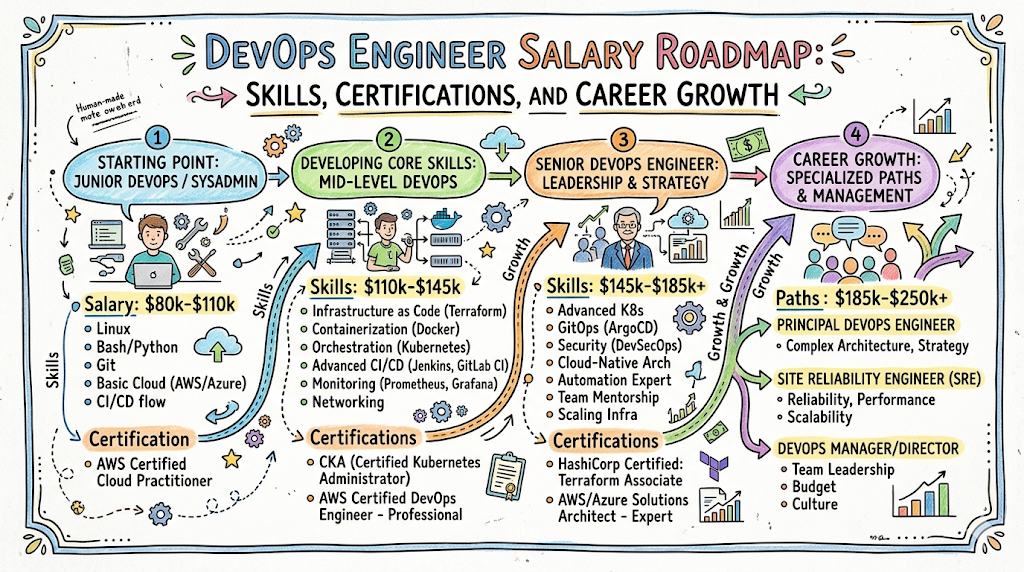
DevOps Career Roadmap for Higher Salary
Beginner Path
Focus on:
- Linux fundamentals
- Git and GitHub
- Networking basics
- Docker
- CI/CD pipelines
These skills build the foundation for DevOps careers.
Intermediate Path
Learn:
- Kubernetes
- Terraform
- Cloud fundamentals
- Jenkins
- Monitoring tools
This stage usually creates major salary growth opportunities.
Advanced Path
Develop expertise in:
- SRE practices
- Platform engineering
- Multi-cloud architecture
- Reliability engineering
- DevSecOps
Advanced engineers often transition into leadership and architecture roles.
Specialized Path
High-growth specializations include:
- GitOps
- MLOps
- AIOps
- FinOps
- Observability engineering
These niche domains may create premium salary opportunities in the future.
Real-World Career Scenarios
Fresher Entering DevOps
A beginner learns Linux, Docker, Git, and basic AWS services before building small CI/CD projects and Kubernetes labs.
Sysadmin Transitioning into Cloud Automation
An experienced Linux administrator learns Terraform and cloud deployment automation to move into higher-paying cloud engineering roles.
Developer Becoming Kubernetes Engineer
A backend developer gains Kubernetes and container orchestration expertise to transition into platform engineering.
Cloud Engineer Moving into SRE
A cloud engineer improves monitoring, incident management, and observability skills to enter Site Reliability Engineering.
Security Engineer Entering DevSecOps
A security professional learns CI/CD security scanning and cloud compliance automation to move into DevSecOps engineering.
Common Mistakes That Limit Salary Growth
- Ignoring Linux fundamentals
- Skipping networking concepts
- Avoiding Kubernetes learning
- Depending only on certifications
- Not building real projects
- Ignoring Infrastructure as Code
- Weak automation skills
- Avoiding cloud platforms
- Relying only on tutorials
- Not learning monitoring tools
These mistakes reduce practical problem-solving ability, which directly impacts hiring and salary growth.
Hands-On Skills Employers Actually Want
Employers consistently value practical implementation skills such as:
- CI/CD pipeline setup
- Docker containerization
- Kubernetes deployments
- Terraform automation
- Monitoring and alerting
- GitOps workflows
- Cloud automation
- Infrastructure security
- Incident response
- Production troubleshooting
Real-world projects demonstrate problem-solving ability far better than theoretical learning alone.
FAQs
1. Is Kubernetes good for salary growth?
Yes. Kubernetes remains one of the strongest skills for DevOps salary growth.
2. Which cloud platform pays the highest salary?
AWS currently has the largest market demand, but Azure and Google Cloud also provide strong opportunities.
3. Do DevOps certifications increase salary?
Certifications help validate skills, especially when combined with hands-on experience.
4. Is AWS or Azure better for DevOps careers?
Both are valuable. AWS dominates startups and cloud-native environments, while Azure is strong in enterprise organizations.
5. Which DevOps skill is most in demand?
Kubernetes, Terraform, and cloud automation remain highly demanded.
6. Is DevOps a high-paying career?
Yes. DevOps is considered one of the stronger-paying technology careers due to automation and cloud expertise demand.
7. Can beginners get high DevOps salaries?
Beginners can improve earning potential faster through practical projects and cloud automation skills.
8. How long does it take to become a high-paid DevOps engineer?
Most professionals require several years of consistent hands-on learning and production experience.
9. Is Terraform important for salary growth?
Yes. Infrastructure as Code skills are heavily used in modern cloud environments.
10. Which certification is best for DevOps salary growth?
Kubernetes and AWS DevOps certifications are widely respected across the industry.
Final Recommendation
The Best DevOps Salary opportunities usually come from strong practical skills rather than shortcuts. Professionals who understand Linux, cloud platforms, Kubernetes, automation, monitoring, and Infrastructure as Code consistently achieve stronger career growth over time. Instead of collecting multiple certifications without experience, focus on building real projects, improving troubleshooting skills, and learning scalable infrastructure design. Kubernetes, Terraform, cloud automation, observability, and SRE practices remain some of the most valuable areas for long-term growth. Cloud technology evolves continuously, so successful DevOps engineers maintain a habit of learning, experimenting, and adapting to modern infrastructure trends.
