Introduction
Imagine stepping off a plane in Tokyo or New York. Your phone shows zero bars. The airport Wi-Fi asks for a password you do not have. Meanwhile, a long queue forms at the local SIM counter.
This scene plays out for millions of travelers every year. Many also face huge roaming bills from their home carrier. Bill shock ruins the first days of a trip.
But there is a smarter path. Travelers now set up their data before the flight leaves home. A travel eSIM makes this easy and cheap.
Platforms like eSIMRoamly help travelers research plans with clear, honest facts. This guide shows you how to compare options and pick the right plan for any destination.
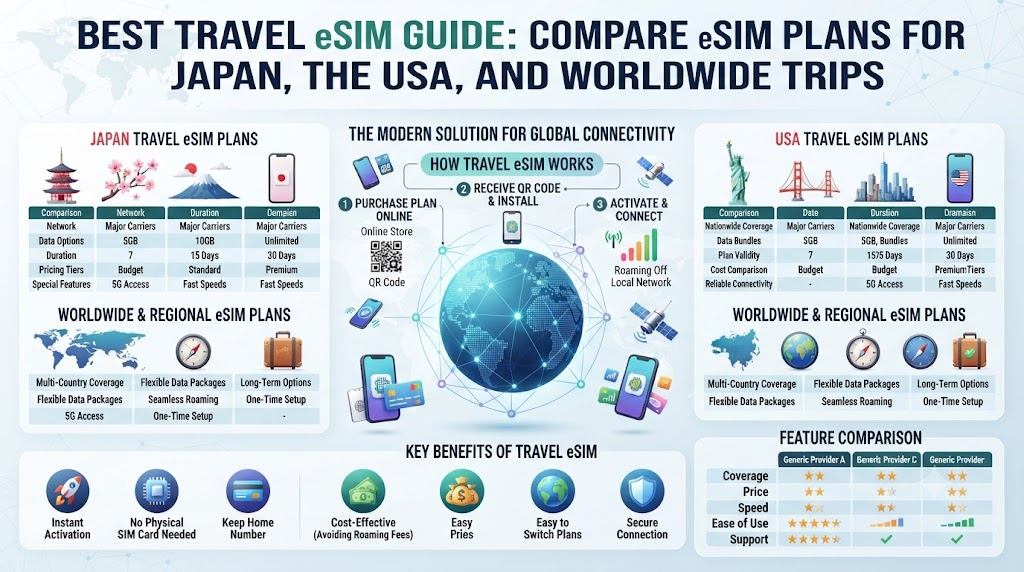
Understanding Travel eSIMs: A Simple Start
Let us begin with the basics. An eSIM is a small digital chip soldered inside modern phones. It is not a plastic card you push into a tray.
Instead, it downloads mobile plans over Wi-Fi. You scan a QR code. The plan installs in seconds. No shop visit. No paperwork.
This gives travelers real freedom. You keep your home number active for bank codes and family texts. At the same time, you use cheap local data for maps, rideshares, and translation apps.
So one phone runs two lines. Your home line handles important messages. Your travel line powers everything else.
Picking the Best Travel eSIM starts with understanding these basics. From here, you can judge plans with confidence.
Four Ways to Get Online Abroad
Travelers have four main choices for overseas data. Each one differs in cost, speed, and convenience. Let us look at each option closely.
The table below sums up the key differences.
| Connection Method | Setup Convenience | Average Cost | Physical SIM Swapping Needed | Risk of Bill Shock |
|---|---|---|---|---|
| Digital Travel eSIM | Instant setup via QR code at home | Low to medium prepaid pricing | No physical card swapping | Zero surprise charges |
| Local Airport Physical SIM | Long waiting queues after landing | Moderate local retail cost | Requires opening tiny phone tray | Zero surprise charges |
| Home Carrier Daily Roaming | Automatic connection upon landing | Very expensive daily flat fees | Keeps original card in phone | High risk of hidden bills |
| Public Pocket Wi-Fi Rental | Must pick up and return hardware | High daily device rental fees | Connects via separate router | Low risk of extra bills |
Digital profiles also save space and reduce risk. You never carry tiny SIM cards. You never lose your home chip in a hotel room. Everything stays safe inside your phone.
What to Check in a Travel eSIM Comparison
Many buyers look only at price. But smart travelers check several factors first. These details decide whether a plan works well in real life.
Start with network generation. A 4G plan often costs less than a 5G plan. But 5G brings faster speeds for video calls and large uploads. Match the plan to your actual needs.
Next, check validity days. Some plans start counting on install. Others start on first connection. This small rule can waste paid days if you install too early.
Hotspot rules matter too. Some plans block tethering fully. Others allow sharing with laptops and travel partners. Families should check this carefully.
Then check the named network partner. A plan may use a top national carrier. Or it may lean on a weaker partner with poor rural signal.
A careful Travel eSIM Comparison covers all these points. Verified provider data lets you Compare eSIM Plans without guesswork. You avoid slow 3G speeds that break map loading mid-journey.
Finding Cheap eSIM Plans the Smart Way
Everyone wants to save on travel data. But the lowest headline price often hides extra costs. You must calculate the true cost per gigabyte.
Do simple math. Divide the plan price by its high-speed data amount. Then compare that figure across plans. Short trips often suit small plans. Long trips usually reward bigger bundles.
Watch for hidden traps too. Some plans expire in tight 24-hour windows. Others add activation fees at checkout. Your bank may also charge foreign transaction fees.
Daily caps deserve special attention. A plan may advertise 10 GB total. But it might allow only 500 MB per day at full speed.
So read every detail. Cheap eSIM Plans deliver real value. But only when you know exactly what you buy.
International eSIM Plans for Multi-Country Trips
Some journeys cross many borders. A Europe train ride may pass four countries in one day. Buying a new SIM at each stop wastes time and money.
This is where International eSIM Plans help. They come in three main forms.
Single-destination plans cover one country. They suit simple trips with one clear target.
Regional bundles cover a group of nations. A Europe pack may cover 30 or more countries. A Southeast Asia pack may cover ten.
Global plans cover 100+ countries on one profile. They suit world tours and multi-stop business trips.
Cross-border travelers love regional packs. You stay connected on trains without switching cards. Maps keep working. Messages keep flowing. No interruptions at any border.
Unlimited Data eSIM Comparison: Fair Use Explained
Unlimited data sounds perfect. You never worry about running out. But many “unlimited” plans hide a catch.
That catch is the Fair Use Policy (FUP). In plain words, you get full speed up to a daily cap. After that cap, speed drops sharply.
Many plans slow you to 128 kbps after 1 GB or 2 GB each day. At that speed, maps barely load. Videos will not play. Even simple pages crawl.
So a real Unlimited Data eSIM Comparison separates true unlimited from fake unlimited. Check the daily high-speed limit first. Then compare throttled speeds across providers.
A truly unlimited full-speed line costs more. But it suits heavy users, remote workers, and families sharing data. A throttled plan suits light users who need only maps and messages.
Pick based on real habits. Do not pay for speed you will never use. But never buy fake unlimited and then suffer slow data all trip.
Judging the Best eSIM Providers
The travel eSIM market keeps growing. Some players are big global brands. Others are marketplaces. A few are direct carrier options.
Each type has strengths. Big brands offer polished apps and wide coverage. Marketplaces compare many plans in one place. Direct carriers give strong local network access.
So how do you spot the Best eSIM Providers? Look past the marketing pages.
Check support first. Does live chat respond fast? Can you reach a human during your trip? Good support saves you when setup fails abroad.
Then read refund terms. Clear policies build trust. Vague policies often hide problems.
Also check network partner listings. Transparent providers name the local carriers they use. This lets you verify coverage before buying. Honest data beats flashy ads every time.
Destination Focus: Best eSIM for Japan
Japan offers amazing travel. Bullet trains link Tokyo, Kyoto, and Osaka. Quiet mountain trails sit just hours away. Every stop needs reliable data.
City subways run deep underground. Rural paths sit far from town. Both need strong signal to keep maps working.
So the Best eSIM for Japan connects to tier-one local networks. NTT Docomo and SoftBank rank among the top Japanese carriers. They offer solid subway coverage and wide rural reach.
Weaker partners may drop signal in tunnels or mountain areas. That leaves you lost with no map. So always check the named network partner before buying.
Also check daily high-speed caps. Heavy map use and photo uploads burn data fast. A strong daily allowance keeps you connected all day.
Japan rewards good preparation. Choose a plan with top local partners. Then enjoy smooth navigation from busy Shibuya streets to quiet mountain shrines.
Destination Focus: Best eSIM for USA
The USA is vast. One road trip may cross several states. You might drive from New York to Los Angeles. Or tour national parks across the West.
Coverage varies a lot by region. Cities like New York and Los Angeles have strong signal everywhere. Remote national parks often have weak or no coverage.
So the Best eSIM for USA depends on your route. Major networks like T-Mobile and AT&T offer broad coverage. T-Mobile often performs well in cities. AT&T often reaches rural areas better.
Check your device radio bands too. American networks use specific frequencies. Your phone must support those bands for full speed. Most modern phones do, but always verify first.
Plan for long drives and cross-country flights. Download offline maps as backup. Even the best plan can lose signal in deep wilderness.
Pre-Purchase Travel eSIM Evaluation Checklist
A few minutes of checking saves hours of trouble later. Use this checklist before buying any plan. It covers the details that matter most.
| Evaluation Area | What to Inspect | Why It Matters |
|---|---|---|
| Device Compatibility | Check if phone is carrier-unlocked and eSIM-ready | Locked phones cannot install third-party profiles |
| High-Speed Cap | Look for daily full-speed data limit (FUP) | Prevents unexpected speed slowdowns in the middle of a trip |
| Hotspot & Tethering | Verify personal hotspot sharing permissions | Crucial if sharing data with a laptop or traveling partner |
| Network Partner Quality | Confirm which local cellular operator provides signal | Determines download speeds and rural coverage |
| Activation Timing | Check if validity starts on install or when landing | Avoids wasting prepaid days while still at home |
| Voice & SMS Inclusions | Check if plan is data-only or includes a phone number | Important if you need to receive local phone calls |
One more step matters before you fly. Confirm your phone is unlocked. Call your home carrier or check your account page. A locked phone rejects every travel eSIM install. Fix this at home, not at a foreign airport.
Verified eSIM Deals and Discounts
Travel data costs add up fast. Smart shoppers hunt for real savings. Seasonal promotions help a lot here.
Holiday sales often cut prices sharply. Black Friday and summer travel events bring strong discounts. Verified coupon codes from official sources also lower costs.
But be careful with discount sites. Many coupon scraper websites list fake codes. These codes fail at checkout and waste your time.
So stick to official provider pages and trusted comparison platforms. Real eSIM Deals and Discounts come from clear, verified sources. A good deal saves money. A fake deal costs time and trust.
How eSIMRoamly Helps Travelers Choose Well
Too many plans exist today. Comparing them all takes hours. Most travelers give up and buy the first ad they see.
eSIMRoamly solves this problem. It works as an independent discovery and comparison platform. It shows real landed costs, not just headline prices.
You can compare plans across many providers in one place. You see verified carrier data behind each plan. You also see daily caps, hotspot rules, and activation timing.
This transparency helps every kind of traveler. Backpackers find cheap regional packs. Remote workers find high-allowance plans. Families find shared hotspot options.
So you pick the right plan for your trip length and data needs. No guesswork. No hidden traps. Just clear facts that help you choose well.
Real-Life Travel Scenarios
Here are four real situations that show smart eSIM use in action.
- A solo backpacker crosses five European countries using one regional Europe eSIM. A single plan shares navigation maps and social updates across every border. No SIM swapping, no wasted days, no stress at busy train stations.
- A remote professional works from a Tokyo cafe using a high-allowance Japan data plan. Video meetings run smoothly without relying on spotty cafe Wi-Fi. The strong local network partner keeps calls clear through the whole workday.
- A family drives across California using a shared hotspot on a prepaid USA eSIM. Everyone stays connected on highway navigation apps. The kids stream music while parents follow the route without any signal gaps.
- A business executive lands in Singapore for a two-day conference. They activate a short-term 3 GB plan in seconds from the airplane seat. Data works the moment the plane doors open.
Common Mistakes to Avoid When Buying Travel eSIMs
Watch out for these eight common errors. Each one has a simple fix.
- Buying an eSIM before checking if your smartphone is carrier-unlocked. Fix: call your home carrier and confirm unlock status before any purchase.
- Installing an eSIM that starts its expiration clock immediately upon QR scan while still at home. Fix: check activation rules and install only when the plan starts on landing.
- Purchasing an “unlimited” plan without reading the fine print regarding daily 128 kbps speed throttling. Fix: compare daily high-speed caps before you buy any unlimited plan.
- Deleting an active eSIM profile from phone settings when troubleshooting rather than toggling flight mode. Fix: try flight mode first, since deleted profiles often cannot be reinstalled.
- Turning on data roaming on your primary home SIM line by mistake, triggering expensive domestic carrier roaming fees. Fix: disable roaming on your home line and enable it only on the travel eSIM.
- Forgetting to turn off background app updates, causing heavy cloud syncs to burn through prepaid travel data in hours. Fix: disable auto-updates and cloud backup before you fly.
- Waiting until arriving at a foreign airport without working Wi-Fi to purchase and download the digital profile. Fix: buy and install your plan at home over reliable Wi-Fi.
- Assuming all data-only plans include a local telephone number for making restaurant reservation calls. Fix: check voice and SMS inclusions, and use messaging apps for calls if needed.
Simple eSIM Setup and Activation Checklist
Follow these steps for a smooth setup. Each one takes just a minute.
- Verify that your smartphone supports eSIM technology in device settings. Most phones made after 2019 include this feature.
- Confirm your phone is fully unlocked from your home telecommunications carrier. A locked phone blocks third-party profiles.
- Purchase your chosen plan and save the installation QR code on a second screen or printed page. You will need it during install.
- Scan and install the digital profile over your home or hotel Wi-Fi network before departure. Do this while you still have reliable internet.
- Turn on your eSIM line and enable Data Roaming for that specific profile upon touching down at your destination. Then watch your signal bars appear.
Frequently Asked Questions
1. What is the difference between an eSIM and a physical travel SIM card?
An eSIM is a digital chip built inside your phone. It downloads plans over Wi-Fi using a QR code. A physical SIM is a plastic card you insert into a tray. eSIMs need no store visit and no card swapping. Physical SIMs require buying and inserting a new card at your destination.
2. How can I tell if my smartphone is unlocked and compatible with travel eSIMs?
Check your phone settings for an “Add eSIM” or “Add Cellular Plan” option. If it appears, your device supports eSIM. For unlock status, call your home carrier or check your account page. Most phones made after 2019 support eSIM technology.
3. When should I install my travel eSIM profile—before leaving home or after landing?
Install before you leave home, over reliable Wi-Fi. But check the activation rule first. Some plans start counting days on install. Others start on first network connection. Pick a plan that starts on landing, then install it at home without wasting paid days.
4. Can I use my WhatsApp and home phone number while using a travel eSIM?
Yes. WhatsApp works over any data connection, including your travel eSIM. Your home number stays active for bank texts and calls if you keep that line enabled. Just disable data roaming on your home line to avoid extra charges.
5. What does Fair Use Policy (FUP) mean on unlimited data eSIM plans?
A Fair Use Policy sets a daily high-speed limit. You get full speed up to that cap. After the cap, speed drops sharply, often to 128 kbps. At that speed, maps barely load. So check the daily cap before buying any “unlimited” plan.
6. Can I share my mobile data using personal hotspot with a travel eSIM?
It depends on the plan. Some plans allow full hotspot sharing. Others block tethering completely. So check the hotspot permission before buying. This matters most for families, remote workers, and anyone sharing data with a laptop.
7. Which local network provides the best cellular coverage for tourists in Japan?
NTT Docomo and SoftBank rank among the top Japanese networks. They offer strong subway coverage and wide rural reach. Weaker partners may drop signal in tunnels or mountain areas. So always check the named network partner before buying a Japan plan.
8. How does coverage differ between major mobile networks when visiting the USA?
T-Mobile often performs well in cities. AT&T often reaches rural areas better. Coverage varies a lot by region, so match the network to your route. Also check your phone’s radio band support for full speeds on American networks.
9. What happens if I use up all my high-speed data before my trip ends?
Most plans slow your speed instead of cutting you off. You stay connected but at a crawl. Some plans let you buy top-up data. Others require a new plan. So track your usage and pick a plan with enough daily allowance for your habits.
10. Do travel eSIM plans include a local phone number for voice calls and text messages?
Most travel eSIMs are data-only. They include no local phone number. You use apps like WhatsApp for calls and messages. A few premium plans include voice and SMS. Check the inclusions carefully if you need a real local number for restaurant bookings.
11. Why should travelers compare eSIM plans on an independent platform instead of buying the first ad they see?
Ads show headline prices, not real value. An independent platform shows daily caps, hotspot rules, activation timing, and network partners. This helps you compare true landed costs. You avoid fake unlimited plans and weak network partners. Better facts lead to better choices.
12. How does eSIMRoamly help international travelers find verified mobile data plans?
eSIMRoamly compares plans across many providers in one place. It shows real landed costs and verified carrier data. You see daily caps, hotspot rules, and activation timing clearly. This transparency helps every traveler pick the right plan without guesswork or hidden traps.
Conclusion
Smart travel data comes down to balance. Match your data allowance to your trip length. Check network speeds and daily caps. Verify the local partners behind each plan. Then compare real prices, not flashy ads. A little preparation at home saves stress, money, and confusion abroad. So plan your connectivity before you pack. Download your eSIM, test the install, and confirm your network partner. Do this, and every landing feels calm. Every map loads fast. Every message reaches home. Smart digital prep keeps overseas journeys stress-free and wonderfully connected from the first step to the last.
