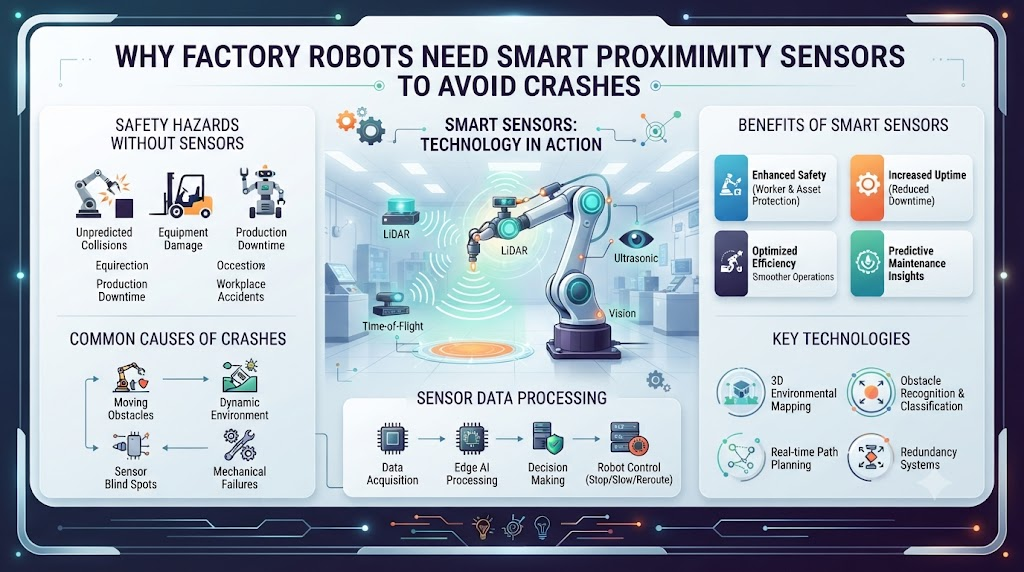
When you walk down a busy assembly line, you see heavy machines moving parts at high speeds. These robots do not have eyes like you and me. They rely on special electronic detectors called proximity sensors to see their surroundings. Without these sensors, a machine would smash into walls or drop heavy loads. If you want to keep your factory floor running smoothly, setting up these tools correctly is essential. Many plant operators use resources like RobotsOps.com to learn the best ways to install and test these systems. In this guide, we will explore how proximity sensors protect equipment, why they matter for daily operations, and how you can add them to your own machines. Let’s dive right in.
What Makes Proximity Sensors So Important for Automation?
Industrial robots perform heavy tasks all day long. They lift steel plates, weld car parts, and pack boxes into shipping crates.
These repetitive tasks require absolute precision. If a stray tool or a human worker steps into the robot path, disaster strikes.
Proximity sensors act as an invisible shield. They spot trouble before physical contact happens. This keeps your expensive machinery safe from sudden crashes and costly downtime.
Understanding How Invisible Detection Fields Work
Proximity sensors do not need to touch an object to know it is there. Instead, they project an invisible field out into the workspace.
This field can consist of magnetic waves, light beams, or high-frequency sounds. When an obstacle enters the zone, the field gets disturbed.
The sensor instantly notices this shift. It sends a quick electrical pulse to the robot brain, telling the machine to brake or stop.
Inductive Sensors for Heavy Metal Environments
Factories dealing with raw steel use inductive sensors. These devices create a strong magnetic field around their sensing tips.
When iron or steel parts get close, the magnetic currents change. The sensor picks up this change right away.
These units work well because dirt, oil, and metal shavings do not block magnetic fields. Your machines keep running even in messy work zones.
Capacitive Sensors for Plastics and Liquids
Not all factory items are made of metal. Many lines handle plastic trays, glass jars, and liquid containers.
For these materials, engineers use capacitive sensors. These tools measure changes in electrical charge around the sensor tip.
When a plastic box or a wave of liquid gets close, the charge shifts. The sensor registers the change and alerts the robot controller instantly.
Ultrasonic Sensors for Open Space Tracking
Sometimes your robot needs to check empty space ahead of its moving wheels. Ultrasonic sensors use sound waves to measure open distances.
The device sends out a high-pitched sound pulse. This pulse travels through the air until it bounces off a solid object.
The sensor measures the travel time. Since sound moves at a fixed speed, the robot calculates the exact distance to the obstacle.
Infrared Beams for Fast Short-Range Triggers
Infrared sensors use invisible light to spot nearby items. They shoot a small light beam forward and wait for the bounce.
These units react in a fraction of a millisecond. They work great for fast-moving sorting belts where speed is everything.
However, you must keep them away from direct sunlight. Bright outdoor light can confuse the receiver lens and cause false stops.
Lidar Systems for Full 3D Room Mapping
Modern autonomous mobile robots need to map entire rooms. They use lidar technology to scan their surroundings continuously.
A spinning laser turret shoots light rays in a complete circle. It measures every wall, desk, and pillar in the room.
The robot builds a live digital map in its memory. This map helps the machine drive smoothly around unexpected clutter without getting stuck.
Comparing Proximity Sensor Technologies
| Sensor Technology | Best Factory Application | Main Operational Benefit | Primary Limitation |
| Inductive Sensors | Steel stamping and welding lines | Ignores grease, oil, and metal dust | Only detects metal objects |
| Capacitive Sensors | Plastic packaging and liquid filling | Detects non-metal items easily | Affected by extreme heat shifts |
| Ultrasonic Sensors | Mobile robot navigation and bins | Unaffected by target color or light | Slower in freezing cold air |
| Infrared Sensors | High-speed conveyor sorting belts | Very fast reaction time and low cost | Blinded by bright outdoor sunlight |
| Lidar Units | Autonomous warehouse floor rovers | Creates full 3D maps of rooms | Higher cost and complex setup |
Real-World Operational Scenarios and Case Studies
- The Assembly Line Forklift Mishap: A factory cart missed a stray wooden pallet because its old sensor had a blind spot. The collision cracked the lift frame. Technicians installed wide-angle ultrasonic sensors to cover all side angles.
- The Robotic Welding Arm Incident: A heavy welding arm swung too close to a worker bench. A capacitive safety mat triggered an emergency stop in time. The plant updated all arms with multi-zone proximity sensors.
- The Microchip Sorting Line Jam: Fine dust covered an optical sensor on a sorting robot. The machine failed to miss a broken tray. Technicians switched to sealed inductive sensors to fix the dust problem.
- The Outdoor Delivery Rover Test: An outdoor rover crossed a sunny parking lot, but glare blinded its infrared sensors. It bumped into a post. Engineers added shielded lidar units to handle bright sunlight.
- The Heavy Metal Press Machine: A stamping press nearly crushed a metal sheet that was out of alignment. Inductive sensors spotted the error early. The machine paused its cycle automatically, preventing tool breakage.
- The Precision Welding Cell: Spatter from a welding torch coated a standard sensor lens and broke it. Maintenance replaced it with a ruggedized sensor housing that shrugs off hot metal drops.
- The Hospital Supply Cart: A hospital delivery robot navigated a crowded hallway filled with visitors. Its ultrasonic sensors detected a child running past. The robot smoothly slowed down and let the child pass.
- The Packaging Line Sorting Glitch: Cardboard boxes of varying colors confused a basic optical sensor. Some boxes slipped past undetected. Upgrading to capacitive sensors solved the color-blindness problem instantly.
- The Farm Harvesting Rover: A farm robot drove through tall, wet grass that blocked its low-mounted sensors, causing it to stall. Raising the sensor mounts and adding waterproof covers kept the rover moving.
- The Airport Luggage Carrier Bot: An autonomous luggage carrier encountered heavy rain on the tarmac. Standard electronic connections shorted out. Waterproof proximity sensors kept the navigation system running through the storm.
Common Mistakes and Pitfalls in Robot Sensor Deployment
- Ignoring Environmental Interference: Problem: Dust, water, and heat ruin sensor readings over time. Solution: Choose sealed sensors rated for your specific factory conditions.
- Mounting Sensors Too Close: Problem: The sensor triggers constantly because it is mounted too close to the robot’s own frame. Solution: Leave a safe gap and test the trigger zones before full runs.
- Using the Wrong Sensor Type: Problem: Using an optical sensor in a dark, dusty coal plant where it cannot see. Solution: Match the sensor physics to your exact material and workspace.
- Skipping Regular Calibration: Problem: Sensor sensitivity drifts over months of heavy machine vibration. Solution: Set up a weekly schedule to test and recalibrate sensor response times.
- Overloading the Control Unit: Problem: Connecting too many sensors to a single input port crashes the controller. Solution: Distribute sensor loads across multiple expansion modules.
- Ignoring Wiring Shielding: Problem: Electrical noise from nearby motors causes false sensor triggers. Solution: Use shielded cables and keep sensor wires away from high-power motor lines.
- Setting Thresholds Too High: Problem: The robot stops too early, slowing down production speeds. Solution: Fine-tune the detection distance to match normal operating workflows.
- Neglecting Firmware Updates: Problem: Outdated sensor firmware contains bugs that cause erratic detection spikes. Solution: Check for manufacturer software updates every few months.
- Failing to Test Edge Cases: Problem: Testing the robot only in a clean lab setting instead of the messy floor. Solution: Run tests with unusual obstacles and low lighting before launch.
- Lack of Redundant Safety Layers: Problem: Relying on a single sensor to prevent catastrophic crashes. Solution: Combine proximity sensors with physical bumpers for ultimate safety backup.
Step-by-Step Implementation Roadmap for Robot Proximity Systems
- Assess the Operating Environment: Walk your workspace and note dust, lighting, moisture, and common obstacles that your robot will face.
- Choose the Right Sensor Technology: Pick inductive, capacitive, ultrasonic, or lidar sensors based on the materials your robot needs to detect.
- Map the Robot’s Blind Spots: Draw a top-down diagram of your robot to see where collisions are most likely to happen during turns.
- Design the Mounting Brackets: Fabricate sturdy metal mounts that hold the sensors firmly in place without shaking during heavy movement.
- Wire the Sensors to the Controller: Connect your sensors to the robot’s main controller using shielded cables to block electrical noise.
- Configure the Detection Thresholds: Program the software settings to define exact stopping distances and warning zones around the machine.
- Write the Initial Safety Logic: Code emergency stop routines so the robot halts immediately when a sensor trips its warning flag.
- Run Controlled Test Scenarios: Push test boxes toward the robot at slow speeds to verify that the sensors trigger the brakes properly.
- Calibrate for Real-World Noise: Adjust filter settings to ignore minor floating dust particles while still catching solid objects.
- Deploy and Monitor Performance: Turn the robot loose on the production floor and track sensor reliability over its first month of work.
Frequently Asked Questions
1. What is a robot proximity sensor?
A proximity sensor is an electronic device that detects nearby objects without any physical contact. It sends out a signal and measures how it bounces back.
2. How do inductive proximity sensors work?
Inductive sensors use a magnetic field to detect metal objects. When metal enters the field, it changes the current, and the robot knows something is there.
3. Can infrared sensors work in the dark?
Infrared sensors emit light and look for reflections. They can struggle in very bright sunlight because ambient light interferes with the infrared beam.
4. What is the difference between ultrasonic and lidar sensors?
Ultrasonic sensors use sound waves to measure distance. Lidar sensors use laser light pulses to create high-resolution maps of the environment.
5. Why do robots need multiple proximity sensors?
A single sensor only covers one angle. Robots use arrays of sensors to create a full 360-degree safety zone around their moving parts.
6. How fast do proximity sensors react?
Most industrial proximity sensors react within milliseconds. This fast response time is essential to prevent sudden collisions on fast assembly lines.
7. Do proximity sensors require maintenance?
Yes, sensors can get covered in dust, oil, or debris. Routine cleaning and alignment checks keep them working accurately over long periods.
8. Are proximity sensors expensive to install?
Basic sensors are very affordable. Advanced 3D lidar systems cost more, but they offer much higher precision for complex autonomous robots.
9. How do proximity sensors prevent workplace injuries?
They detect human workers stepping into restricted zones. When triggered, the robot automatically slows down or stops completely to keep workers safe.
10. Can proximity sensors measure exact distances?
Some advanced sensors measure exact distances, while others only trigger when an object crosses a specific threshold line.
Final Recommendation and Next Steps
Installing proximity sensors on your robots protects equipment, prevents costly factory downtime, and keeps human workers safe. Start small by testing one sensor type on a single test machine. Once you see how well it works, expand your setup across your entire robotic fleet. Keep your sensors clean, check your wiring often, and always test your safety stops before starting daily shifts.
