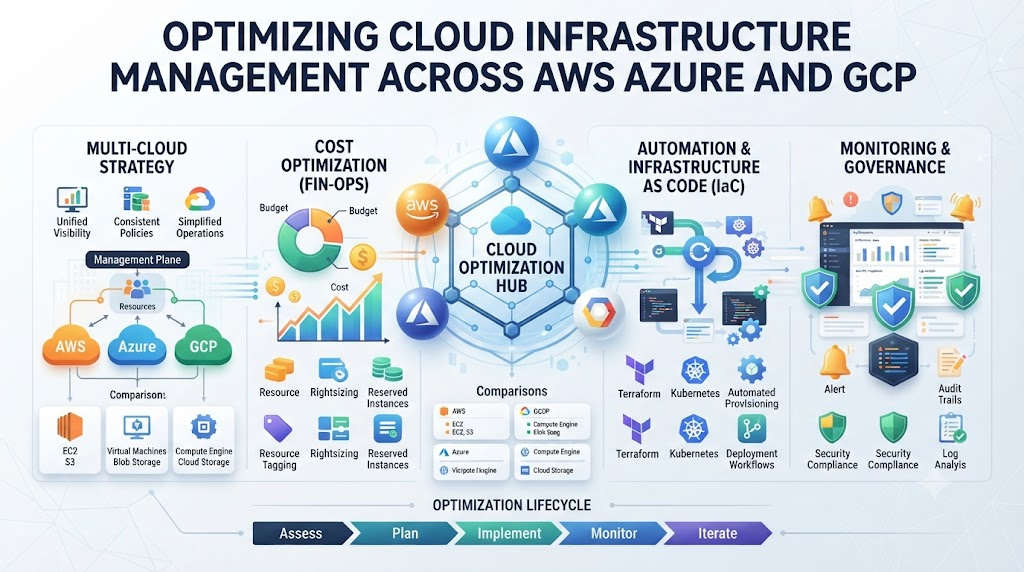
Engineering teams frequently struggle with environment drift, unpredictable deployments, and operational fatigue caused by manual infrastructure changes. As environments expand across distributed architectures, managing resources through ad-hoc scripts or console clicks quickly breaks down. Mastering cloud infrastructure automation provides a structured, repeatable way to provision, configure, and govern environments at scale. Adopting modern engineering practices from cloud operations enables organizations to eliminate configuration bottlenecks, enforce compliance guardrails, and build resilient platforms. This guide covers core architectures, multi-cloud management approaches, observability, security controls, and step-by-step implementation.
What is Cloud Infrastructure Automation?
Cloud infrastructure automation is the practice of using code, automated workflows, and declarative definitions to provision, configure, manage, and retire cloud resources without manual human intervention.
Rather than manually creating compute instances, networks, and storage volumes in web consoles, teams define desired states using structured configuration files. The underlying automation tooling parses these templates and reconciles differences between the declared state and active infrastructure.
Within modern CloudOps, automation serves as the baseline foundation. It connects day-to-day cloud operations management with software engineering workflows. Systems engineers, Site Reliability Engineers (SREs), and platform teams rely on automation to enforce reproducibility, accelerate deployment velocity, minimize operational risk, and establish reliable cloud infrastructure management across distributed environments.
How Does Cloud Infrastructure Automation Work?
Cloud infrastructure automation follows a closed-loop reconciliation cycle:
+-------------------------------------------------------------------+
| 1. Define State (IaC)  -->  2. Version & Test (Git / CI)          |
|                                     |                             |
| 4. Monitor & Drift Detect  <--  3. Reconcile & Provision (APIs)   |
+-------------------------------------------------------------------+
- State Definition: Engineers define compute, networking, security policies, and application dependencies using declarative code templates or domain-specific languages.
- Version Control and Review: Code is committed to a central repository where peer reviews, automated linting, security policy scans, and unit tests execute automatically.
- Execution and API Orchestration: Continuous integration pipelines trigger automation engines (such as Terraform, OpenTofu, or cloud-native resource controllers). These engines authenticate against cloud provider APIs and calculate execution plans.
- State Reconciliation: The engine issues API calls to create, update, or prune resources until live infrastructure matches the declared state file.
- Continuous Verification and Drift Detection: Scheduled background tasks or event-driven controllers compare the live infrastructure against the state baseline, alerting operators or automatically correcting unauthorized manual adjustments.
Core Components of Cloud Infrastructure Automation
Infrastructure as Code (IaC)
IaC forms the foundation of modern automation. Declarative frameworks allow teams to describe end-state topology. The automation engine handles dependency resolution, resource ordering, and destruction logic automatically.
Automated Configuration Management
Once bare compute instances or cluster nodes boot up, configuration management tools install dependencies, inject runtime configurations, apply OS-level security hardening, and register endpoints with service discovery mechanisms.
Policy as Code and Governance
Policy engines evaluate infrastructure configurations against organizational security benchmarks prior to provisioning. This guarantees compliance checks—such as verifying mandatory tagging or blocking public storage buckets—happen before deployment.
Automated Provisioning Pipelines
CI/CD workflows execute linting, dry-runs, plan generations, and automated testing across staging environments before applying changes to production.
Role of AWS, Azure, and GCP
Different cloud service providers implement automation primitives tailored to their platform architectures:
| Platform | Native Declarative Engine | Configuration & Policy | Identity & Access Integration |
| AWS | AWS CloudFormation / CDK | AWS Systems Manager / AWS Config | AWS IAM Roles & OIDC Providers |
| Microsoft Azure | Azure Resource Manager (ARM) / Bicep | Azure Policy / Machine Configuration | Microsoft Entra ID Managed Identities |
| Google Cloud (GCP) | Google Cloud Resource Manager / Config Controller | Google Cloud Policy Intelligence | Workload Identity Federation |
AWS
AWS provides deep integration with API-driven architectures through CloudFormation and the AWS Cloud Development Kit (CDK). Teams frequently combine AWS Systems Manager with EventBridge for automated self-healing workflows across accounts.
Microsoft Azure
Azure leverages Azure Resource Manager (ARM) templates and Bicep to define resources declaratively. Azure Policy enables enterprise-grade multi cloud management governance by blocking non-compliant template deployments at the subscription or management group level.
Google Cloud (GCP)
Google Cloud emphasizes API-first designs and native Kubernetes orchestration. Tools like Google Cloud Config Connector expose cloud resources directly as custom Kubernetes objects, enabling unified GitOps-driven cloud infrastructure automation.
Cloud Operations and Automation Considerations
Modern cloud automation integrates tightly with container orchestration and platform engineering patterns:
- GitOps Workflows: Managing infrastructure state inside Git repositories ensures all configuration adjustments follow strict pull-request reviews, automated validations, and clear audit trails.
- Kubernetes Node & Cluster Automation: Cluster autoscalers and platform operators dynamically adjust underlying compute pools based on live pod demand, enforcing infrastructure scalability.
- Immutable Infrastructure: Rather than patching running production instances, automation pipelines build fresh machine images or container images, deploy new instances, and terminate legacy workloads.
- Drift Mitigation: Scheduled pipeline runs identify manual out-of-band updates, restoring verified configuration states without service interruption.
Monitoring, Observability, and Reliability
Automation systems require rigorous observability to remain dependable:
[ Automation Pipelines ] --> Generates Provisioning Events & Audit Logs
[ Cloud Monitoring ]     --> Tracks API Errors, State Drift, & Quotas
[ SRE Alerts & SLOs ]    --> Triggers Rollbacks / Remediations on Failure
- Pipeline Telemetry: Track pipeline execution duration, success/failure ratios, and API rate-limiting thresholds to avoid pipeline execution stalls.
- Audit Logging: Maintain audit trails using AWS CloudTrail, Azure Activity Log, or GCP Cloud Audit Logs to track what identity executed specific provisioning runs.
- State Drift Metrics: Expose metrics tracking unmanaged infrastructure variations, triggering alerts when manual modifications bypass automation frameworks.
- Health Validation Hooks: Post-provisioning health checks verify application availability before routing live traffic to newly created resources.
Security and Governance
Securing automation workflows requires strict adherence to least-privilege principles:
- Short-Lived Credentials: Avoid static, long-lived API keys. Use OpenID Connect (OIDC) between CI/CD platforms and cloud providers to obtain short-lived tokens dynamically.
- State File Protection: Infrastructure state files frequently contain sensitive resource metadata. Encrypt state files at rest, restrict read access with granular IAM policies, and enforce state-locking to prevent race conditions.
- Pre-Deployment Static Analysis: Run static security scanners during pull-request checks to detect exposed secrets, misconfigured security groups, and open storage endpoints before provisioning.
- Resource Tagging Enforcement: Enforce standardized tagging policies automatically to track cost center allocations, ownership, and environment tiers.
Best Practices for Cloud Infrastructure Automation
- Adopt Declarative State Definitions: Use declarative definitions over imperative scripts to allow the tooling to handle dependencies, state reconciliation, and error handling.
- Modularize Code Repositories: Separate infrastructure into small, decoupled modules (networking, compute, data storage) to limit the blast radius of changes.
- Automate Drift Detection: Run non-destructive plan checks on automated schedules to surface discrepancies between real-world infrastructure and source repositories.
- Implement Robust State Locking: Utilize centralized state backends with automatic locking mechanisms to prevent concurrent pipeline runs from corrupting state data.
- Enforce Policy as Code in CI/CD: Prevent misconfigurations by gating pipeline promotions through automated policy engines before infrastructure changes execute.
- Use Immutable Deployments: Replace compute instances and containers on configuration updates instead of modifying live instances in place.
- Maintain Environment Parity: Structure infrastructure code so development, staging, and production environments share identical module architectures, parameterized only by capacity and scaling limits.
- Document Dependencies Systematically: Explicitly declare module inputs, outputs, and provider versions to prevent breaking changes during upstream updates.
Common Mistakes to Avoid
- Manual Console Adjustments: Applying hotfixes directly inside cloud consoles creates untracked drift that breaks future pipeline runs.
- Monolithic State Files: Managing an entire enterprise estate in a single state file increases plan execution times and dramatically elevates blast radius risks.
- Hardcoded Secrets: Storing database passwords, private keys, or API tokens inside configuration files risks exposure. Always leverage managed secret stores.
- Inadequate State File Backups: Failing to enable versioning and object locking on state file storage buckets leaves platforms vulnerable to catastrophic state corruption.
- Ignoring Provider API Rate Limits: Launching massive parallel provisioning jobs without exponential backoff logic can trigger cloud API throttling and failed deployments.
- Skipping Post-Deployment Validation: Assuming provisioning succeeded without executing automated smoke tests can lead to silent production outages.
Real-World Use Cases
- Ephemeral Staging Environments: Development teams automatically spin up complete, isolated staging environments on pull-request creation and destroy them upon merge to optimize costs.
- Disaster Recovery and Failover: Organizations replicate entire multi-region network and compute architectures within minutes by applying parameterized infrastructure templates during regional outages.
- Multi-Account Platform Vending: Central platform teams provision standardized, compliant cloud accounts for new internal teams automatically with baseline networking and security controls pre-configured.
- Automated Compute Auto-Scaling: Combining infrastructure automation templates with telemetry metrics enables dynamic horizontal node additions during traffic spikes.
Challenges and Limitations
- Initial Complexity and Learning Curve: Transitioning engineering teams to code-driven infrastructure patterns requires training in software engineering best practices, version control, and testing frameworks.
- State Synchronization Overhead: Highly dynamic environments with rapid resource turnover can lead to state lock contention and frequent drift troubleshooting.
- Toolchain Fragmentation: Managing combinations of provisioning tools, configuration managers, policy engines, and CI/CD platforms introduces integration maintenance overhead.
- Cost of Misconfigurations: A logic error within an automated deployment script can instantly deploy thousands of unauthorized instances or terminate critical resources across environments.
Step-by-Step Implementation Guide
Step 1: Audit Infrastructure  -->  Step 2: Modular Architecture
Step 3: Establish Pipelines   -->  Step 4: Add Policy Checks
Step 5: Rollout & Drift Sync
- Audit Existing Assets: Inventory all active cloud workloads, network topologies, and access controls to establish a clean migration baseline.
- Design a Modular Architecture: Separate infrastructure into distinct layers (foundational networking, shared data stores, compute clusters, application services).
- Establish Version Control Repositories: Set up structured Git repositories with branch protection rules, mandatory code reviews, and automated linting checks.
- Configure Automated CI/CD Pipelines: Implement deployment pipelines using OIDC authentication, plan dry-runs, and manual promotion gates for production environments.
- Integrate Security and Policy Gates: Add static code scanners and policy engines to evaluate compliance before plans execute against cloud APIs.
- Import Existing Resources: Gradually import active infrastructure into state files rather than attempting a high-risk mass migration.
- Enable Continuous Drift Detection: Schedule daily automated plan validations to detect and remediate unmanaged configuration drift across all cloud accounts.
Future Trends in Infrastructure Automation
- AI-Assisted Operations and AIOps: Machine learning algorithms will increasingly parse infrastructure logs and execution graphs to recommend architecture optimizations and generate self-healing remediation routines.
- Unified Platform Engineering Portals: Internal developer platforms (IDPs) will abstract underlying IaC templates into self-service catalogs, enabling product teams to provision compliant infrastructure safely.
- Cross-Cloud Control Planes: Tools adopting universal resource models will allow teams to manage multi-cloud platforms using standardized declarative interfaces.
- Fine-Grained Policy as Code: Shift-left security tools will become dynamic runtime guardrails that continuously evaluate live states against organizational compliance baselines.
Frequently Asked Questions
1. What is the primary purpose of cloud infrastructure automation?
The primary purpose is to eliminate manual provisioning, prevent configuration drift, enforce security baselines, and deliver reliable, repeatable cloud environments through software-driven workflows.
2. How does cloud infrastructure automation differ from traditional scripting?
Traditional scripting relies on imperative, sequential steps that lack state awareness, whereas modern automation uses declarative definitions that maintain a central record of the desired infrastructure state and resolve dependencies automatically.
3. What role does cloud infrastructure automation play in multi-cloud operations?
It provides a unified operational framework, allowing platform teams to define consistent provisioning workflows, security policies, and governance guardrails across AWS, Azure, and GCP from single source-controlled repositories.
4. What is configuration drift and how does automation resolve it?
Configuration drift occurs when live cloud environments diverge from their original templates due to manual modifications. Automation engines detect these variations through scheduled state comparisons and reconcile them back to the approved code baseline.
5. How do teams secure state files in automation tools?
Teams secure state files by enabling server-side encryption at rest, enforcing strict IAM role access, maintaining version history on storage buckets, and using native state locking to prevent concurrent overwrite corruption.
6. Can small engineering teams benefit from infrastructure automation?
Yes. Small teams benefit significantly because automated provisioning eliminates repetitive administrative tasks, reduces production deployment errors, and enables rapid creation of identical staging environments without extra operational overhead.
7. How does Policy as Code integrate with infrastructure automation?
Policy as Code tools intercept infrastructure plans within CI/CD pipelines, evaluating configurations against security rules to block non-compliant resources—such as unencrypted disks or unrestricted firewall rules—before deployment.
8. What is the difference between mutable and immutable infrastructure?
Mutable infrastructure involves updating and patching running servers in place, which can cause configuration drift over time. Immutable infrastructure replaces existing instances with newly built, pre-configured instances whenever changes occur.
9. What metrics should teams monitor in automation pipelines?
Teams should track pipeline run durations, plan-to-apply failure rates, API rate-limiting errors, state lock wait times, and the frequency of detected out-of-band configuration drift.
10. How does cloud infrastructure automation improve disaster recovery?
It allows organizations to store their complete infrastructure topology as code, enabling automated, repeatable re-creation of entire networking, compute, and security environments in alternate cloud regions within minutes.
Conclusion
Managing modern cloud environments manually introduces unacceptable operational risks, configuration drift, and deployment bottlenecks. Implementing structured cloud infrastructure automation allows engineering teams to treat infrastructure with the same rigor, quality assurance, and review standards as application software. By combining declarative code definitions, automated CI/CD pipelines, robust observability, and proactive Policy as Code governance, organizations can build scalable, resilient platforms across any cloud environment. Adopting these CloudOps best practices empowers teams to deliver features faster while maintaining rigorous security, reliability, and operational control.
