Introduction
DevOps is now closely connected with many areas of modern software engineering. Development teams work with automated pipelines, cloud infrastructure, containers, Infrastructure as Code, monitoring systems, security controls, and production environments. As organizations adopt these technologies, the need for practical technical knowledge grows alongside the technology itself. One of the biggest challenges is that purchasing or adopting a technology does not automatically create expertise. A team may have a Kubernetes cluster but struggle with troubleshooting. It may have a CI/CD pipeline but lack a clear release strategy. It may use cloud services without having a consistent approach to infrastructure automation or monitoring. This is where structured DevOps learning can make a difference. Good training should help learners understand not only how a tool works, but also why it is used, where it belongs in an engineering workflow, and what can go wrong. For individuals and organizations, selecting the right DevOps Trainer therefore requires more than checking a technology list. The trainer, learning format, practical exercises, curriculum, and alignment with real engineering requirements all deserve consideration.
Understanding the Work of a DevOps Trainer
A DevOps Trainer helps learners develop an understanding of the practices that connect application development, infrastructure, automation, and operations.
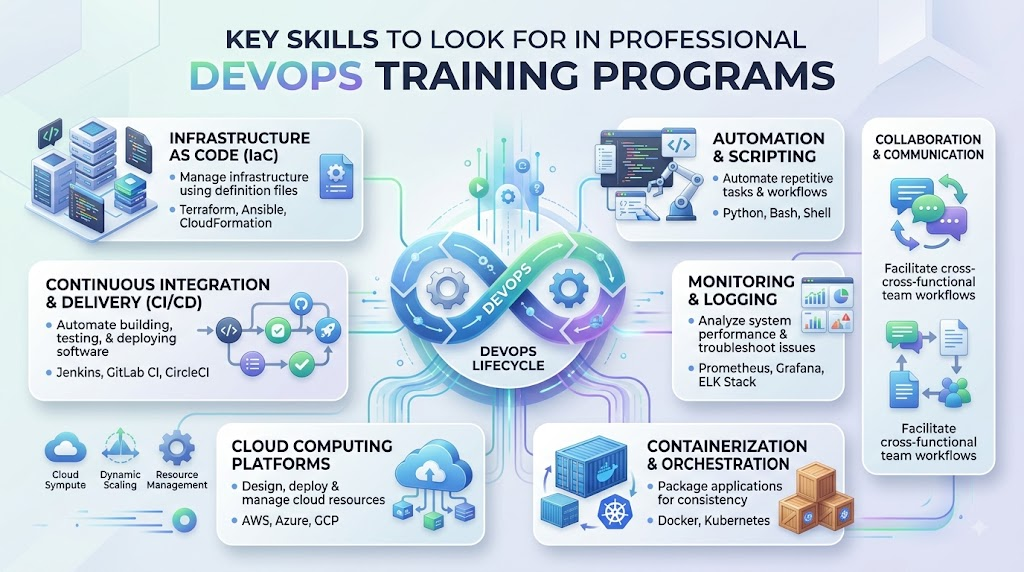
The subject can range from basic DevOps principles to advanced technical workflows. Depending on the audience, training may include source control, continuous integration, continuous delivery, cloud infrastructure, containers, Infrastructure as Code, configuration management, monitoring, logging, and automation.
A strong training session should connect these subjects instead of teaching them as unrelated topics. For instance, learners can follow an application from source code through automated testing, container creation, infrastructure provisioning, deployment, and monitoring.
Hands-on exercises are especially important. A learner who creates a pipeline and then investigates why a deployment failed develops a different level of understanding from someone who only watches a successful demonstration.
The trainer also needs to adapt explanations to the audience. Developers, system administrators, cloud engineers, platform teams, and managers may all approach DevOps from different perspectives. Effective instruction takes those differences into account.
Why Structured DevOps Learning Is Important
Engineering teams are constantly adapting to new platforms and practices. Cloud adoption, containerization, automation, security requirements, and distributed applications can introduce new responsibilities for employees who previously worked in more specialized roles.
A developer may need to understand deployment automation. An administrator may need to work with Infrastructure as Code. A security engineer may need to integrate security checks into CI/CD. An engineering manager may need enough technical understanding to evaluate automation and reliability initiatives.
Without structured learning, employees may develop these skills entirely through trial and error. Real-world experience is valuable, but learning only through production problems can be expensive and risky.
Structured training can provide a controlled environment where learners can experiment, make mistakes, and understand the consequences without affecting production systems.
Training also creates a common foundation. When different teams understand concepts such as CI/CD, observability, infrastructure automation, and deployment strategies, technical discussions can become easier.
However, training should complement—not replace—real engineering experience. Production systems contain business constraints, legacy components, traffic patterns, compliance requirements, and organizational processes that classroom exercises cannot fully reproduce.
Corporate DevOps Training and Team-Specific Learning
Corporate DevOps Training is most effective when it reflects the actual needs of an organization. A standard course may provide useful fundamentals, but companies often need a more focused approach.
Consider two engineering teams. One may be preparing to migrate applications to Kubernetes, while another may already operate Kubernetes but wants to improve monitoring and deployment reliability. Giving both teams exactly the same curriculum may not provide equal value.
Corporate programs can be adjusted according to:
- Existing technology platforms
- Employee experience
- Business objectives
- Team responsibilities
- Current engineering challenges
- Cloud environment
- Security requirements
- Desired technical outcomes
A customized program can include workshops, demonstrations, practical labs, assessments, troubleshooting scenarios, and knowledge-sharing sessions.
Team composition should also influence the training design. Developers may require more attention to pipelines and application deployment, while infrastructure engineers may need deeper coverage of cloud architecture, Terraform, networking, or cluster administration.
The purpose of customization is not to teach every available technology. It is to focus learning time on the skills that are most relevant to the organization’s environment.
Online DevOps Training: Opportunities and Challenges
Remote technical education has become an important option for distributed teams. An Online DevOps Trainer can deliver live sessions to participants working from different locations while using virtual classrooms, screen sharing, remote environments, and interactive demonstrations.
Online training can be convenient because employees do not need to travel to a common classroom. It can also support teams spread across cities, regions, or countries.
A well-designed online program can include:
- Live instructor sessions
- Screen-sharing demonstrations
- Remote laboratory environments
- Interactive discussions
- Troubleshooting exercises
- Practical assignments
- Digital documentation
- Recorded sessions where appropriate
However, online learning also introduces challenges. Participants may have different local environments, connectivity issues, or varying levels of technical familiarity. Passive lectures can also make it difficult for learners to remain engaged.
For this reason, online training should provide frequent opportunities for participants to perform tasks themselves. Learners should be able to ask questions, test configurations, investigate failures, and receive feedback.
Online delivery is not automatically better or worse than classroom training. Its effectiveness depends largely on course design, learner participation, technical support, and the quality of practical work.
Choosing a DevOps Trainer in India
Selecting a DevOps Trainer in India should involve an objective evaluation rather than relying on a long list of technologies or attractive course descriptions.
Technical expertise is important, but teaching ability is equally significant. An experienced engineer may understand complex production environments but may not always be able to explain those concepts clearly to learners with different backgrounds.
When evaluating a trainer, organizations can consider several factors.
Practical Engineering Experience
Look for experience with technologies and practices relevant to the intended learning objectives. These may include CI/CD, cloud infrastructure, containers, Infrastructure as Code, automation, observability, and production troubleshooting.
Teaching Approach
Find out whether the training relies mainly on presentations or includes demonstrations, exercises, labs, and troubleshooting.
Curriculum Relevance
The curriculum should match the organization’s technology environment and the learner’s experience level.
Communication
Technical subjects can become difficult when explanations are unnecessarily complicated. A trainer should be able to simplify concepts without losing technical accuracy.
Lab Quality
Hands-on environments should allow learners to perform meaningful tasks instead of merely following a sequence of commands.
Adaptability
Technology teams have different requirements. A good trainer should be able to adjust examples and depth according to the audience.
Technical knowledge alone does not necessarily make someone a strong trainer. The ability to explain, demonstrate, guide, and respond to questions is equally important.
What a Kubernetes Trainer Should Teach
Kubernetes has become an important part of many cloud-native environments, but effective Kubernetes learning requires more than memorizing commands.
A Kubernetes Trainer should introduce the architecture and then gradually move toward application deployment and operations.
Important topics can include:
- Kubernetes architecture
- Pods
- Deployments
- Services
- ConfigMaps
- Secrets
- Networking
- Storage
- Scaling
- Helm
- Monitoring
- Security
- Cluster administration
- Troubleshooting
- Production operations
Practical exercises can make these subjects easier to understand. Learners might deploy an application, expose it through a Service, update the Deployment, investigate a failed rollout, inspect logs, and troubleshoot configuration problems.
Training can also introduce managed Kubernetes services such as AWS EKS, Azure AKS, and Google GKE. These platforms provide useful examples of how Kubernetes can operate within different cloud environments.
The objective should be to develop operational understanding. Learners should know how to reason about a Kubernetes problem rather than simply search for the correct command.
AWS DevOps Training and Cloud Delivery
An AWS DevOps Trainer can help learners understand how AWS services participate in software delivery and infrastructure management.
Depending on the objectives, training may include:
- EC2
- EKS
- ECS
- Lambda
- Terraform
- CloudFormation
- CI/CD pipelines
- Monitoring
- Infrastructure automation
The important part is connecting these services to engineering workflows.
For example, a training exercise can show how an application moves from source control through testing and deployment. Another exercise can demonstrate how Infrastructure as Code creates repeatable environments.
Learners should also understand operational considerations such as permissions, monitoring, deployment strategies, environment separation, and failure recovery.
AWS provides many services that can solve similar categories of problems in different ways. Therefore, training should encourage evaluation and decision-making rather than suggesting that one service is suitable for every situation.
Azure DevOps Trainer and Modern Delivery Practices
An Azure DevOps Trainer can help teams understand application delivery and automation within Microsoft Azure environments.
Potential learning areas include:
- Azure Pipelines
- AKS
- Azure infrastructure
- Infrastructure as Code
- CI/CD
- Release automation
- Monitoring
- Deployment workflows
- Production operations
A practical Azure exercise might begin with source code and progress through automated validation, artifact creation, infrastructure preparation, deployment, and monitoring.
Training should also discuss operational concerns such as environment management, permissions, rollback planning, release controls, and troubleshooting.
This approach helps learners see Azure services as part of a complete delivery process rather than as independent features.
DevSecOps Training and Security Integration
Security is increasingly becoming part of everyday development and delivery. Instead of waiting until an application is ready for production, organizations can introduce security practices earlier in the lifecycle.
A DevSecOps Trainer can explain how security activities fit into development workflows and CI/CD pipelines.
Relevant topics may include:
- Secure CI/CD
- SAST
- DAST
- Dependency scanning
- Container security
- Secrets management
- Vulnerability management
- Security automation
- Compliance automation
Practical exercises can demonstrate how a security scan works, what happens when a vulnerability is identified, and how teams decide whether remediation is required.
Security tools are not a replacement for human judgment. Findings need to be reviewed, prioritized, investigated, and addressed according to the organization’s risk and compliance requirements.
The goal of DevSecOps training is therefore to help teams build security awareness into normal engineering practices.
SRE Training and Reliable Systems
Site Reliability Engineering focuses on applying engineering principles to the challenge of operating reliable services.
An SRE Trainer may introduce:
- SLI
- SLO
- SLA
- Error budgets
- Observability
- Incident management
- Root-cause analysis
- Capacity planning
- Performance engineering
- Reliability automation
A useful SRE learning program should connect these concepts to operational situations.
For example, learners can examine service metrics and determine whether an application is meeting its reliability objectives. Incident exercises can then help them practice detection, investigation, mitigation, communication, and post-incident analysis.
Observability should also be explained in practical terms. Metrics, logs, and traces should help teams understand system behavior and investigate issues rather than simply generate large amounts of data.
SRE training encourages teams to view reliability as an engineering concern that influences design, development, deployment, and operations.
MLOps Trainer and Production Machine Learning
As organizations operate more machine-learning workloads, they also face the challenge of managing models throughout their operational lifecycle.
An MLOps Trainer can introduce practices for building repeatable processes around machine-learning systems.
Topics may include:
- ML pipelines
- Model deployment
- Model monitoring
- Version management
- Automation
- ML infrastructure
- Cloud environments
- Production operations
- Scalability
MLOps combines software engineering and operational principles with the specific requirements of machine-learning systems.
A training program should explain that production ML involves more than deploying a model. Teams also need processes for versioning, monitoring, infrastructure management, reproducibility, and controlled updates.
The exact tooling depends on the organization’s architecture and machine-learning requirements.
DevOps Training Technology Areas
| Training Area | Common Technologies / Practices | Learning Focus |
|---|---|---|
| CI/CD | Jenkins, GitHub Actions, GitLab CI/CD, Azure Pipelines | Automated delivery |
| Cloud | AWS, Azure, Google Cloud | Cloud operations |
| Containers | Docker, Kubernetes | Containerized workloads |
| Infrastructure as Code | Terraform, CloudFormation | Automated infrastructure |
| Security | SAST, DAST, secrets management | Secure delivery |
| Monitoring | Metrics, logs, traces | Observability |
| SRE | SLI, SLO, error budgets | Reliability |
| MLOps | ML pipelines, model monitoring | Production ML |
This table represents common learning areas, not a mandatory technology list. Organizations should select technologies based on their architecture, existing tools, and learning objectives.
Why Hands-On Learning Matters
Practical exercises provide an opportunity to turn technical concepts into working knowledge. Reading about CI/CD is useful, but creating a pipeline and diagnosing a failed pipeline provides a different type of understanding.
Hands-on training can help learners develop:
- Better understanding of DevOps workflows
- Stronger automation skills
- Greater cloud familiarity
- Improved CI/CD knowledge
- Better troubleshooting habits
- Stronger Infrastructure as Code practices
- Increased security awareness
- Better understanding of reliability
- More confidence with technical tools
Failure scenarios are particularly useful. A training environment where learners can safely break and repair a system can demonstrate how real operational problems are investigated.
The purpose is not to recreate an entire production environment. It is to give learners enough practical exposure to understand how systems behave and how engineers respond when something does not work.
Common Mistakes in DevOps Training
1. Teaching Theory Without Practice
Concepts become difficult to apply when learners do not get opportunities to perform technical tasks.
2. Covering Too Many Technologies
A long tool list can create shallow knowledge and confusion.
3. Ignoring Learner Experience
A beginner and an experienced platform engineer should not necessarily receive identical explanations or exercises.
4. Using Old Examples
Training should reflect relevant engineering practices and modern deployment environments.
5. Neglecting Troubleshooting
Successful demonstrations do not show learners how to respond when systems fail.
6. Separating Security From Delivery
Security is more effective when it is connected to normal development and deployment workflows.
7. Ignoring Cloud Context
Cloud concepts should be included when the organization’s environment depends heavily on cloud infrastructure.
8. Failing to Explain Why
Learners should understand the reason behind a technology or practice, not just the steps required to configure it.
9. Overloading Sessions
Trying to cover too much material can reduce understanding and retention.
10. Ending Learning Too Early
DevOps requires continuous practice. Projects, internal workshops, documentation, and ongoing experimentation can reinforce formal training.
Evaluating a DevOps Training Program
Organizations can evaluate a program using a combination of technical and educational criteria.
Start with the trainer. Review relevant experience, teaching style, communication, and ability to explain complex subjects.
Next, examine the curriculum. It should cover the technologies and practices that matter to the team rather than simply maximizing the number of topics.
Practical learning deserves special attention. Organizations should determine whether participants will build pipelines, configure infrastructure, deploy applications, work with containers, inspect monitoring data, and troubleshoot failures.
Other useful evaluation criteria include:
- Technical depth
- Course organization
- Lab quality
- Documentation
- Assessments
- Troubleshooting exercises
- Cloud coverage
- Kubernetes coverage
- CI/CD coverage
- Security coverage
- SRE concepts
- MLOps awareness
- Learning resources
- Post-training support
For corporate programs, it is also useful to consider how the knowledge will transfer into everyday engineering work.
Training Area and Learning Need
| Training Area | Typical Learning Need |
| DevOps Training | Understand automation and delivery practices |
| Corporate DevOps Training | Build team-wide DevOps capabilities |
| Online DevOps Training | Learn remotely with flexible access |
| Kubernetes Training | Manage container orchestration environments |
| AWS DevOps Training | Learn AWS-based DevOps workflows |
| Azure DevOps Training | Understand Azure delivery and automation |
| DevSecOps Training | Integrate security into software delivery |
| SRE Training | Learn reliability engineering practices |
| MLOps Training | Operate machine-learning systems in production |
FAQ
What does a DevOps Trainer teach?
A DevOps Trainer can cover CI/CD, cloud, automation, containers, Infrastructure as Code, monitoring, troubleshooting, and production practices. The exact curriculum should be adjusted according to the learner’s goals.
What makes Corporate DevOps Training different?
Corporate training is designed around team requirements, existing technology, employee skill levels, business priorities, and organizational workflows rather than following only a generic individual-learning syllabus.
How should I evaluate a DevOps Trainer in India?
Look at technical experience, teaching ability, curriculum relevance, practical labs, communication skills, and knowledge of the technologies used by your organization or team.
Is online DevOps training useful for corporate teams?
It can be effective for distributed teams when it combines live instruction, interaction, demonstrations, remote labs, and practical troubleshooting. The learning design is more important than the delivery format alone.
What should Kubernetes training teach?
A practical program should cover architecture, Pods, Deployments, Services, networking, storage, security, Helm, scaling, monitoring, administration, and troubleshooting.
What can an AWS DevOps Trainer cover?
AWS-focused training may include EC2, EKS, ECS, Lambda, CI/CD, Terraform, CloudFormation, monitoring, and infrastructure automation, depending on the team’s requirements.
Why should DevOps teams learn DevSecOps?
DevSecOps helps teams understand how security activities such as code scanning, dependency checks, container security, secrets management, and vulnerability handling can become part of the delivery lifecycle.
How are DevOps, SRE, and MLOps different?
DevOps generally emphasizes software delivery, automation, and collaboration. SRE focuses on reliability and operational engineering. MLOps concentrates on operating machine-learning systems and managing their deployment and lifecycle.
Conclusion
Modern DevOps learning should focus on practical engineering capability rather than simply increasing the number of technologies a learner has encountered. CI/CD, cloud, Kubernetes, Infrastructure as Code, security, observability, SRE, and MLOps each address different aspects of modern technology operations. The right training program depends on several factors. Learners’ existing knowledge, the organization’s technology stack, team maturity, business priorities, and desired outcomes should all influence the curriculum. For corporate teams, customized workshops and practical exercises can be more useful than attempting to follow a generic syllabus. Individual learners can similarly benefit from programs that allow them to experiment, troubleshoot, and connect concepts with real engineering workflows.
