Introduction
Facing a legal dispute in India often feels like entering an unfamiliar maze. Whether you are an individual confronting a property disagreement, a family dealing with matrimonial friction, an entrepreneur launching a corporate enterprise, or a victim of online financial fraud, the complexity of statutory procedures can be daunting. The first critical step toward protecting your rights is understanding how the legal framework functions and knowing how to access qualified professional support. Without proper guidance, minor disputes often escalate into prolonged, costly litigation. Engaging an experienced advocate early helps clarify your options, preserve critical evidence, and streamline resolution efforts. Platforms such as WakilSahab serve as dedicated legal discovery networks, connecting citizens, families, and business owners across India with verified advocates and practical legal resources tailored to their specific needs.
The Citizen’s Perspective: Understanding the Indian Court Structure
To effectively resolve any dispute, citizens must first understand where their case sits within India’s legal structure. The judiciary is organized systematically from local trial courts up to the highest constitutional authority.
                  ┌───────────────────────────────┐
                  │    Supreme Court of India     │
                  └──────────────┬────────────────┘
                                 │
                  ┌──────────────┴────────────────┐
                  │      State High Courts        │
                  └──────────────┬────────────────┘
                                 │
       ┌─────────────────────────┴────────────────────────┐
       │                                                  │
┌──────┴────────────────────────┐       ┌─────────────────┴─────────────┐
│ Subordinate & District Courts │       │     Specialized Tribunals     │
│  (Civil, Criminal, Sessions)  │       │ (NCLT, RERA, Consumer Courts) │
└───────────────────────────────┘       └───────────────────────────────┘
Disputes are broadly divided into civil matters (concerning personal rights, property, or contracts) and criminal matters (involving statutory offenses investigated by law enforcement). Recognizing this distinction ensures that you seek out an advocate with the exact courtroom exposure required for your situation.
Key Divisions of Practice
- Civil Matters: Focus on enforcing private rights, property recovery, partition suits, breach of contract claims, and monetary compensation.
- Criminal Matters: Cover defense and prosecution regarding statutory offenses under statutory codes, bail petitions, and police investigations.
- Family Matters: Address personal status, guardianship, mutual or contested divorce, alimony, and child custody.
- Commercial & Corporate Matters: Address statutory compliance under the Companies Act, contract drafting, employment agreements, and intellectual property protection.
- Digital & Cyber Matters: Focus on internet fraud, unauthorized access, identity theft, and privacy complaints under IT laws.
Why Early Legal Consultation Prevents Protracted Litigation
Many individuals wait until a crisis occurs before consulting a legal expert. However, securing advice during the early stages of a dispute frequently prevents formal litigation altogether.
┌─────────────────────────────────────────────────────────────────┐
│               BENEFITS OF EARLY LEGAL INTERVENTION              │
├─────────────────────────┬───────────────────────────────────────┤
│ Risk Assessment         │ Identifies legal weaknesses early     │
├─────────────────────────┼───────────────────────────────────────┤
│ Dispute Settlement      │ Facilitates pre-litigation mediation  │
├─────────────────────────┼───────────────────────────────────────┤
│ Evidence Preservation   │ Secures necessary paper trails        │
└─────────────────────────┴───────────────────────────────────────┘
A qualified advocate evaluates the facts, issues formal legal notices, and explores pre-litigation settlement options. This proactive approach saves substantial time and financial resources while shielding litigants from procedural pitfalls.
Understanding Advocate Specializations
Not every legal professional covers all areas of law. Advocates build focused practices to provide specialized advocacy before specific courts and tribunals.
┌─────────────────────────────────────────────────────────────────┐
│                    SPECIALIZED LEGAL PRACTICE                   │
├──────────────┬──────────────┬──────────────┬────────────────────┤
│   Criminal   │ Family Law   │ Real Estate  │ Corporate & Cyber  │
│   Defenders  │ Specialists  │  Advocates   │    Consultants     │
│(Bail, Trials)│(Custody, Div)│(Titles, RERA)│(Contracts, IT Law) │
└──────────────┴──────────────┴──────────────┴────────────────────┘
1. Criminal Defense Advocates
These specialists handle proceedings involving law enforcement inquiries, FIR filings, bail applications (anticipatory and regular), and trial defense before Magistrate and Sessions Courts under provisions like the Bharatiya Nyaya Sanhita (BNS).
2. Family & Matrimonial Advocates
Focusing on domestic relations, these lawyers manage mutual consent or contested divorce petitions, maintenance claims, child custody arrangements, and domestic violence protection cases, prioritizing mediation whenever possible.
3. Property & Real Estate Lawyers
Property lawyers conduct detailed title searches, draft purchase agreements, represent clients in land partition suits, and manage disputes before Revenue Courts or RERA authorities.
4. Cybercrime Advocates
Specialists in digital law assist victims of online banking fraud, identity theft, unauthorized data access, and cyber harassment, guiding them through filing police complaints and securing statutory remedies.
5. Corporate & Commercial Consultants
Corporate attorneys assist startups and established enterprises with business formation, shareholder agreements, regulatory filings with the Ministry of Corporate Affairs (MCA), employment contracts, and trademark protection.
Comparative Frameworks for Litigants
Table 1: In-Person vs. Virtual Legal Consultation
| Factor | In-Person Lawyer Consultation | Online Legal Consultation | Best Application |
| Convenience | Requires traveling to advocate offices or court complexes | Accessible from anywhere via secure digital calls | Online ideal for preliminary guidance; in-person for trial prep |
| Document Handling | Review of original physical records during meetings | Digital submission of scanned PDF files beforehand | Online requires structured digital document organization |
| Cost Efficiency | May involve travel expenses and higher consultation fees | Generally cost-effective for initial opinion gathering | Online saves time and money for early-stage evaluations |
| Jurisdictional Reach | Typically limited to advocates in your immediate city | Connects you with specialists across different states | Online is ideal for multi-city or NRI legal requirements |
Table 2: Practice Area Overview and Relevant Forums
| Legal Domain | Core Matters Addressed | Governing Legislation | Relevant Judicial Forum |
| Criminal Defense | Bail, FIR quashing, trials, fraud defense | BNS, BNSS, Special Acts | Sessions & Magistrate Courts |
| Matrimonial Law | Divorce, maintenance, child custody | Personal Laws, Special Marriage Act | Family Courts |
| Property Law | Title search, partition, sale deeds | Transfer of Property Act, RERA | Civil Courts & RERA Tribunals |
| Corporate Law | Compliance, agreements, IP, incorporation | Companies Act, Contract Act | NCLT & Commercial Courts |
| Cyber Law | Online fraud, identity theft, data breaches | Information Technology Act | Cyber Adjudicating Officers |
Table 3: Dispute Resolution Stages in India
| Dispute Stage | Key Focus | Essential Documentation | Core Purpose |
| Pre-Litigation | Fact compilation & notice issuance | Legal Notice, Demand Letters | Attempting out-of-court settlement |
| Pleadings Phase | Filing claims and counter-arguments | Plaint, Written Statement | Establishing legal positions on court record |
| Trial & Evidence | Examining witnesses & presenting evidence | Affidavits, Exhibits, Testimony | Proving claims before the presiding judge |
| Decree & Execution | Final court judgment & implementation | Court Order, Execution Petition | Enforcing binding legal outcomes |
Framework for Selecting an Advocate
Choosing the right advocate requires careful evaluation rather than relying purely on informal references.
┌─────────────────────────────────────────────────────────┐
│                 ADVOCATE EVALUATION LOG                 │
├─────────────────────────────────────────────────────────┤
│ [ ] Confirm State Bar Council Registration              │
│ [ ] Evaluate Experience in Relevant Practice Domain     │
│ [ ] Assess Familiarity with Specific Court/Tribunal     │
│ [ ] Obtain Written Explanation of Fee Structures        │
│ [ ] Verify Mode and Frequency of Case Updates           │
└─────────────────────────────────────────────────────────┘
- Confirm Domain Expertise: Match your legal issue directly with an advocate whose primary practice focuses on that specific domain.
- Verify Bar Council Standing: Confirm that the professional is actively enrolled with a State Bar Council under the Advocates Act, 1961.
- Assess Court Familiarity: Verify that the advocate regularly represents clients before the specific court or tribunal handling your matter.
- Demand Transparency on Fees: Clarify whether fees cover initial drafting, per-appearance court visits, or ongoing retainers before finalizing engagement terms.
Maximizing the Value of Online Legal Advice
Digital legal consultations have made professional advice widely accessible across India. To get the maximum value from an online consultation:
┌─────────────────────────────────────────────────────────┐
│             ONLINE CONSULTATION PREPARATION             │
├─────────────────────────┬───────────────────────────────┤
│ Digital Documentation   │ Scan all notices, agreements, │
│                         │ and receipts into PDF format  │
├─────────────────────────┼───────────────────────────────┤
│ Factual Timeline        │ List key dates, events, and   │
│                         │ involved parties sequentially │
├─────────────────────────┼───────────────────────────────┤
│ Specific Questions      │ Write down exact queries on   │
│                         │ risks, costs, and options     │
└─────────────────────────┴───────────────────────────────┘
- Organize Case Records: Compile scanned, high-resolution copies of all relevant agreements, notices, or receipts in chronological order.
- Construct a Factual Timeline: Prepare a brief document summarizing dates, key events, and communications between the parties.
- List Core Questions: Direct your queries toward immediate risks, procedural next steps, likely timelines, and total estimated expenses.
Situations Demanding Immediate Legal Consultation
You should seek professional legal representation immediately in situations such as:
- Receiving an official legal notice, summons, or court appearance directive.
- Executing major real estate transactions that require title verifications and deed registrations.
- Launching a business partnership or startup requiring co-founder agreements and compliance filings.
- Experiencing domestic or matrimonial disputes involving custody or maintenance claims.
- Falling victim to cyber banking fraud or unauthorized digital transactions needing rapid intervention.
- Being named in police complaints or formal investigation notices.
Understanding Fee Arrangements in Legal Practice
Legal fees in India depend on advocate seniority, location, case complexity, and the court involved. Common fee arrangements include:
- Fixed Consultation Charges: A clear fee for an initial time-bound session (in-person or virtual).
- Per-Appearance Fees: Charges applicable for each scheduled hearing before a judge or tribunal.
- Drafting Fees: Set charges for writing legal notices, plaints, written statements, or commercial contracts.
- Retainership Models: Fixed monthly or annual fees for ongoing corporate, contractual, or compliance management.
Note: Litigants should always request a clear written fee schedule before engaging an advocate to avoid unexpected expenses.
Common Mistakes Made by Litigants
- Ignoring Statutory Deadlines: Waiting too long to respond to legal notices or missing court filing windows can cause loss of statutory remedies.
- Failing to Retain Records: Discarding receipts, emails, text messages, or written agreements severely weakens your evidence in court.
- Discussing Sub-Judice Matters Publicly: Posting case details or allegations on social media platforms can compromise court proceedings.
- Selecting Lawyers Solely on Low Cost: Choosing representation based exclusively on price rather than domain specialization often results in inadequate defense.
- Treating Generic Articles as Advice: Relying on general online discussion forums instead of customized professional counsel leads to legal missteps.
Actionable Legal Advice for Litigants
- Maintain an Organized Case Folder: Keep updated physical and scanned digital records of all filings, orders, and receipts.
- Formalize Retainership Terms: Ensure professional fees, scope of work, and billing schedules are documented in writing before proceedings start.
- Stick to Objective Facts: Communicate dates, events, and tangible evidence clearly rather than emotional narratives when briefing your advocate.
- Protect Attorney-Client Confidentiality: Limit case discussions strictly to your appointed advocate and authorized representatives.
- Review Documents Thoroughly: Carefully read all plaints, affidavits, and applications before signing them for court submission.
Best Practices for Managing Legal Representation
          PRE-CONSULTATION                ADVOCATE SELECTION                  CASE MANAGEMENT
┌─────────────────────────────┐   ┌─────────────────────────────┐   ┌─────────────────────────────┐
│ • Gather all evidence       │──>│ • Check Bar enrollment      │──>│ • Maintain an appearance log│
│ • Draft a concise timeline  │   │ • Evaluate specialization   │   │ • Request court order sheets│
│ • Prepare key questions     │   │ • Finalize fee agreements   │   │ • Store digital backups     │
└─────────────────────────────┘   └─────────────────────────────┘   └─────────────────────────────┘
- Prioritize Domain Focus Over Convenience: Choose an advocate specialized in your specific legal issue over a general practitioner located closer to your home.
- Ask About Alternative Dispute Options: Inquire whether mediation, arbitration, or Lok Adalats could resolve the dispute faster than a full trial.
- Track Case Progress: Request copies of court order sheets and filing receipts after every effective hearing to stay informed.
- Seek Second Opinions When Necessary: If facing complex litigation, consult a senior specialist to review the proposed strategy.
The Modern Era of Digital Legal Discovery
The Indian judicial system is rapidly integrating digital technologies through e-Courts portals, virtual hearings, digital cause lists, and online filing systems.
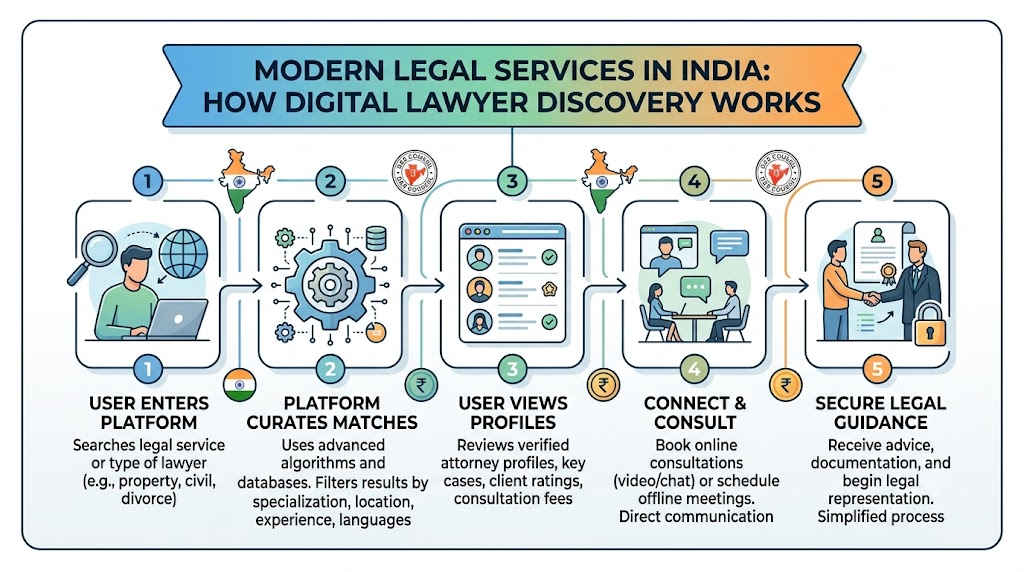
In step with this transition, legal discovery portals like WakilSahab make finding reliable legal representation simpler. Instead of relying on word-of-mouth references, individuals and business owners can browse structured directories, filter advocates by practice domain and court location, and access verified legal guides to navigate their legal journeys confidently.
Why Use WakilSahab for Legal Discovery
WakilSahab provides a structured platform to help citizens and businesses find suitable legal professionals and educational resources across India:
- Comprehensive Search Filters: Search for advocates specializing in criminal defense, family law, property verification, cyber offenses, or corporate compliance.
- Location-Based Discovery: Locate qualified advocates practicing before your local District Court, State High Court, or specialized tribunal.
- Transparent Profiles: Review professional practice focus areas, location details, and core specializations.
- Educational Resources: Access clear legal guides, frameworks, and articles designed to explain legal rights and procedures in simple language.
Frequently Asked Questions (FAQs)
1. How do I find a qualified lawyer near me in India?
To find a qualified lawyer near you, determine the exact practice area required (such as property, family, or criminal law) and use specialized discovery platforms like WakilSahab. Check that the advocate is registered with a State Bar Council, review their court exposure, and schedule an initial consultation.
2. How does online lawyer consultation work?
An online lawyer consultation connects you with an advocate via video or phone call. You submit digital copies of relevant notices, contracts, or records before the session. The lawyer reviews your documents, evaluates legal options, and outlines practical next steps.
3. What is the difference between an advocate and a lawyer in India?
In India, a lawyer is a person holding an LL.B degree. An advocate is a lawyer who has officially enrolled with a State Bar Council under the Advocates Act, 1961, and cleared the All India Bar Examination (AIBE). Only registered advocates hold the right to represent clients in court.
4. When should I consult a criminal lawyer?
You should consult a criminal defense advocate immediately if you receive a police inquiry notice, are named in an FIR, face potential arrest, or need to file a formal complaint. Early legal counsel helps secure anticipatory bail and protects your rights during investigation.
5. What factors should I consider when hiring a divorce lawyer?
When choosing a matrimonial advocate, consider their trial experience in family courts, expertise in mutual consent or contested proceedings, child custody arrangements, and maintenance claims. Look for an advocate skilled in both courtroom advocacy and amicable mediation.
6. When is title verification necessary from a property lawyer?
Title verification is essential prior to purchasing land, residential flats, or commercial spaces. A specialized property advocate inspects records at the Sub-Registrar’s office for 13 to 30 years to verify clear ownership, identify encumbrances, and review land-use permissions before contracts are signed.
7. What does a cybercrime lawyer handle?
A cybercrime lawyer handles cases involving online financial fraud, identity theft, unauthorized data access, hacking, data privacy breaches, and online harassment. They guide victims through filing complaints on reporting portals, coordinating with police, and seeking statutory remedies under the Information Technology Act.
8. How can a corporate lawyer assist small businesses and startups?
A corporate lawyer assists small businesses and startups by drafting founder agreements, commercial contracts, employment policies, trademark registrations, and managing statutory filings with the MCA. Securing legal counsel early helps prevent costly shareholder or contractual disputes.
9. What should I prepare before my first legal consultation?
Before your initial meeting, assemble all relevant physical and digital documents in chronological order. Draft a concise timeline of events, prepare questions regarding fees, risks, and timelines, and define your core objectives so the lawyer can assess your case accurately.
10. How do lawyers in India charge for their services?
Lawyer fees vary depending on experience, specialization, location, and case complexity. Fee structures include fixed consultation charges, per-appearance fees for court hearings, fixed drafting rates for documents, or ongoing retainers for commercial clients. Always request a clear fee schedule beforehand.
11. Can I handle a legal dispute without hiring a lawyer?
While citizens are legally permitted to represent themselves in court as a “petitioner in person,” doing so requires navigating complex evidence rules and statutory procedures. Hiring an experienced advocate ensures proper document drafting, timely filings, and effective representation of your legal rights.
12. Is legal information online the same as legal advice?
No. Legal information found online provides general educational context about laws and court processes. Personalized legal advice is tailored guidance provided by a qualified advocate after analyzing your specific evidence and case facts. General information should never replace professional legal counsel.
13. What should I do if I receive a formal legal notice?
If you receive a formal legal notice, note the delivery date and do not ignore it. Consult an advocate immediately to review the claims, verify the statutory response timeframe (usually 15 to 30 days), and draft an appropriate legal reply to protect your legal position.
14. How can I verify if a lawyer is registered in India?
You can verify an advocate’s credential by requesting their State Bar Council enrollment number, inspecting their Bar ID card, or using verification portals hosted by State Bar Councils or the Bar Council of India to confirm their active standing.
15. Why should I use a legal discovery platform like WakilSahab?
Legal discovery platforms like WakilSahab simplify finding legal assistance by providing structured access to advocate profiles categorized by practice domain and location. Users can evaluate options, read educational guides, and connect with suitable legal professionals for initial consultations.
Conclusion
Navigating legal challenges in India requires a clear understanding of legal procedures, accurate documentation, and timely guidance from qualified advocates. Whether you are managing property verifications, resolving a family dispute, establishing a company, or responding to a formal legal notice, taking proactive steps protects your rights and prevents costly delays. Evaluating advocates based on their practice specializations, court experience, Bar Council registration, and transparent fee structures ensures strong representation. Platforms like WakilSahab support this journey by making legal discovery accessible, helping citizens, families, and entrepreneurs connect with specialized advocates and informative resources. By staying informed and engaging qualified legal professionals early, you can resolve legal disputes effectively.
