Introduction
Cloud computing has become the default choice for modern businesses, and Microsoft Azure is one of the most trusted platforms for running applications, data, and critical workloads. In this environment, Azure Solutions Architects play a key role because they design how all these services fit together in a secure, scalable, and cost-effective way. The Azure Solutions Architect Expert certification is built for engineers and managers who want to move from day-to-day implementation work into high-impact architecture and decision-making roles. This guide will help you clearly understand what this certification is, who should pursue it, what skills you gain, and how it can shape your long-term career in cloud, DevOps, and architecture.
What Is Azure Solutions Architect Expert?
Azure Solutions Architect Expert is a senior-level certification that proves you can design and implement secure, scalable, and reliable solutions on Microsoft Azure. It focuses less on “how to click in the portal” and more on “which design is right for this business problem.” You learn to make choices across compute, network, storage, security, and identity with clear reasoning. In simple terms, it tells employers that you can handle complex cloud architecture end to end.
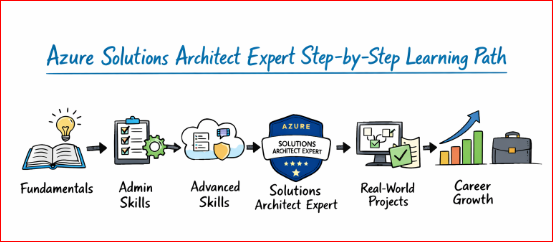
Azure Solutions Architect Expert Certification Table
| Track | Level | Who it’s for | Prerequisites | Skills covered | Recommended order |
|---|---|---|---|---|---|
| Azure Fundamentals | Foundation | Beginners to cloud, students, junior engineers | Basic IT understanding | Cloud concepts, core Azure services, basic security, pricing, support | 1st (optional but helpful) |
| Azure Administrator Associate | Associate | System admins, infra engineers, DevOps engineers managing Azure resources | Hands-on with VMs, networking, identities, basic scripting | Deploy/manage VMs, configure VNets, manage identities, storage, monitoring | 2nd (strongly recommended before Architect) |
| Azure Solutions Architect Expert | Expert | Senior engineers, leads, architects, managers driving cloud architecture | Azure Administrator-level skills or equivalent experience | Design identity, governance, networking, storage, BCDR, security, monitoring, hybrid and multi-tier solutions | 3rd (capstone in Azure infra / architecture path) |
Deep Dive: Azure Solutions Architect Expert (DevOpsSchool Program)
The DevOpsSchool Azure Solutions Architect Expert program is designed to take you from “service-level understanding” to “architecture-level thinking.” It blends classroom style explanations with strong hands-on labs and real-world case studies. You do not just learn what a feature is, you learn when to use it and when to avoid it. This makes the training very practical for working professionals who have to solve real customer or business problems.
What It Is
This program is a focused training and certification journey that covers the core skills expected from an Azure Solutions Architect. You work through topics like identity, networking, security, governance, storage, and business continuity in a structured way. The aim is not just to pass an exam but to help you think like an architect on every project. It prepares you to design solutions that you can defend in front of both technical and non-technical stakeholders.
Who Should Take It
This program suits engineers who want to grow into architecture and leadership responsibilities. It is ideal for cloud engineers, system administrators, DevOps engineers, and SREs who already work with infrastructure or platforms. Technical leads and managers who need to review designs and guide teams also benefit from it. If you often find yourself in design discussions or migration planning, this certification is a strong next step.
Skills You’ll Gain
- Ability to design secure, scalable, and highly available architectures on Azure across compute, network, storage, and identity.
- Skill to choose the right Azure services and patterns based on business, performance, security, and cost requirements.
- Strong understanding of identity, access management, governance, and policy to control and protect Azure environments.
- Capability to plan backup, disaster recovery, and business continuity with clear RPO/RTO objectives.
- Competence in integrating DevOps practices into architecture, including CI/CD, infrastructure as code, and observability.
- Confidence in reading requirements, creating architecture diagrams, and explaining design decisions to engineers, managers, and stakeholders.
Real-World Projects You Should Be Able to Do After It
- Design and document a complete multi-tier web application on Azure with secure front-end, API, and database layers, including load balancing, autoscaling, and monitoring.
- Build a hybrid architecture that securely connects on‑premises data center resources to Azure using VPN or ExpressRoute, with proper routing and network security controls.
- Create a highly available, multi‑region deployment of a critical application with backup, disaster recovery, and clear RPO/RTO objectives.
- Architect an end‑to‑end DevOps-enabled environment using Azure services, integrating CI/CD pipelines, infrastructure as code, observability, and blue‑green or canary deployments.
- Design a secure data and analytics platform on Azure that uses appropriate storage, databases, and processing services with governance, access control, and cost optimization.
- Set up an Azure landing zone with identity, RBAC, policies, logging, and cost management to onboard multiple teams or projects in a controlled way.
Preparation Plan
The best preparation plan depends on your current level and available time. If you already work deep with Azure, a short, intensive plan focusing on case studies and mocks might be enough. If you are still growing your Azure skills, a 30 or 60‑day plan with daily study and labs works better. The key is to mix reading, videos, and hands-on practice around realistic scenarios.
7–14 Days (Fast Track for Experienced Azure Engineers)
This plan is suitable only if you already manage or design Azure solutions daily. Your focus should be on exam blueprint review, scenario-based questions, and filling any gaps in areas like governance, security, or BCDR. Each day, spend focused time on practice questions and architecture cases instead of just reading theory. This is an exam-crash plus design-refresh style approach.
30 Days (Balanced Learning Path)
A 30‑day plan is realistic for most working professionals who already know some Azure. You can divide your time by topic: identity and governance, data and storage, networking and connectivity, continuity and cost. Each week, mix concepts with portal or CLI practice and at least a few design exercises. By the end of the month, you should be able to read a business case and sketch a reasonable Azure solution.
60 Days (Structured for Busy Professionals)
A 60‑day plan is better if you are new to Azure or can only study a little each day. In the first month, focus on fundamentals and administrator-level understanding, so services and basic operations feel normal to you. In the second month, move into architecture, patterns, and design trade-offs. This slower pace helps you build a deep, stable foundation instead of rushing for a quick pass.
Common Mistakes Learners Make
- Focusing on memorizing Azure service features instead of learning end‑to‑end solution design and trade‑offs.
- Ignoring identity, security, and governance topics because they seem “theoretical” or less hands‑on.
- Skipping business continuity, backup, and disaster recovery, assuming infra or ops teams will handle it.
- Studying only from notes or videos and avoiding real hands‑on labs in the Azure portal or CLI.
- Practicing only direct Q&A instead of working through scenario‑based, case‑study style questions.
- Rushing to the expert exam without first building solid Azure fundamentals and administrator‑level skills
Best Next Certification After This
- Azure DevOps–focused certification to strengthen your CI/CD, automation, and platform engineering skills and take end‑to‑end ownership of delivery on Azure.
- Security / DevSecOps certification (Azure security, cloud security, or DevSecOps track) to specialize in secure-by-design architectures, governance, and compliance.
- Data / Analytics / AI certification (Azure data engineer, data analytics, or AI track) to become a specialist architect for data platforms and intelligent applications.
- SRE / Reliability–oriented certification or training to focus on high availability, SLOs/SLIs, incident management, and resilient architectures on Azure.
- FinOps / cloud cost management certification or training to combine architecture with cost optimization and financial governance of cloud environments.
- Leadership or architecture–focused programs (enterprise architecture, technical leadership, or cloud architecture leadership tracks) to move towards head-of-cloud, practice lead, or architect manager roles.
Choose Your Path: 6 Learning Paths Around Azure Solutions Architect Expert
Azure Solutions Architect Expert can be positioned as the central building block for multiple modern roles. Instead of treating it as a single exam, think of it as a foundation for your long-term path. Each of the six paths below uses this certification as a pivot point. You can start in one area and then slowly add skills from the others as your career grows.
1. DevOps Path
In the DevOps path, you use Azure Solutions Architect Expert to design the environments where your CI/CD pipelines deploy. You understand how infrastructure, networking, and security support continuous delivery and fast feedback. Your work goes beyond writing pipeline scripts; you decide how environments should be structured and governed. This path suits engineers who want to own both delivery and platform.
2. DevSecOps Path
In the DevSecOps path, you focus on building “secure by design” platforms on Azure. You learn how identity, network security, encryption, and policies fit into the overall architecture. Over time, you become the person who can explain security trade-offs in simple language to both security teams and developers. This is a good path if you enjoy combining security awareness with practical delivery.
3. SRE Path
In the SRE path, Azure Solutions Architect Expert helps you design reliable, observable systems. You learn to think in terms of SLOs, error budgets, redundancy, and failure domains. Your architectural decisions directly influence uptime, incident rates, and recovery time. This path suits people who care deeply about stability and want to make reliability a design feature, not an afterthought.
4. AIOps / MLOps Path
In the AIOps/MLOps path, you blend architecture skills with automation and AI-focused workloads. You design platforms where data, models, and applications work together with strong monitoring and feedback loops. You also introduce intelligent automation for operations, such as smart alerting and self-healing patterns. This path is ideal if you like data, analytics, and intelligent systems along with infrastructure.
5. DataOps Path
In the DataOps path, you design cloud architectures that handle data pipelines, storage, and analytics reliably. You learn how to choose between different data services, manage data flows, and support teams that build reports or models. Architecture here is not only about performance but also about data quality, lineage, and governance. This path fits engineers who enjoy working close to data and business insights.
6. FinOps Path
In the FinOps path, architecture and cost management go hand in hand. You design Azure environments with clear cost visibility, right-sizing, and usage controls. Over time, you become the person who can explain cloud bills in plain language and show how design decisions affect cost. This path is suitable if you enjoy both technical design and financial responsibility.
Role → Recommended Certifications Mapping
| Role | Primary certification path | Next step | Advanced / leadership angle |
|---|---|---|---|
| DevOps Engineer | Azure Administrator Associate → Azure Solutions Architect Expert | Azure DevOps-focused certification | Architecture plus platform engineering / DevOps lead |
| SRE | Azure Administrator Associate → Azure Solutions Architect Expert | SRE-specific training or certifications | Reliability architect / Head of SRE |
| Platform Engineer | Azure Administrator Associate → Azure Solutions Architect Expert | Azure DevOps and infrastructure-as-code focus | Platform architecture and internal developer platform |
| Cloud Engineer | Azure Fundamentals → Azure Administrator Associate | Azure Solutions Architect Expert | Cloud architect / Principal engineer |
| Security Engineer | Security / identity fundamentals on Azure | Azure Solutions Architect Expert | Cloud security architect / DevSecOps lead |
| Data Engineer | Azure data-focused certifications (data engineer / analytics track) | Azure Solutions Architect Expert | Data platform architect |
| FinOps Practitioner | Cloud fundamentals + basic cost management / FinOps foundation | Azure Solutions Architect Expert | Cloud cost and architecture governance lead |
| Engineering Manager | Azure Fundamentals or Administrator-level awareness for managers | Azure Solutions Architect Expert | Head of cloud / Architecture manager / Practice lead |
Top Training and Certification Institutions for Azure Solutions Architect Expert
DevOpsSchool
DevOpsSchool offers a dedicated Azure Solutions Architect training program with live sessions, 30–35 hours of intensive learning, and 100+ hands-on labs and projects. The course is designed around real-world architecture scenarios so you learn how to design secure, scalable Azure solutions. Learners also get lifetime LMS access, interview preparation, and ongoing technical support, which makes it very suitable for working professionals.
Cotocus
Cotocus is a pioneer in corporate Azure training, known for its practical, hands-on approach to cloud learning. Their Azure programs focus on real-world scenarios, best practices, and industry use cases so participants can apply concepts directly in projects. The training is suitable for both individuals and teams who want structured, guided preparation for Azure roles and certifications.
ScmGalaxy
ScmGalaxy provides Azure Architect and Azure DevOps-oriented training that emphasizes scalable and secure solution design on Azure. Their courses typically combine architecture fundamentals with modules on identity, security, data, hybrid, and CI/CD integration. This makes the programs useful for professionals who want to connect Azure architecture with DevOps and modern delivery practices.
BestDevOps
BestDevOps focuses on advanced Azure and DevOps training, including paths that align well with architecture and expert-level certifications. Their guidance often covers step-by-step learning journeys, from fundamentals to expert, with strong attention to hands-on labs. This is a good option if you want to grow towards architect and DevOps expert roles in a structured way.
devsecopsschool.com
DevSecOpsSchool specializes in secure cloud and DevSecOps training, helping you apply security-by-design principles to Azure solutions. While its core focus is security, the skills strongly complement Azure Solutions Architect Expert by strengthening identity, access, policy, and compliance thinking. This is ideal for learners who want their architecture skills to include strong security and governance depth.
sreschool.com
SRESchool centers on Site Reliability Engineering concepts and connects them with modern cloud and architecture practices. For Azure architects, this type of training helps deepen skills in reliability, SLIs/SLOs, incident response, and high availability design. It is a good companion to Azure Solutions Architect Expert if you want to lead reliability and SRE initiatives on Azure platforms.
aiopsschool.com
AIOpsSchool focuses on automation and intelligent operations (AIOps), showing how monitoring, analytics, and automation can be layered on top of cloud architectures. For someone with or pursuing Azure Solutions Architect Expert, it helps in designing platforms that are easier to operate, observe, and auto-remediate. This is useful if you want to connect architecture with smart, AI-driven operations.
dataopsschool.com
DataOpsSchool offers training around data pipelines, data platforms, and analytical workloads, often in cloud-native environments. When combined with Azure Solutions Architect Expert, it helps you design data-centric architectures with strong pipeline, quality, and governance practices. This path suits architects who want to specialize in data platforms and analytics solutions on Azure.
finopsschool.com
FinOpsSchool focuses on cloud financial operations, teaching how to manage, optimize, and govern cloud spend effectively. For Azure architects, these skills are critical to design cost-aware environments, set up budgets, and tie architecture decisions to financial outcomes. It is a strong add-on if you want to be seen as both a technical and cost-conscious Azure leader.
FAQs on Azure Solutions Architect Expert
1. Is Azure Solutions Architect Expert difficult?
Yes, it is challenging because it tests your ability to design and justify complete solutions. It is not only about remembering services but about choosing the right design for each scenario. However, with proper study and hands-on practice, many working professionals clear it comfortably. Think of it as demanding but very achievable with discipline.
2. How much experience should I have before attempting it?
You should at least be comfortable operating Azure resources such as virtual machines, networks, storage, and identities. Some exposure to real projects or environments makes the architecture concepts much easier to understand. If you are completely new to Azure, it is better to first build fundamentals and admin-level skills. Once you feel fluent with the basics, the architect material becomes more natural.
3. Do I need Azure Administrator certification first?
It is not always mandatory, but it is strongly recommended. The architect exam assumes you understand how Azure services behave in real environments. If you already have administrator-level knowledge, you can focus on design, trade-offs, and patterns. If not, you may spend too much time just trying to understand the building blocks.
4. How long does preparation usually take?
Preparation time varies based on your starting point and daily schedule. Some experienced professionals may finish in a few focused weeks with strong practice. Others, especially those newer to Azure, might need one to two months of consistent learning. The most important factor is not the total days but how regularly you practice and revise.
5. Is this certification useful for DevOps and SRE roles?
Yes, it is very useful because DevOps and SRE roles are closely linked to how platforms are designed. When you understand architecture, you can design better pipelines, rollout strategies, and monitoring setups. It also helps you speak confidently with architects and security teams during design reviews. In many companies, senior DevOps and SRE engineers are expected to think at architecture level.
6. What if I am from a non-cloud or on-prem background?
You can still succeed, but you should follow a staged plan. Start with Azure fundamentals and then move into admin-level practice so that portals, services, and concepts feel familiar. Once you are comfortable running workloads on Azure, you can move into architecture design. This way, the expert-level concepts build on real understanding instead of guesswork.
7. Does this certification help managers as well?
Yes, it helps managers who want to make better decisions about cloud projects and teams. With architecture knowledge, you can ask sharper questions, understand risks, and evaluate proposals more accurately. It also improves your ability to plan cost, reliability, and security with your technical leads. For managers in cloud-heavy organizations, it adds strong credibility.
8. Is hands-on lab work really necessary?
Hands-on practice is one of the most important parts of preparation. Labs help you connect theory with real behavior, and you remember concepts much better. Scenario-based exam questions are easier if you have actually built and broken similar setups. Without labs, it is hard to develop the confidence needed for architecture decisions.
9. Can this certification help me move into architecture from development?
Yes, many developers use this certification as a bridge into solution architecture roles. Your development background gives you a strong understanding of application behavior and patterns. Adding architecture skills lets you take ownership of the bigger system, including infrastructure and security. This combination is highly valuable for product companies and consulting roles.
10. What real job roles can I target after this?
After achieving Azure Solutions Architect Expert, you can target roles like Azure Solutions Architect, Cloud Architect, Lead DevOps Engineer, or Platform Engineer. In some organizations, it also opens doors to SRE lead or head-of-cloud style positions. The exact title will differ by company, but the core expectation is architecture and technical leadership. Over time, it can also support a move towards principal engineer or architect manager.
11. How relevant is this certification in the current market?
This certification remains one of the top Azure credentials for people who want architecture and leadership roles. Many companies use it as a benchmark when hiring or promoting cloud architects. It signals that you are comfortable with complex design and cross-team collaboration. As long as Azure continues to grow, this certification will stay valuable.
12. Does this certification cover security and compliance?
Yes, security, identity, and governance are core pillars of the architect syllabus. You are expected to design solutions that protect data, control access, and meet compliance needs. This means understanding tools like identity management, network security, encryption, and policies. In real projects, this knowledge helps you build trust with security and audit teams.
13. Can I combine this with Data, AI, or FinOps skills?
You can and you should, if these areas interest you. Data and AI skills let you design platforms for analytics and intelligent applications. FinOps skills help you align architecture decisions with cost control and financial accountability. Together, these combinations make you stand out as a specialist architect.
14. Is it vendor-specific or does it help outside Azure too?
While the certification is Azure-focused, the core thinking patterns are universal. You learn how to reason about requirements, constraints, and trade-offs in a structured way. These skills transfer well to other cloud providers and even hybrid environments. You may change tools, but your architecture mindset remains useful everywhere.
15. Can I prepare for this certification while working full-time?
Yes, you can prepare while working full-time if you follow a realistic schedule and stay consistent. Even 1–2 focused hours per day with weekends for labs is enough over a few weeks. The key is to use a clear plan and avoid long gaps in study. Short, regular practice works better than random long sessions.
16. Do I need strong coding skills for Azure Solutions Architect Expert?
You do not need to be a heavy coder, but you should be comfortable reading basic scripts and templates. Knowledge of concepts like infrastructure as code, APIs, and automation is very helpful. Most architecture questions focus on design and patterns, not deep programming. If you understand how applications are built and deployed, you are in a good position.
17. Is this certification suitable for freshers?
This certification is designed more for experienced professionals than freshers. Freshers can aim for fundamentals and maybe an associate-level certification first. After getting hands-on experience with real projects, moving to the architect level becomes more natural. Trying it too early may feel overwhelming and less practical.
18. How often should I revise once I finish the syllabus?
Once you complete the syllabus, revision should be regular and focused. Spend time on weak areas, scenario-based questions, and full-length practice tests. It is better to revise in small chunks over several days rather than rushing everything in one weekend. Revision also becomes stronger when you repeat key designs or draw them on paper.
19. Will this certification help if my company uses multiple clouds?
Yes, it still helps because the architecture mindset you build is transferable. You learn how to think about requirements, constraints, and trade-offs in a structured way. While the services differ between clouds, the principles of security, scalability, and reliability remain similar. This makes you more adaptable in multi-cloud environments.
20. How can I show this certification’s value to my employer?
You can connect the certification to current or upcoming projects in your organization. Offer to review architectures, propose improvements, or lead a pilot migration or optimization initiative. Share simplified summaries of what you learned and how it reduces risk or cost for the company. When employers see direct impact on projects, they value the certification more.
Testimonials
Learners often report that this certification changes how they think about cloud projects. Instead of focusing on individual tickets, they start seeing systems as a whole and can anticipate issues earlier. Many mention that design reviews and client discussions become more comfortable after this training. Several also see clear improvement in job opportunities and interview success.
- “The Azure Solutions Architect journey helped me step out of pure operations and into design ownership. I now lead conversations with stakeholders instead of just following instructions.”
- “What made the biggest difference was the focus on real cases and whiteboard thinking. I learned how to defend my design choices and explain them clearly to both engineers and managers.”
- “After completing the architect track, I was able to move into a cloud architect role and take responsibility for large migration projects. The certification gave me confidence and credibility in front of customers.”
Next Certifications to Take After Azure Solutions Architect Expert
Your next step should match your long-term direction, not just what is popular. If you want to go deeper in Azure and platform work, a DevOps-focused certification keeps you close to engineering. If you enjoy security, data, or AI, choose a specialist certification and build a strong niche. If you are moving into leadership roles, combine this technical credential with people and delivery skills to grow into head-of-cloud type positions.
- Same Track (Azure / DevOps)
Continue with a DevOps-oriented certification that focuses on CI/CD, automation, and platform engineering on Azure. This keeps you close to the technology and makes you a key player for delivery practices. It suits people who want to stay hands-on and technical while still operating at a high level. - Cross-Track (Security, Data, AI)
Pick a security, data, or AI certification based on your interest and your company’s focus. This lets you become the “go-to architect” for that domain while still using your Azure architecture base. For example, you can be the architect who specializes in secure workloads or data platforms. - Leadership Track
Use your architecture skills to move into roles where you guide teams and strategy. You can combine this with leadership or project management training to handle budgets, people, and vision. Over time, this path can lead to positions like cloud practice lead, director of engineering, or CTO in smaller setups.
Conclusion
Azure Solutions Architect Expert is much more than a line on your resume; it is a shift in how you think about cloud systems. It takes you from focusing on individual components to owning entire solutions, their risks, and their outcomes. For engineers, it opens the door to architecture and leadership responsibilities. For managers, it provides the technical depth needed to guide teams and make better cloud decisions.
