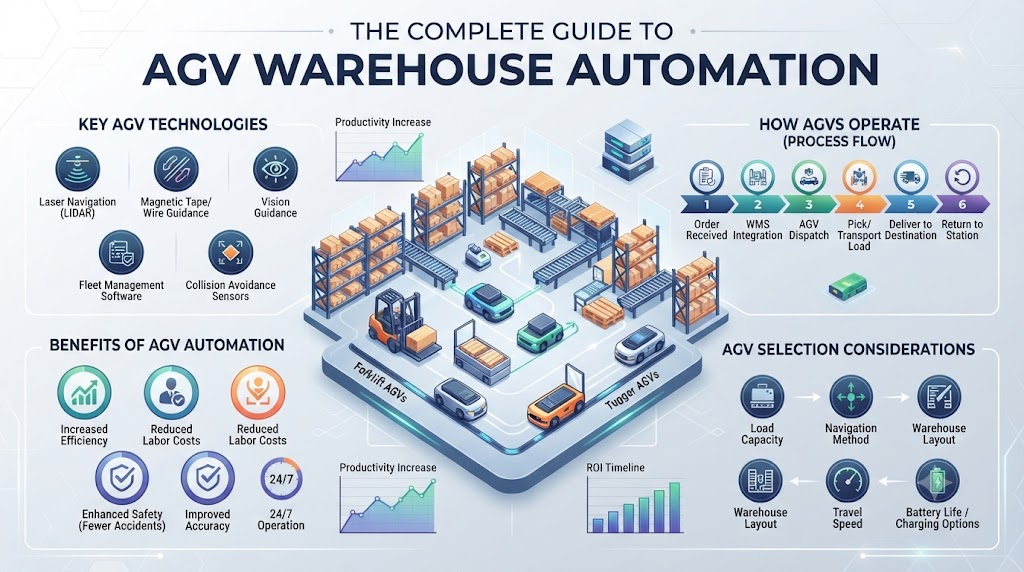
Heavy pallets move across busy warehouse floors without a human driver in sight. You watch a bright yellow cart navigate a tight corner, stop for a stray box, and deliver its load on time. How does this machine know where to go?
Automated Guided Vehicles, or AGVs, run on smart sensors, pre-set paths, and steady onboard computers. They handle repetitive transport tasks so your human team can focus on complex work.
If you want to understand how these industrial robots transform modern fulfillment, you can explore detailed operational guides at RobotsOps.com.
We will break down the exact tech, daily workflows, and maintenance rules that keep these machines moving.
What Is an AGV and Why Do You Need One?
An AGV is a mobile robot designed to haul heavy loads across industrial spaces. Traditional forklifts need a human driver. AGVs follow invisible lines, laser paths, or magnetic tape.
You reduce labor costs and cut down on costly workplace injuries. These robots never get tired, lose focus, or rush dangerously. They repeat the same exact route shift after shift with zero errors.
Your inventory moves faster from receiving docks to storage racks. You gain real-time visibility into every material flow inside your building.
The Core Hardware Anatomy of a Warehouse AGV
Every AGV relies on sturdy physical parts built for heavy daily abuse. A thick steel frame protects the internal battery and computer units. High-torque electric motors drive the wheels and steer the chassis.
Powerful lithium or lead-acid batteries power the machine for long hours. Charging stations are placed along common paths for quick top-ups.
Safety bumpers wrap around the base of the vehicle. If the bumper touches any object, it cuts power instantly.
Sensors and Perception: How Robots See the Floor
Your AGV needs to know its exact location at all times. LiDAR sensors bounce laser light off walls to map the room. Optical cameras track visual markers fixed to the high warehouse ceiling.
Wheel encoders count tire rotations to estimate distance traveled. Infrared sensors spot low obstacles hidden in blind spots.
These sensors feed data into the onboard computer fifty times a second. The machine reacts faster than any human driver could manage.
Navigation Methods: Magnetic Tape vs. Laser Guidance
Different floors require different navigation setups. Magnetic tape sticks to the concrete floor, and sensors under the AGV track the magnetic field. This method is cheap and reliable for simple, straight paths.
Laser triangulation uses reflectors mounted on warehouse pillars. The AGV fires laser pulses and calculates distances to pin down its coordinates.
Natural feature navigation maps the building walls without adding extra physical markers. You can change routes instantly via software updates.
Fleet Management Software: The Brains Behind the Fleet
One robot is easy to manage, but twenty robots need a central brain. Fleet management software acts as the traffic controller for your entire vehicle fleet.
The software assigns jobs based on battery levels and current location. It routes vehicles around traffic jams and temporary road blocks.
If a robot’s battery drops below twenty percent, the software sends it to the charging dock. You get a clean dashboard showing live statuses for every machine.
Power Systems and Automated Charging Protocols
Keeping industrial robots powered up is a major operational challenge. Traditional battery swaps take time and risk worker strains. Modern AGVs use opportunity charging stations.
When idle, the robot backs up to a wall-mounted charging plate. Metal contact pads complete the circuit and feed power into the battery.
Smart software tracks discharge rates to ensure machines charge before a job fails. You never have to worry about dead robots blocking main aisles.
Safety Protocols and Collision Avoidance Standards
Safety comes first in any busy fulfillment center. AGVs follow strict international standards to protect human workers.
Warning fields project outward from the front of the moving vehicle. If a worker steps into this outer zone, the AGV slows down smoothly.
Protective stop fields trigger an emergency brake if a person gets too close. Flashing lights and loud audio alarms alert nearby staff when a vehicle approaches.
Real-World Story About Server Crasches / Case Studies
- Scenario one involved a central fleet server crash during peak holiday shipping season. The recovery team restored database backups from an offsite drive within fifteen minutes.
- Scenario two featured a sudden Wi-Fi dead zone that cut off fleet signals. Engineers installed redundant access points overhead to restore stable signal strength.
- Scenario three saw a magnetic strip ripped up by heavy forklift traffic. Maintenance crews replaced the damaged tape with durable recessed floor markers.
- Scenario four highlighted battery degradation after three years of heavy use. The facility replaced aging lead-acid packs with fast-charging lithium iron units.
- Scenario five involved a software update bug that froze vehicle steering controls. Developers rolled back the patch remotely while dispatchers used manual override pendants.
- Scenario six showed a sensor lens coated in thick warehouse dust and debris. Technicians added automated cleaning wipes to the daily preventive maintenance checklist.
- Scenario seven dealt with a collision caused by a blind corner stack. Warehouse managers installed convex safety mirrors and restricted pallet heights near corners.
- Scenario eight uncovered a bottleneck at a busy conveyor drop-off point. Operations split the drop zone into two separate lanes to keep traffic flowing.
- Scenario nine featured unexpected floor cracks that threw off laser calibration. Facilities poured smooth self-leveling epoxy over the damaged concrete sections.
- Scenario ten solved a communication lag between the warehouse management system and AGVs. IT upgraded the local switch gear to handle higher packet loads.
| Feature | Traditional Forklifts | Automated Guided Vehicles (AGVs) |
| Driver Requirement | Human operator required | Fully autonomous operation |
| Speed Consistency | Varies by operator mood | Constant, programmed speed |
| Safety Risk | Higher human error risk | Predictable sensor stops |
| Operating Cost | High ongoing labor wages | One-time setup, low labor cost |
| Shift Endurance | Limited by driver breaks | Runs 24/7 with auto-charging |
| Path Flexibility | Free roaming anywhere | Follows fixed or mapped routes |
Common Mistakes and Pitfalls
- Mistake one involves skipping floor preparation before installing magnetic tape. The fix is cleaning and sealing the concrete floor so adhesive bonds permanently.
- Mistake two relies on weak Wi-Fi networks in high-rack steel storage zones. The fix is running a site survey and adding industrial mesh routers.
- Mistake three ignores routine wheel cleaning, letting shrink wrap tangle axles. The fix is adding a daily wheel inspection to the shift checklist.
- Mistake four sets vehicle speeds too high in narrow pedestrian walkways. The fix is programming slow-speed zones near break rooms and crosswalks.
- Mistake five forgets to train floor staff on safe pedestrian interaction rules. The fix is hosting monthly safety workshops on how to yield to robots.
- Mistake six places charging stations in high-traffic bottleneck corridors. The fix is moving chargers to out-of-the-way maintenance spurs.
- Mistake seven fails to update maps when warehouse racking layouts change. The fix is scheduling monthly cartography scans to match physical changes.
- Mistake eight buys low-end batteries that degrade after a single heavy year. The fix is investing in enterprise-grade lithium cells with warranty protection.
- Mistake nine neglects software security patches for onboard controllers. The fix is setting up an automated patch management pipeline via secure VLANs.
- Mistake ten treats AGVs as set-and-forget tools without performance audits. The fix is reviewing weekly uptime metrics to catch small issues early.
Step-by-Step Implementation Roadmap
- Audit your current material flow and identify high-volume transport routes.
- Measure floor flatness and repair any major cracks or deep potholes.
- Choose your navigation technology based on layout complexity and budget.
- Select a reliable fleet management software package that fits your systems.
- Install wireless access points to ensure zero dead zones across the facility.
- Mount charging stations in designated safe spots along travel paths.
- Run pilot tests with a single AGV on a simple loop route.
- Train your warehouse staff on safety protocols and manual override tools.
- Scale up by adding more vehicles and linking complex cross-aisle maps.
- Monitor daily performance metrics and tweak routes for maximum speed.
Frequently Asked Questions
1. What happens if an AGV’s path is blocked by a stray pallet?
The onboard LiDAR and safety bumpers detect the obstruction instantly. The vehicle stops safely and waits for the path to clear. If the blockage remains, the fleet software reroutes other vehicles around the obstacle.
2. Can AGVs operate safely around human workers?
Yes, industrial safety standards require multiple sensor layers. Warning zones slow the vehicle down, and stop fields halt motion immediately if a person steps too close. Flashing lights and audio beeps warn workers of approaching units.
3. How do AGVs handle multi-floor warehouses?
Standard AGVs cannot climb stairs or use normal ramps easily. For multi-floor buildings, facilities integrate AGVs with automated freight elevators. The fleet software triggers elevator doors and floor selection signals remotely.
4. What is the typical lifespan of a warehouse AGV?
A well-maintained industrial AGV lasts between eight and twelve years. Battery packs usually need replacement every three to five years depending on charge cycles. Regular grease, wheel swaps, and software updates keep hardware running smoothly.
5. Do AGVs require special flooring to work correctly?
Magnetic tape systems need clean, sealed concrete floors for good adhesion. Laser and natural navigation systems work on standard concrete. However, large potholes or extreme floor slopes can disrupt wheel traction and sensor accuracy.
6. How long does it take to charge an AGV battery?
Opportunity charging takes about fifteen to thirty minutes for a partial top-up. A full deep charge from empty can take two to four hours. Most facilities use scheduled breaks for quick top-ups so machines run continuously.
7. Can AGVs integrate with existing Warehouse Management Systems?
Yes, modern fleet software includes standard APIs and connectors. Your Warehouse Management System sends transport job orders directly to the fleet controller. The system updates inventory statuses automatically as loads move.
8. What is the difference between an AGV and an AMR?
An AGV follows fixed physical or mapped lines and stops for obstacles. An Autonomous Mobile Robot or AMR uses advanced artificial intelligence to navigate around obstacles dynamically. AMRs can chart brand new paths on the fly without fixed routes.
9. Are AGVs difficult to program for new routes?
Modern software makes route updates simple through drag-and-drop map editors. You draw new paths on the computer screen and push updates to the fleet over Wi-Fi. Physical tape layouts take a bit more manual floor work to alter.
10. How much downtime should I expect for maintenance?
Scheduled preventive maintenance takes about two to four hours per vehicle each month. Technicians check tire wear, clean sensor lenses, test safety bumpers, and check electrical connections. Unplanned downtime stays low if daily checklists are followed.
Final Recommendation and Next Steps
Start small by mapping out your highest-volume, most repetitive pallet transport route. Run a limited trial with one or two vehicles to learn how your team interacts with the system.
Track your throughput gains, downtime events, and battery health metrics every single week. Use those early insights to refine your floor layout before scaling automation across the entire warehouse.
