Introduction
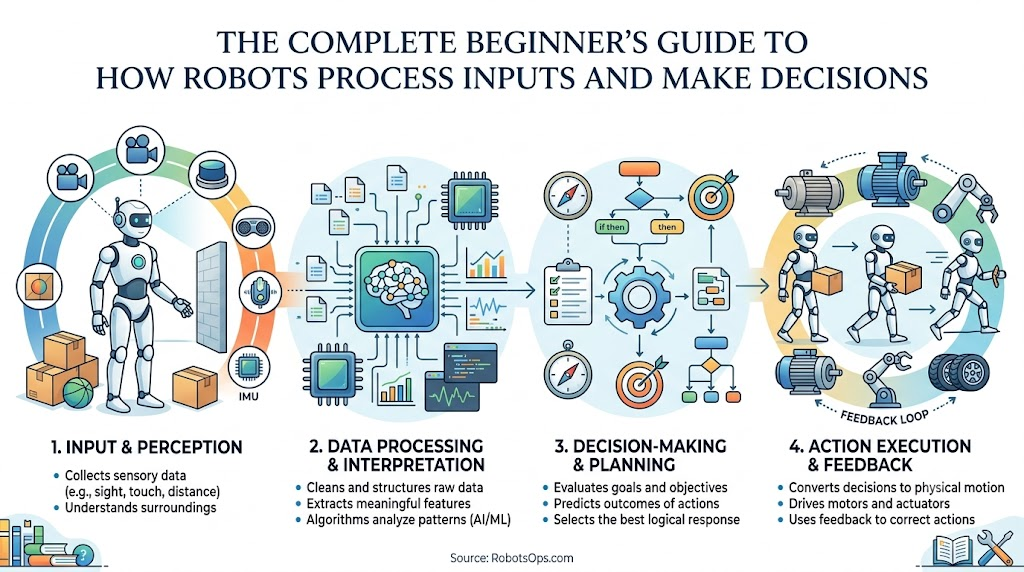
Understanding how robots process inputs and make decisions requires opening the “black box” of robotic autonomy. At its core, every intelligent robot—whether a simple automated guided vehicle (AGV) or a humanoid assistant—relies on a continuous operational loop: gathering raw data from the physical world, translating that data into a coherent internal representation, evaluating potential actions, and translating chosen decisions into motor movements. For developers, students, and engineers entering the field, mastering this pipeline is essential. Educational platforms like RobotsOps provide detailed guides, tutorials, and system architectures to help learners bridge the gap between theoretical robotics and practical software deployment. In this guide, we will break down the mechanics of robotic decision-making step by step.
What is Robotic Decision-Making?
Robotic decision-making is the algorithmic process by which a robot evaluates environmental data and internal states to select the optimal course of action to achieve a specific goal. Unlike standard computer programs that operate entirely inside a digital memory space, a robot’s decision-making system directly interacts with the chaotic, unpredictable physical world.
+-------------------+      +-------------------+      +-------------------+
|    PERCEPTION     | ---> |     PLANNING      | ---> |      ACTION       |
| (Sensors & Fusion)|      | (AI & Logic Maps) |      | (Motors & Driver) |
+-------------------+      +-------------------+      +-------------------+
          ^                                                     |
          |__________________ FEEDBACK LOOP ____________________|
In classical computing, an input leads directly to a deterministic output (e.g., $2 + 2 = 4$). In robotics, decision-making is probabilistic. Sensors are noisy, physical environments change dynamically, and motor movements are subject to friction and mechanical wear. Therefore, robotic decision-making involves constantly evaluating probabilities: “Where am I?”, “What obstacles are around me?”, and “What movement brings me closest to my goal without causing a collision?”
The Perception–Planning–Action Pipeline
The architecture of almost every autonomous robot is built around the classical Perception–Planning–Action (PPA) pipeline. This structural loop runs continuously, often hundreds of times per second (10 Hz to 1000 Hz), ensuring the machine responds dynamically to environmental changes.
+-----------------------------------------------------------------------+
|                   PERCEPTION-PLANNING-ACTION PIPELINE                 |
+-----------------------------------------------------------------------+
|  1. PERCEPTION  | Captures raw physical data via sensors.             |
|                 | Converts signals into structured world representations.|
+-----------------+-----------------------------------------------------+
|  2. PLANNING    | Evaluates current state against goal state.         |
|                 | Generates trajectory and decision trees.            |
+-----------------+-----------------------------------------------------+
|  3. ACTION      | Converts trajectory commands into electrical pulses |
|                 | Drives actuators to physical motion.                |
+-----------------------------------------------------------------------+
- Perception (Sensing & Understanding): The robot uses sensors to collect raw physical data from its surroundings and internal systems. Data filtering and sensor fusion algorithms clean this raw noise, outputting a structured digital map or state estimate.
- Planning (Reasoning & Choice): The decision-making engine processes the state estimate. It compares where the robot currently is with where it needs to be, considering constraints like physical boundaries, motor limits, and obstacles. It then generates an optimal trajectory or action command.
- Action (Execution & Control): The planned command is sent to low-level motor controllers. These controllers adjust currents and voltages delivered to electric, hydraulic, or pneumatic actuators to physically move the machine.
How Robots Collect Inputs Using Sensors
Before a robot can make a single decision, it must gather raw data from the physical universe. Sensors act as the robot’s sensory organs, transforming physical phenomena—such as light waves, sound frequencies, magnetic fields, and mechanical pressure—into electrical signals that microcontrollers can interpret.
Sensors fall into two broad categories:
- Proprioceptive Sensors: These measure the robot’s internal state (e.g., joint angle, wheel speed, battery level, internal temperature).
- Exteroceptive Sensors: These measure external environmental properties (e.g., distance to wall, ambient light, obstacle position).
Types of Sensors Used in Robotics
Modern intelligent robots rely on a diverse suite of hardware sensors. Each sensor type brings specific strengths and operational trade-offs:
+--------------------+-----------------------+----------------------------------+
| Sensor Type        | Operating Principle   | Primary Application              |
+--------------------+-----------------------+----------------------------------+
| LiDAR              | Time-of-flight light  | 3D spatial mapping, localization |
| RGB-D Cameras      | Visual light + Depth  | Object detection, visual SLAM    |
| Ultrasonic         | Sound wave reflection | Close-range obstacle detection   |
| IMU                | Accelerometer/Gyro    | Balance, orientation tracking    |
| Encoders           | Optical/Magnetic grid | Wheel speed, joint rotation      |
| Force/Torque       | Strain gauge          | Haptic feedback, gripping payload|
+--------------------+-----------------------+----------------------------------+
- LiDAR (Light Detection and Ranging): Fires thousands of laser beams per second to create dense, highly accurate point clouds representing the 3D geometry of the room.
- Cameras (2D RGB & 3D RGB-D): Capture visual details, texture, and color. RGB-D (Depth) cameras combine standard visual images with infrared depth-mapping.
- Inertial Measurement Units (IMUs): Combine accelerometers and gyroscopes to measure angular velocity and linear acceleration, giving the robot sense of tilt, orientation, and balance.
- Wheel Encoders: Track the precise rotations of motor shafts to measure how far a wheel has rolled, serving as the baseline for wheel odometry.
- Ultrasonic & Infrared Sensors: Cost-effective proximity detectors that emit high-frequency sound waves or light beams to measure short distances.
Sensor Fusion Explained
Relying on a single sensor type poses significant risks. Cameras fail in pitch darkness, LiDAR can be blinded by dense fog or reflective glass, and wheel encoders slip on slick floors. To overcome these individual limitations, modern autonomous systems use Sensor Fusion.
+-----------------------+
|  Camera (Visual Data) | --+
+-----------------------+   |
                            |----> [ SENSOR FUSION ENGINE ] ----> Unified World Model
+-----------------------+   |      (Kalman / Particle)            (High Confidence)
|  LiDAR (Point Cloud)  | --+
+-----------------------+   |
                            |
+-----------------------+   |
|  IMU / Odometry Data  | --+
+-----------------------+
Sensor fusion is the process of combining mathematical data streams from multiple sensors to produce a single unified state estimate that is far more accurate than any single sensor input could yield alone.
The primary algorithms used for sensor fusion include:
- Extended Kalman Filters (EKF): Blends noisy measurements from IMUs, wheel encoders, and GPS using probabilistic prediction and update cycles.
- Unscented Kalman Filters (UKF): Handles highly non-linear robot movements more effectively than standard EKFs.
- Particle Filters (Monte Carlo Localization): Uses hundreds of discrete “particles” (hypotheses) to estimate a robot’s position across complex maps.
Data Processing Inside a Robot
Once sensor inputs are retrieved and fused, the raw signals must be parsed, structured, and processed. This data journey flows through distinct computational layers:
[Raw Physical Signal] -> [ADC Conversion] -> [Low-Pass Filter] -> [Pose Estimation] -> [High-Level Planner]
- Signal Conditioning: Analog sensor outputs pass through Analog-to-Digital Converters (ADCs). Noise reduction algorithms, such as low-pass or Butterworth filters, clean high-frequency voltage spikes.
- Coordinate Transformations: Sensor data is collected in the frame of reference of the individual sensor (e.g., camera frame). Using linear algebra, the robot converts these points into a unified body frame (
base_link) and eventually into a global map frame (map). - World State Representation: The processed points fill a digital memory construct—such as a 2D Costmap, an OctoMap (3D occupancy grid), or a semantic graph identifying discrete objects (e.g., “chair”, “doorway”, “person”).
Role of Embedded Systems and Controllers
High-level decision logic is meaningless if low-level hardware cannot execute it deterministically. Embedded systems form the nervous system that links the high-level brain to physical hardware.
+--------------------------------------------------------------------+
|                       SYSTEM ARCHITECTURE                          |
+--------------------------------------------------------------------+
|  High-Level Processor (x86 / ARM / GPU)                            |
|  Runs: ROS 2, AI Models, SLAM, Path Planners                       |
+--------------------------------------------------------------------+
                                  |
                   Bus Comm (CAN, EtherCAT, UART)
                                  v
+--------------------------------------------------------------------+
|  Low-Level Microcontrollers (STM32, ESP32, FPGA)                   |
|  Runs: RTOS, PID Motor Control Loops, Encoder Counting             |
+--------------------------------------------------------------------+
                                  |
                                  v
+--------------------------------------------------------------------+
|  Hardware Layer: Motor Drivers, Servos, Solenoids, Actuators       |
+--------------------------------------------------------------------+
- Microcontrollers (MCUs): Chips like STM32 ARM Cortex, ESP32, or specialized FPGAs handle high-frequency tasks where microsecond timing matters—such as reading pulse encoders or executing PID (Proportional-Integral-Derivative) motor velocity loops.
- Real-Time Operating Systems (RTOS): Systems like FreeRTOS or Zephyr ensure that critical threads (like emergency stop monitoring) execute within strict timing windows without interruption from background tasks.
- High-Level Compute Units: Systems like NVIDIA Jetson modules or Intel x86 industrial PCs run heavy computing workloads like Deep Learning models, spatial SLAM mapping, and motion path computations.
Artificial Intelligence and Machine Learning in Robotics
Artificial Intelligence has transformed robot decision-making from rigid, programmed routines into flexible, adaptive behaviors.
- Machine Learning (ML): Allows robots to detect patterns in massive sensor datasets without hand-crafted features. For example, instead of writing thousands of lines of explicit geometric code to detect a box, an ML model is trained on thousands of box photos.
- Deep Neural Networks (DNNs): Convolutional Neural Networks (CNNs) handle image detection, while Transformers and Recurrent Neural Networks (RNNs) process temporal sequential data.
- Reinforcement Learning (RL): An agent learns optimal policy choices through trial-and-error interactions inside simulated environments. By earning digital rewards for successful actions and penalties for collisions, the neural network learns optimal control strategies.
Rule-Based vs AI-Based Decision-Making
Robotics engineers select decision frameworks based on environmental predictability, system safety requirements, and operational constraints.
| Feature / Aspect | Rule-Based Decision-Making | AI-Based Decision-Making |
| Primary Logic | Finite State Machines (FSM), Behavior Trees, If-Else Logic | Neural Networks, Reinforcement Learning, Deep Learning |
| Predictability | 100% deterministic; easy to debug and audit | Probabilistic; outputs can be difficult to trace (“black box”) |
| Adaptability | Rigid; fails when facing unforeseen environmental scenarios | Highly adaptable; generalizes to new surroundings |
| Compute Needs | Minimal; runs efficiently on basic microcontrollers | High; requires GPUs, TPUs, or dedicated edge AI accelerators |
| Development Cost | High manual setup for complex behaviors; low initial setup | High training data collection and compute setup costs |
| Safety Certification | Easy to certify for industrial safety standards (e.g., ISO 13849) | Difficult to certify due to non-deterministic edge outputs |
| Best Uses | Industrial arm assembly, basic AGV track-following | Humanoid navigation, autonomous driving, pick-and-pack sorting |
Motion Planning and Path Planning
Once a decision is made (e.g., “Drive to Station B”), the robot must convert that intent into a safe, physically executable trajectory.
[Global Goal] --> [Global Planner: A*/Dijkstra] --> Topological Map Path
                                                          |
[Local Motion] <-- [Local Planner: TEB / DWA] <-----------+
      |
      v
[Motor Velocity Commands (v, w)]
- Global Path Planning: Finds the topological path from point A to point B across a static map. Algorithms like A* (A-Star), Dijkstra, or RRT* (Rapidly-exploring Random Trees) calculate geometric paths around known walls and static obstacles.
- Local Motion Planning: Handles real-time dynamic obstacle avoidance (e.g., a person stepping in front of the robot). Algorithms like Dynamic Window Approach (DWA) or Timed Elastic Band (TEB) calculate instantaneous linear and angular velocity commands to maneuver around moving obstacles while staying close to the global path.
Computer Vision and Object Recognition
Visual information provides rich spatial awareness. Computer vision pipelines convert raw grid pixel arrays into actionable spatial knowledge:
- Object Detection: Neural architectures like YOLO (You Only Look Once) or SSD (Single Shot Detector) identify bounding boxes around objects in real time.
- Semantic & Instance Segmentation: Assigns every pixel in an image to a specific category (e.g., sidewalk, pedestrian, vehicle, road surface).
- Pose Estimation: Determines an object’s exact 3D spatial orientation ($X, Y, Z$ positions plus roll, pitch, yaw angles). This allows a robotic manipulator arm to align its end-effector gripper precisely around a part’s handle.
Environmental Mapping and Localization (SLAM overview)
A fundamental challenge in mobile robotics is answering two questions simultaneously: “What does the world look like?” (Mapping) and “Where am I inside it?” (Localization).
                       +------------------------+
                       |    Sensors: LiDAR,     |
                       |    Cameras, Odometry   |
                       +------------------------+
                                   |
                                   v
                       +------------------------+
                       |    SLAM ALGORITHM      |
                       | (Cartographer / ORB)   |
                       +------------------------+
                        /                      \
                       v                        v
             +-------------------+    +--------------------+
             | Occupancy Map     |    | Estimated Robot    |
             | Generated         |    | Position (X, Y, θ) |
             +-------------------+    +--------------------+
SLAM (Simultaneous Localization and Mapping) solves this chicken-and-egg problem. As the robot explores an unknown space:
- It reads visual or LiDAR landmarks.
- It uses wheel odometry and IMUs to estimate its move.
- It compares new landmark sightings against its built map, iteratively minimizing positioning errors through graph optimization techniques (e.g., g2o, Ceres Solver).
Common SLAM implementations include Cartographer (LiDAR-based graph SLAM), Gmapping, and ORB-SLAM3 (Visual-Inertial SLAM).
Executing Actions with Actuators
Planning leads to execution. Actuators are the muscles of a robot, converting electrical energy from drivers into physical work.
[Target Velocity / Angle] --> [PID Controller] --> [PWM Duty Cycle] --> [H-Bridge / Inverter] --> [Motor]
- Electric Motors: DC Brushed, Brushless DC (BLDC), and Stepper motors drive wheels and joints with precision.
- Hydraulic & Pneumatic Systems: Used in heavy industrial machines or legged robots (e.g., Boston Dynamics systems) requiring high power-to-weight performance.
- Low-Level Motor Control (PID): A Proportional-Integral-Derivative controller continually measures actual physical state (via encoders) against target commands, automatically adjusting PWM (Pulse-Width Modulation) voltage signals to correct errors instantly.
Feedback Loops and Continuous Learning
Decision-making is never a one-shot process. Robots operate within closed feedback loops where physical output continually updates perception inputs.
       +-------------------------------------------------------+
       v                                                       |
[Sense Environment] -> [Evaluate State] -> [Command Action] -> [Physical Move]
- Low-Latency Feedback: Ensures stability during unexpected surface shifts, slope variations, or payload changes.
- On-Machine Learning: Advanced autonomous systems log sensory inputs and motion outcomes. In fleet setups, telemetry data uploads to cloud servers running machine learning models, fine-tuning path optimization and predictive maintenance algorithms across all deployed units.
Robot Operating System (ROS) in Decision-Making
The Robot Operating System (ROS / ROS 2) serves as the open-source software backbone for modern robotics development. ROS provides a publish-subscribe middleware architecture that connects individual functional modules (called Nodes).
+------------------+                    +--------------------+
|  Camera Node     | --( /image_raw )-> | Vision Processing  |
+------------------+                    +--------------------+
                                                  |
                                             ( /detected_obstacles )
                                                  v
+------------------+                    +--------------------+
| Motor Driver Node| <-- ( /cmd_vel )-- | Nav2 Planner Node  |
+------------------+                    +--------------------+
In a ROS-powered decision-making architecture:
- A Camera Node publishes raw images to a
/camera/image_rawtopic. - An AI Inference Node reads the images, identifies obstacles, and publishes locations to
/detected_obstacles. - A Nav2 (Navigation 2) Node reads obstacle locations, evaluates a global costmap, and calculates safe trajectory velocity vectors.
- A Motor Controller Node reads
/cmd_velvelocity topics and outputs PWM commands to wheel motors.
ROS decouples complex robotic software into modular, reusable, and easily testable components.
Real-World Examples
Robots process inputs and execute decisions differently depending on their field of application:
- Industrial Automation (Manipulator Arms): Robot arms use force-torque sensors and 2D vision to pick unorganized parts out of bins, calculate optimal gripping vectors, and assemble electronics components with sub-millimeter repeatable precision.
- Service Robotics (Warehouse AMRs): Autonomous Mobile Robots (AMRs) in fulfillment facilities combine 2D LiDAR SLAM, safety laser scanners, and fleet planning software to move goods, dynamically yield to human workers, and re-route around unexpected corridor blockages.
- Medical Systems (Surgical Assistants): Surgical platforms like the da Vinci system use high-definition 3D vision, haptic force feedback, and motion scaling to eliminate surgeon hand tremors during microsurgery procedures.
- Autonomous Vehicles (Self-Driving Cars): Self-driving platforms fuse long-range radar, multi-camera suites, and high-definition LiDAR point clouds through deep neural networks to evaluate pedestrian intent, monitor traffic signals, and execute speed changes in complex traffic environments.
Common Challenges and Limitations
Despite rapid technological progress, robotic perception and decision-making systems face persistent engineering hurdles:
- Sensor Noise and Environmental Adversity: Rain, snow, glare, dust, and direct sunlight distort optical and LiDAR signals, degrading perception maps.
- Edge Computing Bottlenecks: Heavy AI perception models demand significant power and processing, creating battery life and thermal constraints on portable platforms.
- The “Edge Case” Dilemma: Rule-based systems fail when encountering rare scenarios, while AI systems can misinterpret novel environmental situations.
- Latency Constraints: At high speeds, delays in processing sensor fusion or motion planning can cause system instability or collisions.
Safety, Reliability, and Ethical Considerations
Deploying autonomous hardware alongside human workers demands robust safety engineering:
- Deterministic Hardware Interlocks: Critical safety features (like emergency stop buttons or laser safety curtains) bypass software decision layers entirely, cutting power directly at the hardware layer upon sensor break.
- Fail-Safe Fallbacks: When sensor noise exceeds safety thresholds, robots are programmed to execute deterministic safe-state procedures (e.g., coming to a controlled stop).
- Ethical Considerations: Autonomous systems—especially self-driving vehicles and medical assistants—must be designed with clear operational boundaries, transparent accountability, and bias-tested AI models to protect human life.
Future Trends in Intelligent Robotics
The field of robotic decision-making is evolving rapidly through several emerging technological trends:
- Embodied AI and Vision-Language-Action (VLA) Models: Models like RT-2 (Robotics Transformer) allow machines to understand direct natural language commands (e.g., “Pick up the spilled drink”) and translate them into physical physical manipulation tasks.
- Neuromorphic Computing: Brain-inspired event-based vision sensors and chips process visual changes asynchronously, reducing power consumption and latency by orders of magnitude.
- Digital Twins & High-Fidelity Physics Simulation: Platforms like NVIDIA Isaac Sim and Gazebo allow engineers to train AI decision models across millions of simulated scenarios before uploading code to real hardware.
- Fleet Intelligence: Swarm robotics platforms share real-time spatial and map updates over 5G/6G networks, allowing one robot’s map update to benefit an entire warehouse fleet instantly.
Skills Required to Build Intelligent Robots
Building complete end-to-end autonomous systems requires interdisciplinary technical skills:
+-------------------------------------------------------------------+
|                        ROBOTICS SKILL MATRIX                      |
+-------------------------------------------------------------------+
|  Software & AI      | C++, Python, ROS 2, PyTorch, OpenCV       |
|  Control & Math     | Linear Algebra, Probability, PID, Kinematics|
|  Embedded Hardware  | C/C++, Microcontrollers, CAN Bus, RTOS    |
|  Systems & Ops      | Linux, Docker, Git, CI/CD, Simulation     |
+-------------------------------------------------------------------+
- Programming: Mastery of C++ for low-latency performance systems and Python for rapid AI model development and ROS prototyping.
- Mathematics & Physics: Strong foundations in linear algebra, vector calculus, probability, differential equations, and rigid-body kinematics.
- Robotics Frameworks: Practical experience with ROS 2, OpenCV (Computer Vision), PCL (Point Cloud Library), and MoveIt (manipulation planning).
- Embedded Hardware: Working knowledge of microcontrollers, serial bus protocols (CAN, SPI, I2C, EtherCAT), and sensor interfaces.
Frequently Asked Questions (10 FAQs)
What is the main difference between a simple automated machine and an intelligent robot?
An automated machine follows pre-programmed, fixed movements regardless of external changes (e.g., a factory stamping press). An intelligent robot uses sensors to perceive its environment, evaluate variable options, and dynamically adapt its actions based on changing conditions.
How do robots handle unexpected obstacles in their path?
Robots use real-time local path planning algorithms (such as TEB or DWA) connected to proximity sensors like LiDAR or depth cameras. When an obstacle appears, the local planner re-evaluates the occupancy grid and recalculates velocity commands to safely steer around the obstacle.
What is sensor fusion, and why is it necessary?
Sensor fusion is the algorithmic combination of data from multiple sensors (e.g., combining LiDAR, cameras, and IMUs). It is necessary because every individual sensor has physical limitations; fusing data creates a reliable world model even if one sensor encounters noise or interference.
What role does ROS (Robot Operating System) play in decision-making?
ROS acts as the software middleware that manages communication between a robot’s perception, planning, and motor control software modules. It allows developers to easily connect sensor drivers, AI vision models, and motion planners together using standardized publish-subscribe messages.
Can a robot make decisions without using Artificial Intelligence?
Yes. Many industrial robots use deterministic, rule-based logic like Finite State Machines (FSMs) or decision trees. These rule-based systems execute pre-written conditional statements (e.g., “IF sensor A detects object, THEN stop motor B”) without requiring neural networks or machine learning models.
What is SLAM, and why is it important for autonomous navigation?
SLAM stands for Simultaneous Localization and Mapping. It is the process where a mobile robot builds a map of an unknown environment while simultaneously tracking its own precise position within that map, enabling autonomous navigation without requiring GPS.
What is the difference between global path planning and local path planning?
Global path planning computes an overall topological route from start to destination across a known static map. Local path planning continuously calculates immediate trajectory adjustments to avoid unexpected dynamic obstacles (like people or moving vehicles) while staying aligned with the global route.
How fast do robots make decisions?
Robotic control loops run at various frequencies depending on the task layer. High-level path planners and AI perception models typically update at 10 Hz to 30 Hz, local obstacle avoidance planners run at 50 Hz to 100 Hz, and low-level motor PID controllers update at 500 Hz to 1000 Hz (every millisecond).
What are actuators, and how do they differ from sensors?
Sensors are input devices that collect physical data from the environment and convert it into digital signals. Actuators are output devices (like electric motors, hydraulic cylinders, or pneumatic valves) that convert digital control commands into physical movement or mechanical force.
How can beginners start learning robotic programming and decision-making?
Beginners can start by learning Python or C++, experimenting with open-source platforms like Arduino or Raspberry Pi, and exploring simulation environments like ROS 2 and Gazebo. Following structured tutorials and hands-on project guides on educational platforms like RobotsOps provides a practical learning path.
Conclusion
Understanding how robots process inputs and make decisions reveals the intricate harmony between physical hardware and intelligent software. Through the continuous Perception–Planning–Action pipeline, modern autonomous machines convert noisy physical sensor signals into clear, actionable spatial models, evaluate potential paths using logic and AI, and execute precise physical actions through actuators. As sensor technologies become more accurate, edge processors grow more powerful, and machine learning architectures continue to evolve, the boundary of what robots can accomplish continues to expand. Whether in automated logistics, advanced manufacturing, surgical suites, or autonomous transportation, mastering these core principles is key to building the next generation of intelligent systems.
