Introduction
The AiOps Certified Professional (AIOCP) certification is designed for professionals who want to learn how to use Artificial Intelligence (AI) to improve IT operations. This certification focuses on how AI can help automate IT tasks, improve system monitoring, and solve problems faster. As businesses look for ways to be more efficient and proactive, professionals with AiOps skills are in high demand. This guide will provide you with all the information you need to understand the AIOCP certification, what you will learn, and how to prepare for it.
What is AiOps Certified Professional (AIOCP)?
AiOps stands for Artificial Intelligence for IT Operations. It combines AI with IT operations to make IT processes smarter, faster, and more efficient. The AiOps Certified Professional (AIOCP) certification helps professionals learn how to use AI tools to improve monitoring, automate tasks, and predict and solve problems before they happen. In simple terms, AiOps helps IT teams detect issues, fix problems, and improve overall performance using AI. This makes IT operations run more smoothly and reduces the risk of system downtime. The AIOCP certification teaches you how to apply AI in a practical IT environment to make these improvements.
Who Should Take the AIOCP Certification?
The AIOCP certification is perfect for anyone who works in IT and wants to add AI to their skillset. This certification is especially useful for:
- DevOps Engineers: DevOps Engineers who focus on automating IT operations will find AiOps useful for integrating AI into their workflows, making automation even more powerful.
- Site Reliability Engineers (SREs): SREs work on maintaining the reliability of systems. AiOps can help them use AI to predict problems and solve them before they affect users.
- Cloud Engineers: Cloud Engineers can use AiOps to improve how cloud systems are monitored and maintained, leading to better performance and fewer outages.
- Security Engineers: Security Engineers can use AI to detect and prevent security threats more quickly by analyzing large amounts of security data.
- Data Engineers: Data Engineers who manage large volumes of data can benefit from AiOps tools that help them monitor and optimize data systems.
If you work in any of these fields and want to learn how AI can help you automate tasks and improve system performance, the AIOCP certification is a great choice.
Skills You’ll Gain
When you earn the AIOCP certification, you will learn several important skills:
- AI-Driven Incident Management: You’ll learn how to use AI to automatically detect problems and fix them without needing manual intervention, which helps reduce downtime and service interruptions.
- Automation of IT Tasks: You will gain skills to automate repetitive tasks such as system updates, backups, and troubleshooting, making IT operations more efficient.
- AI-Powered Monitoring and Predictive Analytics: You will learn how to use AI to monitor systems in real-time, predict potential issues before they occur, and take action to prevent them.
- Root Cause Analysis: You’ll be able to use AI to automatically identify the cause of problems, helping you fix issues faster and reduce manual troubleshooting.
- Building AI Dashboards: You will learn how to create dashboards that display real-time system data, helping you easily monitor system performance and identify areas for improvement.
These skills are highly valuable in today’s IT landscape, where AI is becoming an essential tool for improving efficiency, reducing errors, and ensuring system reliability.
Real-World Projects You Should Be Able to Do After It
Once you’ve completed the AIOCP certification, you’ll be able to apply your skills to real-world projects. Here are a few examples of projects you will be able to work on:
- AI-Based Incident Detection and Remediation: You’ll be able to set up systems that use AI to automatically detect and fix problems, reducing downtime and improving service reliability.
- Predictive System Monitoring: You’ll use AI to predict when systems might fail or experience issues and take action to prevent these problems before they impact users.
- Automating the Incident Resolution Process: You’ll be able to automate the process of detecting, analyzing, and resolving IT issues using AI, which makes IT operations more efficient.
- AI-Powered Performance Optimization: You’ll implement AI solutions to optimize system performance by identifying inefficiencies and resolving them automatically.
- AI-Driven Root Cause Analysis: You’ll use AI to quickly find the cause of problems in your systems and fix them, speeding up the troubleshooting process.
These are just a few examples of how you will be able to apply the knowledge gained in the certification to make a real impact in your organization.
Preparation Plan
To get ready for the AIOCP certification, you will need to follow a well-structured plan. The amount of time you need to prepare depends on your current knowledge and experience. Here’s a suggested preparation plan:
7-14 Days Preparation
- Introduction to AiOps: Learn the basic principles of AiOps, such as how AI can be used in IT operations for monitoring and incident management.
- AI Tools for IT Operations: Get familiar with basic AI tools that help in monitoring systems and detecting issues in real-time.
- Hands-On Labs: Engage in simple, practical exercises to learn how AI can help automate tasks like incident detection and resolution.
30 Days Preparation
- Advanced AI Tools for Automation: Learn how to use more advanced AI tools to automate IT tasks and manage systems more efficiently.
- Real-Time Incident Management: Focus on learning how to detect and manage incidents using AI tools in real-time.
- Data Analysis for IT Operations: Understand how AI can be used to analyze large amounts of data to predict issues and optimize system performance.
60 Days Preparation
- Comprehensive Project Work: Work on larger, more complex projects where you apply AiOps to manage IT systems and automate operations.
- Master Automation Tools: Become highly proficient in automation tools like Ansible, Kubernetes, and others that help automate IT tasks using AI.
- Deploying AI Models: Learn how to train and deploy machine learning models to improve the performance and reliability of IT systems.
Common Mistakes
Here are a few common mistakes that people make while preparing for the AIOCP certification:
- Not Getting Enough Hands-On Experience: AiOps is all about practical skills. Make sure you spend time working with real AI tools and environments, not just reading about them.
- Skipping Basic AI Concepts: It’s important to understand basic AI principles, like machine learning and data analysis, as these are foundational for AiOps.
- Ignoring Automation: AiOps relies heavily on automation. Make sure you focus on learning how to automate tasks with tools like Ansible and Terraform.
- Underestimating AI Model Deployment: AiOps involves working with AI models. Make sure you understand how to train, test, and deploy machine learning models in an IT environment.
Best Next Certification After AIOCP
After you complete the AIOCP certification, here are some other certifications you can pursue to continue your professional growth:
- Same Track:
- MLOps Certified Professional (MLOCP) – If you’re interested in machine learning, this certification will deepen your understanding of how to apply machine learning models in IT operations.
- Cross-Track:
- Certified DevOps Architect – This will broaden your knowledge of DevOps, helping you understand how DevOps and AiOps can work together in a larger IT strategy.
- Leadership Track:
- Certified DevOps Manager – This certification is perfect if you’re looking to move into a leadership role, as it focuses on managing teams and projects within DevOps and AiOps environments.
Choose Your Path
Once you’ve earned the AIOCP certification, you can choose from several learning paths depending on what you want to specialize in. Here are some options:
1. DevOps Path
If you’re already a DevOps professional, the AIOCP certification complements your skills by helping you integrate AI into your DevOps workflows. You will focus on automating tasks, improving system reliability, and enhancing the monitoring and deployment processes using AI. This path emphasizes faster incident response, real-time issue detection, and AI-driven automation for DevOps teams.
Key Certifications for DevOps Path:
- DevOps Certified Professional (DCP)
- Certified DevOps Architect
- Certified Kubernetes Administrator
2. DevSecOps Path
DevSecOps focuses on integrating security practices within the DevOps process. By adding AIOCP to your skill set, you can leverage AI to enhance security automation, threat detection, and vulnerability management. AiOps helps DevSecOps professionals proactively address security issues and automate security incident response, making systems more secure.
Key Certifications for DevSecOps Path:
- Certified DevSecOps Professional
- Certified Security Operations Professional
- Certified Ethical Hacker (CEH)
3. Site Reliability Engineering (SRE) Path
Site Reliability Engineers (SREs) focus on maintaining system reliability and uptime. The AIOCP certification adds AI-powered monitoring and predictive analytics to your SRE toolkit, helping you predict and resolve issues before they impact users. AI-based automation also plays a crucial role in improving incident response times and system health monitoring.
Key Certifications for SRE Path:
- Certified SRE Professional (SREC)
- Certified Kubernetes Administrator
- Google Professional Cloud Architect
4. AIOps/MLOps Path
If you’re interested in specializing in AI and machine learning operations, the AIOCP certification provides a solid foundation in integrating AI into IT operations. The MLOps path focuses more on machine learning models, data pipelines, and AI deployment. Combining AIOCP with MLOps knowledge allows you to build, deploy, and maintain machine learning models within AI-driven operations environments.
Key Certifications for AIOps/MLOps Path:
- MLOps Certified Professional (MLOCP)
- Google Cloud Professional Machine Learning Engineer
- AWS Certified Machine Learning – Specialty
5. DataOps Path
DataOps focuses on the management and automation of data pipelines. With AIOCP, DataOps professionals can leverage AI to automate data operations, improve monitoring of data flows, and optimize performance. This path is ideal for those working with large-scale data systems and wanting to improve efficiency through AI tools.
Key Certifications for DataOps Path:
- DataOps Certified Professional
- Certified Data Engineer
- Google Professional Data Engineer
6. FinOps Path
FinOps combines financial operations with cloud cost management. Adding AIOCP to your FinOps skill set enables you to use AI to monitor, predict, and optimize cloud costs. You will also be able to automate financial reporting and use AI-based predictive models to forecast future spending trends, ensuring that your company stays within budget.
Key Certifications for FinOps Path:
- FinOps Certified Practitioner
- AWS Certified Solutions Architect
- Certified Cloud Financial Management
Role → Recommended Certifications
Here’s a table that maps your role to the recommended certifications for continued growth in your career:
| Role | Recommended Certifications |
|---|---|
| DevOps Engineer | AIOCP, DevOps Certified Professional (DCP), DevOps Architect |
| SRE (Site Reliability Engineer) | AIOCP, SRE Certified Professional (SREC), DevOps Engineer |
| Platform Engineer | AIOCP, Kubernetes Certified Administrator, Cloud Certified Professional |
| Cloud Engineer | AIOCP, Cloud Architect Certified Professional, AWS Certified DevOps Engineer |
| Security Engineer | AIOCP, Certified DevSecOps Professional, Security Operations Professional |
| Data Engineer | AIOCP, DataOps Certified Professional, MLOps Certified Professional |
| FinOps Practitioner | AIOCP, FinOps Certified Professional, Cloud Financial Management |
| Engineering Manager | AIOCP, DevOps Manager Certification, Leadership in Technology Management |
Frequently Asked Questions (FAQs)
1. How difficult is the AIOCP exam?
The AIOCP exam is of moderate difficulty. It covers both theoretical concepts and practical applications, so you will need to have a solid understanding of AiOps tools and techniques. The hands-on experience is just as important as the theoretical knowledge, so make sure to practice using AI tools for incident management, monitoring, and automation.
2. How much time do I need to prepare for the AIOCP certification?
The preparation time for AIOCP varies depending on your current knowledge of IT operations and AI. On average, most candidates spend 30 to 60 days preparing. If you have prior experience with DevOps or AI concepts, the preparation time may be shorter. It’s recommended to dedicate several hours per week to studying and practicing with AI tools.
3. What are the prerequisites for taking the AIOCP certification?
There are no strict prerequisites for taking the AIOCP certification, but having a basic understanding of IT service management (ITSM) and DevOps principles will be helpful. Familiarity with automation tools (such as Ansible, Terraform, or Kubernetes) and basic AI concepts will make it easier for you to grasp AiOps concepts.
4. What is the sequence of certifications I should take before AIOCP?
If you’re new to AiOps, it’s recommended to start with DevOps or Cloud certifications such as Certified DevOps Engineer (CDE) or AWS Certified DevOps Engineer. Once you have a good understanding of DevOps and IT operations, you can move on to AIOCP. Alternatively, starting with AI-related certifications like MLOps or DataOps could also be beneficial.
5. What is the value of the AIOCP certification?
The AIOCP certification holds significant value, especially as AI continues to be integrated into IT operations. With this certification, you will be equipped with the knowledge to improve system monitoring, automate tasks, and reduce the risks of downtime. The skills gained from AIOCP can set you apart in the job market and enhance your ability to make operational processes smarter and more efficient.
6. What are the career outcomes after obtaining AIOCP certification?
After earning the AIOCP certification, you’ll be qualified for roles such as AiOps Engineer, Site Reliability Engineer (SRE), DevOps Engineer, or Cloud Engineer. The certification also opens doors for leadership roles in AiOps, such as AiOps Manager or AI Strategy Lead. The demand for professionals who can leverage AI in IT operations is growing, leading to better job opportunities and career growth.
7. How long is the AIOCP certification valid for?
The AIOCP certification is valid for 3 years. After that period, you’ll need to renew it by taking continuing education courses or passing an updated version of the exam, depending on the certification provider’s requirements.
8. Can I take the AIOCP certification if I’m new to AI?
Yes, you can take the AIOCP certification even if you’re new to AI. The certification is designed to help you learn the foundational principles of AiOps, so it doesn’t require advanced AI knowledge. However, some basic understanding of AI and machine learning concepts will be helpful for grasping the content more easily.
9. How much practical experience do I need before attempting the AIOCP exam?
While prior hands-on experience with AI tools is helpful, it’s not strictly required. The AIOCP certification provides you with the necessary theoretical background, and you can gain practical experience through labs and exercises during your preparation. It’s highly recommended to get as much hands-on practice as possible during the preparation phase to solidify your knowledge.
10. Is the AIOCP exam a written exam, or does it include practical assessments?
The AIOCP exam consists of both written questions (theoretical) and practical assessments. You will be tested on your understanding of AiOps concepts, as well as your ability to apply them in real-world scenarios. This makes the certification comprehensive and ensures you are well-prepared for practical job roles.
11. What tools or platforms should I be familiar with to succeed in the AIOCP certification?
It’s helpful to be familiar with the following tools and platforms to succeed in the AIOCP exam:
- Ansible (for automation)
- Kubernetes (for container orchestration)
- TensorFlow or PyTorch (for AI/ML frameworks)
- Cloud platforms such as AWS, Azure, or Google Cloud (for cloud-based AI tools)
- Monitoring tools like Prometheus, Nagios, or Datadog
Familiarity with these tools will give you a competitive edge as you’ll be able to apply AI-driven solutions in IT operations.
12. How does AIOCP compare to other certifications like DevOps or MLOps?
The AIOCP certification focuses specifically on AiOps, which combines AI with IT operations. While DevOps certifications focus on automation and collaboration between development and operations, AiOps brings AI into these workflows to make them smarter and more predictive. On the other hand, MLOps focuses more on the deployment and maintenance of machine learning models, while AiOps is about using AI to improve IT operations. If you’re interested in AI-driven incident management and automation within IT, AIOCP is the perfect fit.
FAQs (Frequently Asked Questions)
- How difficult is the AIOCP exam?
The AIOCP exam is moderately challenging and will test both your theoretical knowledge and practical skills with AI tools. - How long does it take to prepare for the AIOCP exam?
Most candidates spend between 30 and 60 days preparing for the exam, depending on their background and experience. - What are the prerequisites for AIOCP?
A solid understanding of IT service management and basic knowledge of DevOps is helpful before starting the certification. - Should I focus on hands-on practice?
Yes! Hands-on practice is essential for mastering AiOps tools and techniques. Be sure to spend time working with real AI systems and tools. - How will AIOCP help my career?
AiOps is in demand, and the certification will open up career opportunities in automation, AI-based monitoring, and IT operations management. - Can I take AIOCP if I’m new to AI?
Yes, the certification is designed to teach you everything you need to know to apply AI in IT operations, even if you have little prior knowledge of AI. - How long is the AIOCP certification valid?
The AIOCP certification is valid for 3 years. After that, you will need to renew it by completing continuing education or taking additional certifications. - Does the AIOCP certification help in career progression?
Yes, AiOps is a rapidly growing field, and earning this certification will make you a more valuable employee and help you move into advanced roles.
Top Institutions Providing Training and Certifications for AiOps Certified Professional (AIOCP)
FinOpsSchool
FinOpsSchool combines AI and financial operations, providing training for professionals who want to optimize financial management through automation and AI. Their courses focus on leveraging AI tools for budgeting, cost management, and financial forecasting, ensuring that professionals can apply AiOps principles to FinOps effectively.
DevOpsSchool
DevOpsSchool offers expert-led training with a practical, hands-on approach. The institute focuses on real-world labs, ensuring that students gain a deep understanding of AiOps tools and practices. It provides comprehensive learning paths to help students pass the AIOCP certification with confidence.
Cotocus
Cotocus is a well-known platform for IT training, specializing in AiOps and automation. They offer in-depth courses that cover both theoretical concepts and practical applications of AI in IT operations. With experienced instructors and interactive learning methods, Cotocus helps professionals become proficient in AiOps.
ScmGalaxy
ScmGalaxy provides high-quality AiOps certification programs, offering training designed for real-world application. Their curriculum includes both foundational and advanced topics, helping students integrate AI into their IT operations seamlessly. They emphasize hands-on labs to strengthen practical knowledge.
BestDevOps
BestDevOps is a trusted name in IT certification training, offering structured AiOps courses. The programs are designed to equip students with essential AiOps skills, focusing on automation, predictive analytics, and AI-driven incident management. The institute also offers career support to help graduates succeed in their roles.
DevSecOpsSchool
DevSecOpsSchool provides specialized AiOps training that merges security with operations. Their courses cover AI in incident management, automation, and security monitoring, helping professionals integrate AI-driven security solutions into their IT operations. The certification ensures that students are well-prepared for the challenges of AiOps and DevSecOps.
SRESchool
SRESchool focuses on Site Reliability Engineering (SRE) combined with AiOps, making it ideal for professionals aiming to enhance system reliability using AI. Their courses offer practical insights into how AiOps can improve incident response times and operational efficiency. Students get hands-on experience with the latest tools in the field.
AiOpsSchool
AiOpsSchool is dedicated to providing cutting-edge training in AiOps. The school’s courses are designed to teach professionals how to implement AI tools in IT operations for monitoring, automation, and predictive maintenance. With a practical approach to learning, AiOpsSchool equips students with the skills they need to become certified professionals.
DataOpsSchool
DataOpsSchool focuses on the intersection of data and AI in IT operations. Their certification programs emphasize how data-driven insights can optimize AiOps and improve operational decision-making. They offer hands-on training in AI for data pipelines, helping professionals integrate machine learning and AI into data operations.
Testimonials
John Smith, DevOps Engineer
“The AIOCP certification has been a game-changer for me. It helped me automate my IT operations and use AI to predict issues before they occur.”
Sarah Johnson, Cloud Engineer
“AiOps is an essential skill for cloud engineers. This certification taught me how to apply AI to make my cloud systems more reliable and efficient.”
Conclusion
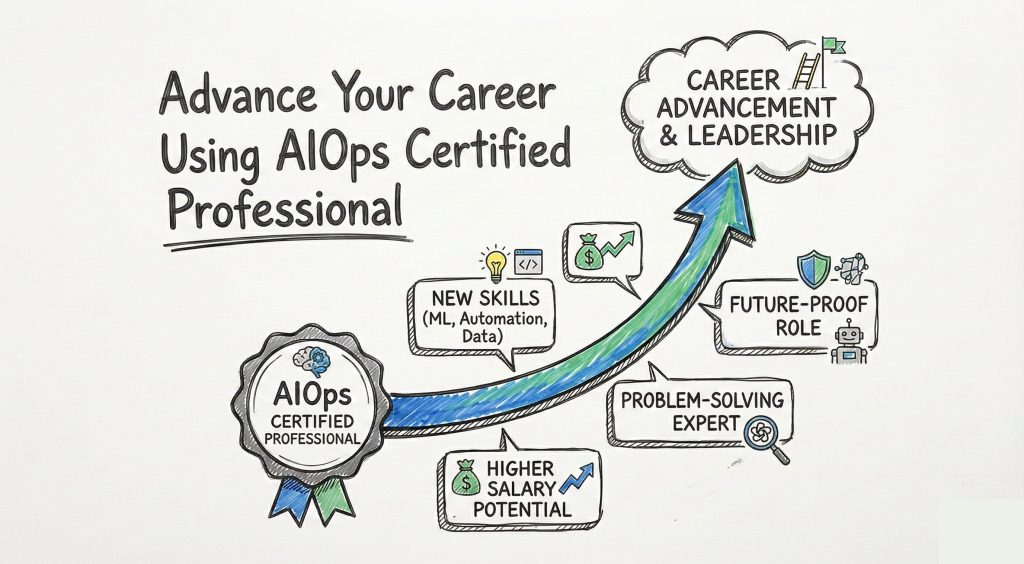
The AiOps Certified Professional (AIOCP) certification is a great way to improve your skills in IT operations by learning how to use AI to automate tasks, monitor systems, and prevent issues. Whether you’re a DevOps engineer, cloud engineer, or IT professional, AIOCP will help you become an expert in AiOps and make you a more valuable member of your team. Take the first step today to earn this certification and advance your career.
