Introduction
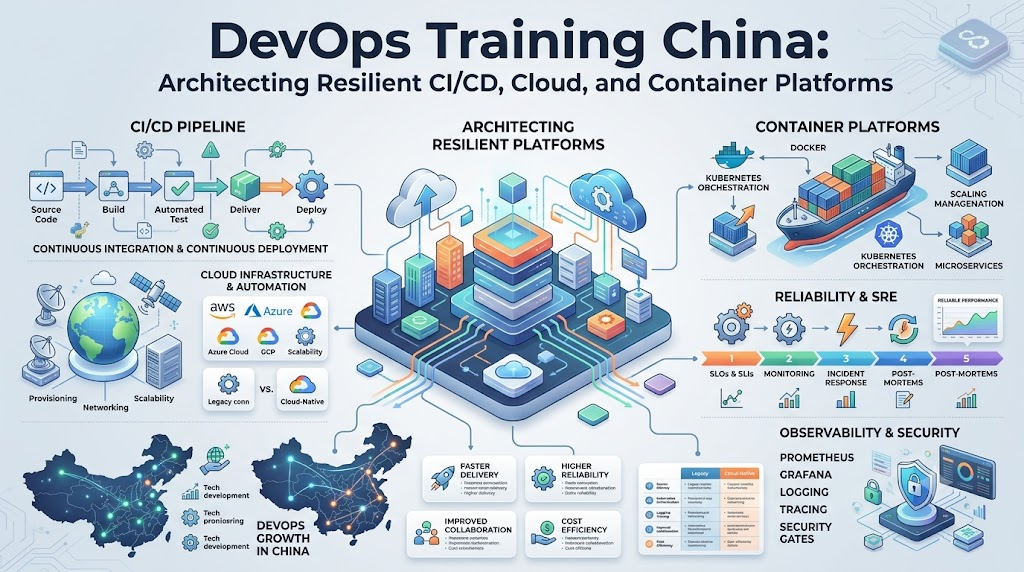
Engineering teams across high-velocity technology hubs in mainland China face a persistent operational hurdle: releasing features at scale without degrading production reliability. When organizations rely on manual coordination, disconnected staging configurations, and fragmented ownership between software developers and operations personnel, release velocity stalls. Database migrations conflict, distributed microservices crash during peak operational traffic, and hotfixes bypass testing gates, generating unplanned platform outages. Solving these systemic bottlenecks demands a structured framework built on automated delivery, declarative infrastructure definitions, and disciplined feedback loops. Navigating this technical evolution requires engineers to build core competencies across version control automation, containerized runtimes, and automated quality gates. This operational guide provides an in-depth breakdown of DevOps Training China from the perspective of an infrastructure systems architect. We explore how development and operations groups transition from reactive firefighting to predictable software operations through structured learning programs available at DevOpsSchool.cn.
Understanding the Core Architecture of Modern Delivery
Software delivery failures typically stem from operational fragmentation. When developers construct features in local runtime containers without visibility into the underlying network topology, security firewalls, or persistent storage constraints of live clusters, operational failures inevitably emerge. DevOps solves this structural friction by unifying application architecture, environment configuration, and runtime monitoring into an integrated operational cycle.
+------------------+     +------------------+     +------------------+
| Developer Work   | --> | Pipeline Engine  | --> | Immutable Build  |
| (Code & Config)  |     | (Automated Test) |     | (Signed Image)   |
+------------------+     +------------------+     +------------------+
                                                           |
+------------------+     +------------------+              |
| Observability &  | <-- | Infrastructure   | <------------+
| System Telemetry |     | Reconciliation   |
+------------------+     +------------------+
Rather than treating operations as an administrative gatekeeper, modern engineering treats infrastructure configurations as executable code. Every application dependency, network firewall policy, and compute provision is version-controlled, reviewed, and tested alongside core business logic.
This discipline spans foundational sysadmin concepts to distributed systems architecture:
- Software developers acquire deep visibility into container lifecycles, memory pressure limits, and dynamic traffic routing.
- Infrastructure administrators transition from imperative terminal commands to declarative configuration management.
- Quality and security engineers embed non-negotiable policy checks directly into automated pipelines.
How Automated Delivery Pipelines Operate in Production
A resilient continuous delivery pipeline automates operational quality gates, verifying that code meets architectural and security baselines before touching live infrastructure:
- Commit and Validation: Developers merge feature branches through peer-reviewed pull requests. Automated webhooks trigger short-lived runner environments to execute unit test suites.
- Deterministic Builds: Compilers assemble application artifacts within isolated build containers, generating reproducible artifacts regardless of the host environment.
- Automated Static Scanning: Pipelines analyze source code for common security vulnerabilities, flag unpinned external packages, and intercept accidentally committed authentication tokens.
- Container Packaging: Validated binaries are sealed inside minimal container runtimes and tagged with immutable commit identifiers.
- Declarative State Update: Deployment repositories record updated image tags, initiating automated reconciliation routines.
- Zero-Downtime Rollout: Container orchestrators execute rolling updates or canary deployments, monitoring health check endpoints before retiring previous application revisions.
- Production Telemetry: Metrics collectors, distributed trace agents, and log aggregators capture runtime signals to verify service stability.
Modern Engineering Toolchains and Architectural Layers
Operating reliable production environments requires deploying decoupled, specialized tooling across every phase of the application lifecycle.
| Architectural Layer | Core Toolchains | Operational Responsibilities |
| Source Control | Git, GitLab, GitHub | Enforces branch protections, maintains commit history, and initiates event-driven automation. |
| CI Automation | Jenkins, GitLab CI, GitHub Actions | Executes parallel test suites, runs linter checks, and builds immutable application binaries. |
| Container Engine | Docker, Containerd | Isolates runtime processes, standardizes environment configurations, and optimizes image sizes. |
| Container Orchestration | Kubernetes, Helm | Manages scheduling, service networking, horizontal resource scaling, and automated self-healing. |
| Infrastructure as Code | Terraform, OpenTofu, Ansible | Provisions cloud resources declaratively and manages server configurations across regions. |
| Observability & Alerting | Prometheus, Grafana, OpenTelemetry | Ingests runtime metrics, visualizes service latency, and routes actionable alerts. |
| Security Automation | Trivy, SonarQube, Gitleaks | Identifies dependency vulnerabilities, checks code quality, and blocks unauthorized secret commits. |
Operational Benefits of Engineering Automation
Establishing automated delivery pipelines delivers concrete architectural and operational advantages:
- Lower Mean Time to Recovery (MTTR): Small, incremental rollouts and automated rollback mechanics allow engineers to remediate failed updates within minutes.
- Elimination of Configuration Drift: Declarative code patterns ensure staging and production environments match precisely, eliminating environment-specific bugs.
- Higher Resource Utilization: Container orchestrators schedule workloads efficiently across compute nodes, reducing excess cloud infrastructure costs.
- Proactive Vulnerability Prevention: Scanning dependencies within delivery pipelines stops exploitable packages from entering production clusters.
- Increased Deployment Frequency: Removing manual deployment gates allows organizations to ship bug fixes and production features continuously without scheduling risky overnight maintenance windows.
Enterprise Delivery Bottlenecks and Architectural Solutions
Transforming delivery workflows across complex enterprise systems introduces predictable technical and organizational hurdles:
- Monolithic Application Couplings: Large, legacy codebases with tightly coupled services prevent independent updates.Architectural Solution: Implement the Strangler Fig pattern. Isolate edge functionalities into microservices backed by independent pipelines, routing traffic gradually via API gateways.
- Fragmented Tooling Ecosystems: Teams adopting disjointed tools create unmaintainable, brittle deployment pipelines.Architectural Solution: Define centralized, reusable pipeline templates and establish unified internal container base images.
- Alert Fatigue and Shallow Metrics: Inundating operations on-call staff with non-actionable server alerts leads to ignored production warnings.Architectural Solution: Pivot from raw infrastructure monitoring (CPU, RAM) to user-facing Service Level Indicators (error rates, request latency).
- Cross-Departmental Friction: Development teams penalized for delays conflict with operational teams measured solely on uptime.Architectural Solution: Align incentives around shared Service Level Objectives (SLOs) and error budgets that clearly define release risk boundaries.
Core Specializations in Modern Cloud Engineering
DevOps forms the foundational discipline for multiple operational specializations, each addressing distinct engineering needs:
                            +---------------------------------+
                            |      Foundational DevOps        |
                            |   Git, CI/CD, Linux, Docker     |
                            +---------------------------------+
                                             |
         +--------------------+--------------+----------------+--------------------+
         |                    |                               |                    |
         v                    v                               v                    v
+-----------------+  +-----------------+             +-----------------+  +-----------------+
|   Kubernetes    |  |       SRE       |             |    DevSecOps    |  |    Platform     |
|   Engineering   |  |   Reliability   |             |   Governance    |  |   Engineering   |
+-----------------+  +-----------------+             +-----------------+  +-----------------+
         |                                                                         |
         +-----------------------------------+-------------------------------------+
                                             |
                                             v
                            +---------------------------------+
                            |        MLOps Operations         |
                            |     Training & Model Stores     |
                            +---------------------------------+
Container Orchestration at Scale
Managing microservice workloads across dynamic infrastructure demands robust orchestration. Kubernetes Training China covers multi-tenant cluster architecture, declarative manifest definitions, Ingress configurations, persistent storage volumes, and network security policies. Engineers learn how Kubernetes schedules pods, handles hardware node outages, and performs rolling updates without dropping network requests.
Site Reliability Engineering (SRE)
High-volume architectures require systematic operational engineering to prevent outages. SRE Training China focuses on quantifiable availability metrics, including Service Level Indicators (SLIs), Service Level Objectives (SLOs), and error budgets. Instead of aiming for impossible 100% uptime, engineers use data-driven error budgets to balance rapid feature releases with production stability.
DevSecOps and Automated Governance
Modern infrastructure demands proactive security integrated directly into build and deployment pipelines. DevSecOps Training China teaches defensive architectures, including automated container vulnerability scanning, Software Bill of Materials (SBOM) generation, secrets management, and policy-as-code enforcement. This ensures engineering workloads stay secure and compliant with regional regulatory requirements.
Cloud Infrastructure Architecture
Modern distributed applications rely on hybrid networks, private cloud environments, and hyperscale providers. Cloud Computing Training China teaches virtual private cloud (VPC) peering, identity access boundaries, multi-region failover design, and Infrastructure as Code using Terraform. Understanding these patterns helps architects build resilient, cost-effective infrastructure.
Platform Engineering
As software development groups expand, managing infrastructure configurations directly creates unnecessary friction for engineers. Platform Engineering Training China shows teams how to construct Internal Developer Platforms (IDPs). These internal platforms provide standardized, self-service infrastructure blueprints that let developers deploy applications independently while maintaining security and operational controls.
Operationalizing Machine Learning (MLOps)
Deploying machine learning models in production involves unique engineering hurdles, such as tracking model performance drift, data lineage, and compute-heavy training loops. MLOps Training China covers automated model training pipelines, feature store infrastructure, artifact registries, and low-latency inference services running on Kubernetes.
The Engineering Competency Matrix
Transitioning to high-performing systems engineering requires a progressive path of technical competencies.
+------------------------------------------------------------------------------------+
| ADVANCED: Platform Engineering, Mesh Routing, MLOps Pipelines, Chaos Automation    |
+------------------------------------------------------------------------------------+
| INTERMEDIATE: Kubernetes Orchestration, Terraform State, DevSecOps Automated Gates |
+------------------------------------------------------------------------------------+
| FOUNDATIONAL: Linux Kernels, Bash Scripting, Git Operations, Container Primitives  |
+------------------------------------------------------------------------------------+
Foundational Competencies
- System Internals & Scripting: Linux namespaces, cgroups, systemd services, POSIX file permissions, bash scripting, and TCP/IP networking diagnostics.
- Source Control Hygiene: Trunk-based development, semantic branch tagging, rebase workflows, and automated pull-request validation.
- Basic Pipeline Automation: Configuring continuous integration runners, caching build artifacts, and writing automated unit testing workflows.
- Container Fundamentals: Writing secure, multi-stage Dockerfiles, managing base-layer caching, and troubleshooting container networking.
Intermediate Competencies
- Cluster Management: Deploying scalable Kubernetes primitives, configuring ingress routers, handling Secrets, and managing stateful applications.
- Infrastructure Automation: Developing reusable Terraform modules, managing locking remote state files, and automating configuration with Ansible.
- Telemetry and Tracing: Implementing Prometheus exporters, instrumenting code using OpenTelemetry standards, and creating actionable Grafana alert matrices.
- Security Automation: Running container image scans, blocking vulnerable open-source dependencies, and automating compliance checks.
Advanced Competencies
- Platform Architecture: Building internal developer platforms, designing self-service application templates, and enforcing policy via Open Policy Agent (OPA).
- Reliability Engineering: Designing fault-tolerant multi-region failovers, calculating real-time error budgets, and conducting blameless post-mortem investigations.
- GitOps and Continuous Delivery: Designing Git-driven cluster synchronization loops with Argo CD, managing progressive canary rollouts, and configuring zero-downtime service meshes.
- Machine Learning Pipelines: Orchestrating GPU compute resources, automating model retraining triggers, and monitoring real-time inference latency.
The Role of Certification Versus Production Engineering
Industry certifications provide a structured curriculum for mastering technical tooling. Pursuing credentials through DevOps Certification China offers engineers a reliable roadmap to systematically learn system architectures, discover advanced features, and establish baseline competencies.
However, certifications serve primarily to structure knowledge and validate core tool literacy. True operational expertise develops through resolving complex production failures: diagnosing split-brain database clusters, mitigating DDoS attacks, resolving cross-region VPC peering failures, and troubleshooting high-concurrency database connection spikes. Successful engineering teams value practitioners who pair rigorous theoretical knowledge with hands-on troubleshooting experience.
Enterprise Transformation and DevOps Consulting
For established enterprises operating legacy workloads across multiple business units, tool upgrades alone cannot solve systemic deployment friction. Long-term operational agility requires modernizing team culture, processes, and architectures together.
Organizations use Corporate DevOps Training China to align entire engineering teams around modern cloud-native standards, unified security models, and automated deployment architectures. Paired with DevOps Consulting China, companies can assess current-state maturity, modernize legacy pipelines, optimize cloud infrastructure costs, and build secure, enterprise-grade container platforms.
Practical Engineering Example: GitOps-Driven Container Deployment
The following workflow demonstrates a modern GitOps continuous delivery pattern, where an infrastructure deployment repository manages the desired state of a production Kubernetes cluster.
+-------------------+     +--------------------+     +--------------------+
| Developer Merges  | --> | CI Pipeline Builds | --> | Security Scan      |
| Code Pull Request |     | Container Image    |     | Passes Inspection  |
+-------------------+     +--------------------+     +--------------------+
                                                              |
+-------------------+     +--------------------+              |
| Kubernetes Cluster| <-- | Argo CD Detects    | <------------+
| Reconciles State  |     | Manifest Change    | (Updates Deployment Git Repo)
+-------------------+     +--------------------+
Pipeline Steps
- Commit and Build Verification: An engineer pushes an approved code update to the application source repository. The CI pipeline executes automated unit tests, confirms build integrity, and compiles the application binary.
- Container Build and Scanning: The pipeline builds a container image using a multi-stage Dockerfile to ensure that compilers and development dependencies are omitted from the final production layer:
- Security Validation: Trivy scans the compiled image for critical vulnerabilities and exposed credentials. The build halts immediately if any unpatched, high-severity CVE is discovered.
- Registry Push: Upon passing security inspection, the image is tagged with the unique Git commit SHA and pushed to the internal, private container registry.
- Automated Manifest Modification: The CI pipeline submits an automated pull request to a separate Git infrastructure deployment repository. This update modifies the application manifest’s image tag to match the newly built container SHA.
- GitOps State Synchronization: A continuous delivery controller running inside the Kubernetes cluster (such as Argo CD) constantly compares the live cluster state with the Git deployment repository:
- State Drift Detection: The controller recognizes that the repository specifies a newer image tag than what is currently running on the nodes.
- Rolling Update Rollout: The orchestrator initiates a rolling deployment, provisioning new pods, confirming readiness and liveness probes, and cleanly terminating legacy instances without dropping active user connections.
- Automated Rollback Safeguard: If the new pods fail initial startup probes or throw fatal runtime exceptions, the deployment halts automatically, preserving the stable, running version.
Frequently Asked Questions
What is DevOps Training China?
DevOps Training China is a structured, practical educational program covering modern cloud-native software delivery. It teaches automated build systems, container runtimes, Infrastructure as Code, continuous integration, and system observability, helping teams build resilient, automated delivery platforms.
How does this training benefit infrastructure and operations engineers?
It equips operations teams with modern software engineering practices. Engineers learn to automate repetitive manual administration tasks, manage infrastructure declaratively using code, run container orchestrators, and implement proactive system telemetry.
What specific tools and platforms are covered in the training?
The curriculum covers modern cloud-native toolchains, including Git for version control, Jenkins and GitLab CI for continuous integration, Docker and Kubernetes for container operations, Terraform for infrastructure provisioning, and Prometheus and Grafana for system monitoring.
How does Site Reliability Engineering differ from traditional DevOps?
DevOps focuses broadly on breaking down operational silos and automating release pipelines from code commit to production. SRE applies software engineering techniques directly to operations, using data-driven metrics like Service Level Objectives and error budgets to maintain system reliability.
Why is DevSecOps a critical component of modern delivery pipelines?
DevSecOps embeds automated security checks directly into the continuous integration pipeline. By catching code flaws, vulnerable dependencies, and insecure configurations during automated builds, teams remediate security issues early rather than delaying releases for manual audits.
What core concepts are taught in Kubernetes training?
Kubernetes training covers pod scheduling mechanics, dynamic storage integration, internal service routing, Ingress controllers, declarative deployment strategies, and health-check monitoring, preparing engineers to operate resilient microservices clusters.
What is the goal of Platform Engineering?
Platform Engineering focuses on creating Internal Developer Platforms (IDPs). These platforms give software developers self-service access to standardized infrastructure and deployment blueprints, reducing developer friction while ensuring corporate security and operational controls.
Are professional DevOps certifications useful for working engineers?
Certifications provide a comprehensive, structured path to validate core tool knowledge and understand architectural standards. However, certifications are most effective when paired with hands-on experience managing and troubleshooting production systems.
What are the primary benefits of corporate DevOps training for enterprises?
Corporate training aligns distributed software engineering teams around modern cloud-native standards. By tailoring the curriculum to an organization’s specific toolchains and operational bottlenecks, companies shorten release cycles, improve system reliability, and reduce deployment overhead.
What technical foundation is required before starting DevOps training?
Learners should understand fundamental Linux operating system concepts, basic bash terminal commands, core networking protocols (such as DNS, TCP/IP, and HTTP), and basic programming or scripting logic. Prior experience in software development or systems administration is helpful.
Conclusion
Modern software delivery requires replacing fragile manual workflows with resilient, automated, and observable deployment systems. Bridging the gap between software development and production operations requires disciplined engineering practices, including continuous integration, declarative Infrastructure as Code, and container orchestration. Mastering these practices helps organizations reduce deployment lead times, scale systems securely, and maintain high service availability. Whether you are an individual engineer looking to expand your cloud-native technical skills or an enterprise team modernizing your deployment pipelines, structured training offers a clear learning path. Explore comprehensive hands-on courses, certification tracks, and engineering programs to master the systems, tools, and operational practices driving modern technology architectures.
