Introduction
In the world of Industrial Robotics and Manufacturing Automation, a robot arm is often compared to a human arm. The shoulder, elbow, and wrist joints work in harmony to move through space with millimeter precision. However, just as a human wrist cannot write a letter or weld a steel joint without fingers or a specialized tool, a Robot Arm cannot perform a value-adding manufacturing task on its own. The component that transforms a bare robotic manipulator into a functional automated worker is the End-Effector, often referred to as End-of-Arm Tooling (EOAT). Whether picking up fragile eggs in a food processing facility, spot-welding automotive chassis on a high-speed assembly line, or executing delicate surgical procedures in healthcare, the end-effector is where physical execution happens. For automation engineers, system integrators, and robotics enthusiasts learning on RobotsOps.com, Understanding End-Effector Functions is essential to mastering robotic system design and deployment.
What is an End-Effector?
An End-Effector (or End-of-Arm Tooling / EOAT) is the peripheral device attached to the mechanical wrist flange of a robot arm. It acts as the interface between the robot manipulator and its physical environment, allowing the robot to interact directly with workpieces, raw materials, or specialized instruments.
+---------------------------------------------------------------------------------+
|                                 ROBOTIC SYSTEM                                  |
|                                                                                 |
|  +------------------+     +-------------------+     +------------------------+  |
|  |  Robot Base &    | --> |  Wrist Flange     | --> |  END-EFFECTOR (EOAT)   |  |
|  |  Articulated Arm |     |  (Tool Center Pt) |     |  "The Robot's Hand"    |  |
|  +------------------+     +-------------------+     +------------------------+  |
|                                                                 |               |
|                                                                 v               |
|                                                      +---------------------+    |
|                                                      |  Workpiece / Target |    |
|                                                      +---------------------+    |
+---------------------------------------------------------------------------------+
In control theory and kinematics, the central point of reference on an end-effector is known as the Tool Center Point (TCP). When a robot programmer writes motion commands (e.g., in ROS or vendor-specific languages like ABB RAPID or FANUC Karel), the controller moves the TCP through Cartesian coordinates ($X, Y, Z$) and orientations (roll, pitch, yaw).
Analogy: If the robot arm represents the human arm—providing range of motion, payload reach, and spatial positioning—the end-effector represents the hand, fingers, or handheld power tool that performs the physical work.
Why End-Effectors Are Important in Robotics
Without an end-effector, a $100,000 articulated robot arm is merely a positioning system moving through air. End-effectors define the functional versatility and economic value of an automated system.
Key reasons why EOAT is critical in Robotics Engineering include:
- Task Specialization: A single standard 6-axis robot arm can switch from palletizing heavy cardboard boxes to plasma-cutting sheet metal simply by swapping its end-effector.
- Quality and Repeatability: Precision-engineered grippers and tools eliminate manual variances, delivering sub-millimeter placement accuracy and identical operational results across thousands of production cycles.
- Safety & Hazard Mitigation: End-effectors allow robots to work safely in extreme environments, handling molten metals, toxic chemicals, radioactive materials, or sharp glass panes without risking human health.
- Throughput Optimization: High-speed pneumatic grippers and multi-cavity vacuum arrays drastically reduce cycle times, boosting factory output.
How End-Effectors Work
End-effectors convert energy inputs—electrical power, compressed air, or hydraulic fluid—into mechanical action or process execution. Their operation is controlled directly by the robot’s main control cabinet or local PLC via Fieldbus protocols (such as EtherCAT, PROFINET, or Ethernet/IP) and digital I/O lines.
+-------------------+      Digital / Fieldbus Signal      +-----------------------+
|  Robot Controller | ---------------------------------> | Tool I/O Interface    |
+-------------------+                                    +-----------------------+
                                                                     |
                                                                     v
+-------------------+        Pneumatic / Electric        +-----------------------+
|   Power Source    | ---------------------------------> | Actuator / Valve      |
| (Air Comp / PSU)  |                                    | (Solenoid/Servo Motor)|
+-------------------+                                    +-----------------------+
                                                                     |
                                                                     v
                                                         +-----------------------+
                                                         | Mechanical Engagement |
                                                         | (Jaws / Vacuum / Tool)|
                                                         +-----------------------+
The Operational Process
- Signal Command: The robot controller executes a program routine and sends a trigger signal to the tool interface.
- Actuation: Solenoid valves open to route compressed air, or servo drivers send current to an electric motor.
- Mechanical Engagement: Parallel jaw fingers close, vacuum suction seals against a surface, or an arc welding torch ignites.
- Sensor Feedback: Integrated proximity sensors or hall-effect switches confirm that the workpiece has been successfully gripped or processed.
- Signal Completion: The end-effector sends an
In-PositionorPart-Detecteddigital signal back to the controller to resume arm motion.
Main Components of an End-Effector
While end-effector designs vary based on their intended task, most industrial EOAT units share core sub-assemblies:
- Mounting Flange / Adapter Plate: The structural aluminum or steel interface that bolts the end-effector directly to the ISO 9409-1 mechanical wrist flange of the robot arm.
- Actuators: The drive units responsible for moving the gripper fingers or powering the tool. Common actuators include pneumatic cylinders, electric brushless DC motors, hydraulic rams, or piezoelectric triggers.
- Jaws / Fingers / Contact Pads: The physical contact points shaped to match the geometry of the target workpiece.
- Tool Changer (Manual or Automatic): A pneumatic or mechanical locking mechanism that allows a robot to detach one tool and pick up another mid-process without human intervention.
- Sensory System: Proximity sensors, reed switches, optical sensors, or strain gauges that monitor tool status and workpiece detection.
- Pneumatic / Electric Pass-Through Modules: Cable management solutions (dress packs) and internal slip rings that route compressed air and signals down the robot arm without tangling or stressing cables.
Types of Robot End-Effectors
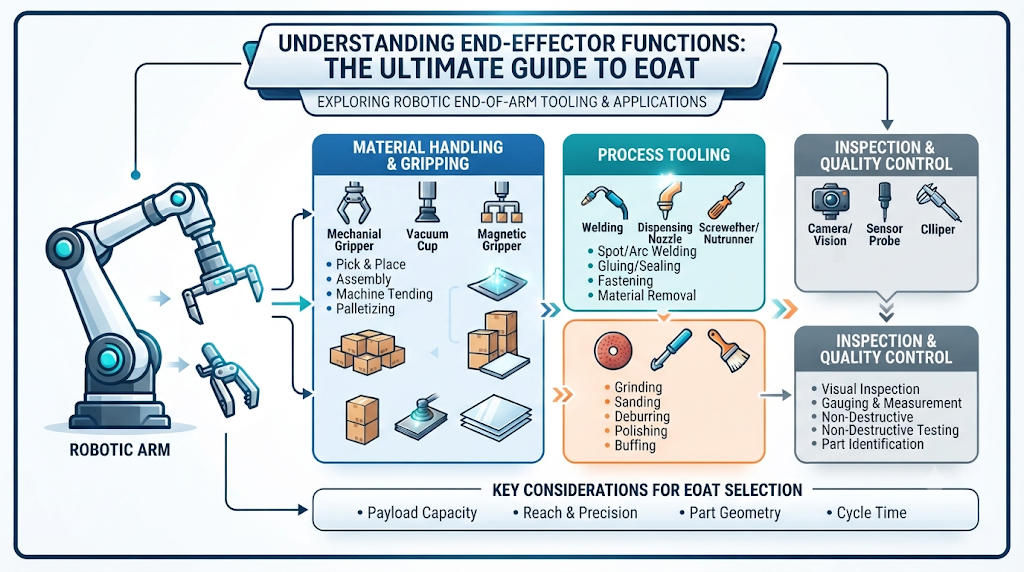
End-effectors fall into two broad functional categories: Grippers (designed to hold, shift, or manipulate objects) and Process Tools (designed to transform workpieces through welding, cutting, or painting).
                             +-----------------------------------+
                             |     ROBOT END-EFFECTORS (EOAT)    |
                             +-----------------------------------+
                                               |
                    +--------------------------+--------------------------+
                    |                                                     |
                    v                                                     v
      +---------------------------+                         +---------------------------+
      |      ROBOT GRIPPERS       |                         |       PROCESS TOOLS       |
      +---------------------------+                         +---------------------------+
      | * Mechanical Grippers     |                         | * Welding Torches         |
      | * Vacuum Grippers         |                         | * Paint Spray Guns        |
      | * Magnetic Grippers       |                         | * Cutting & Milling Heads |
      | * Soft Robotic Grippers   |                         | * Dispensing Valves       |
      +---------------------------+                         | * Inspection & Cameras    |
                                                            +---------------------------+
Mechanical Grippers
Mechanical grippers use movable jaws or fingers powered by electric motors, pneumatic cylinders, or hydraulic drives to physically clamp onto an object using friction or form-fit contact.
Parallel Griper Action:            Angular Gripper Action:
  [Finger] -> |Part| <- [Finger]     \  [Finger]   /  [Finger]
      <== [Slide] ==>                 \   <===>   /
                                        \ |Part| /
- Parallel Grippers: The fingers move in a straight line relative to each other along a linear guide rail. They offer consistent clamping forces and high precision for rectangular or uniform parts.
- Angular Grippers: The fingers pivot around a central hinge pin like scissors, making them compact and cost-effective for tight spaces.
- Three-Finger / Multi-Fingered Grippers: Designed for spherical or cylindrical parts, providing centered alignment and multi-point contact.
Vacuum Grippers
Vacuum grippers rely on atmospheric pressure differentials to hold flat, non-porous workpieces. They are widely used in packaging, automotive glass handling, and sheet metal fabrication.
               [ Compressed Air Supply ]
                           |
                           v
               [ Venturi Ejector Valve ]
                           |
                     (Low Pressure)
                           v
        =======================================  <- Workpiece Surface
        [ Suction Cup ]  |  [ Suction Cup ]
             (Vacuum)    |       (Vacuum)
        =======================================
- Suction Cup Systems: Elastomer cups (silicone, NBR, or polyurethane) connected to a central vacuum pump or compressed-air Venturi generator.
- Vacuum Foam Mats: Large foam surfaces capable of picking up irregular, textured, or porous objects (such as wooden pallets or uneven cardboard boxes) without requiring a complete surface seal.
Magnetic Grippers
Magnetic grippers use permanent magnets or electromagnets to handle ferrous metals (iron and steel).
- Electromagnetic Grippers: Powered by direct current (DC) coils. When energized, the magnetic field holds the metal part; when turned off, the part releases.
- Permanent Magnetic Grippers: Use high-strength Neodymium magnets that require an air pulse or mechanical lever to release parts, ensuring items remain held even during power failures.
Soft Robotic Grippers
Made from flexible elastomers, silicone polymers, or pneumatic artificial muscles, Soft Robotic Grippers bend around objects without rigid mechanical joints.
       Compressed Air In
              |
              v
       /**************\  <- Flexible Silicone Channels
      (   (   (   (    )
       \              /
        \  Workpiece /   <- Conforms around organic shapes (e.g., fruit)
         \__________/
They are ideal for fragile, delicate, or variably-shaped items, such as picking fresh berries, handling bakery products, or sorting delicate medical vials.
Welding End-Effectors
Welding tools turn a standard industrial robot into a precision joining system.
- MIG/MAG Arc Welding Torches: Feed consumable wire electrode and shielding gas continuously to fuse metal seams.
- Spot Welding Guns: Large pneumatic or servo-driven arms equipped with copper-alloy electrodes, widely used in automotive body assembly lines.
- Laser Welding Heads: High-energy fiber optic laser heads for deep-penetration, high-speed welds with minimal thermal distortion.
Painting End-Effectors
Automotive and industrial coating lines rely on specialized spray guns and high-speed rotary atomizers mounted to explosion-proof robot wrists.
- Airless / Electrostatic Spray Guns: Atomize liquid paints and charge particles electrostatically to ensure uniform coating thickness while reducing overspray waste.
Dispensing and Adhesive Tools
Dispensing tools apply controlled lines of sealants, adhesives, thermal pastes, or gaskets along precise 3D paths.
- Progressive Cavity Pumps & Jetting Valves: Dispense micro-liter volumes of high-viscosity materials in electronics assembly (e.g., placing underfill fluid under smartphone microchips).
Cutting and Drilling Tools
High-torque spindle motors, plasma torches, waterjet nozzles, or laser cutting optics convert a robot arm into a flexible multi-axis CNC machining cell.
- High-Speed Routing Spindles: Trim edge flash from molded carbon-fiber or composite aerospace structures.
- Abrasive Waterjet Nozzles: Slice through thick titanium plates or stone using high-pressure water mixed with garnet abrasive.
Inspection and Vision-Based End-Effectors
Rather than physically modifying a workpiece, these tools gather quality control and dimensional inspection data.
- 3D Structured Light Scanners / Laser Profilometers: Mounted directly on the wrist, these devices scan complex assemblies to construct high-density 3D point clouds, verifying tolerances on the fly.
Force and Torque Sensors in End-Effectors
For complex assembly, grinding, polishing, or surface finishing, positional control alone is insufficient. If a component is misaligned by $0.2\text{ mm}$, rigid positional control can crush parts or damage the robot.
                   +----------------------------+
                   |    Robot Wrist Flange      |
                   +----------------------------+
                                 |
                                 v
                 +-------------------------------+
                 |  6-AXIS FORCE/TORQUE SENSOR   |
                 |  [Fx, Fy, Fz | Mx, My, Mz]    |
                 +-------------------------------+
                                 |
                                 v
                   +----------------------------+
                   | Mechanical Gripper / Tool  |
                   +----------------------------+
Integrating a 6-Axis Force/Torque (F/T) Sensor between the robot flange and the end-effector allows the system to measure forces along three orthogonal axes ($F_x, F_y, F_z$) and torques around them ($M_x, M_y, M_z$).
- Hole-in-Shaft Insertion: The robot feels contact resistance and dynamically adjusts its movement vector to seat a pin smoothly.
- Deburring and Sanding: Maintains a constant contact force against uneven contoured surfaces for smooth, uniform finishing.
End-Effectors for Collaborative Robots (Cobots)
Unlike traditional industrial robots enclosed behind safety cages, Collaborative Robots (Cobots) operate alongside human personnel. Their end-effectors must meet strict safety standards, such as ISO/TS 15066.
  TRADITIONAL INDUSTRIAL EOAT                COLLABORATIVE (COBOT) EOAT
+-------------------------------+          +-------------------------------+
| * Exposed sharp metallic edges|          | * Rounded, smooth contours    |
| * High-force pneumatic pinch  |          | * Power & Force Limiting (PFL)|
| * Hard mechanical stops       |          | * Soft touch / foam padded    |
| * High speed / high payload   |          | * Integrated status LED rings |
+-------------------------------+          +-------------------------------+
Cobot end-effectors feature soft-touch materials, force-limiting electric drives, rounded geometry free of pinch points, and status LED rings that show operational mode (e.g., green for active, red for fault).
End-Effector Selection Criteria
Choosing the right end-effector requires evaluating workpiece geometry, material, payload limits, cycle time, and environmental conditions.
| Selection Metric | Vacuum Grippers | Mechanical Grippers | Magnetic Grippers | Soft Grippers | Process Tools |
| Primary Material | Glass, cardboard, sheet metal | Metals, plastics, structural components | Ferrous steels, iron castings | Produce, food, fragile optics | Sheet metal, raw castings |
| Surface Tolerance | High (flat, non-porous required) | Medium (tolerates rough surfaces) | High (requires magnetic contact) | Very High (handles irregular shapes) | N/A (process dependent) |
| Actuation Speed | Fast ($50\text{–}100\text{ ms}$) | Moderate ($100\text{–}300\text{ ms}$) | Very Fast ($20\text{–}50\text{ ms}$) | Moderate ($150\text{–}400\text{ ms}$) | Continuous |
| Payload Capacity | Light to Heavy ($1\text{–}500\text{ kg}$) | Very High ($1\text{–}1,000+\text{ kg}$) | High ($10\text{–}500\text{ kg}$) | Light ($0.1\text{–}5\text{ kg}$) | Process Dependent |
| Maintenance Cost | Low (replace worn cups) | Medium (joint lubrication) | Very Low (no moving parts) | Low (replace wear sleeves) | High (torch/spindle consumables) |
End-Effector Materials and Design Considerations
Modern EOAT design balances structural rigidity, mass, and durability. Excess end-effector weight directly reduces the robot’s usable payload capacity.
       +-----------------------------------------------------------------+
       |                  CRITICAL DESIGN CONSIDERATIONS                 |
       +-----------------------------------------------------------------+
       |                                                                 |
       |  [ Mass Optimization ] ----> Reduces inertial strain on joints  |
       |  [ Cable Management ]  ----> Eliminates snagging / cable fatigue |
       |  [ Thermal Shielding ] ----> Protects electronics from heat     |
       |  [ Ingress Protection] ----> Seals components (IP65 / IP67)     |
       |                                                                 |
       +-----------------------------------------------------------------+
Material Choices
- Aircraft Aluminum (6061-T6 / 7075-T6): Standard for structural frames due to its high strength-to-weight ratio.
- Carbon Fiber Composites: Preferred in high-speed Delta robot applications to minimize rotational inertia.
- 3D-Printed Polymers (PETG, Nylon-CF): Rapidly used for custom finger jaws, reducing fabrication lead times from weeks to hours.
AI and Smart Sensors in Modern End-Effectors
The convergence of AI in Robotics, 3D machine vision, and edge computing has turned passive end-effectors into intelligent manipulation systems.
+------------------+     2D/3D Image Feed      +-------------------+
| Wrist 3D Camera  | ------------------------> | AI Vision Engine  |
+------------------+                           | (Deep Learning)   |
                                               +-------------------+
                                                         |
                                                         | Pose & Orientation
                                                         v
+------------------+   Force Feedback Stream   +-------------------+
| F/T Sensor Array | ------------------------> | Adaptive Gripper  |
+------------------+                           | Control Loop      |
                                               +-------------------+
Smart Features
- AI-Driven Pose Estimation: Wrist-mounted cameras feed image data into deep neural networks to identify randomly oriented items in a bin (Random Bin Picking).
- Dynamic Slip Detection: Tactile sensor arrays sense microscopic slip vectors, adjusting gripping force in real time to prevent dropping objects without crushing delicate surfaces.
- Condition-Based Predictive Maintenance: Internal accelerometers and temperature sensors stream vibration and thermal profiles to cloud monitoring platforms, flagging bearing wear before total failure occurs.
Integration with Robot Arms and Controllers
Integrating end-effectors with a robot arm involves three physical and electrical interfaces:
+-------------------------------------------------------------------------+
|                         ROBOT-TO-EOAT INTERFACE                         |
|                                                                         |
|   1. MECHANICAL INTERFACE : Flange Bolting (ISO 9409-1 Standard)        |
|   2. PNEUMATIC INTERFACE  : Direct Wrist Ports vs. External Solenoids    |
|   3. ELECTRICAL INTERFACE : Tool I/O Connectors & Fieldbus Communications|
+-------------------------------------------------------------------------+
Software control is typically implemented using standardized communication frameworks. For instance, in ROS/ROS2, grippers are driven using the control_msgs/GripperCommand action interface, allowing programmers to send explicit position targets, max force limits, and speed parameters.
Real-World Industrial Applications
+-------------------------------------------------------------------------+
|                  END-EFFECTOR INDUSTRIAL APPLICATIONS                   |
+-------------------------------------------------------------------------+
|  [ Automotive ]    --> Servo spot welding guns, windshield glass cups   |
|  [ E-Commerce ]    --> AI vision-guided vacuum pickers for mixed bins   |
|  [ Electronics ]   --> Micro-dispensing jet valves, ESD-safe fingers     |
|  [ Food & Bev ]    --> Hygienic soft grippers for bakery & soft fruits  |
|  [ Agriculture ]   --> Vision-guided soft harvesters for fresh produce  |
|  [ Healthcare ]    --> Haptic surgical cutters & diagnostic probes      |
+-------------------------------------------------------------------------+
- Automotive Manufacturing: Heavy-duty servo spot welding guns join body panels, while custom vacuum tool arrays move windshields into place.
- E-Commerce & Warehousing: Autonomous mobile manipulation robots use AI-guided vacuum-mechanical hybrid grippers to sort thousands of unique SKUs.
- Electronics Assembly: High-speed SCARA robots fit micro-scale surface-mount components using delicate ESD-safe vacuum tips.
- Food Processing & Agriculture: Soft silicone grippers handle delicate baked goods and harvest tomatoes without bruising their skin.
- Healthcare & Medicine: Surgical robotics utilize haptic-feedback end-effectors to perform minimally invasive procedures with human-level dexterity.
Common Challenges and Limitations
Despite rapid technological advances, EOAT deployment faces several engineering challenges:
- Payload Limitations: High-strength grippers add dead weight to the wrist, reducing the robot’s net payload capacity.
- Cable and Hose Fatigue: Repeated twisting across multi-axis wrist moves can cause cable strain and pneumatic hose leaks over time.
- Part Geometry Variance: Standard mechanical grippers struggle when handling mixed, unorganized, or deformative workpieces without specialized tooling.
- Environmental Wear: Abrasive dust, moisture, or chemical splatter can degrade sensitive vacuum seals and optical sensor windows.
Best Practices for Selecting the Right End-Effector
Follow this systematic 5-step engineering workflow when specifying EOAT for an automation project:
+-------------------------------------------------------------------------+
|                     SELECTION & DESIGN WORKFLOW                         |
+-------------------------------------------------------------------------+
| Step 1: Analyze Workpiece (Weight, surface finish, deformation limit)  |
| Step 2: Calculate Dynamics (Acceleration, center of gravity, payload)   |
| Step 3: Evaluate Environment (Cleanroom, IP rating, temperature)        |
| Step 4: Determine Control Interfaces (Digital I/O, Fieldbus, ROS)       |
| Step 5: Validate Safety Standards (ISO 10218, ISO/TS 15066 compliance)   |
+-------------------------------------------------------------------------+
- Analyze the Workpiece: Identify dimensions, weight, surface porosity, temperature, and structural fragility.
- Calculate Dynamic Payloads: Factor in the robot’s maximum acceleration and deceleration forces—inertial loading can double or triple the effective weight during fast moves.
- Assess Environmental Factors: Determine if the work cell requires IP67 washdown ratings, explosion-proof enclosures, or cleanroom certifications.
- Define Control Interfaces: Verify whether digital I/O, fieldbus communications, or ROS drivers best suit your control system architecture.
- Ensure Safety Compliance: Review international robot safety standards (such as ISO 10218 and ISO/TS 15066) to safeguard operators.
Future Trends in Robotic End-of-Arm Tooling (EOAT)
The future of end-effectors is defined by hyper-flexibility, intelligent feedback, and biological inspiration:
+-------------------------------------------------------------------------+
|                           FUTURE EOAT TRENDS                            |
+-------------------------------------------------------------------------+
|  * Biomimetic Dexterous Hands (Multi-fingered, human-like grasping)     |
|  * Universal Modular Tooling (Instant electro-permanent magnetic tools) |
|  * Integrated Edge AI (Embedded neural chips on the wrist tool)        |
|  * Self-Healing Polymers (Soft grippers that seal minor punctures)      |
+-------------------------------------------------------------------------+
- Biomimetic Dexterous Hands: Multi-jointed, five-fingered robotic hands equipped with artificial tactile skins, mimicking human sensory feedback.
- Universal Electro-Permanent Tooling: Adaptable magnetic and electro-adhesive grippers that shape themselves dynamically around any object.
- Embedded Wrist Edge AI: Embedded neural network chips built directly into the gripper housing, processing vision and tactile inputs locally with near-zero latency.
- Self-Healing Elastomers: Soft robotic grippers made from self-healing polymer matrix materials that automatically close minor surface cuts or punctures.
Beginner Learning Roadmap
If you are new to robotics engineering and want to master end-effector design, follow this practical learning path:
[ Phase 1: Core Fundamentals ]
   ├── Basic Mechanical CAD (SolidWorks, Fusion 360)
   └── Physics & Mechanics (Friction, Force Vectors, Statics)
          │
          v
[ Phase 2: Actuation & Sensors ]
   ├── Pneumatics (Valves, Cylinders, Venturi Tubes)
   └── Sensor Interfaces (Proximity, Reed, F/T Sensors)
          │
          v
[ Phase 3: Control Systems ]
   ├── Industrial PLC Programming & Digital I/O
   └── ROS/ROS2 Gripper Drivers & Kinematics
          │
          v
[ Phase 4: Advanced Systems ]
   ├── Machine Vision (OpenCV, 3D Point Clouds)
   └── AI-Driven Tactile Sensing & Learning
Career Opportunities in Robotics and Automation
Mastering end-effector mechanics, force control, and vision integration opens up key technical roles in the automation industry:
- EOAT Design Engineer: Designs mechanical grippers, vacuum manifold arrays, and custom 3D-printed tooling for factory automation.
- Robotics System Integrator: Selects and integrates arms, controllers, grippers, and safety systems into complete production cells.
- Automation Application Engineer: Partners with manufacturing clients to solve complex pick-and-place, assembly, or welding challenges.
- Robotics Research Scientist: Develops next-generation biomimetic hands, soft robotic materials, and AI-driven tactile grasping algorithms.
Frequently Asked Questions (FAQs)
What is the difference between EOAT and an end-effector?
There is practically no functional difference. “End-Effector” is the broad engineering term for any tool attached to a robot wrist, whereas “End-of-Arm Tooling” (EOAT) is the standard industry term used in manufacturing and industrial automation.
How do I select between a pneumatic and an electric mechanical gripper?
Pneumatic grippers offer higher power density, lower initial costs, and faster cycle speeds. Electric grippers provide precise control over jaw position, velocity, and grip force, making them ideal for delicate parts or cleanroom environments without compressed air.
Can a single robot arm use multiple end-effectors?
Yes. By installing an Automatic Tool Changer (ATC), a robot can switch tools mid-cycle. Alternatively, engineers can design a multi-tool wrist containing several integrated grippers (e.g., combining a vacuum cup array with a parallel jaw gripper).
What is the function of a Tool Center Point (TCP)?
The Tool Center Point (TCP) is the mathematical origin point located on the active part of the end-effector (such as the tip of a welding torch or center of gripper jaws). The robot controller calculates all spatial motion paths relative to this point.
Why are soft robotic grippers gaining popularity?
Soft grippers conform naturally to irregular or fragile items without requiring complex sensors or precise positioning control. They are widely adopted in food handling, agriculture, and e-commerce order fulfillment.
What role do force-torque sensors play in robotic manipulation?
Force-torque sensors measure physical reaction forces and moments at the wrist. This feedback allows the robot to adapt its motion dynamically during delicate tasks like part insertion, sanding, deburring, and polishing.
What safety standards apply to cobot end-effectors?
Cobot end-effectors must comply with ISO/TS 15066 safety guidelines. Design requirements include rounded contours, energy-absorbing padding, force-limiting actuators, and the elimination of sharp pinch points.
How does AI improve robot gripper performance?
AI algorithms analyze camera feeds and tactile sensor data to identify randomly oriented objects, estimate optimal pick points, detect slippage, and automatically adjust gripping forces in real time.
How do I prevent cable damage from end-effector rotation?
Use specialized robot dress packs, internal wrist routing channels, high-flex robotics cables, or rotational slip rings to prevent twisting and fatigue stress during multi-axis maneuvers.
Where can I learn to program and integrate robotic end-effectors?
Structured educational tutorials, ROS drivers, and practical industrial automation guides are available at RobotsOps.
Conclusion
End-effectors are the essential bridge between digital control algorithms and the physical world. While a robotic arm provides spatial positioning and reach, the end-effector determines what the system can accomplish—whether that involves spot-welding auto bodies, picking fresh produce, or micro-dispensing adhesives onto circuit boards. As Industrial Automation, Collaborative Robots (Cobots), and AI in Robotics continue to advance, end-of-arm tooling is evolving from rigid mechanical jaws into intelligent, sensing-driven hands. Understanding end-effector functions, actuation methods, and selection frameworks is vital for designing reliable, efficient, and future-proof automated systems.
