Introduction
In the modern tech landscape, the distance between a “good” company and a “market leader” is measured by the speed of their release cycles and the stability of their production environments. After twenty years of witnessing the evolution from manual server racking to cloud-native dominance, I have realized that the most successful teams don’t just use tools—they build cultures.
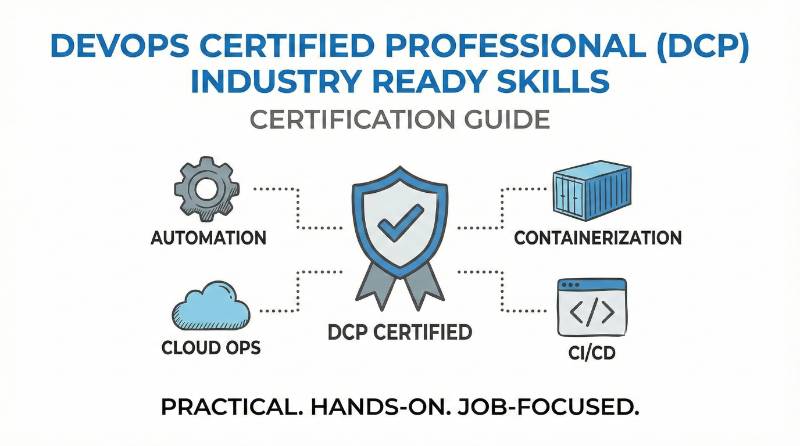
The DevOps Certified Professional (DCP) is the blueprint for this culture. It isn’t just another certification; it is a strategic framework for senior engineers and managers to align technical delivery with business outcomes. If you are looking to move beyond “fixing bugs” and into “architecting excellence,” this guide is for you.
The Multi-Track Certification Ecosystem
Building a resilient organization requires expertise across multiple domains. The DCP program offers several specialized tracks designed for the diverse needs of global engineering teams.
| Track | Level | Who it’s for | Prerequisites | Skills Covered | Recommended Order |
| DevOps | Professional | SDEs, Architects | Linux, Git | CI/CD, K8s, Terraform | The Anchor |
| DevSecOps | Professional | Security Leads | DCP Foundation | Shift-Left Security, Vault | Advanced |
| SRE | Professional | Ops Managers | DCP Foundation | Error Budgets, SLOs | Advanced |
| AIOps/MLOps | Professional | ML Engineers | Python, DevOps | Model Ops, Automation | Specialist |
| DataOps | Professional | Data Architects | SQL, Cloud | Data Governance, Pipelines | Specialist |
| FinOps | Professional | Execs, Leads | Cloud Literacy | Unit Economics, Cost Gov | Leadership |
Inside the DevOps Certified Professional (DCP)
What it is
The DCP is a master-level accreditation that transforms practitioners into architects. It bridges the gap between software development logic and operational reliability by leveraging the world’s most advanced automation ecosystems. It is the gold standard for those who manage high-concurrency, high-availability systems.
Who should take it
This is for senior software engineers, platform architects, and engineering managers who are responsible for the delivery and stability of enterprise-grade software. It is also vital for technical leads in India and globally who are tasked with scaling their organization’s cloud-native maturity.
Skills you’ll gain
- Infrastructure Governance: Using Terraform and Ansible to ensure your environment is immutable and reproducible.
- Cloud Orchestration: Deep mastery of Kubernetes for managing distributed microservices at scale.
- Automation Strategy: Designing CI/CD pipelines that act as “quality gates” for production.
- Full-Stack Observability: Implementing Prometheus and Grafana to move from reactive fixing to proactive monitoring.
Real-world projects you should be able to do
- Multi-Region Disaster Recovery: Orchestrate a failover system that migrates traffic between global data centers in under five minutes.
- The Self-Healing Infrastructure: Design a Kubernetes cluster that automatically detects performance degradation and scales or restarts services without intervention.
- Governance as Code: Build a pipeline that automatically audits every code change for security vulnerabilities and cost impacts before deployment.
Preparation Plan
- 7-14 Days: Focus on the “Shift-Left” mindset. Master advanced Git workflows (Rebase, Cherry-pick) and Linux kernel optimization.
- 30 Days: Build “Pilot” pipelines. Spend this phase connecting Docker containers to Jenkins and automating server configurations.
- 60 Days: The “Architect” phase. Design full-scale environments using Terraform and Kubernetes, focusing on high availability and security.
Common Mistakes
- Siloed Thinking: Trying to automate without talking to the developers. Tools are useless if they don’t solve the team’s friction.
- Manual Overrides: Fixing a server manually instead of updating the code (Infrastructure as Code). This leads to “Configuration Drift.”
- Ignoring the Data: Automating a bad process just makes a bad process happen faster. Always measure your impact.
Best next certification after this
The DevSecOps Professional track is the ideal next step to ensure that your high-speed automation is also high-security.
Choose Your Strategic Path
- DevOps Path: Focus on Velocity. Build the engine that drives software to the market faster than the competition.
- DevSecOps Path: Focus on Trust. Ensure that every release is hardened against modern cyber threats.
- SRE Path: Focus on Resilience. Build systems that are virtually un-killable, maintaining 99.99% uptime.
- AIOps/MLOps Path: Focus on Intelligence. Use machines to manage the complexity of your growing infrastructure.
- DataOps Path: Focus on Quality. Ensure that your company’s data is as reliable as its code.
- FinOps Path: Focus on Efficiency. Turn your cloud bill from a liability into a strategic business asset.
Role → Recommended Certifications
| Role | Career Blueprint |
| DevOps Engineer | DCP (Foundation) → DevSecOps Practitioner |
| SRE | DCP (Foundation) → SRE Specialist |
| Platform Engineer | DCP (Foundation) → Infrastructure Architect |
| Cloud Engineer | DCP (Foundation) → Multi-Cloud Mastery |
| Security Engineer | DevSecOps Professional → Security Architect |
| Data Engineer | DataOps Professional → Data Architect |
| FinOps Practitioner | FinOps Professional → Cloud Financial Analyst |
| Engineering Manager | DCP (Foundation) → FinOps → DevOps Leader |
Top Institutions for DevOps Certified Professional (DCP) Training
Here is a curated list of the top institutions that provide specialized training and certification for the DCP program. These organizations are recognized for their practical approach, expert mentorship, and deep industry connections.
- DevOpsSchool As the primary provider for the DCP program, DevOpsSchool sets the gold standard for hands-on learning. Their “Certified DevOps Professional” course is rigorous, featuring over 120 hours of mentor-led training and real-world “Live Projects” that simulate actual corporate environments. They are unique in offering internship programs to help bridge the gap between learning and employment.
- Cotocus Cotocus specializes in high-end corporate consulting and training for large enterprises. Their training methodology is built on real-world “war stories” from their consulting business, helping students understand how to solve complex production issues. They are an excellent choice for managers and teams who need to understand the cultural and strategic side of DevOps transformations.
- Scmgalaxy What started as a community for configuration management experts is now a massive resource hub for DevOps learners. Scmgalaxy offers deep-dive training into specific tools like Ansible, Jenkins, and Git, supported by a vibrant community of thousands of engineers. Their library of scripts and tutorials is an invaluable lifetime resource for any student.
- BestDevOps This institution focuses on staying on the “bleeding edge” of technology. BestDevOps ensures its curriculum is updated faster than anyone else, covering the latest versions of Kubernetes, AI tools, and cloud platforms. They are perfect for engineers who want to ensure their skills are future-proof and aligned with upcoming industry trends.
- DevSecOpsSchool A specialized wing dedicated entirely to security automation. This school focuses on “shifting left,” teaching you how to integrate security checks (SAST/DAST) directly into your pipelines. It is the go-to place for security engineers who want to master tools like Vault and SonarQube within a DevOps framework.
- SRESchool Focused purely on the science of reliability, SRESchool is for those who want to master the “run” side of software. Their curriculum dives deep into Service Level Objectives (SLOs), Error Budgets, and advanced monitoring, preparing you to keep massive systems online and stable.
- AIOpsSchool This niche academy focuses on the intersection of Artificial Intelligence and IT Operations. They teach you how to use machine learning models to predict server failures and automate incident response. It is an advanced track for those looking to build “self-healing” systems using data.
- DataOpsSchool Designed for data engineers and architects, this school applies DevOps principles to the world of Big Data. You will learn how to build automated data pipelines, ensure data quality, and manage ETL jobs with the same speed and reliability as software code.
- FinOpsSchool This institution addresses the critical need for cloud financial management. Their training focuses on “Cloud Economics,” teaching leaders and engineers how to optimize cloud spend, read complex billing reports, and ensure that engineering efficiency translates to business profitability.
The Master FAQ: Career, Growth, and Outcomes
1. Is the DCP certification recognized by global firms?
Yes. The principles and tools (Docker, K8s, Terraform) are the universal standard for modern engineering teams.
2. How does the DCP help a manager who doesn’t code daily?
It provides the technical “fluency” needed to hire the right talent and set realistic goals for automation and release speed.
3. What is the impact of DCP on a career in India?
India is a global hub for DevOps. Having a DCP certification puts you in the top tier of candidates for high-paying roles in multinational tech firms.
4. Can I transition from QA or System Admin to a DevOps role?
Absolutely. The DCP is designed to bridge the gap from manual testing or operations to automated “everything.”
5. Is the DCP exam theoretical or hands-on?
It is a practical, lab-based exam. You must show you can build and fix systems in a live environment to pass.
6. Does it cover Multi-Cloud strategies?
Yes. The DCP focuses on “cloud-agnostic” tools that work on AWS, Azure, and Google Cloud, making you a versatile architect.
7. How long does the certification stay valid?
It is usually valid for 2-3 years, keeping you current with the rapid evolution of tech.
8. What is the ROI for a company sponsoring its team for DCP?
Companies see a significant reduction in deployment failures and a 2x-3x increase in release frequency.
9. Do I need to learn Python for the DCP?
Basic scripting knowledge is required. The program will help you apply that logic to infrastructure automation.
10. How does this differ from tool-specific certs (like AWS or Docker)?
DCP teaches you how these tools integrate. A tool cert teaches you how to use a hammer; DCP teaches you how to build the house.
11. Is there a community for DCP graduates?
Yes, graduates get access to the Scmgalaxy and DevOpsSchool networks for lifelong support and job leads.
12. Can a freshener take the DCP?
While possible, it is best for those with at least 1-2 years of experience to fully grasp the complex operational challenges.
DCP Specific FAQs
1. What is the core focus of the DevOps Certified Professional (DCP) program?
The core focus is mastering the “Automated Delivery Pipeline” and “Cloud Orchestration” at an enterprise scale.
2. Is there a project required for certification?
Yes, a Capstone Project demonstrating a full CI/CD pipeline is a standard requirement.
3. What is the “Big Four” toolkit of the DCP?
Git, Jenkins, Docker, and Kubernetes.
4. Does the program cover Infrastructure as Code?
Yes, Terraform and Ansible are major components of the DCP curriculum.
5. Are there weekend batches for working professionals?
Yes, most institutions like DevOpsSchool offer flexible weekend schedules for senior engineers.
6. Is the DCP exam open-book?
It is an open-internet, practical exam—simulating a real work environment where searching for documentation is allowed.
7. Can I move into SRE after this?
Yes, the DCP is the perfect foundation for the SRE (Site Reliability Engineering) track.
8. How do I start the journey?
The first step is a mentor-led session. Click the links above to find the next batch.
Conclusion: The Future is Automated
The days of “throwing code over the wall” are gone. As an industry veteran, my advice is to stop viewing yourself as a coder and start seeing yourself as a System Architect. The future of tech belongs to those who can build systems that work for them, not the other way around. The DevOps Certified Professional (DCP) is your path to that future. Build your expertise, lead your team, and architect the future.
