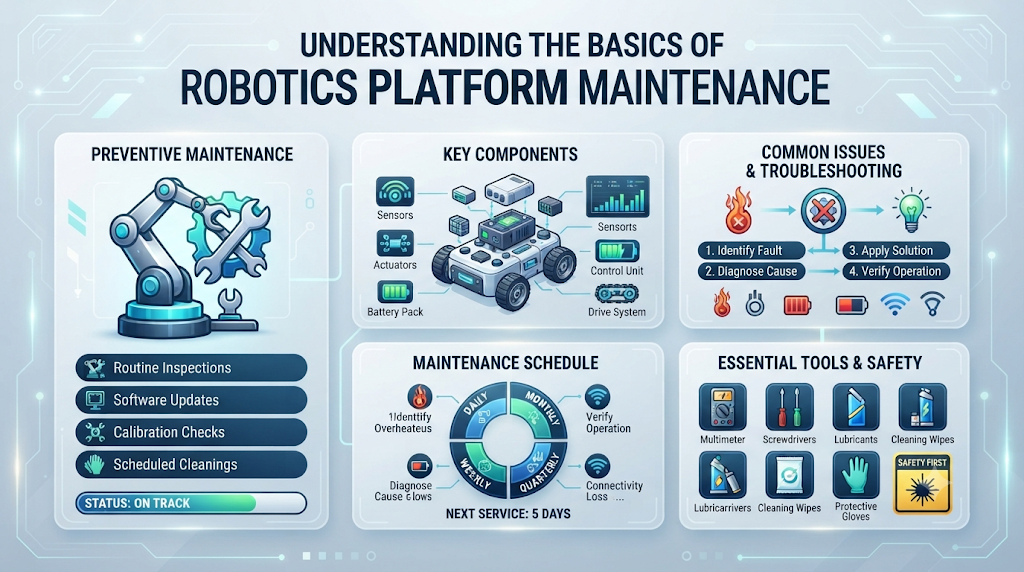
Industrial and service robots live in harsh physical environments. While software updates can be pushed over-the-air in minutes, physical wear, sensor drift, thermal stress, and battery degradation require rigorous maintenance schedules. A stalled automated guided vehicle (AGV) or an articulated manipulator arm with a failing harmonic drive can bring an entire production line or fulfillment center to a halt.
Robotics platform maintenance is the systematic process of preserving hardware integrity, calibrating perception suites, validating safety systems, and managing firmware lifecycles. This article examines how engineering and reliability teams approach robotics maintenance, operational trade-offs, and strategies to prevent catastrophic hardware failures.
The Shift from Reactive to Predictive Maintenance
Historically, manufacturing and logistics operations relied on reactive maintenance (fixing robots only after they break) or periodic calendar-based maintenance (servicing every unit every six months regardless of usage). Both approaches carry heavy penalties. Reactive repairs result in unplanned downtime and expensive emergency part shipments, while calendar-based maintenance often wastes labor by servicing healthy components too early while missing high-stress units that fail prematurely.
Modern robotics platforms leverage telemetry data from internal motor encoders, joint torque sensors, and thermal monitors to transition toward condition-based and predictive maintenance. By tracking anomalies such as rising motor current draws or vibration spikes in gearboxes, maintenance teams can intervene before a mechanical seizure occurs.
Core Pillars of Robotics Maintenance
Maintaining a heterogeneous fleet of robots requires balancing mechanical, electrical, and software disciplines across four primary pillars.
[ Mechanical Inspection ]  ──>  Gearboxes, bearings, lubrication, seals
[ Electrical & Power ]     ──>  Battery health, slip rings, wiring harnesses
[ Perception & Sensor ]    ──>  LiDAR calibration, camera alignment, IMU bias
[ Software & Firmware ]    ──>  OS updates, ROS/ROS2 packages, safety parameter verification
1. Mechanical Maintenance and Lubrication
Robotic joints endure immense cyclical stress. Articulated arms rely on harmonic drives and planetary gearboxes that require precise lubrication schedules.
- Backlash Monitoring: Increased play or mechanical backlash in a joint often indicates worn gear teeth or loose mounting bolts.
- Seal Integrity: In dusty or wet environments (such as food processing or outdoor logistics), wiper seals degrade, allowing contaminants to ruin internal bearings.
- Torque Validation: Technicians periodically measure holding torque and friction coefficients to detect premature wear before catastrophic jamming occurs.
2. Electrical Systems and Power Management
Electrical failures account for a significant percentage of robot downtime, often stemming from mechanical fatigue in wiring harnesses.
- Cable Flex Fatigue: Robots that continuously rotate or articulate subject internal cables to millions of bend cycles. Routing channels must be inspected for insulation cracking and conductor fatigue.
- Battery Degradation: Autonomous mobile robots (AMRs) powered by Lithium-ion battery packs lose capacity over charge-discharge cycles. Battery management systems (BMS) must monitor cell balancing, internal resistance, and thermal thresholds during fast-charging sessions.
3. Perception and Sensor Calibration
Autonomous navigation depends on flawless sensor data. Even minor physical bumps can knock sensors out of alignment.
- LiDAR and Camera Calibration: Extrinsic calibration between LiDAR frames, depth cameras, and the robot’s base frame must be verified periodically using target boards or automated point-cloud registration.
- IMU Bias Correction: Inertial Measurement Units suffer from drift over time. Regular stationary calibration routines are required to reset gyro and accelerometer biases.
4. Software, Firmware, and Safety Validation
Physical maintenance is meaningless if the software stack or safety limits are compromised.
- Safety PLC Verification: Emergency stop (E-stop) loops, light curtains, and safety laser scanners must be physically tested on a scheduled basis.
- Configuration Management: Fleet management software must maintain strict version control over firmware images deployed across different hardware revisions in the field.
Practical Implementation: Routine Maintenance Workflow
A disciplined maintenance workflow ensures that interventions are recorded, safety-certified, and minimally disruptive to operations.
- Lockout/Tagout (LOTO): Disconnect primary power sources and bleed pneumatic or hydraulic pressure before any hands-on mechanical servicing.
- Telemetry Log Review: Analyze pre-failure logs for thermal anomalies, current spikes, or localization loss warnings recorded by the onboard computer.
- Component Inspection & Servicing: Inspect high-wear items, clear debris from heat sinks and optical windows, and replenish grease or lubricant according to manufacturer specifications.
- Calibration and Self-Test: Run automated kinematic calibration routines and sensor alignment checks before re-enabling the robot in the production environment.
- Safety Loop Validation: Trigger physical E-stop switches and verify that the safety controller halts motion within certified latency limits.
Advantages, Limitations, and When NOT to Automate Maintenance
Advantages
- Maximized Fleet Uptime: Prevents unexpected bottlenecks in automated workflows.
- Extended Asset Lifespan: Proper lubrication and early intervention delay expensive capital expenditures on replacement hardware.
- Enhanced Workplace Safety: Ensures that physical safety interlocks and collision-avoidance systems operate flawlessly.
Limitations
- High Initial Setup Cost: Implementing sensor-driven predictive maintenance requires robust data logging infrastructure and specialized diagnostic tooling.
- Skilled Labor Shortage: Diagnosing complex electromechanical faults in advanced robotics requires cross-disciplinary technicians.
When NOT to Rely on Automated Diagnostics
- Post-Collision Assessment: After a high-impact crash or structural overload, automated sensor diagnostics are insufficient. The robot must undergo a complete manual teardown to inspect for micro-fractures in cast aluminum frames and hidden damage to internal load cells.
- Custom Prototyping Stages: For experimental or low-volume research platforms undergoing constant hardware redesigns, rigid maintenance schedules are less effective than continuous engineering oversight.
Risks, Failure Modes, and Prevention
- Over-Greasing Bearings: Applying excess grease to harmonic drives or motor bearings can cause hydraulic lock, seal blowout, and contamination of optical encoders. Prevention: Follow strict volume specifications and use calibrated grease guns.
- Ignorance of Thermal Thresholds: Operating robots in environments exceeding ambient thermal limits degrades electronic components and accelerates lubricant breakdown. Prevention: Monitor internal processor and motor temperatures via telemetry alerts.
- Unvalidated Firmware Rollouts: Pushing unverified software updates simultaneously across a heterogeneous fleet can cause widespread localization failures. Prevention: Implement canary deployments, testing updates on a single staging robot before fleet-wide rollout.
Frequently Asked Questions
Q1. How often should industrial robot gearboxes be lubricated?
Lubrication intervals vary widely based on duty cycle, payload, and operating speed, typically ranging from 5,000 to 20,000 operational hours. Manufacturers provide specific guidelines, but high-frequency pick-and-place applications require more frequent inspection than slow palletizers.
Q2. What is the most common cause of sudden robot failure?
Mechanical cable harness fatigue and connector degradation caused by continuous flexing are among the most frequent culprits. Electrical noise from worn shielding can also corrupt sensor data, leading to erratic navigation or sudden stops.
Q3. How do AMRs detect sensor calibration drift?
Autonomous mobile robots often use stationary calibration bays equipped with visual fiducial markers or walls with known geometry. When entering the bay, the robot compares its current sensor readings against known ground-truth coordinates to calculate angular and translational error.
Q4. Can predictive maintenance completely eliminate unexpected downtime?
No. While predictive maintenance catches most wear-related failures (such as bearing degradation or battery capacity loss), it cannot predict sudden external events, such as physical fork truck collisions or unexpected electrical surges from the facility grid.
Q5. Why is safety system validation separate from standard functional testing?
Safety systems (like E-stop circuits and category 0/1/2 stop behaviors) protect human workers from injury and must adhere to strict international standards (such as ISO 10218 and ISO 13849). These systems require dedicated verification independent of standard operational software performance.
Q6. What tools are essential for robotics field technicians?
Standard toolkits include digital multimeters, oscilloscope diagnostic tools for bus communication (like CANopen or EtherCAT), thermal imaging cameras, precision torque wrenches, and manufacturer-specific diagnostic software pendants.
Q7. How does operating environment temperature impact robot maintenance?
Extreme cold thickens lubricants and reduces battery capacity, while excessive heat accelerates electronic component aging and thermal expansion in mechanical linkages. Enclosures must feature adequate climate control or heating elements where necessary.
Q8. What is backlash, and why is it dangerous in robotic arms?
Backlash is the clearance or lost motion between mating gear teeth when direction reverses. Excessive backlash reduces positional accuracy, creates vibrations under heavy payloads, and accelerates mechanical wear through shock loading.
Q9. How should historical maintenance data be utilized?
Maintenance logs should be analyzed to identify recurring failure patterns across specific models or work cells. This data helps refine future procurement decisions, spare parts inventory levels, and preventive maintenance intervals.
Q10. Is specialized training required to maintain collaborative robots (cobots)?
Yes. While cobots feature simplified user interfaces for programming, their internal joint modules, force-torque sensors, and safety-rated architecture require specialized technical training from the manufacturer or certified integration partners.
Conclusion
Maintaining robotics platforms requires a disciplined synthesis of mechanical upkeep, electrical rigor, and software verification. Moving from reactive fixes to condition-based strategies protects capital investments and ensures steady operational flow. Success relies on meticulous adherence to manufacturer specifications, systematic safety validation, and continuous monitoring of component health.
