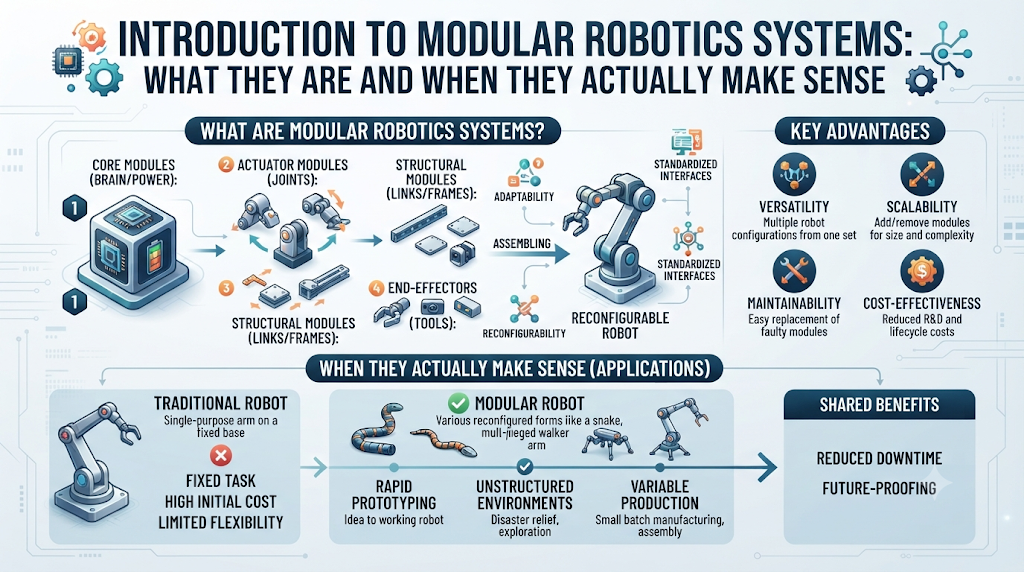
Modular robotics promises a simple trade: build robots from interchangeable units, and you get adaptability that fixed-architecture machines cannot match. A robot that can reconfigure its own shape, swap a failed module without a full teardown, or scale from a small manipulator to a larger structure by adding units sounds like a straightforward engineering win.
In practice, the trade is not simple. Every docking mechanism adds mass, every wireless link introduces latency, and every distributed control scheme creates debugging problems that do not exist in centralized systems. The failure probability of at least one module in a system of *n* modules approaches one as *n* grows, which means a large modular robot is almost guaranteed to face defective modules and need recovery strategies . Modular robotics systems are not better robots. They are a different set of engineering trade-offs, and understanding those trade-offs is the difference between a useful deployment and an expensive prototype that never leaves the lab.
Assumption: This article assumes you are evaluating modular robotics for a practical application—research, industrial inspection, education, or field deployment—and that you already understand basic robotics concepts like actuators, sensors, and control loops. It does not assume you have built a modular system before.
What Makes a Robot Modular
A modular robotics system consists of discrete units that can be physically connected and disconnected to form different robot configurations. The modules are typically identical or drawn from a small set of types, each carrying its own actuation, sensing, computation, and often power . The connection points—docking interfaces—provide both mechanical coupling and electrical or data communication.
The defining capability is reconfiguration. Changing the robot’s shape means changing how the modules are connected, either manually or autonomously. Self-reconfiguration, where the robot rearranges its own modules without human intervention, is the more ambitious version of this idea and remains an active research problem rather than a mature commercial capability .
Two properties distinguish modular systems from conventional robots with swappable end-effectors. First, the modules are structurally interchangeable: any module can occupy any position in the lattice or chain, subject to interface compatibility. Second, the system’s behavior is an emergent property of module interactions rather than a fixed kinematic chain. This is what enables fault tolerance—a failed module can be replaced by a spare or bypassed by reconfiguration—but it also makes control substantially harder.
The Engineering Trade-Offs That Define the Field
Modular systems occupy a specific niche defined by what they sacrifice for adaptability. Understanding these trade-offs before committing to a design is more valuable than any list of features.
Scalability versus per-module capability. Every module must carry its own power source, actuator, sensor, and communication hardware. This constrains how small and how capable each module can be. Miniaturizing modules reduces their performance capabilities, and there is no straightforward solution that preserves capability while shrinking size . A modular system with many small, weak modules behaves differently from a system with few large, strong modules, and neither is universally better.
Redundancy versus failure probability. Hardware redundancy is the modular approach’s core reliability argument: if one module fails, others can take its place. But the mathematics work against large systems. With a per-module failure probability *p*, the probability that at least one module in an *n*-module system fails is 1−(1−p)n, which tends toward 1 as *n* increases . The controller must handle defective modules as a routine condition, not an exception. This is a software problem as much as a hardware one.
Adaptability versus control complexity. Self-reconfiguration requires distributed planning across modules with limited local information. Convergence to a target configuration is not guaranteed by many simple control methods, and gradient-based approaches are communication-intensive and can conflict with kinematic constraints . The controller must be scalable, robust to module failure, and capable of recovering functionality within a bounded time—requirements that are difficult to satisfy simultaneously.
Portability versus power delivery. Modular components favor portability because each unit carries its own energy source and actuation . But this distributed power architecture limits how much energy each module can store and deliver. Systems that require high force or sustained operation may need centralized power delivery, which undermines the modularity advantage.
A Practical Starting Point: Manual Modularity Before Autonomous Reconfiguration
The most common mistake in modular robotics adoption is starting with self-reconfiguration. The research literature is clear that self-reconfiguration is a software-hardware challenge that remains unsolved for general-purpose deployment . Starting there means betting your project on an open research problem.
A more defensible path is to begin with manually reconfigurable modules and validate the value of modularity before adding autonomy.
Step 1: Define the reconfiguration use case in operational terms. Not “the robot should change shape” but “the robot must transition from a narrow inspection configuration to a wide manipulation configuration in under five minutes without specialized tools.” The specificity forces you to confront whether the modular architecture is actually necessary. If a fixed robot with a quick-change end-effector solves the problem, modularity is overhead.
Step 2: Choose a docking interface standard and validate it under load. The docking mechanism is the single point of failure that defines the system’s reliability. Electrical interface identification—where each docking port has a recognizable identifier that the control system can read—is a practical requirement for any system that needs to know its own topology . Test the interface under the worst-case load, vibration, and contamination conditions your application will encounter. A docking mechanism that works on a bench and fails in the field invalidates the entire architecture.
Step 3: Build the control architecture around failure as a normal condition. Because large modular systems will have defective modules , the controller must detect failed modules, isolate them, and route around them. This is not an advanced feature. It is a baseline requirement. Test it by deliberately disabling modules during operation and verifying that the system maintains function or degrades gracefully.
Step 4: Instrument the system for observability. Distributed systems made of autonomous modules are harder to monitor than centralized systems, and undetected failures can be fatal to the application . Log module-level state, communication health, and configuration transitions from the first prototype. Without this data, debugging a reconfiguration failure becomes guesswork.
Step 5: Add autonomy only after manual reconfiguration is reliable. Self-reconfiguration algorithms have convergence and scalability limitations that are easier to address when the underlying hardware and manual procedures are already validated . If the robot cannot be reconfigured reliably by hand, no algorithm will fix that.
What Commonly Goes Wrong
The failure modes in modular robotics cluster around three areas: interfaces, control software, and unrealistic expectations about autonomy.
Docking failures under real conditions. A docking interface that works in the lab may fail under vibration, thermal cycling, or contamination. The mechanical and electrical tolerances that make a connection reliable on a bench are often insufficient for field deployment. Design for misalignment and contamination from the start, and test the interface to failure before committing to a module count.
Distributed software bugs that only appear in specific configurations. A distributed program may work in most configurations but fail in a particular topology or when a specific module is faulty . This is qualitatively different from centralized software bugs because the state space of configurations is combinatorial. Configuration-specific testing—deliberately exercising unusual topologies and failure combinations—is not optional.
Communication bandwidth and latency assumptions. Communication range between modules is often limited to local connections due to energy and bandwidth constraints . If your control scheme assumes global state knowledge or low-latency coordination, it may fail when the system scales. Design control laws that tolerate the communication topology you actually have, not the one you wish you had.
Treating self-reconfiguration as a product feature. The gap between research demonstrations and deployable self-reconfiguration is substantial. If your business case depends on the robot autonomously rearranging itself in unstructured environments, validate that capability in your specific conditions before building the rest of the system around it.
How to Verify the System Is Working
Measure the right things. Module count and configuration range are vanity metrics. What matters:
- Reconfiguration time and reliability: Can the system reach target configurations within the operational window, and what percentage of attempts succeed without manual intervention?
- Failure recovery rate: When a module is disabled, does the system detect it and maintain function? Measure the time from failure to recovery.
- Docking cycle life: How many connect-disconnect cycles does the interface survive before degradation? This directly determines maintenance cost.
- Control latency under load: Does the distributed controller maintain acceptable response times as module count increases?
- Observability coverage: Can you reconstruct the sequence of events that led to a failure from logged data? If not, the system is not operable at scale.
Frequently Asked Questions
Q1. What is the difference between a modular robot and a robot with interchangeable parts?
A modular robot’s modules are structurally interchangeable—any module can occupy any position in the configuration. A robot with interchangeable end-effectors has a fixed kinematic structure and swaps only the tool. The distinction matters because structural modularity enables reconfiguration and fault tolerance in ways that tool-changing does not.
Q2. Do I need self-reconfiguration for a modular system to be useful?
No. Many practical applications of modular robotics rely on manual reconfiguration or module swapping for maintenance. Self-reconfiguration adds significant control complexity and remains a research challenge for general deployment. The value of modularity—repairability, scalability, configuration flexibility—can be realized without autonomous rearrangement.
Q3. What is the biggest technical challenge in modular robotics?
Distributed control that remains reliable as module count grows. Every module adds communication overhead, failure probability, and configuration state. Controllers must guarantee convergence, handle faulty modules, and scale without centralized coordination—requirements that are difficult to satisfy simultaneously .
Q4. How does module failure affect a large modular system?
With a per-module failure probability *p*, the probability that at least one module in an *n*-module system fails approaches 1 as *n* increases . Large systems must treat module failure as a routine condition. The hardware redundancy helps, but the control software is responsible for actually detecting and routing around failures.
Q5. Are modular robots more expensive than fixed robots?
The per-unit cost is often higher because each module duplicates actuation, sensing, power, and communication hardware. The total cost depends on the application. Modular systems can be cost-effective when reconfiguration or fault tolerance replaces the need for multiple specialized robots, but the economics are rarely as simple as “one robot instead of many.”
Q6. What is a docking interface, and why does it matter?
The docking interface is the mechanical and electrical connection between modules. It defines what configurations are possible, how reliable the system is under load and contamination, and how many connect-disconnect cycles the system can survive. A weak docking interface invalidates the modular architecture regardless of how good the modules are.
Q7. Can modular robots work outdoors or in harsh environments?
They can, but the docking interfaces and communication links must be designed for the environment. Contamination, vibration, and thermal cycling are more aggressive on exposed interfaces than on sealed fixed joints. Field deployment requires testing the interface under the actual conditions, not just the modules in isolation.
Q8. What is the role of simulation in modular robotics development?
Simulation lets you explore configurations and control strategies without building every physical variant . But simulation results can diverge from reality when contact dynamics, communication latency, or module failure behavior are simplified. Use simulation for exploration and regression testing, but validate critical behaviors on hardware.
Q9. How do I choose the right module size for my application?
Start from the force and precision requirements of the most demanding task, then work backward to module capability. Smaller modules enable finer reconfiguration granularity but reduce per-module strength and payload. There is no universal answer; the choice depends on whether your application values fine shape control or high force output.
Q10. What should I build first if I want to explore modular robotics?
Build a small system of manually dockable modules with a well-instrumented control interface and a clear reconfiguration use case. Validate the docking interface, the failure detection, and the observability before adding any autonomy. A reliable four-module system with good logging teaches more than a fragile twenty-module system that cannot be debugged.
Conclusion
Modular robotics systems trade per-module capability and control simplicity for adaptability and repairability. That trade is worth making when reconfiguration or fault tolerance solves a real operational problem—and not worth making when a fixed robot with a quick-change tool would do the job. Start with manual modularity, instrument everything, and treat module failure as a design condition rather than an exception. The systems that succeed are the ones that respected the engineering constraints before reaching for autonomy.
