Introduction
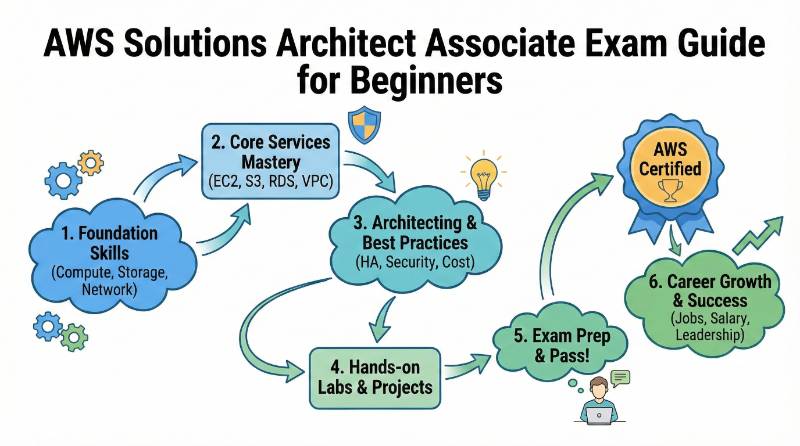
In the world of cloud computing, certifications are often just pieces of paper—until you need to prove you can design a system that won’t crash under load or bankrupt your company. The AWS Certified Solutions Architect – Associate is the exception. It is widely regarded as the “gold standard” for cloud professionals because it forces you to think about architecture, not just tools. This guide is for working engineers, managers, and software developers who need to understand not just how to pass the exam, but how to actually build resilient, secure, and cost-effective systems on AWS.
Certification Overview
Below is the essential breakdown of this certification.
| Feature | Details |
|---|---|
| Certification Name | AWS Certified Solutions Architect – Associate |
| Track | Architecture |
| Level | Associate (Intermediate) |
| Who it’s for | Solutions Architects, DevOps Engineers, Developers, and Technical Managers. |
| Prerequisites | None officially, but basic Linux/networking knowledge is highly recommended. |
| Skills Covered | Resilient Architecture, High Performance, Secure Applications, Cost Optimization. |
| Recommended Order | Take this as your first serious AWS exam (skip Cloud Practitioner if you are technical). |
Deep Dive: AWS Certified Solutions Architect – Associate
What it is
This certification validates your ability to design distributed systems on AWS. It doesn’t just ask “what does S3 do?”; it asks “Which S3 storage class is most cost-effective for data accessed once a year but needed immediately?” It tests your ability to make trade-offs between speed, cost, and reliability.
Who should take it
- Software Engineers moving into cloud-native development.
- System Administrators transitioning to DevOps or Cloud Engineering.
- Technical Managers who need to vet architectural decisions proposed by their teams.
- Anyone looking to prove they understand the “Well-Architected Framework.”
Skills you’ll gain
- Designing for Failure: How to build systems that heal themselves when a server crashes.
- Security Posture: Implementing IAM roles, Security Groups, and NACLs correctly (least privilege).
- Storage Strategy: Choosing between S3, EBS, EFS, and FSx based on workload requirements.
- Database Selection: Knowing when to use RDS vs. DynamoDB vs. Aurora.
- Cost Optimization: Spotting waste in architecture and using Savings Plans/Spot Instances.
Real-world projects you should be able to do after it
- 3-Tier Web Architecture: Deploy a highly available WordPress site with an Application Load Balancer, Auto Scaling Group, and Multi-AZ RDS.
- Serverless API: Build a REST API using API Gateway, AWS Lambda, and DynamoDB.
- Secure VPC Design: Create a custom VPC with public/private subnets, NAT Gateways, and a bastion host.
- Static Website Hosting: Host a secure website on S3 with CloudFront and Route 53.
Preparation plan
- 7-14 Days (Crash Course): Only feasible if you have 2+ years of daily AWS experience. Focus strictly on practice exams and “exam logic.”
- 30 Days (Standard): 2 hours/day. Week 1: VPC & Networking. Week 2: Compute & Storage. Week 3: Databases & Security. Week 4: Practice Exams.
- 60 Days (Recommended for Beginners): 1 hour/day. allows time to actually build the labs. If you rush the labs, you will fail the interview even if you pass the exam.
Common mistakes
- Ignoring VPCs: Many candidates gloss over networking. If you can’t debug a Security Group vs. NACL issue, you aren’t ready.
- Memorizing answers: AWS changes questions frequently. Understand the concept (e.g., why decoupling with SQS is better than direct calls).
- Overlooking “Stateless” design: Failing to understand why web servers in an Auto Scaling Group must be stateless.
Best next certification after this
- AWS Certified DevOps Engineer – Professional (if you build pipelines).
- AWS Certified Solutions Architect – Professional (if you design complex hybrid networks).
Choose Your Path
Once you have your Associate Architect certification, your career can branch out. Here are the 6 most common paths.
- DevOps Path: Focus on CI/CD, Infrastructure as Code (Terraform/CloudFormation).
- Next Step: AWS DevOps Engineer – Professional.
- DevSecOps Path: Focus on compliance, IAM policies, and automated security remediation.
- Next Step: AWS Certified Security – Specialty.
- SRE (Site Reliability Engineering) Path: Focus on observability, chaos engineering, and SLAs/SLOs.
- Next Step: SysOps Administrator – Associate.
- AIOps/MLOps Path: Focus on deploying ML models and automating operations with AI.
- Next Step: AWS Certified Machine Learning – Specialty.
- DataOps Path: Focus on ETL pipelines, Redshift, and Glue.
- Next Step: AWS Certified Data Engineer – Associate.
- FinOps Path: Focus on cost allocation tags, billing reports, and reserved instance planning.
- Next Step: FinOps Certified Practitioner (Linux Foundation).
Role → Recommended Certifications Mapping
Don’t just collect certifications randomly. Match them to your target role.
| Role | Recommended Certifications Sequence |
|---|---|
| DevOps Engineer | Solutions Architect Associate $\rightarrow$ Developer Associate $\rightarrow$ DevOps Professional |
| SRE | Solutions Architect Associate $\rightarrow$ SysOps Administrator $\rightarrow$ DevOps Professional |
| Platform Engineer | Solutions Architect Associate $\rightarrow$ CKA (Kubernetes) $\rightarrow$ Advanced Networking Specialty |
| Cloud Engineer | Solutions Architect Associate $\rightarrow$ Solutions Architect Professional |
| Security Engineer | Solutions Architect Associate $\rightarrow$ Security Specialty $\rightarrow$ CISSP (Vendor neutral) |
| Data Engineer | Solutions Architect Associate $\rightarrow$ Data Engineer Associate $\rightarrow$ Machine Learning Specialty |
| FinOps Practitioner | Solutions Architect Associate $\rightarrow$ FinOps Certified Practitioner |
| Engineering Manager | Cloud Practitioner $\rightarrow$ Solutions Architect Associate (Stop here; you need breadth, not depth) |
Top Training Institutions
For those who prefer structured learning over self-study, these institutions provide training and certification support.
- DevOpsSchool
DevOpsSchool is a premier destination for instructor-led training, offering a “learning by doing” approach with real-time AWS projects. They go beyond the exam syllabus by including interview preparation kits and lifetime access to resources, making them ideal for candidates seeking job-readiness alongside their certification. - Cotocus
Specializing in corporate consulting and team upskilling, Cotocus is excellent for professionals looking to understand AWS within an enterprise context. Their training emphasizes industry-standard architectural patterns and collaborative cloud workflows, helping you understand how AWS fits into large-scale business operations. - Scmgalaxy
A robust community-driven platform that offers extensive tutorials, reference guides, and troubleshooting forums for AWS tools. It is a fantastic resource for finding practical configuration examples and scripts, which helps demystify the “hidden details” often tested in the Associate exam. - BestDevOps
Focuses on providing clear, structured career roadmaps and curated study guides for cloud aspirants. They help break down the overwhelming AWS ecosystem into manageable learning paths, ensuring you study the right topics in the right order for the Solutions Architect exam. - devsecopsschool
The ideal choice for architects who want to specialize in the “Security” pillar of the AWS Well-Architected Framework. Their training dives deep into IAM policies, encryption, and VPC security, ensuring you are prepared to answer the toughest security-related questions on the exam. - sreschool
Tailored for those interested in the reliability and operational excellence aspects of AWS. Their curriculum focuses heavily on monitoring, auto-scaling, and disaster recovery strategies, helping you master the high-availability concepts that are central to the Solutions Architect certification. - aiopsschool
Perfect for forward-thinking architects who want to understand how AI and Machine Learning integrate with standard AWS infrastructure. While covering core concepts, they also provide unique insights into designing architectures that support predictive analytics and automated operations. - dataopsschool
Focuses intensively on the data storage and management domains, such as RDS, DynamoDB, and S3 strategies. Their training is highly beneficial for mastering the “Data” portion of the exam, teaching you exactly when to choose one database type over another based on specific use cases. - finopsschool
Dedicated to the “Cost Optimization” pillar, which is a critical component of the AWS Associate exam. They teach practical strategies for managing cloud spend, utilizing Spot Instances, and analyzing billing, ensuring you can design architectures that are as cost-efficient as they are technical.
Next Certifications to Take
- Same Track (Deepen Architecture): AWS Certified Solutions Architect – Professional. This is a massive jump in difficulty but validates you can handle complex, multi-account migrations.
- Cross-Track (Specialize): AWS Certified Security – Specialty. Security is everyone’s job now. This makes you indispensable.
- Leadership Track: Project Management Professional (PMP) or Certified Scrum Master (CSM). If you want to manage the team building the cloud, combine AWS tech skills with management process.
FAQs — Difficulty, Time, Prerequisites, Sequence, Value, Career Outcomes
1) Is AWS Certified Solutions Architect – Associate difficult?
It is medium difficulty for most working professionals. It is not about deep coding. It is about making the right architecture choice in real scenarios (scaling, reliability, security, and cost). If you practice design-based questions and do some hands-on work, it becomes very manageable.
2) How much time do I need to prepare?
It depends on your starting point:
- If you already work on AWS daily: 7–14 days can work.
- If you are busy with job and can study 1–2 hours/day: 30 days is realistic.
- If you are new to AWS or cloud: 60 days is safer and less stressful.
3) What are the prerequisites for this certification?
There is no strict prerequisite. But you should be comfortable with:
- basic cloud concepts (compute, storage, networking),
- basic Linux/Windows usage,
- and simple understanding of how web applications work.
4) Do I need real AWS job experience to pass?
Not mandatory. Many learners pass without job experience, but you must do labs or small projects. Without hands-on practice, it becomes harder to answer scenario questions confidently.
5) Is this certification useful for software engineers (not cloud engineers)?
Yes. Developers benefit a lot because architecture decisions impact performance, reliability, and cost. It also helps you communicate better with DevOps, platform, and cloud teams.
6) Is this certification valuable for managers?
Yes. It helps managers review architecture plans, ask smarter questions, and understand cost and risk. Even if you don’t build systems daily, you can guide teams better after learning these concepts.
7) What is the best study sequence to follow?
A simple sequence that works well:
- Resilience and availability thinking
- Networking basics and secure boundaries
- Storage and database selection
- Performance and scaling approach
- Security and access control
- Cost optimization patterns
- Full revision + practice tests + weak-area repair
8) How many hours per day should I study?
- 60–90 minutes/day is enough for a strong 30-day plan.
- 2–3 hours/day helps if you want a fast-track timeline.
A good daily split is: concept (30 min) + hands-on (30 min) + practice Q&A (30 min).
9) What is the biggest mistake learners make?
They memorize AWS services instead of learning how to choose the best design for a requirement. The exam is scenario-focused, so decision-making matters more than memory.
10) What makes this certification valuable in the job market?
It signals that you can:
- design scalable and reliable systems,
- think about security early,
- optimize cost,
- and explain trade-offs clearly.
These skills are needed in almost every cloud-based company.
11) What career outcomes can I expect after passing?
Depending on your current role, you can move toward:
- Cloud Engineer / Cloud Architect track
- DevOps Engineer / Platform Engineer track
- SRE track
- Security Engineer track
- FinOps / Cloud cost optimization track
It also supports promotion discussions because you improve design ownership.
12) Should I take this certification before DevOps/SRE/Kubernetes paths?
In many cases, yes. This certification gives you strong cloud foundation. Then you can add DevOps tools, SRE practices, or Kubernetes based on your target job role.
FAQs: AWS Certified Solutions Architect – Associate
Q1: How hard is the exam?
It is challenging but fair. It tests scenarios, not just facts. You need to read carefully to spot keywords like “most cost-effective” or “lowest latency.”
Q2: How long does it take to prepare?
For a working professional with some IT background, 4-6 weeks of consistent study (1-2 hours daily) is standard.
Q3: Do I need to know how to code?
No. You need to understand code flow (e.g., how a Lambda function triggers), but you won’t be asked to write Python or Java syntax.
Q4: What is the passing score?
720 out of 1000. It is a scaled score, so questions have different weights.
Q5: Does this certification expire?
Yes, it is valid for 3 years. You must recertify to stay active, though usually, you would level up to the Professional exam by then.
Q6: Can I get a job with just this certification?
In India and globally, the certification gets you the interview. Your hands-on knowledge (labs, projects) gets you the job. It is not a magic ticket without practical skills.
Q7: Is it better than the Developer Associate?
It is broader. Solutions Architect is better for overall understanding. Developer Associate is better if you are strictly writing code that runs on AWS.
Q8: What is the cost of the exam?
The exam typically costs $150 USD. Prices may vary by region or with vouchers.
Testimonials
“The training was very useful and interactive. Rajesh helped develop the confidence of all. We really liked the hands-on examples covered during this training program.”
— Indrayani, India
“Very well organized training, helped a lot to understand the DevOps concept and details related to various tools. Very helpful.”
— Sumit Kulkarni, Software Engineer
“Good training session about basic DevOps concepts. Working sessions were also good.”
— Ravi Daur, Noida
Conclusion
The AWS Certified Solutions Architect – Associate is more than just a badge; it is a mindset shift. It moves you from “making things work” to “designing things that last.” Whether you are a fresh graduate or a manager looking to upskill, this path provides the highest ROI in the cloud industry today.
