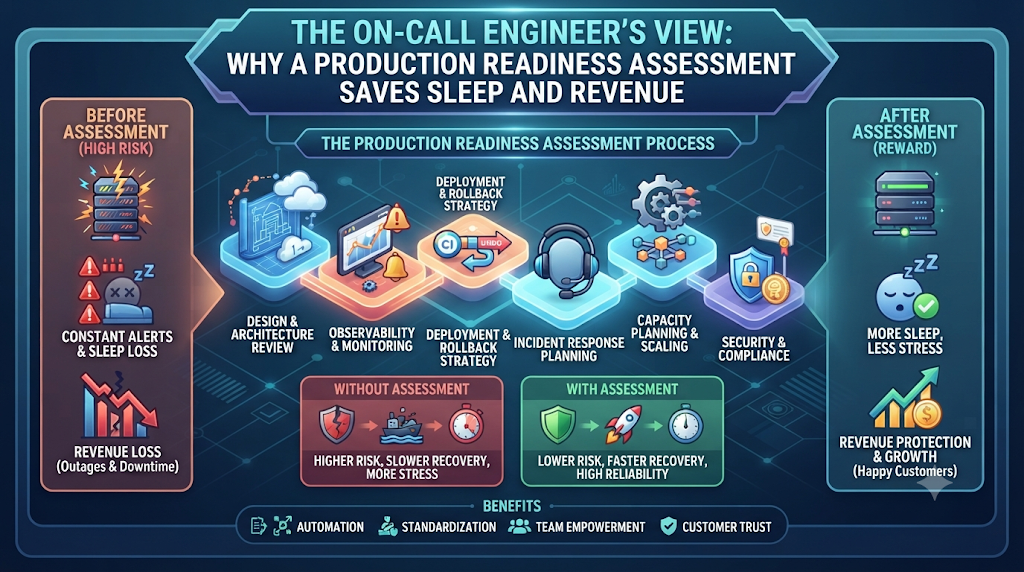
Ask any experienced on-call engineer what their worst weekend looked like, and the story rarely starts with an exotic zero-day exploit. It usually starts with something mundane: a brand-new microservice pushed straight to production without memory limits, a missing rollback script, or an alert wired to a Slack channel nobody checks after 6:00 PM. Running a practical production readiness assessment stops those preventable surprises before real customers ever feel them.
At OpsRoadmaps, we look at engineering operations through the eyes of the people who actually build, deploy, and carry the pager for live software. Rather than treating readiness as red tape designed to slow down product launches, this guide shows how teams use clear readiness habits—alongside broader maturity roadmaps—to ship faster while sleeping better at night.
What Happens When Teams Skip Readiness Checks
In fast-moving engineering teams, shipping features feels like progress, while operational prep can feel like paperwork. Yet skipping basic operational checks quietly shifts the cost onto your future self.
When a service goes live without a structured review, three predictable problems follow:
- Silent Blind Spots: A dependency slows down, connection pools fill up, and nobody knows until customers start posting screenshots of error pages.
- Slow, Chaotic Recoveries: During an outage, responders waste precious minutes hunting down who owns the service, where its logs live, or how to roll back safely.
- Burnout and Friction: Product developers grow frustrated when operations teams block releases at the last minute, while SREs burn out fighting avoidable fires.
A production readiness assessment breaks that cycle. It creates a transparent, shared agreement on what “ready for live traffic” actually means long before deployment day arrives.
Seeing the Bigger Picture: Service Readiness vs. Organizational Maturity
Checking whether one service is ready for launch is vital, yet lasting reliability depends on the habits of the entire engineering organization. Think of service readiness as inspecting a single aircraft before takeoff, while broader maturity models evaluate the airport, maintenance crews, and air-traffic systems supporting every flight.
Depending on where your organization struggles most, readiness connects directly to seven foundational capability tracks:
- DevOps maturity assessment: Measures how smoothly your teams plan, build, test, deploy, and monitor software across the full delivery lifecycle.
- Platform engineering adoption roadmap: Helps internal platform teams replace repetitive infrastructure tickets with self-service golden paths and compliant templates.
- SRE adoption roadmap: Introduces error budgets, Service Level Objectives (SLOs), toil reduction, and blameless postmortems so reliability becomes measurable rather than emotional.
- Incident management maturity model: Tracks how your team moves from chaotic late-night heroics to calm, coordinated detection, triage, communication, and follow-up learning.
- DevSecOps implementation roadmap: Embeds container scanning, dependency checks, and secrets hygiene directly into everyday pull requests instead of leaving security to a late pre-launch audit.
- Observability maturity model: Evaluates whether engineers can answer unfamiliar questions about live production behavior using correlated logs, metrics, and traces.
- Cloud cost optimization roadmap: Ensures teams track workload unit economics, right-size compute resources, and eliminate idle cloud waste as traffic scales.
One vital rule: Neither a readiness checklist nor a maturity score replaces an independent security audit, and neither guarantees zero downtime. Both exist to surface blind spots early so your team can fix high-risk gaps intentionally.
Five Practical Questions Every Readiness Review Should Answer
You do not need a fifty-page questionnaire to catch 90% of production risks. Instead, sit down with the service owners and verify concrete evidence across five everyday operational questions.
| Core Question | What Could Go Wrong Without It | Concrete Proof to Check |
| 1. Can it survive a bad day? | One overloaded node or slow database takes down the whole user flow | Multi-zone replicas, request timeouts, circuit breakers, and tested failover behavior |
| 2. Can we undo a bad deploy fast? | A broken release lingers for hours while engineers scramble to patch live code | Automated CI/CD pipeline, canary or blue-green rollout, and a tested rollback command |
| 3. Will we know before users complain? | Customers report broken checkouts before any internal dashboard turns red | Actionable SLO burn-rate alerts, structured logs, traces, and an attached runbook |
| 4. Are secrets and access locked down? | Hardcoded API keys or overly broad cloud roles expose sensitive data | Vault-managed secrets, least-privilege IAM roles, image scans, and network policies |
| 5. Who answers the pager—and what does it cost? | Alerts fire into an unmonitored inbox while runaway pods spike the cloud bill | Active on-call rotation, escalation path, CPU/memory limits, and workload cost tags |
How to Introduce Readiness Reviews Without Slowing Down Developers
The fastest way to kill a readiness program is to turn it into a surprise hurdle three days before a promised customer launch. Keep adoption human, lightweight, and predictable:
- Start With Your Most Critical Services: Classify workloads by business impact. Apply strict readiness criteria to customer-facing, revenue-critical services first, and keep internal tools lightweight.
- Write the Rules Together: Invite product engineers, SREs, and security specialists to co-design a concise baseline—such as a Kubernetes production readiness checklist for containerized apps. People support standards they helped shape.
- Bake Standards Into Starter Templates: Give developers ready-made Helm charts, Terraform modules, and CI templates that already include logging, metrics endpoints, and security defaults.
- Verify Live Links, Not Checkboxes: Require links to working dashboards, alert rules, and runbooks rather than simple “Yes/No” answers.
- Log Non-Blocking Gaps Openly: If a service has minor telemetry gaps that do not threaten stability, let it ship while tracking those items with clear owners and due dates.
- Refine After Every Real Incident: Whenever a production issue exposes a missing check, update your baseline so the whole organization learns once.
Hands-On Example: Kubernetes Health Probes and Resource Guardrails
In Kubernetes clusters, unconfigured memory limits and missing health probes remain two of the top causes of sudden pod restarts and dropped traffic. Below is a clean, production-ready Deployment manifest showing non-root execution, explicit compute bounds, and separated startup, readiness, and liveness probes:
YAML
apiVersion: apps/v1
kind: Deployment
metadata:
  name: notification-worker
  namespace: messaging-prod
  labels:
    app: notification-worker
    tier: tier-1
spec:
  replicas: 3
  strategy:
    type: RollingUpdate
    rollingUpdate:
      maxUnavailable: 0
      maxSurge: 1
  selector:
    matchLabels:
      app: notification-worker
  template:
    metadata:
      labels:
        app: notification-worker
    spec:
      securityContext:
        runAsNonRoot: true
        runAsUser: 10005
      containers:
        - name: worker
          image: registry.example.com/notification-worker:3.1.0
          ports:
            - containerPort: 8080
          resources:
            requests:
              cpu: "300m"
              memory: "384Mi"
            limits:
              cpu: "600m"
              memory: "768Mi"
          startupProbe:
            httpGet:
              path: /health/startup
              port: 8080
            failureThreshold: 10
            periodSeconds: 5
          readinessProbe:
            httpGet:
              path: /health/ready
              port: 8080
            periodSeconds: 10
          livenessProbe:
            httpGet:
              path: /health/live
              port: 8080
            periodSeconds: 20
Giving slow-starting containers a dedicated startupProbe stops Kubernetes from killing them prematurely during boot, while readinessProbe ensures load balancers only send traffic to healthy, warmed-up instances.
Real-World Scenarios From the Trenches
Case 1: Catching a Hidden Queue Bottleneck Before a Product Launch
A fintech team prepares to roll out instant payout notifications to millions of users. During a focused production readiness assessment two weeks before launch, engineers notice that their message consumer lacks backpressure limits and dead-letter queue routing. Under simulated peak load, a downstream email provider slowdown causes worker memory usage to spike until pods crash. Adding rate limits, dead-letter queues, and memory alerts before launch prevents a major customer-facing outage.
Case 2: Calm Kubernetes CrashLoopBackOff Troubleshooting
Imagine getting paged because a freshly deployed service is stuck in CrashLoopBackOff. Following a structured Kubernetes CrashLoopBackOff troubleshooting sequence keeps you from making panicked changes that worsen the outage:
- Inspect pod status and recent cluster events:Bash
kubectl get pods -n messaging-prod kubectl describe pod notification-worker-6b8d9f-k92lm -n messaging-prod - Read current and previous container logs:Bash
kubectl logs notification-worker-6b8d9f-k92lm -n messaging-prod kubectl logs notification-worker-6b8d9f-k92lm -n messaging-prod --previous - Pinpoint the exact failure signal:
OOMKilledwith exit code137means the container exceeded its memory limit—check for memory leaks or adjust limits carefully.- Exit code
1with application stack traces usually points to a missing secret, bad environment variable, or unreachable database on startup. - Repeated probe failures in
describe podindicate an incorrect health endpoint path, wrong port, or overly aggressive timeout.
- Revert or fix cleanly: Roll back the offending release through your CI/CD or GitOps workflow and verify that pods reach
RunningwithREADY 1/1. (Avoid force-deleting stateful pods or namespaces in production without checking controller behavior first.)
Measuring Whether Your Readiness Habits Actually Work
Checklists only matter if they improve life for your users and your on-call engineers. Track a concise set of outcome-focused indicators:
- Deployment Frequency and Lead Time for Changes: Drawn from DORA research, confirming that operational guardrails support—rather than block—steady delivery.
- Change Failure Rate and Mean Time to Restore (MTTR): Showing whether releases break less often and recover faster when issues occur.
- SLO Attainment and Error Budget Burn: Keeping engineering priorities grounded in real user experience instead of gut instinct.
- Actionable Alert Ratio: Measuring how often pages lead to real corrective work versus noisy false alarms that disrupt sleep.
- Cost per Workload or Transaction: Ensuring reliability upgrades stay aligned with healthy cloud unit economics.
Common Traps That Undermine Operational Readiness
- Turning Readiness Into a Pre-Launch Ambush: Reviewing a service for the first time two days before launch forces ugly choices between delaying business goals or waiving critical safety checks.
- Copying Enterprise Complexity Too Early: A small team running five services does not need the heavy multi-cluster governance of a global bank—match standards to real risk.
- Equating Dashboards With Observability: Collecting gigabytes of metrics helps nobody if engineers cannot trace a failing user request across service boundaries during an incident.
- Neglecting Runbook Maintenance: A runbook written eighteen months ago with outdated CLI commands can mislead responders during a high-pressure outage.
How OpsRoadmaps Helps Teams Turn Gaps Into Action
OpsRoadmaps helps engineering teams and technical leaders assess operational health, spot capability gaps, and build structured improvement roadmaps across 42 engineering operations disciplines.
Rather than offering generic individual tutorials, OpsRoadmaps provides structured evaluations, explainable maturity insights, prioritized findings, technical checklists, architecture blueprints, and troubleshooting runbooks covering production readiness, DevOps, SRE, platform engineering, Kubernetes, incident management, DevSecOps, observability, and FinOps—giving teams a clear, practical path from self-assessment to measurable operational progress.
Frequently Asked Questions (FAQs)
1. What is a production readiness assessment in simple terms?
It is a structured pre-launch and ongoing check to verify that a software service has the resilience, monitoring, security, rollback capability, and on-call ownership needed to run safely in production.
2. When should an engineering team run a production readiness assessment?
Run one before launching a new customer-facing service, ahead of major traffic or architectural changes, and periodically afterward to catch configuration and operational drift.
3. How does a DevOps maturity assessment differ from a readiness review?
A DevOps maturity assessment evaluates organization-wide delivery speed, automation, testing, and collaboration habits, while a readiness review verifies whether a specific service is prepared for live production traffic.
4. What belongs on a practical Kubernetes production readiness checklist?
A strong Kubernetes production readiness checklist includes CPU and memory requests/limits, startup/readiness/liveness probes, multiple replicas across zones, non-root security contexts, network policies, centralized logging/metrics, and tested rollback steps.
5. When should a company follow a platform engineering adoption roadmap?
Teams benefit from a platform engineering adoption roadmap when multiple product squads start duplicating CI/CD pipelines, infrastructure scripts, and Kubernetes configs—creating heavy cognitive load and inconsistent security baselines.
6. How does an SRE adoption roadmap balance speed and reliability?
An SRE adoption roadmap introduces Service Level Objectives (SLOs) and error budgets, giving product and engineering leaders an objective signal for when to push new features versus investing in stability.
7. What does an incident management maturity model help teams improve?
An incident management maturity model helps teams evolve from chaotic ad-hoc troubleshooting to clear incident commander roles, tested runbooks, timely stakeholder updates, and blameless postmortems.
8. Where should teams begin with a DevSecOps implementation roadmap?
Most teams start a DevSecOps implementation roadmap by adding automated secrets scanning, dependency checks, and container vulnerability scans directly into pull-request workflows before enforcing stricter runtime controls.
9. How do teams progress along an observability maturity model?
An observability maturity model guides teams from basic server uptime alerts to unified logs, metrics, and distributed traces tied directly to user-facing SLOs.
10. What are the core steps in a cloud cost optimization roadmap?
A cloud cost optimization roadmap focuses on accurate workload tagging, right-sizing over-provisioned compute and storage, autoscaling idle capacity, and giving developers visibility into the cost of their code.
11. What is the first command to run during Kubernetes CrashLoopBackOff troubleshooting?
Start with kubectl describe pod to inspect exit codes and probe events, followed by kubectl logs --previous to view the exact error output before the container crashed.
12. Does completing a readiness review guarantee zero production incidents?
No. Readiness reviews dramatically reduce preventable outages and speed up recovery, but upstream provider failures, hardware faults, and unexpected traffic surges can still happen.
Conclusion
Great engineering operations are built through steady, practical habits—not last-minute heroics. A clear production readiness assessment aligns developers, SREs, and leaders around shared reliability standards, turns risky launches into calm routines, and keeps on-call nights quiet.
Start with one concrete step this week: pick a critical production service, verify its health probes, rollback steps, and alert runbooks against a concise checklist, and explore OpsRoadmaps assessments and roadmaps to guide your team’s next operational improvements.
