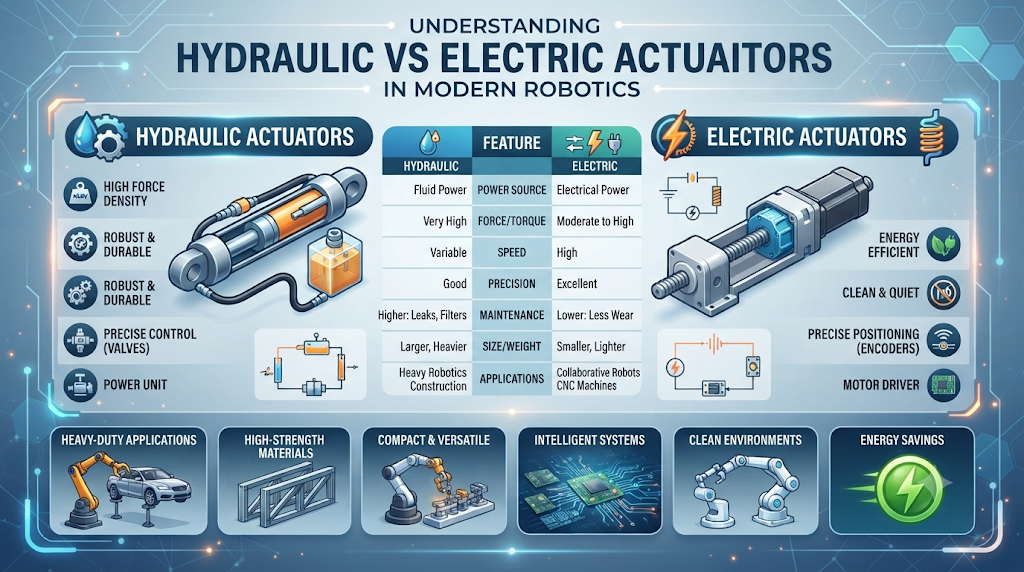
Choosing the right actuation technology is one of the most consequential decisions in robotic system design. Whether you are building heavy-duty industrial manipulators, quadruped robots, or precision automated guided vehicles (AGVs), the choice between hydraulic and electric actuators dictates payload capacity, power density, maintenance schedules, and control complexity. For a deeper look at industrial automation infrastructure, you can reference RobotsOps.com. This guide breaks down the engineering mechanics, operational trade-offs, and selection criteria for both actuation systems so you can make an informed architecture choice.
Core Fundamentals: How Hydraulic and Electric Actuators Work
To evaluate hydraulic and electric actuators effectively, we must first understand their fundamental energy conversion mechanisms and operational architectures.
Hydraulic Actuators
Hydraulic actuators convert fluid pressure—typically pressurized mineral oil or synthetic fluid driven by a pump—into mechanical force or torque. The core components include a hydraulic power unit (HPU), valves, hoses, and cylinders or rotary motors.
Pascal’s law governs their operation: force applied at one point is transmitted undiminished throughout an incompressible fluid. This allows hydraulic systems to generate immense force densities relative to their physical footprint.
Electric Actuators
Electric actuators convert electrical energy into mechanical movement using an electric motor (stepper, DC, or brushless AC servo motor) coupled with a mechanical transmission mechanism such as a ball screw, lead screw, rack and pinion, or belt drive.
They rely on electromagnetic fields to generate torque, which is then translated into linear or rotational motion via precision mechanical interfaces. Advanced closed-loop feedback systems using encoders allow micro-meter level positioning accuracy.
Key Performance Comparison
Evaluating these two technologies requires looking across several distinct performance vectors: power density, precision, maintenance overhead, and environmental suitability.
Power Density and Force Output
Hydraulic systems excel in high-payload, high-force applications. Because fluids are incompressible and systems can operate at pressures exceeding 3,000 to 5,000 PSI, hydraulic actuators deliver unmatched force-to-weight ratios. This is why heavy construction machinery, hydraulic press brakes, and heavy-payload industrial robots rely on hydraulics.
Electric actuators have traditionally lagged in extreme force categories, though modern rare-earth magnet motors and high-efficiency roller screws are closing the gap. However, for payloads exceeding several thousand pounds, electric actuators become bulky and thermally constrained.
Precision, Control, and Bandwidth
When it comes to fine control and positioning accuracy, electric actuators are the clear winners. Servo-driven electric actuators offer exceptional repeatability, often down to microns, with programmable velocity profiles and integrated force sensing.
Hydraulic systems, while capable of high dynamic response, suffer from fluid compressibility, thermal expansion of oil, valve hysteresis, and stiction (static friction). Closed-loop electro-hydraulic servo valves can mitigate these issues, but they require complex tuning and continuous calibration.
Efficiency and Energy Consumption
Electric actuators consume energy on-demand. When an electric actuator holds a position, power draw drops to near zero (or requires minimal holding current), and regenerative braking can capture energy during deceleration.
Hydraulic systems, by contrast, often require the pump (driven by an electric motor) to run continuously or maintain system pressure via an accumulator. This results in continuous parasitic power losses, heat generation, and lower overall system efficiency.
Practical Implementation and System Design
Integrating either actuator type into a robotic platform demands distinct engineering considerations.
Hydraulic System Architecture
Designing a hydraulic circuit involves sizing the HPU, selecting appropriate filtration (typically 10-micron or better to prevent valve stiction), routing rigid steel tubing or flexible hoses, and managing thermal loads with oil coolers.
- Fluid management: Prevent contamination, which is the leading cause of hydraulic valve failure.
- Pressure regulation: Install pressure relief valves and accumulators to absorb hydraulic shock (water hammer effects).
- Sealing: Use high-grade elastomer seals compatible with your operating fluid and temperature range.
Electric System Architecture
Electric actuators require careful matching of the motor, drive amplifier, gearbox, and mechanical linkage.
- Thermal management: Monitor continuous vs. peak torque ratings to prevent stator overheating.
- Back-drivability: Determine whether the application requires a holding brake. Ball screws have low friction and will back-drive under load when unpowered, whereas lead screws are often self-locking.
- Cable management: Account for continuous flexing of power and encoder cables in articulated robotic joints.
Decision Guidance: When to Use Which Technology
Selecting between hydraulic and electric actuators depends heavily on your application constraints.
Choose Hydraulic Actuators When:
- You need extreme force density in a compact form factor (e.g., walking quadrupeds navigating rugged terrain, hydraulic rescue robots, or 50+ kg payload industrial arms).
- The system operates in harsh, shock-load environments where mechanical impacts would strip gear teeth in an electric drive.
- Inherent compliance is desired; fluid compressibility provides natural shock absorption against sudden mechanical impacts.
Choose Electric Actuators When:
- Cleanroom compatibility is required (no risk of oil leaks contaminating food processing, medical, or semiconductor manufacturing environments).
- High-speed, high-precision positioning and complex multi-axis interpolation are mandatory.
- Energy efficiency, low acoustic noise, and low maintenance overhead are top priorities.
When NOT to Use Electric Actuators:
Avoid electric actuators in high-payload, continuous-shock environments where peak forces would necessitate massive, cost-prohibitive motor and gearbox combinations that exceed allowable weight budgets.
Risks and Failure Modes
Every actuation technology comes with specific failure modes that engineers must design around.
Hydraulic Failure Modes
- Fluid Contamination: Particulate matter or moisture degrades servo valves and scores cylinder walls.
- Leakage: Hose ruptures or fitting failures create fire hazards, environmental slip hazards, and loss of control pressure.
- Cavitation: Vapor bubbles forming in low-pressure zones collapse violently, eroding pump internals.
Electric Failure Modes
- Mechanical Wear: Ball screw fatigue, bearing pitting, and backlash accumulation over millions of cycles.
- Thermal Overload: Excessive duty cycles or stalled motors leading to winding insulation breakdown.
- Electrical Noise (EMI): High-frequency PWM signals from servo drives interfering with sensitive sensor feedback loops.
Validation and Success Metrics
To verify that your actuation system is performing to specification, track the following metrics during commissioning:
- Step Response & Settling Time: Measure how quickly the actuator reaches commanded position without excessive overshoot.
- Thermal Equilibrium: Log operating temperatures of the motor casing or hydraulic fluid over a 4-hour continuous duty cycle.
- Position Repeatability: Perform multiple homing and positioning cycles to verify encoder or linear transducer consistency.
- Flow/Current Monitoring: Monitor baseline power consumption to detect unexpected mechanical binding or internal leakage.
Common Mistakes and Checklist
Common Mistakes
- Ignoring peak load requirements in favor of average load calculations, leading to thermal cutout or stalled actuators.
- Failing to account for flow losses and pressure drops in long hydraulic line runs.
- Overlooking thermal dissipation needs in enclosed robotic chassis.
Engineering Checklist
- [ ] Maximum payload and peak force/torque calculated with a 1.5x safety factor.
- [ ] Duty cycle (continuous vs. intermittent) verified against thermal limits.
- [ ] Environmental factors (temperature, dust, moisture, washdown) accounted for in ingress protection (IP) ratings.
- [ ] Maintenance accessibility planned for filter replacements, seal inspections, or gearbox lubrication.
Frequently Asked Questions
Q1. Are electric actuators completely replacing hydraulics in modern robotics? No. While electric actuators dominate clean, high-precision, and medium-payload applications, hydraulics remain irreplaceable in heavy-duty robotics, construction, and high-force dynamic systems where power-to-weight ratio is paramount.
Q2. How do hydraulic actuators handle shock loads compared to electric ones? Hydraulic fluid compressibility provides natural shock absorption, protecting structural components from sudden impacts. Electric actuators rely on rigid mechanical gear trains, meaning shock loads transfer directly through gear teeth unless mitigated by compliant couplings or torque-limiting clutches.
Q3. What is the primary cause of failure in hydraulic robot joints? Fluid contamination is the leading cause of failure. Microscopic particulate matter scores precision servo valve spools, leading to internal leakage, control drift, and eventual system failure.
Q4. Can electric actuators achieve the same force output as hydraulic cylinders? Theoretically yes, but practically no. To match the force of a modest hydraulic cylinder, an electric motor requires massive reduction gearing and heavy ball screws, resulting in a package that is significantly larger, heavier, and slower than its hydraulic counterpart.
Q5. Which system has higher initial capital expenditure (CapEx)? Electric actuation systems generally have lower initial setup costs for standard multi-axis robots due to off-the-shelf servo drives and controllers. High-end hydraulic systems require specialized pumps, manifolds, precision valves, and reinforced routing, often increasing upfront custom engineering costs.
Q6. What are electro-hydrostatic actuators (EHAs), and how do they differ from traditional hydraulics? EHAs combine the best of both worlds by integrating an electric motor, a miniature hydraulic pump, and a cylinder into a single self-contained modular unit. They eliminate centralized HPUs and long hoses while retaining high hydraulic force density.
Q7. How do operating temperatures affect hydraulic vs. electric actuators? High temperatures thin hydraulic oil, reducing volumetric efficiency and risking pump cavitation, while extreme cold thickens oil, causing sluggish response. Electric actuators face thermal limits based on motor winding insulation ratings and magnet degradation at elevated temperatures.
Q8. Which system requires more routine maintenance? Hydraulic systems demand rigorous maintenance, including regular fluid analysis, filter changes, seal inspections, and pressure checks. Electric actuators are largely maintenance-free, though some high-cycle gearboxes require periodic relubrication or ball-screw inspection.
Q9. Is energy efficiency significantly better with electric actuation? Yes. Electric actuators draw power proportional to the work performed and can regenerate energy during braking. Hydraulic systems suffer from constant pump running losses and throttling heat generation, resulting in lower system-level efficiency.
Q10. How do I decide between ball screws and roller screws for high-force electric actuators? Ball screws use recirculating balls and are ideal for standard precision and load requirements. Roller screws use multiple threaded rollers around the shaft, offering higher load capacities, greater rigidity, and longer lifespans in demanding high-force applications.
Conclusion
Choosing between hydraulic and electric actuators ultimately boils down to balancing power density, precision, environment, and maintenance realities. By evaluating your robot’s exact payload, duty cycle, and operational envelope against these core engineering principles, you can design a robust, reliable actuation architecture.
