A robot arm freezes in the middle of a weld. The line goes quiet. Everyone stares at the robot. But the real problem sits in the power cabinet.
Power is the part of robotics that most teams skip. We talk about speed, vision, and smart software. Yet a robot with weak power does nothing. Good power planning keeps robots safe, fast, and cheap to run.
In this guide, we explain how industrial robots get their power. You will learn about wall power, batteries, air, and oil. You will also see how energy moves from the plant grid to each robot joint. Teams at RobotsOps.com use this same simple view to plan robot fleets and avoid surprise downtime.
We keep the words plain and the steps clear. You do not need an electrical degree to follow along. By the end, you will know what to check, what to fix, and what to plan next.
The Short Answer: What Powers an Industrial Robot?
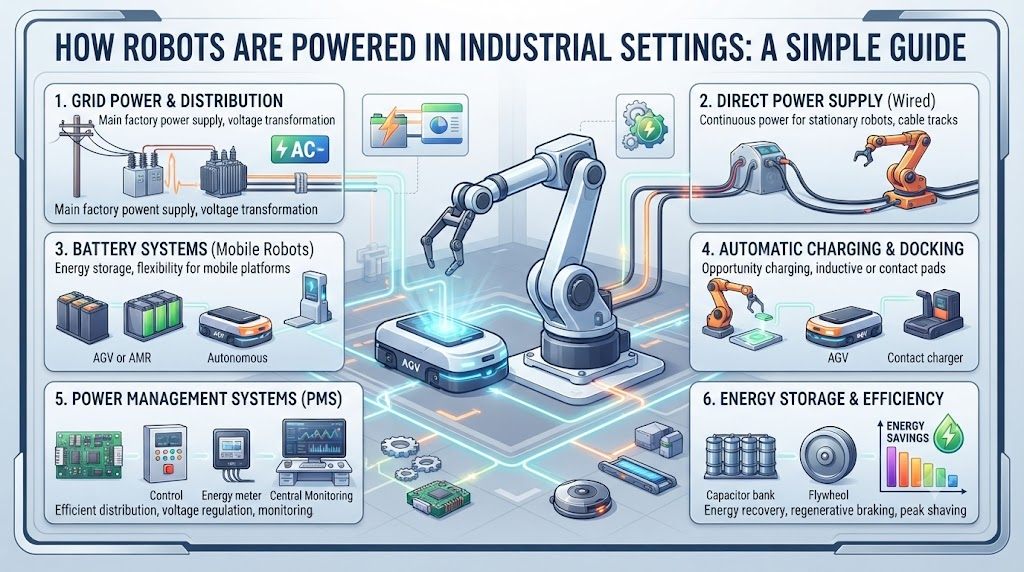
Most industrial robots run on electricity. The factory sends three-phase AC power to the robot controller. The controller turns that power into the right form for the motors. Each joint then moves with a servo motor.
Some robots also use air or oil. Grippers often use compressed air. Heavy lifting robots may use hydraulic oil. Mobile robots carry batteries because they cannot trail a cable.
That is the whole story in short. Now let us look at each part.
The Four Main Power Sources
Every robot uses one or more of four power sources. Each has strong and weak points.
Grid electricity powers most robot arms. It is steady, clean, and cheap. The robot stays plugged in, so it never runs flat.
Batteries power mobile robots such as AGVs and AMRs. These robots roam the floor, so they carry their own energy.
Compressed air drives grippers, clamps, and small tools. It is simple and fast. But air lines leak, and leaks waste money.
Hydraulic oil moves very heavy loads. It gives huge force. But it needs pumps, hoses, and careful upkeep.
| Power Source | Best For | Main Strength | Main Weakness |
|---|---|---|---|
| Grid electricity | Robot arms, welding, assembly | Steady and low cost | Needs fixed cables |
| Batteries | AGVs, AMRs, carts | Free movement | Needs charging time |
| Compressed air | Grippers, clamps, tools | Simple and quick | Leaks waste energy |
| Hydraulic oil | Heavy presses, big lifts | Very strong force | High upkeep and mess |
How Power Flows From the Wall to the Robot Joint
Think of power as water in pipes. It starts big and rough. Then each part cleans it and trims it down.
First, the plant brings in high voltage. A transformer steps it down to the level the work cell needs. Many plants use 400 to 480 volts, three-phase.
Next, a rectifier turns AC into DC. The DC sits on a shared “DC bus.” Think of it as a small tank of stored energy.
Then servo drives pull from that tank. Each drive sends exact pulses to one motor. The motor spins and moves one joint.
Last, the controller makes low-voltage DC, often 24 volts, for sensors, screens, and safety circuits. This control power stays apart from motor power. That split keeps the robot safe during a stop.
Regenerative Braking Saves Energy
When an arm slows down, its motors act like small generators. They send energy back to the DC bus. Other axes reuse that energy.
Some plants even send it back to the grid. This trick cuts the power bill. It also lowers heat inside the cabinet.
Battery Power for Mobile Robots
Mobile robots usually run on 24-volt or 48-volt battery packs. The battery type changes cost, safety, and uptime.
| Battery Type | Charge Speed | Life Span | Upkeep | Best Use |
|---|---|---|---|---|
| Lead-acid | Slow | Short | High (water, venting) | Low-cost, light duty |
| Lithium-ion | Fast | Long | Low | Busy, multi-shift fleets |
| Lithium iron phosphate (LFP) | Fast | Very long | Low | Safe, heavy daily use |
Lithium packs win in most busy sites. They accept short top-ups and do not need water. LFP packs add extra safety because they handle heat well.
Charging Methods for Robot Fleets
Fleets use three common ways to charge. Each fits a different work style.
Dock charging sends robots to a charger when they run low. It is simple and needs no people.
Opportunity charging gives short top-ups during idle breaks. Robots rarely run low, so fewer robots sit idle.
Battery swapping lets a worker or machine replace the pack in minutes. It suits sites that never pause.
Some sites also use wireless charging pads. They cost more, but they remove plugs and wear.
Backup Power and Safe Stops
Power drops happen. A good cell plans for them.
Every robot axis has a brake. The brake locks when power fails. So the arm does not fall or swing.
A small UPS keeps the controller alive for a short time. The robot can save its position and shut down in order. That saves hours of restart work.
Safety relays cut motor power but keep the logic power on. So the robot stops fast, and the team still sees the fault code.
Smart Ways to Cut Robot Energy Use
In many plants, electric motors use about two-thirds of all factory electricity. So even small gains matter.
Start with idle time. Put robots into low-power mode during breaks. Next, fix air leaks, because they run compressors all day for nothing.
Then smooth the robot paths. Sharp, jerky moves burn more power. Finally, pick motors that match the load. A motor that is too big wastes energy every cycle.
How Teams Watch Robot Power Every Day
You cannot fix what you cannot see. So track a few numbers on every robot.
Watch voltage, current, cabinet heat, and battery health. Set alerts for early warning signs, like a slow rise in heat. Then compare each week against the last one.
This is the RobotsOps way of thinking. Small trends warn you long before a robot stops. A quick fix on Tuesday beats a full line stop on Friday.
Real-World Power Stories From the Factory Floor
These stories come from common plant situations. Each one teaches a clear lesson.
- The hot cable lug: A car parts plant lost a welding cell for two hours. A loose cable lug heated up and tripped the drive. A yearly heat-camera check would have caught it early.
- The dying fleet: A warehouse ran 40 AMRs on lead-acid packs. Robots died in the middle of shifts. The team moved to lithium packs with short top-ups, and the dead-robot calls stopped.
- The weak air supply: A packaging line kept dropping boxes. Air leaks had eaten the pressure. The team fixed the leaks and added an air tank, and the grippers held firm again.
- The storm resets: A food plant saw robot arms reset during storms. Short voltage dips caused it. A small UPS on each controller kept the robots running.
- The costly morning peak: An electronics plant paid high demand charges. All robots started at the same minute each shift. Staggered start-ups cut the peak and the bill.
- The tired hydraulic oil: A paint shop ran hydraulic robots on old oil. Pumps wore out early. Regular oil tests and filter changes made the pumps last much longer.
- The hot charger corner: A pallet robot stopped every afternoon. Its charger sat in a hot corner, so the pack overheated. Moving the dock to a cooler spot fixed it.
- The shared weak circuit: A machine shop fed several robots from one weak circuit. Motors pulled big current at start, and breakers tripped. A dedicated feeder ended the trips.
- The energy-saving lifts: A battery plant added regenerative drives to lifting robots. Braking energy flowed to the shared DC bus and fed other axes. The monthly power bill dropped.
- The early battery warning: A logistics hub tracked battery health on a dashboard. Alerts flagged weak packs weeks before failure. The team swapped packs on schedule and avoided breakdowns.
Common Mistakes and Pitfalls
- Sizing power by the label only: Teams read the average power and forget the peak. Robots pull more current when they start and stop. Size feeders and breakers for the peak.
- Skipping power quality checks: Voltage dips and electrical noise cause strange faults. Test the supply before you install. Add filters or a stabilizer when needed.
- Sharing circuits with big machines: Welders and large motors shake the line for everyone. Give robots their own feeder when you can.
- Weak grounding and shielding: Poor grounding lets noise creep into sensors and drives. Use proper ground bonds and shielded cables, and keep power and signal cables apart.
- Ignoring cabinet heat: Drives lose power as heat. Hot cabinets shorten part life. Keep fans clean, filters fresh, and airflow clear.
- Running batteries from full to empty: Deep daily drains age packs fast. Use top-up charging and keep the charge level in a healthy range.
- Living with air leaks: Leaks look small, but they run compressors all day. Walk the lines each month and fix every leak you find.
- No backup for controllers: One short dip can wipe a robot’s position. Add a UPS so the robot can stop and save its state in order.
- Weak lockout habits: Stored energy stays in DC buses, air tanks, and springs after you switch power off. Follow lockout steps and release all stored energy before work.
- No power monitoring: Without data, every fault feels like a surprise. Log voltage, current, and heat so you can spot trends early.
Step-by-Step Implementation Roadmap
- List every robot and load. Write down each robot’s voltage, current, and air or oil needs. Include grippers, controllers, and tools.
- Check the plant supply. Measure voltage, dips, and noise at the point where the cell connects.
- Size the feeders and transformers. Plan for peak current, not average. Leave room for future robots.
- Pick the right power type for each task. Use electric for most jobs. Use air for light grippers. Keep hydraulics for heavy work only.
- Plan grounding and cable paths. Bond grounds well. Route power and signal cables apart, and use shielded cable where needed.
- Add protection. Install breakers, surge protectors, and a UPS for each controller.
- Plan the charging setup for mobile robots. Choose dock, top-up, or swap charging. Place chargers in cool, easy-to-reach spots.
- Set up safe stops and lockout steps. Test the brakes and safety relays. Write clear lockout steps for every cell.
- Install monitoring and alerts. Track voltage, current, heat, and battery health. Send alerts to the right people.
- Test, train, and review each quarter. Run power-loss drills. Train your team. Then review the data every three months and tune the setup.
10 Detailed FAQs
1. What powers most industrial robots?
Most industrial robots run on three-phase AC power from the plant grid. The controller turns it into DC and feeds servo drives. Each drive powers one motor. Mobile robots use battery packs instead, and some tools use air or oil.
2. What voltage do industrial robots use?
Large robot arms often connect to 400 to 480 volts, three-phase. Smaller arms and collaborative robots may use single-phase mains or 24-volt DC. Mobile robots mostly use 24-volt or 48-volt batteries. Always check the maker’s data sheet.
3. How do mobile robots get their power?
Mobile robots carry rechargeable battery packs. They return to a charging dock, get quick top-ups during breaks, or swap packs. Some sites use wireless charging pads. The plan depends on shift length and fleet size.
4. Are hydraulic robots still used today?
Yes, but in fewer places. Hydraulic systems still suit very heavy loads, such as large presses and lifts. Electric robots now handle most other jobs. They are cleaner, quieter, and easier to control.
5. What happens to a robot when power fails?
The axis brakes lock at once, so the arm holds its place. A UPS can keep the controller on for a short time. The robot then saves its position and shuts down in order. After power returns, you check it before restart.
6. How much power does an industrial robot use?
It varies by size and task. A small collaborative robot may draw a few hundred watts. A big arm can draw several kilowatts at peak. Heavy payloads, fast moves, and long duty cycles all raise the number.
7. Should I choose lithium or lead-acid batteries for robots?
Choose lithium for busy fleets. Lithium packs charge fast, last longer, and need little upkeep. Lead-acid costs less up front. But it charges slowly and needs care. Over time, lithium often costs less for multi-shift work.
8. What is regenerative braking in robots?
When a robot slows a heavy load, its motors turn into generators. They send energy back to the DC bus. Other axes reuse it, or the plant takes it back. This saves power and reduces heat.
9. Can solar power run factory robots?
Yes, through the plant grid. Solar panels feed the factory’s electric system, and robots draw from that system like any other load. Some sites add storage batteries to smooth the supply. The robot itself needs no special change.
10. How can I lower the energy cost of my robots?
Start by turning robots to low-power mode during idle time. Then fix air leaks and smooth robot paths. Use regenerative drives where you can. Finally, stagger start-ups so all robots do not pull peak power at once.
Final Recommendation and Next Steps
Start with a simple power map. Write down every robot, its voltage, and its peak current. This one page shows you where the risks hide. It also gives your whole team a shared picture.
Next, test the supply. Measure voltage dips and noise at each cell. Many strange robot faults come from bad power, not bad robots. A single day of testing can save weeks of guessing.
Then protect your weak points. Add a UPS to every controller and give busy robots their own feeder. Check your grounding and your cabinet heat. These low-cost steps stop the most common stoppages.
If you run mobile robots, fix your charging plan first. Pick lithium packs for busy fleets. Place chargers in cool spots, and use short top-ups instead of deep drains. Your robots will work longer between breaks.
After that, add monitoring. Track voltage, current, heat, and battery health in one place. Set alerts for slow changes, not only for failures. Small warnings give you time to act on your own schedule.
Finally, make this a habit, not a one-time project. Review your power data every quarter. Train your team and run power-loss drills. Strong power is quiet work, and it keeps every other robot goal on track.
